When war, material shortages, political tumult, and economic malaise subsided, the world returned to motor racing. Most of the automotive industry returned to civilian vehicle production with mildly updated versions of their pre-war products. Privateers modified whatever they could acquire, typically Fiats, tuning them to the best of their ability and for the intended application. 
Spyder
Chassis #: 0278M
Engine #: 0278M
View info and historyEnzo Ferrari was a veteran of the infamous Alfa Romeo team and a man of many skills and experiences. With the return of peace, he began work on developing a 12-cylinder sports car that would compete at the highest level of motorsport competition and against the most capable and competitive teams. Two examples of the Ferrari 125 S, also known as the 125 Sport, were built and powered by the Colombo-designed V12 engine installed in a Aurelio Lampredi-designed steel tube-frame chassis (with a wheelbase of 95.3 inches) and backed by a five-speed manual transmission. Hydraulic power drum brakes provided the stopping power and the suspension was comprised of double wishbones with transverse leaf springs in the front and a live axle setup in the rear. Gioacchino Colombo was tasked with building the 1,497cc (1.5-liter) 60-degree V12 engine that used a bore of 55mm and a stroke of 52.5 mm. It used single overhead camshafts, two valves per cylinder, three double-choke Weber 30DCF carburetors, a compression ratio of 9.5:1, and developed 118 horsepower at 6,800 RPM. The racing debut was at the Circuito di Piacenza where it was driven by Franco Cortese but failed to finish. Its inaugural victory was two weeks later at the Grand Prix of Rome on the Terme di Caracalla Circuit driven by Cortese. During the 1947 racing season, the 125 S would capture six of the fourteen races it contested.
Spyder
Chassis #: 0278M
Engine #: 0278M
View info and historyThe Ferrari 125 V12 was a very capable racer, but racing regulations soon adopted a two-liter limit for Formula 2, so Ferrari's long-term associate Luigi Bazzi was tasked with increasing the 125's displacement, growing to 1,902cc for the 159 which appeared late in 1947. This increase boosted output to over 100 bhp, encouraging another increase in displacement to nearly two liters for the 1948 season. The first version, of which very few were built, had a 60mm bore and 58mm stroke giving 1,968cc displacement. Increasing the stroke to 58.8mm brought nearly the optimum 2-liter displacement: 166.25cc per cylinder, 1,995cc in all, and the model designation 166.The Ferrari 125 S was the first car to bear the Ferrari name, but the first car to wear a Ferrari badge on the radiator cowl was the It was backed by a five-speed transmission. The car that would ultimately establish Enzo Ferrari's Modenese workshop as a leading manufacturer of racing cars was the Tipo 166 Sport, which essentially replaced the 125 S. (Ferrari built two examples of the 159 S and one was later rebuilt as a Ferrari 166 Spyder Corsa. The 195 S was powered by a 1.9-liter V12 delivering 125 bhp).Ferrari 166
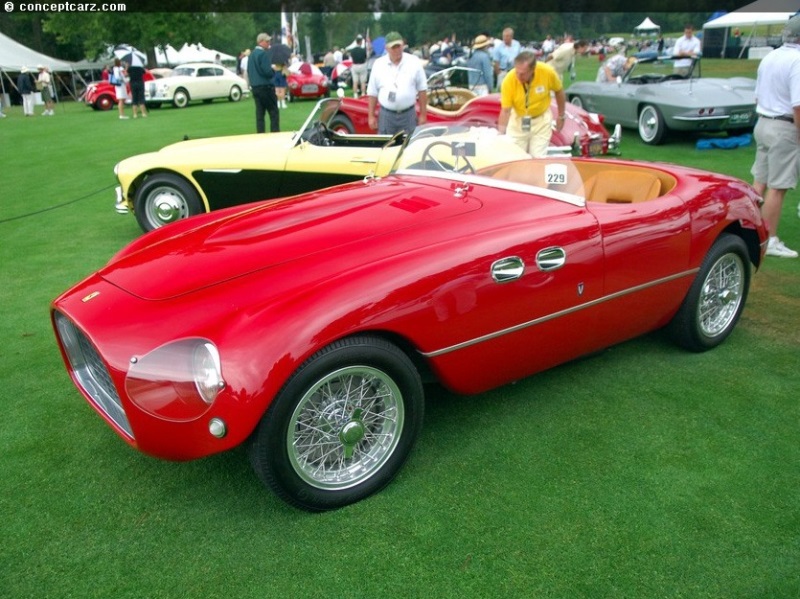
Ferrari built 12 examples of the 166 S including three 'Sports' and nine Spyder Corsas. These were soon followed by the 166 MM (Mille Miglia) which were built between 1948 to 1953 with a total of 47 examples produced. Twenty-six Touring Barchetta (Italian for 'little boat') first series 166 MM examples were built from 1948 through early-1951. Eleven 166 MMs were built in 1949 followed by a further thirteen examples in 1950, including six 166 MM Berlinetta Le Mans examples. Only six 166 MMs were employed by Scuderia Ferrari; the others were raced by privateers including the Marzotto brothers, Franco Cornacchia and Inico Bernabei.
Spyder
Chassis #: 0342M
View info and historyThe 166 used the suspension and frame of the 125, including the 95-inch (2420mm) wheelbase, but with a slightly enlarged engine. The coachwork for the first two 166 S models (resting on a longer 2620mm wheelbase) was courtesy of Carrozzeria Allemano and the last one by Carlo Anderloni at Carrozzeria Touring. at Carrozzeria Touring. Most of the 166 MM cars (on a shorter 86.5-inch platform - which meant it was shorter than the MG TC Midget) received Barchetta bodies by Touring, the coachbuilder most closely associated with the Ferrari marque during its early years of operation. The exquisite designs and technically advanced Superleggera constructed complimented the sporting qualities of the 166 S and 166 MM chassis. Enzo Ferrari's relationship with Touring began many years prior, when Touring supplied bodies built with its patented Superleggera construction system of lightweight alloy
panels supported by a network of small diameter tubes for the Alfa Romeo competition and sports cars of Scuderia Ferrari. The two Torpedino Brescia-style Auto Avio Costruzione 815's which Ferrari created for the 1940 Mille Miglia were also clothed with Touring coachwork. The early cycle fendered botticella-style Spider Corsa bodies were adaptable to both Formula 2 and sports car competition. One of the long-wheelbase 166 Sports wearing a coupe body by Allemano was driven by Clemente Biondetti and Giuseppe Navone to an overall victory in the 1948 Mille Miglia. In recognition of this accomplishment on what was then the most demanding and prestigious sports car race in the world, the 166 became the 166MM (Mille Miglia), leaving little doubt whatsoever the spirit and intent of the Ferrari-built vehicle.
Spyder
Chassis #: 0342M
View info and historyThe 2.0-liter (1995cc / 121 cubic-inch) V12 engine retained many of the qualities used in the earlier 125 S, but with a bore of 60 mm and a stroke of 58.8 mm. It delivered around 110 to 130 horsepower depending on the configuration, while the version powering the 166 MM was rated at about 140 horsepower at 6,600 RPM. The mechanical approach to many early Ferrari vehicles took a simple, effective, reliable, and adaptable approach. The frame was comprised of two oval tubes with X-members for torsional strength and outriggers to support the body. This simple design allowed the wheelbase size to vary, accomodating various racing situations, as well as different passenger accommodations. The rear suspension used a simple live axle with semi-elliptical leaf springs and trailing arms to control axle location and torque, also with Houdaille shocks. The front setup was independent with parallel A-arms supported by a transverse leaf spring and snubbed by Houdaille lever-action hydraulic shock absorbers.The Ferrari 166 MM made its debut in 1948 at the Turin Motor Show in November in two versions. The Touring stand displayed a long wheelbase 'coupe 2-3 posti' (a 2+2) which contained similar design cues to the Touring-bodied 2-seat roadster on Ferrari's display, the 'spider da corsa.' The bodies wore a swage line that traversed the body side, from the front wheel well back to, and over the rear wheel. The widest portion of the body was just below the fender peaks. The grille was large and ovid with egg crate trim, horizontal bars, and flanked by round headlights with 'catwalks' flowing down and under the lights.
Competizione Spider by Autodromo
Chassis #: 0272M
Engine #: 0272M
View info and history
Auction entries : 1The popularity of the Barchetta bodies outlasted the 166 model, extending into the succeeding 195, 212, and 340 series. Other coachbuilders who clothed the 166 MM include Carrozzeria Autodromo and Vignale. Vignale built six second-series spiders.Since these were hand-crafted vehicles and built over a rather long period of time, specifications vary. Several improvements were integrated by the factory during the production lifespan, including changes to the shock absorbers, water radiators, and gearbox. Larger 117-liter competition fuel tanks were installed for vehicles competing in endurance races. The racing success for the 166 MM for both privateers and Scuderia Ferrar was immediate, including victories at the 24 Hours of Le Mans in 1949 driven by Luigi Chinetti and Lord Selsdon. By this point, Biondetti had scored his third consecutive Mille Miglia victory in his 166 earlier in 1949, and Chinetti and Jean Lucas followed the victory at Le Mans with an overall victory in the Spa 24 Hours.
Competizione Spider by Autodromo
Chassis #: 0272M
Engine #: 0272M
View info and history
Auction entries : 1The Ferrari 166MM sports-racer became the godfather of all the short-block-based competition cars that followed, from the 195 and 212 Exports, to the Twenty-six examples of the 166 were bodied in the open style that came to be known as the Barchetta.
by Daniel Vaughan | Nov 2021
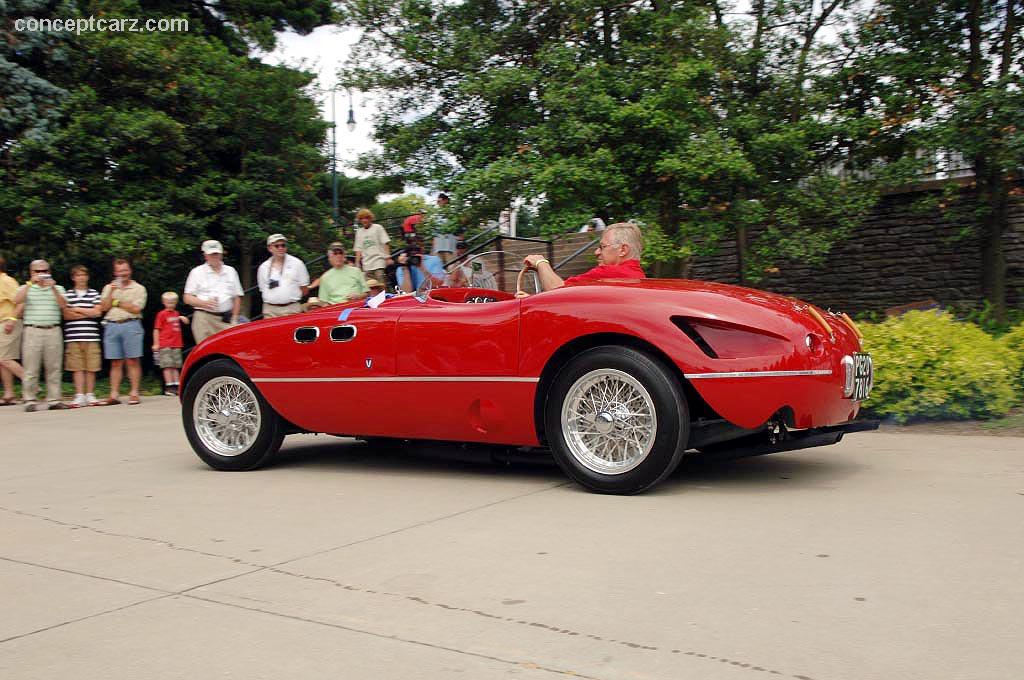
Spyder
Chassis #: 0278M
Engine #: 0278M
View info and history
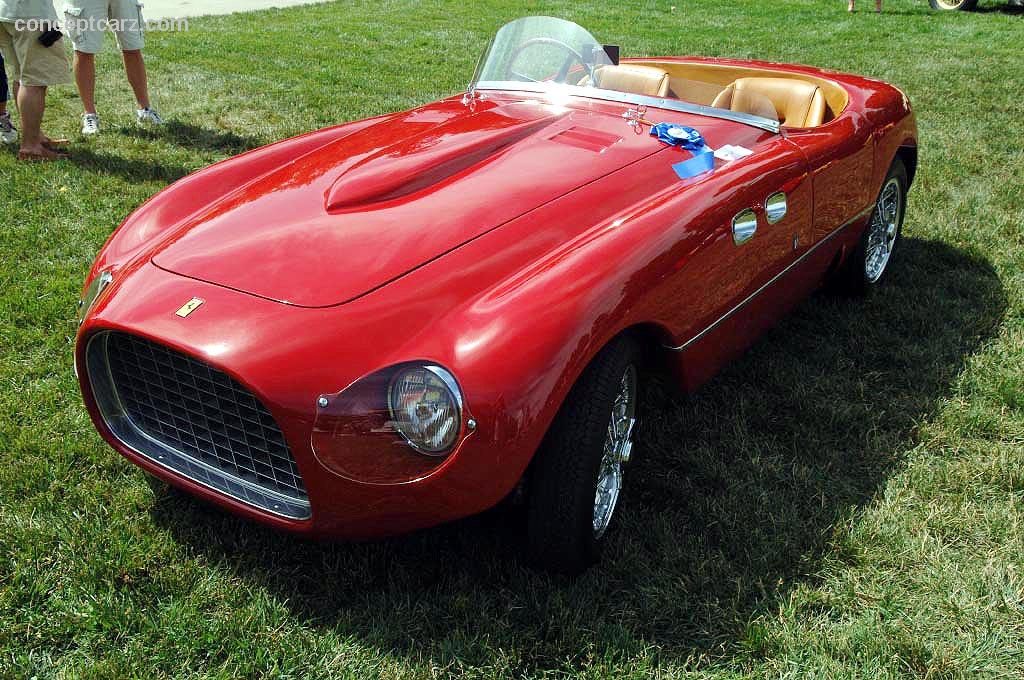
Spyder
Chassis #: 0278M
Engine #: 0278M
View info and history
Ferrari built 12 examples of the 166 S including three 'Sports' and nine Spyder Corsas. These were soon followed by the 166 MM (Mille Miglia) which were built between 1948 to 1953 with a total of 47 examples produced. Twenty-six Touring Barchetta (Italian for 'little boat') first series 166 MM examples were built from 1948 through early-1951. Eleven 166 MMs were built in 1949 followed by a further thirteen examples in 1950, including six 166 MM Berlinetta Le Mans examples. Only six 166 MMs were employed by Scuderia Ferrari; the others were raced by privateers including the Marzotto brothers, Franco Cornacchia and Inico Bernabei.

Spyder
Chassis #: 0342M
View info and history
panels supported by a network of small diameter tubes for the Alfa Romeo competition and sports cars of Scuderia Ferrari. The two Torpedino Brescia-style Auto Avio Costruzione 815's which Ferrari created for the 1940 Mille Miglia were also clothed with Touring coachwork. The early cycle fendered botticella-style Spider Corsa bodies were adaptable to both Formula 2 and sports car competition. One of the long-wheelbase 166 Sports wearing a coupe body by Allemano was driven by Clemente Biondetti and Giuseppe Navone to an overall victory in the 1948 Mille Miglia. In recognition of this accomplishment on what was then the most demanding and prestigious sports car race in the world, the 166 became the 166MM (Mille Miglia), leaving little doubt whatsoever the spirit and intent of the Ferrari-built vehicle.

Spyder
Chassis #: 0342M
View info and history

Competizione Spider by Autodromo
Chassis #: 0272M
Engine #: 0272M
View info and history
Auction entries : 1
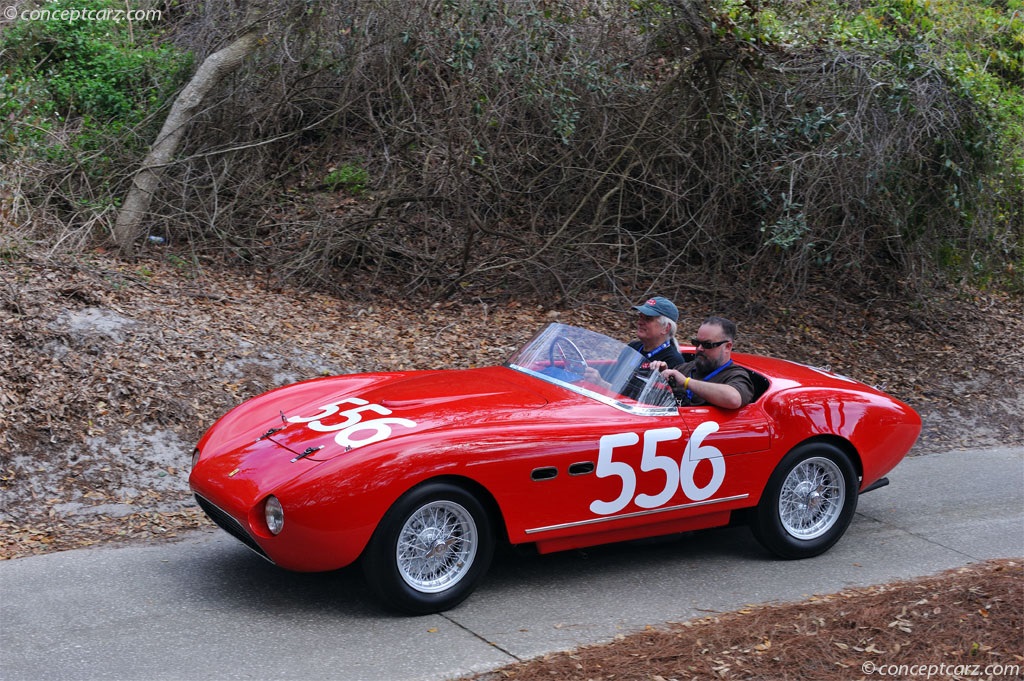
Competizione Spider by Autodromo
Chassis #: 0272M
Engine #: 0272M
View info and history
Auction entries : 1
by Daniel Vaughan | Nov 2021
Related Reading : Ferrari 166 History
It was in 1948 when the newly formed Italian automobile company named Ferrari began selling a promising sports car named the 166. The two-seater sports car featured a 12-cylinder engine mounted in the front and supplying over 100 horsepower to the rear wheels. The engine was just under two-liters in size and had a unitary displacement of 166 cc, thus, the evolution of the model name. Production would....
Continue Reading >>
Continue Reading >>


1953 Ferrari 166 MM Vehicle Profiles



Recent Vehicle Additions


Related Automotive News

Gooding & Company Releases Entire Catalogue for Upcoming London Sale, Led by a 1953 Ferrari 166 MM/53 Spider Offered from Long-Term Ownership
The London Auction at Hampton Court Palace will present an unrestored Ferrari 166 MM53 Spider and Ferrari 250 Europa, as well as a desirable Fiat 8V Berlinetta and right-hand-drive Aston Martin DB5 Convertible.
Gooding %26 Company, the international...

Ex-Scuderia Ferrari Alfa Romeo 8C 2300 Monza Spider By Zagato Scoops Best Of Show At Salon Privé
Alfa Romeo 8C 2300 Monza Spider by Zagato raced by Tazio Nuvolari wins top award
Leading designers present inaugural Churchill Cup to rare Lancia Astura
Duke of Marlborough selects his favourites on two wheels and four
Record entry for the UKs...

Gooding & Company Presents Three Significant Competition Ferrari Berlinettas At The Company's 15Th Annual Pebble Beach Auctions
These three cars showcase Ferraris lineage of competition GT cars. Selections include the 1966 Ferrari 275 GTBC, the 1959 Ferrari 250 GT Tour de France, and the 1950 Ferrari 166 MM195 S Berlinetta Le Mans.
Santa Monica, Calif. (June 28,...

Ferrari: Under The Skin
15 November 2017 - 15 April 2018
Major exhibition announced by the Design Museum in London to mark the 70th anniversary of Ferrari
£140M worth of Ferraris featured in exhibition displaying cars driven by racing drivers Peter Collins and Stir...

Historic Jaguar D-Type Leads Growing List of Significant Entries for RM's Monterey Sale
RM Auctions building towards a spectacular roster of cars for its flagship Monterey sale held during the famous Pebble Beach Concours dElegance motoring week, August 16–17, in California
Historic 1955 Jaguar D-Type leads a superb roster of the...