1966 500 Superfast ![]() |
1965 Ferrari 500 Superfast news, pictures, and information | ||
| Tweet | ||
![]() | ![]() | ![]() | Coupe Designer: Pininfarina Chassis Num: 5989 SF |
| Sold for $935,000 at 2011 RM Auctions. | |||
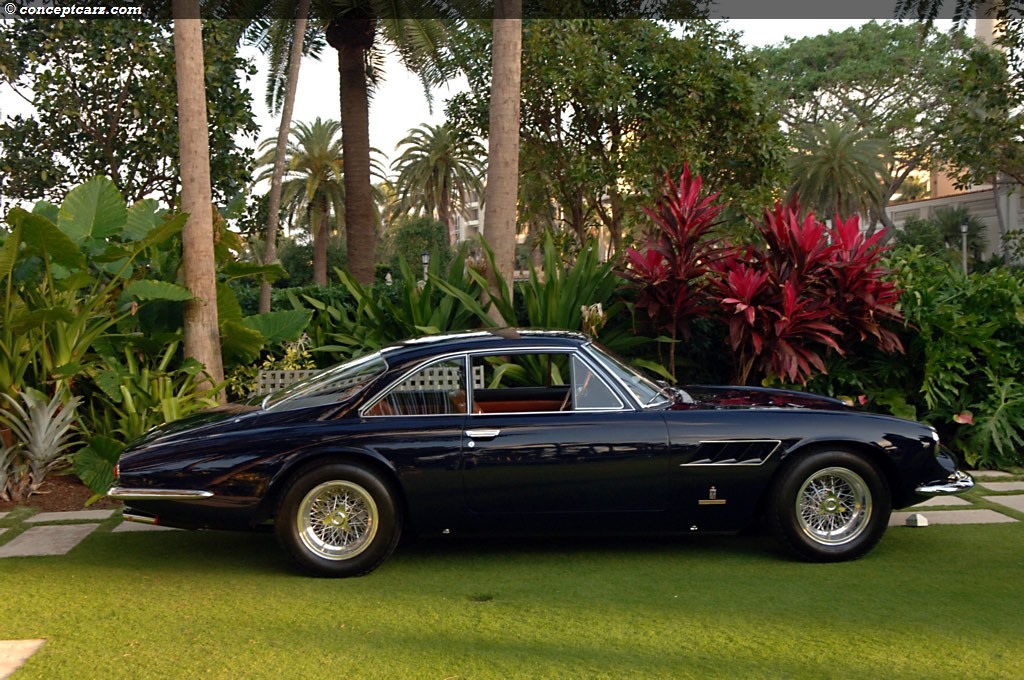
Everything about the 500 Superfast screamed 'exclusive', from the unique Tipo 208 V-12 engine and pressed cylinder liners to the very elegant body styling. Of course, nothing demonstrated the 500 Superfast's exclusivity like its price. It wasn't as if Ferraris were just normal, everyday, seen everywhere, kinds of cars during the 1960s, but the Superfast had a price that was nearly double what its fellow, not so 'rare', Ferraris were being offered to the public.
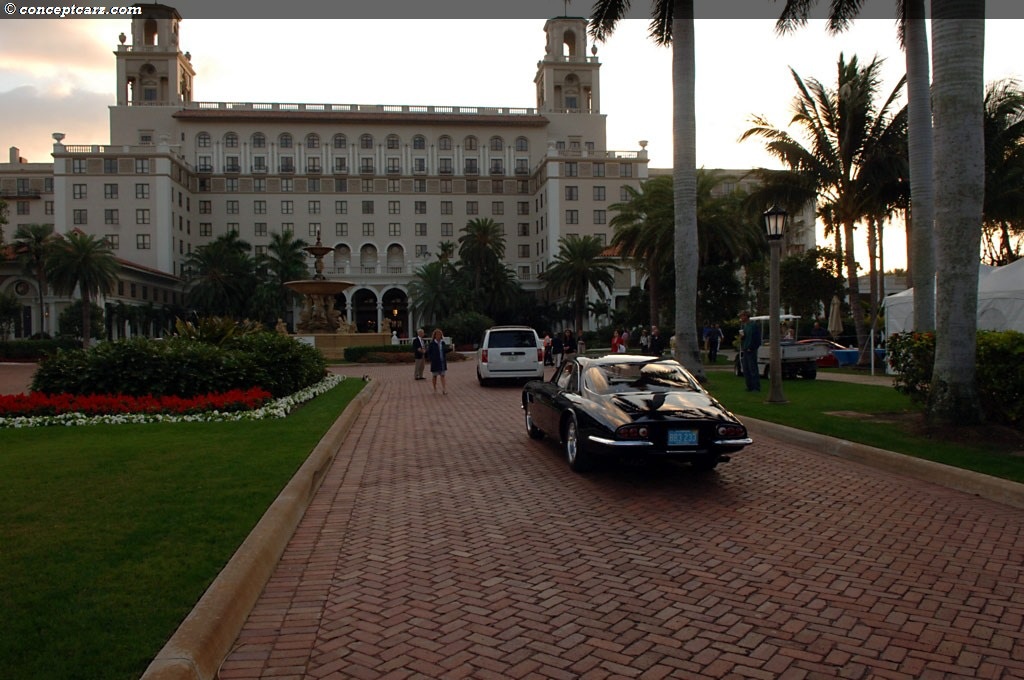
Offered at the 2011 RM Auction in Arizona was one of those extremely-rare 500 Superfasts. One of just 36 made between the introduction of the 500 at Geneva in March of 1964 and its last brethren built in 1967, this Ferrari Superfast certainly belongs in a special, and obviously, rare class.
Being so rare, just touching it would seem incredibly inappropriate, but its look just begs to be taken for a long, and fast, drive. A GT car in the truest sense, Pininfarina's elegant chassis courts the lover of the open road, but underneath its sleek appearance it has the muscle and the strength to have fun at the same time.
Taking almost an entire year to build by Pininfarina, chassis number 5989 SF was originally finished in Azzurro (sky-blue) with a blue interior. It was the seventh example built out of the series I. Because it was part of the early production it came finished with the eleven vent plates in the fender and circular turn signal lights.
When it was completed it came with a 400 bhp 4.9-liter V-12 engine utilizing three Weber twin-choke carburetors. All that power was transferred to the wheels via a four-speed manual gearbox. The car featured four-wheel disc brakes, an independent front suspension and a rigid rear axle with parallel trailing arms and semi-elliptic leaf springs.
The car was shipped to the United States in 1965 and had numerous high-profile and, obviously, wealthy owners all the way up into the 1990s. In 1984, the car was showed at the Monterey Historic Races at Laguna Seca, California.
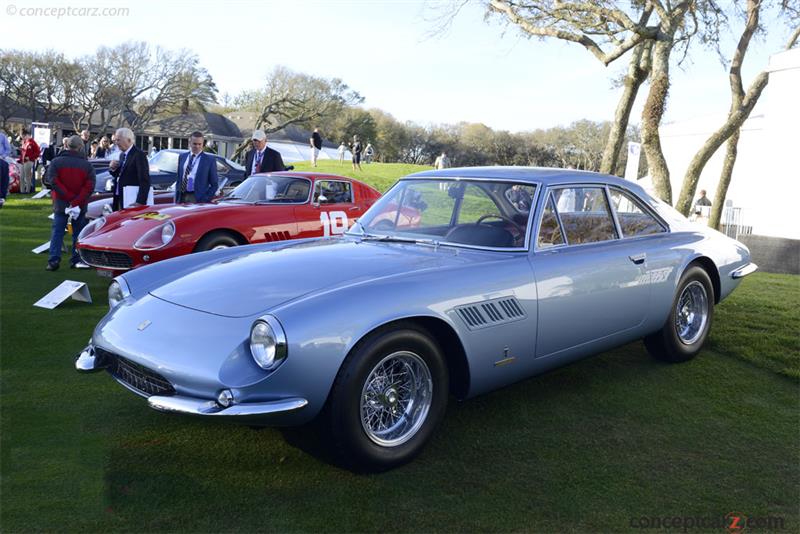
In 2005, the Superfast was acquired by Edward Hol and was sent to Steve Beckman to go through a chassis-up restoration. During that restoration process the car was refinished in light metallic blue color. The interior was also entirely refinished in oxblood leather. Upon completion, the car was sold to movie director John Calley and commissioned to be part of a collection of elite cars.
A majority of the time, such a car as this Ferrari Superfast, would only be offered as part of a private auction. The public RM Auction provided a rare opportunity to both see and buy a virtually unrivaled Ferrari. It was expected, prior to auction, the car would garner between $900,000 and $1,100,000! Even amongst its many 'priceless' automobiles, this is one of just 36 that stands alone, practically unchallenged at the top of Ferrari's list of ultimate GTs. This truly was, as it would almost certainly have been expected to be, a crowning jewel of the auction.
Sources:
'Buy: Featured Lots (Lot 268: 1965 Ferrari 500 Superfast Series I', (http://www.rmauctions.com/FeatureCars.cfm?SaleCode=AZ11&CarID=r139). RM Auction Arizona. http://www.rmauctions.com/FeatureCars.cfm?SaleCode=AZ11&CarID=r139. Retrieved 13 January 2011.
Wikipedia contributors, 'Ferrari America', Wikipedia, The Free Encyclopedia, 29 December 2010, 00:47 UTC, http://en.wikipedia.org/w/index.php?title=Ferrari_America&oldid=404733647 accessed 14 January 2011
By Daniel Vaughan | Jan 2011
![]() | Coupe Designer: Pininfarina |
The Pininfarina body was sleek, elegant and uncluttered by excess decoration. Other than color preferences or cosmetic updates, such as the change from 11 vents in the front fender louvers to three vents, there were few other variants in the various cars built, other than two cars being ordered with covered headlights and several cars ordered with an assist allowing the driver to open the passenger door without leaving the driver's seat. One car was delivered with extra front-mounted driving lights.
The 500 Superfast seems to have been aimed at the American and British markets, with 12 of 36 being delivered in the USA. Of the 36 cars built, two were destroyed in accidents, and all of the remaining 34 cars are accounted for today.
![]() | ![]() | ![]() | Coupe Designer: Pininfarina Chassis Num: 8083 SF Build Num: 99615 |
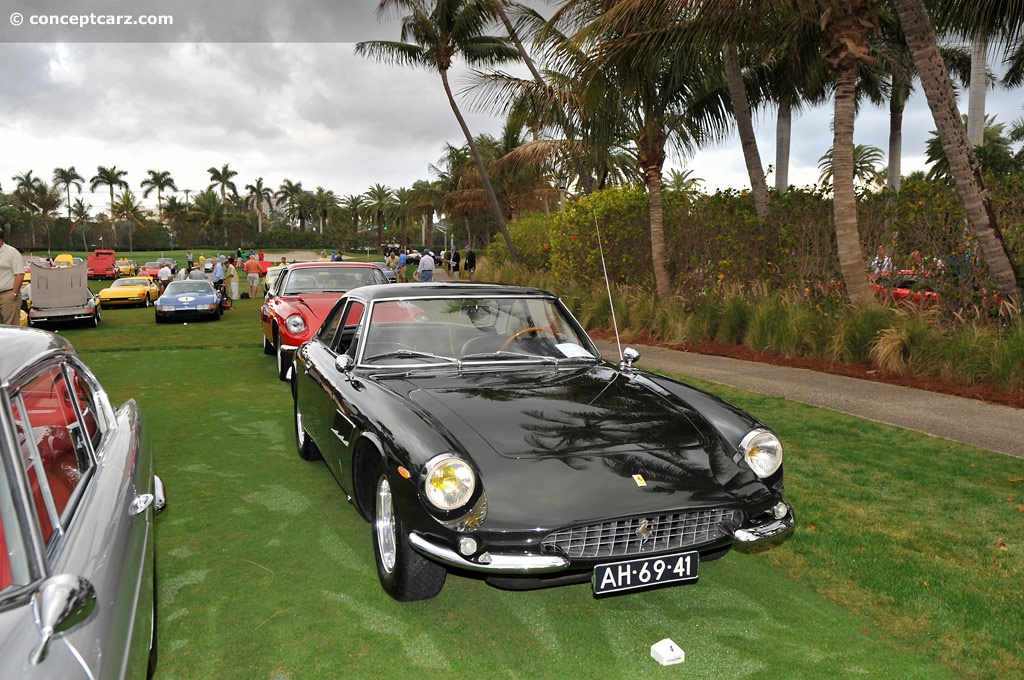
In 1995 it was purchased by Mike and Becki Dunn of Newark, California. While in their care the car was treated to a comprehensive and complete restoration. The exterior was finished in 'Blu Scuro' and the interior is 'Grigio.' In 2000 it was awarded Platinum in Class and an award for 'Outstanding Restoration' at the FCA National Concours. At the Concorso Italiano is was awarded a Platinum in Class and the Phil Hill award for a 'Ferrari of Outstanding Merit.' Another Platinum in Class was awarded at the Cavallino Classic X.
In 2001 it was shown at the Pebble Beach Concours d'Elegance. In 2002 it was offered for sale by RM Auctions at their Arizona sale. The car was sold for $335,000.
In 2008 it was shown at the Cavallino Classic.
By Daniel Vaughan | Oct 2009
![]() | ![]() | ![]() | Coupe Designer: Pininfarina Chassis Num: 6043 SF |
| Sold for $965,271 (€715,000) at 2009 RM Auctions. | |||
The 500 Superfast was the fastest production car of its time and the most powerful. It was intended to enhance the lifestyle of the rich and famous. Among its customers were Aga Khan, the Shah of Iran, Prince Bernhard of the Netherlands and actor Peter Sellers.
The car is powered by a 4963cc, twin-overhead cam, V12 engine developing 400 horsepower, coupled to a five-speed transmission. This enabled the car to achieve an estimated speed of 175 mph. Only 36 Superfast cars were produced and 34 remain in existence today.
This car sold for $24,400 in the United Sates in 1964-1965.
![]() | ![]() | ![]() | Coupe Designer: Pininfarina Chassis Num: 6049 SA Engine Num: 6049 SA |
| Sold for $814,000 at 2010 Gooding & Company. Sold for $1,100,000 at 2012 Gooding & Company. | |||
The Pininfarina design was an enhancement of the earlier 'Aerodynamica' Coupes riding on the 400 SA chassis. The car had a large greenhouse, fluid lines and a Kamm-style tail. Inside, there were adjustable seats upholstered in Connolly leather, spacious luggage platform, fluted headlining, and a deluxe radio.
The current owner purchased this car around a decade ago. At that time, the car was wearing its original paint which was in need of restoration. Great lengths were taken to carefully disassemble the car before it was painted the original color.
In 2005, the car was given a thorough mechanical overhaul. The engine was removed and rebuilt to factory specifications utilizing new pistons, rings and valve guides. The crankshaft was balanced, as was the flywheel and a new clutch assembly was installed. There were no limitations on cost or time; the work was done correctly with much attention to detail.
The inside has been lovingly persevered and is entirely original. The black leather is in good condition, and every gauge, material and finish is just as it was when the Ferrari was delivered to its original owner, Price Sadruddin Aga Khan in 1965.
This car has had only four owners since new with the odometer reading less than 65,000 original kilometers.
In 2010, this Coupe was offered for sale at the Gooding & Company auction at Amelia Island, Florida. It was estimated to sell for $800,000 - $1,000,000. As bidding came to a close, the car had been sold for the sum of $814,000, inclusive of buyer's premium.
By Daniel Vaughan | Apr 2010
The 500 Superfast was the last in a line of luxury Ferrari GT's. Introduced in 1964, production continued until 1966 with just 37 examples being produced.
Production of luxury Ferrari GT's began during the early 1950's with the introduction of the 342 America. Based on the 340 America, it featured a chassis that had been extended to provide ample interior space. The mechanics were similar, outfitted with a derivative of the Lampredi's 'long block' engine.
Next in line were the 250 Europa and 375 America. The Ferrari 375 was introduced at the Paris Salon in 1953. During its production run which lasted until May of 1954, less than 45 examples of the 375 America were produced. The car was constructed for Ferrari's clientele who had the means to afford one of these beautiful creations. Since they were produced in limited numbers, the production took far longer than volume models. Power was provided by a 4.5-liter Lampredi designed V-12 engine with either three twin choke Weber 40 DCZ or DCF downdraughts, resulting in 300 horsepower. On all four corners were drum brakes, Borrani wire wheels accented the exterior of the vehicle, and a leaf spring suspension was used in the front and the rear. With the four-speed manual gearbox, the car could achieve a top speed of 150 mph and could race from zero to sixty in less than seven seconds.
In regards to the 375, Pinin Farina was tasked with building the bodywork for many of the models. The Pinin Farina design shared a similarity with the 250 Europa's. The dimensions of several automobiles were similar but their interiors, wings, bumpers and detailing were all unique.
In 1955, Enzo Ferrari displayed a polished chassis #0423 SA at the Paris Salon. The completed version of the 410, crafted by the Italian coachbuilder Pinin Farina, was displayed at the Brussels Salon in January of 1956. As was the style of Ferrari, many variations of this vehicle were built. This is due to the fact that Ferrari used different coachbuilders during the vehicles assembly. Coachbuilders such as Boano, Ghia, and Scaglietti produced versions such as the Testa Rossa, Series I, II and III, and Superfast. This included Coupes and cabriolet versions. Mario Boano produced two, one by Ghia, one by Scaglietti, and the remaining thirty were by Pinin Farina.
The 410 came as a replacement for the 375 America. There were three series for this model but only a total of 38 were produced from 1956-1959.
Although similar to some of the earlier models produced by Ferrari, this one had a few styling changes. The 410 featured side vents located behind the front wheels. These have become a signature of the Superamerica series.
The 410 was given a larger engine and bigger brakes. Coil spring suspensions were used in the front. As with most of the Ferrari's from this era, Pinin Farina produced most of the bodies. From 1956-1958, a 110.2 inch wheelbase was used. In 1958 the size of the wheelbase was decreased to 102.3.
In 1959 Ferrari ceased production of the Lampredi engine. Instead, a Colombo deigned 'short block' V-12 engine would provide the power for the next iteration of Ferrari Luxury GT's, the 400 SuperAmerica. A few years later, the four-liter engine was enlarged to five and the final increment of the Luxury GT's was introduced: the Ferrari 500 Superfast. The five liter engine was capable of producing 400 horsepower. The aerodynamic bodies complimented its engine and did glory to the Superfast name. Top speed was achieved at 175 mph. The chassis was multi-tubular. A four-speed manual gearbox with overdrive provided power to the rear wheels. Later, the four-speed was replaced by a all-synchromesh five-speed unit.
These special-order vehicles were customizable. Their dimensions, colors, upholstery, carpets, etc were selected by the owner. Because of this, the specifications vary.
The 500 Superfast was Ferrari's fastest, most expensive, most exclusive, and most powerful vehicle at the time. With production only reaching 37 units, their exclusivity is guaranteed in modern times.
By Daniel Vaughan | Mar 2007
For more information and related vehicles, click hereProduction of luxury Ferrari GT's began during the early 1950's with the introduction of the 342 America. Based on the 340 America, it featured a chassis that had been extended to provide ample interior space. The mechanics were similar, outfitted with a derivative of the Lampredi's 'long block' engine.
Next in line were the 250 Europa and 375 America. The Ferrari 375 was introduced at the Paris Salon in 1953. During its production run which lasted until May of 1954, less than 45 examples of the 375 America were produced. The car was constructed for Ferrari's clientele who had the means to afford one of these beautiful creations. Since they were produced in limited numbers, the production took far longer than volume models. Power was provided by a 4.5-liter Lampredi designed V-12 engine with either three twin choke Weber 40 DCZ or DCF downdraughts, resulting in 300 horsepower. On all four corners were drum brakes, Borrani wire wheels accented the exterior of the vehicle, and a leaf spring suspension was used in the front and the rear. With the four-speed manual gearbox, the car could achieve a top speed of 150 mph and could race from zero to sixty in less than seven seconds.
In regards to the 375, Pinin Farina was tasked with building the bodywork for many of the models. The Pinin Farina design shared a similarity with the 250 Europa's. The dimensions of several automobiles were similar but their interiors, wings, bumpers and detailing were all unique.
In 1955, Enzo Ferrari displayed a polished chassis #0423 SA at the Paris Salon. The completed version of the 410, crafted by the Italian coachbuilder Pinin Farina, was displayed at the Brussels Salon in January of 1956. As was the style of Ferrari, many variations of this vehicle were built. This is due to the fact that Ferrari used different coachbuilders during the vehicles assembly. Coachbuilders such as Boano, Ghia, and Scaglietti produced versions such as the Testa Rossa, Series I, II and III, and Superfast. This included Coupes and cabriolet versions. Mario Boano produced two, one by Ghia, one by Scaglietti, and the remaining thirty were by Pinin Farina.
The 410 came as a replacement for the 375 America. There were three series for this model but only a total of 38 were produced from 1956-1959.
Although similar to some of the earlier models produced by Ferrari, this one had a few styling changes. The 410 featured side vents located behind the front wheels. These have become a signature of the Superamerica series.
The 410 was given a larger engine and bigger brakes. Coil spring suspensions were used in the front. As with most of the Ferrari's from this era, Pinin Farina produced most of the bodies. From 1956-1958, a 110.2 inch wheelbase was used. In 1958 the size of the wheelbase was decreased to 102.3.
In 1959 Ferrari ceased production of the Lampredi engine. Instead, a Colombo deigned 'short block' V-12 engine would provide the power for the next iteration of Ferrari Luxury GT's, the 400 SuperAmerica. A few years later, the four-liter engine was enlarged to five and the final increment of the Luxury GT's was introduced: the Ferrari 500 Superfast. The five liter engine was capable of producing 400 horsepower. The aerodynamic bodies complimented its engine and did glory to the Superfast name. Top speed was achieved at 175 mph. The chassis was multi-tubular. A four-speed manual gearbox with overdrive provided power to the rear wheels. Later, the four-speed was replaced by a all-synchromesh five-speed unit.
These special-order vehicles were customizable. Their dimensions, colors, upholstery, carpets, etc were selected by the owner. Because of this, the specifications vary.
The 500 Superfast was Ferrari's fastest, most expensive, most exclusive, and most powerful vehicle at the time. With production only reaching 37 units, their exclusivity is guaranteed in modern times.
By Daniel Vaughan | Mar 2007
| KIA RACING CELEBRATES RETURN TO SOUTHERN CALIFORNIA WITH DEBUT OF TURBOCHARGED OPTIMA RACECAR | |
![]() | • With two victories and six podium finishes to its credit after just 14 Pirelli World Challenge (PWC) races, Kia Racing's turbocharged Optima to be available for Car Town players to add to their virtual garages starting tomorrow
• Kia Racing arrives in Long Beach third in Grand Touring Sport (GTS) Manufacturer points after strong performances at season-opening doubleheader in St. Petersburg IRVINE, Calif., April 18, 2013 – Kia Motors' fourth season of U.S. road racing c...[Read more...] |
| 2014 MAZDA6 NAMED TO WARD'S ‘10 BEST INTERIORS' LIST | |
| The all-new 2014 Mazda6 today was named to WardsAuto World's 10 Best Interiors list, as chosen by the publication's editors. The redesigned mid-size sports sedan features Mazda's new design language called KODO 'Soul of Motion,' which translates muscular movement and power into agile proportions, detailed sculpting and expressive character. The Mazda6 also was recently named one of the top three vehicle designs in the world for 2013 by the World Car Awards. 'The automotive industry, regardl...[Read more...] | |
| Continental Tire Sports Car Festival Powered by Mazda | |
![]() | PENULTIMATE RACE OF 2012 GRAND-AM ROLEX SPORTS CAR SERIES The penultimate race of the 2012 GRAND-AM Rolex Sports Car Series will mark the finale of the professional racing season at Mazda Raceway Laguna Seca when the Continental Tire Sports Car Festival sends 10 Daytona Prototypes and 17 Grand Touring cars on a two hour and 45 minute sprint around the 11 turn, 2.23 mile track on Sunday, September 9. During qualifying, held on Saturday, Richard Westbrook (London, England) drove the #...[Read more...] |
| 1962 Monaco Grand Prix: McLaren Carries the Cooper Flag back to the Top | |
![]() | By the beginning of the 1962 Formula One season Jack Brabham had left Cooper to form his own racing team. It seemed the glories days of the double World Championship were well and truly behind them. However, left in Brabham's stead would be a man very akin to the Australian in so many ways. And in Bruce McLaren, Cooper had a driver and competitor more than apt to help carry the team forward into the future. The first race of the 1962 season, the Grand Prix of the Netherlands, certainly didn't...[Read more...] |
| 1958 Moroccan Grand Prix: British All the Way | |
![]() | After years of frustration, and well past his life-expectancy, Mike Hawthorn would be on the verge of his first World Championship. This was more than likely Hawthorn's last and best hope at a World Championship title. Just one last race, and a fellow Brit, would separate Hawthorn from his World Championship. Emotionally, Hawthorn was done. The last few seasons had seen Hawthorn fail to experience anywhere near the level of success he had even in his rookie year of 1952. In 1952, with an unde...[Read more...] |
1965
Ferrari
models |
| Ferrari 275 GTB |
| Ferrari 275 GTB Competition |
| Ferrari 275 GTS |
| Ferrari 275 P2 |
| Ferrari 330 GT 2+2 |
| Ferrari 330 GT Shooting Brake |
| Ferrari 365 P2 | 1965 Ferrari Concepts |
| Ferrari 250 LM |
| Similar Automakers | |
| Aston Martin | Bentley |
| Bugatti | Devon |
| GTA | Koenigsegg |
| Lamborghini | Lotus |
| Maserati | Maybach |
| McLaren | Porsche |
| Rolls-Royce | Spyker |
| Tesla | |
| Similarly Sized Vehicles from 1965 |
| BMW 3200CS |
| Dodge Dart |
| Ferrari 330 GT 2+2 |
| Ferrari 330 GT Shooting Brake |
| Mercedes-Benz 220 Series |
| Studebaker Daytona |
| Ferrari: 1961-1970 |
| Similar Automakers |
| Other models by Ferrari |
1966 500 Superfast ![]() |


1965