1899 Locomobile Stanhope Style I news, pictures, and information | ||
| Tweet | ||
The first prototype gasoline-powered Locomobile was completed at the company's factory in Bridgeport, Connecticut. Francis and Freelan Stanley created the original steam-powered Locomobile in 1898. 'Yankee tinkerers,' the Stanley brothers had been working on designs for steam-powered carriages for many years. Success came when one of their cars appeared at a Boston fair in October 1908. Interest in their cars, stemming from the debut of their lightweight, affordable vehicle, led them to undertake the construction of one hundred cars. To put the brothers' ambition in perspective, one need only recognize that the largest American gasoline-powered auto producer in the country, Alexander Winton, made twenty-two cars in 1898; Pope Electric of Hartford, Connecticut, produced a few dozen. The Stanley Brothers' resolve to 'mass-produce' inexpensive cars marked an important transition in automobile manufacturing.
But only a few months into their venture, the Stanley Brothers sold their enterprise to Amzi Barber, America's sheet-asphalt tycoon. It was under Barber's direction that the Locomobile name became a brand. The 1899 Locomobile sold for $600 and, as its advertisements boasted, it was noiseless and odorless. Refreshing to think of, but the Locomobile's water tank held only twenty-one gallons, enough for just a twenty-mile journey. Besides, starting a steam-powered engine was time-consuming and dangerous, as boilers frequently burned out. The gasoline burners that heated the boilers could backfire, potentially setting the car on fire. Sales of the Locomobile peaked in 1900 at sixteen hundred, a remarkable figure at such an early date. The total was far greater than any other American automaker could produce and it rivaled the French automaker, De Dion-Bouton, as the greatest car production in the world. Sales fell the next year, however, as the primacy of gasoline-powered automobiles was established. Gas-powered cars could go farther, faster, and wîth fewer hassles than steam-powered cars of comparable sizes. Barber hired automobile engineer Andrew Riker to design him a gas-powered vehicle. The car he designed sold for $5,000. The new Locomobile appealed to rich consumers, and the company shifted its focus from low-cost production for the masses to high-cost production for the elite few. The last Locomobile steamers were produced in 1904. The end of the steam era saw the end of the company's importance. Other firms had been building gas-powered automobiles better, for longer. Locomobile survived through World War I producing trucks for the war market. After the war it became one in the overflowing market of luxury cars. The company died in 1929 after having been briefly incorporated into one of William Durant's holding companies.
Charles A. Yont and W.B. Felker completed the first automobile trip to the summit of Pikes Peak, Colorado, on this day, driving an 1899 locomobile steamer. Climbing 14,110 feet to the top was quite a feat for the little steamer. Pikes Peak is well known because of its commanding location and easy accessibility, and the view from the summit is said to have inspired the song 'America the Beautiful.'Source - Unknown
But only a few months into their venture, the Stanley Brothers sold their enterprise to Amzi Barber, America's sheet-asphalt tycoon. It was under Barber's direction that the Locomobile name became a brand. The 1899 Locomobile sold for $600 and, as its advertisements boasted, it was noiseless and odorless. Refreshing to think of, but the Locomobile's water tank held only twenty-one gallons, enough for just a twenty-mile journey. Besides, starting a steam-powered engine was time-consuming and dangerous, as boilers frequently burned out. The gasoline burners that heated the boilers could backfire, potentially setting the car on fire. Sales of the Locomobile peaked in 1900 at sixteen hundred, a remarkable figure at such an early date. The total was far greater than any other American automaker could produce and it rivaled the French automaker, De Dion-Bouton, as the greatest car production in the world. Sales fell the next year, however, as the primacy of gasoline-powered automobiles was established. Gas-powered cars could go farther, faster, and wîth fewer hassles than steam-powered cars of comparable sizes. Barber hired automobile engineer Andrew Riker to design him a gas-powered vehicle. The car he designed sold for $5,000. The new Locomobile appealed to rich consumers, and the company shifted its focus from low-cost production for the masses to high-cost production for the elite few. The last Locomobile steamers were produced in 1904. The end of the steam era saw the end of the company's importance. Other firms had been building gas-powered automobiles better, for longer. Locomobile survived through World War I producing trucks for the war market. After the war it became one in the overflowing market of luxury cars. The company died in 1929 after having been briefly incorporated into one of William Durant's holding companies.
Charles A. Yont and W.B. Felker completed the first automobile trip to the summit of Pikes Peak, Colorado, on this day, driving an 1899 locomobile steamer. Climbing 14,110 feet to the top was quite a feat for the little steamer. Pikes Peak is well known because of its commanding location and easy accessibility, and the view from the summit is said to have inspired the song 'America the Beautiful.'Source - Unknown
![]() | ![]() | ![]() | Runabout Chassis Num: 33 |
| Sold for $71,500 at 2007 RM Auctions. | |||
The Stanley brothers had created a successful business in manufacturing photographic plates. When the world was introduced to the motor car, the brothers began to tinker. By the autumn of 1897 they had produced their first motor car, with their automobile business opening in November 1898.
Their cars were shown at the Boston motor show in 1898 but prior to this, John Brisben Walker, publisher of Cosmopolitan magazine, acquired about buying the business. The brothers quickly stated a very high sum of $250,000, which was accepted, to much surprise of the Stanley brothers. The brothers were appointed as General Managers. To aid in the acquisition, Walker took Amzi Lorenzo Barber as partner in this venture. Barber had made a fortune paving America's cities and was known as 'The Asphalt King.' By June of 1899, deliveries of the Locomobiles had begun.
Almost as quickly as these acquisitions and alliances formed, they began to degrade. Quarrels between Walker and Barber broke out which later led to Barber running the Locomobile production on his own, with the help of his son-in-law Samuel Davis. In the very early 1900s they significantly changed the Stanley brothers designed. By 1904, Barbed decided to leave Locomobile.
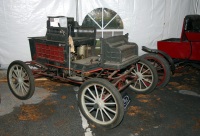
This vehicle is an 1899 Locomobile Steam Runabout that sits on a wheelbase that measures 66-inches and is powered by the 3.5 horsepower twin-cylinder double-acting steam engine and powers the rear wheels through a single chain drive. Its wheelbase is longer than that of a standard runabout. There are wooden artillery wheels wearing Lincoln Highway 28x3 tires. The original wheels measured 28x2.5.
The standard boiler size was 14-inches in diameter, this example has a 16-inch boiler. The engine is a 'Number 5' type which was introduced around 1901, after around 3,000 examples had been produced. This is chassis number 33, meaning it was treated to modifications after it left the factory, later in its life.
This vehicle was offered for sale at the Vintage Motor Cars sale at Hershey, PA presented by RM Auctions. It was estimated to sell for $25,000 - $30,000 and offered without reserve. Bidding quickly surpassed the estimates with the final bid settling at $71,500.
By Daniel Vaughan | Dec 2007
![]() | ![]() | ![]() | Runabout |
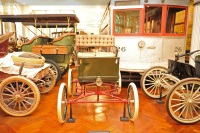
This car has a folding top which is very rare on this model, and spindle seats. The car has a leather covered deck lid with exhaust pipe coming thru it. The first car had no exhaust pipe and later cars had a metal cover. The engine is a two-cylinder steam, 14-inch boiler. The cylinder is gasoline fired, which had to heat gas to a vapor to start, a 30 to 40 minute warm-up before you had steam. You could go 20 miles per tank of water.
It has a 5.5 horsepower rating, and the car weighs 850 lbs. Total production was 2050, and it is believed that only 7 remain today. The selling price was $750.
![]() | ![]() | ![]() | Runabout Chassis Num: 389 |
| Sold for $46,800 at 2006 Bonhams. Sold for $63,250 at 2011 RM Auctions. | |||
The editor and publisher of Cosmopolitan magazine, John B. Walker, purchased the plans for a steam runabout from Francis and Freelan Stanley for $250,000. He then sold half interest to asphalt contractor Amzi Barber for the same amount. The name Locomobile was chosen as it combined locomotive and automobile. Locomobile set up shop in the Stanley's Watertown, Massachusetts factory. Unfortunately, the union between Walker and Barber lasted just two weeks. Barber kept the Watertown premises and Walker went to Tarrytown, New York to build the same car as the Mobile.
In 1900, Barber moved to Bridgeport, Connecticut and hired the Stanley brothers as managers. Within just two years of time, they had built 4,000 two-cylinder runabouts.
In 2011, the car was offered for sale at the Amelia Island sale presented by RM Auctions. It was estimated to sell for $50,000 - $70,000 and offered without reserve. As bidding came to a close, the car was sold for the sum of $63,250 including buyer's premium.
By Daniel Vaughan | Apr 2011
![]() | ![]() | Runabout |
![]() | ![]() | ![]() | Runabout |
In 1902, the Locomobile Company began producing a gasoline-powered vehicle and in 1903, dropped steam-powered cars from their lineup.
During the Boer War, Locomobile was the first automobile used in war serving as a generator and searchlight vehicle. They were particularly useful in British eyes for its ability to brew a cup of tea by tapping the boiler.
Steam cars were difficult and time consuming to use, as water was brought to a boil and could be exciting if the boiler burned out or the gasoline burner backfired setting the car on fire. The 21 gallon water tank limited trips to about 20 miles.
The 1899 Locmobile sold for $600 and sales peaked at 1,600 in 1900 making it the second highest selling car in the world. However, sales fell the following year as simpler gasoline-powered cars gained popularity.
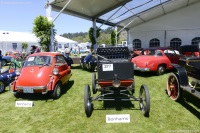
This example has a Stanhope body with a single bench seat. It was fully restored by the current owner without the benefit of parts availability or even a manual. He first ran the car on compressed air since he was afraid to fire the burner.
| RM Auctions In Association With Sotheby's To Showcase Automotive Artistry At New York Sale | |
![]() | • RM Auctions, in association with Sotheby's, announces exclusive New York collector car auction, November 21 • Groundbreaking sale to celebrate the automobile as an art form and feature an elite, handpicked selection of approximately 35 significant motor cars • Early highlight: bespoke, one-off 1956 Aston Martin DB 2/4 MkII 'Supersonic' embodies wonderful concept of 'rolling sculpture' BLENHEIM, Ontario (April 30, 2013) - RM Auctions, in association with Sotheb...[Read more...] |
| FULL STEAM AHEAD FOR HISTORICS | |
![]() | • Stanley Steamer takes centre stage for spring sale Brooklands will provide the backdrop for the ultimate MPV – built long before the category was even invented – when a 1917 20hp Stanley Mountain Wagon crosses the 'block' on Saturday March 9th for Historics' spring sale. Having sold their dry plate photographic business to Eastman Kodak, twin brothers Francis E. Stanley and Freelan O. Stanley decided to set up the Stanley Motor Carriage Company in order to manufacture steam powe...[Read more...] |
| Mini Cars Attract Mega Interest At RM's Record-Setting Bruce Weiner Microcar Museum Sale | |
![]() | • RM Auctions' highly anticipated Bruce Weiner Microcar Museum sale generates more than $9.1 million with 100 percent of all lots sold • Multi-day auction shines spotlight on microcar values with numerous new records set • Top sellers: 1958 F.M.R. Tg 500 'Tiger' brings $322,000, a world record price for a microcar sold at auction; 1951 Reyonnah achieves a remarkable $184,000 • The world's smallest production car, the 1964 Peel P50, triples pre-sale estimate, realizing an impressive $120,750 ...[Read more...] |
| COLLECTORS SET TO DESCEND ON FLORIDA FOR RM'S HIGHLY ANTICIPATED SALE | |
![]() | • Final countdown underway to RM's John Staluppi Cars of Dreams Museum sale, December 1, in North Palm Beach, Florida • Auction features nearly 120 automobiles without reserve, with a strong emphasis on American convertibles of the '50s and '60s • Selection rounded out by more than 60 lots of memorabilia, including a historic 1918 Herschell-Spillman 32' Carousel, an elaborate Lionel Train Set, and a Cretors Antique Popcorn Wagon • Digital catalogue and collection vide...[Read more...] |
| EXCEPTIONAL ROSTER OF PORSCHE RACE CARS JOIN THE STARTING GRID FOR RM'S EAGERLY AWAITED MONTEREY SALE | |
![]() | RM Auctions, the world's largest collector car auction house for investment-quality automobiles, has announced more star consignments for its highly anticipated Monterey sale, August 17–18, in California, this time a remarkable group of Porsches. Comprising twelve examples in total and spanning 48 years of production, the offering is headlined by an exceptional group of racing greats from the sixties, seventies, and eighties. Continuing RM's commitment to present the world's finest automobiles, ...[Read more...] |
| Similar Automakers | |
| American | Chalmers |
| Chandler | EMF |
| Lozier | Marr |
| Mercer | National |
| Paige | Penn |
| Pierce Arrow | Simplex |
| Stellite | Stevens Duryea |
| Stoddard-Dayton | Stutz |
| Locomobile: 1891-1900 |
| Similar Automakers |
| Locomobile History |
| Other models by Locomobile |
| Model 30 Model 40 Model 48 Type E |
© 1998-2012. All rights reserved. The material may not be published, broadcast, rewritten, or redistributed.