1906 Locomobile Old 16

1906 Locomobile Old 16 Navigation
Identical twin brothers Freelan Oscar and Francis Edgar Stanley were one of the first motorcar producers in the United States and one of the more successful in steam-powered car production. Freelan Oscar and his wife are credited with being the first individuals to drive an automobile to the top of New Hampshire's Mount Washington on August 31st, 1899. Their Locomobile steam runabout took two hours and ten minutes to climb the slope, excepting the time required to refill the boiler with water. Their journey took about half the time required by a team of horses.
Chassis #: 1619
View info and historyThe Stanley brothers had created a successful business in manufacturing photographic plates. When the world was introduced to the motor car, the brothers began to tinker. By the autumn of 1897, they had produced their first motor car, with their automobile business opening in November 1898. Their cars were shown at the Boston motor show in 1898, but prior to this, John Brisben Walker, publisher of Cosmopolitan magazine, acquired about buying the business. The brothers quickly stated a very high sum of $250,000, which was accepted, to much surprise by the Stanley brothers. The brothers were appointed as General Managers. To aid in the acquisition, Walker took Amzi Lorenzo Barber as a partner in this venture. Barber had made a fortune paving America's cities and was known as 'The Asphalt King.' By June of 1899, deliveries of the Locomobiles had begun. The partnership between Walker and Barber did not last long, and soon the men parted company. Both men went on to establish separate car companies. Barber kept the Locomobile name and moved operations to Massachusetts. He purchased numerous plant sites before finally settling on a plant in Bridgeport, Connecticut. Production began in early 1901. A year later, over 4,000 Locomobile steam-powered cars were delivered. Part of the popularity was due to a Locomobile steam-powered racer driven by S.T. Davis Jr. a distance of one mile in just fifteen seconds. Davis Jr. was Barber's son-in-law who had joined the Locomobile company in 1900 as its treasurer. He later became a founder and president of the National Association of Automobile Manufacturers.
Chassis #: 1619
View info and historyIn 1903, Davis Jr. took over the company as president, and under his care, the company's reputation flourished and given national recognition. This was the same year that the company merged with the Overman Wheel Company. The Overman Wheel Company had been supplying Locomobile with parts and boilers. It was not long before the Stanley brother's steam-powered car began gaining popularity and providing fierce competition for Locomobile. Locomobile decided to add internal combustion engines beginning in 1903 to their vehicles to diversify the products and increase sales. By 1905, the Locomobile Company no longer offered a steam-powered model and had switched completely to gasoline power. Locomobile's powerplant was designed by Andrew Lawrence Riker, and it would quickly gain a reputation for its durability and power. It was initially a twin-cylinder unit but soon was made into a four-cylinder version featuring automatic inlet valves. As 1905 came into sight, only the T-head four-cylinder models remained. Motorsports
Locomobile's success in motorsports led them to claim their product was 'Easily the Best Built Car in America.' This claim was backed up by winning America its first victory in a major international race, making Locomobile the first American racing car to triumph over European competition. In 1908 a Locomobile wearing number 16 and driven by racer George Robertson won the grueling Vanderbilt Cup. From that day forward, the racer became known as 'Old 16' and instantly became a racing legend.
Chassis #: 1619
View info and history'Old 16' was one of two Locomobiles built specifically for motorsport competition. In 1909, George Robertson drove 'Old 16' in the Cobe Trophy AAA Indy Car Race on the Crown Point, IN street circuit. He started ninth and led three laps to finish on the podium. This would be the final race for the Bridgeport-based manufacturer as rule changes brought an end to racing for Locomobile. The other Model I was chassis number 9, known as the 'Cobe Cup Racecar.' It shared its 40 horsepower four-cylinder engine and dimensions with its 'Old 16' sibling, and together they reinforced Locomobile's reputation as 'the best-built car in America.'
by Daniel Vaughan | Dec 2007
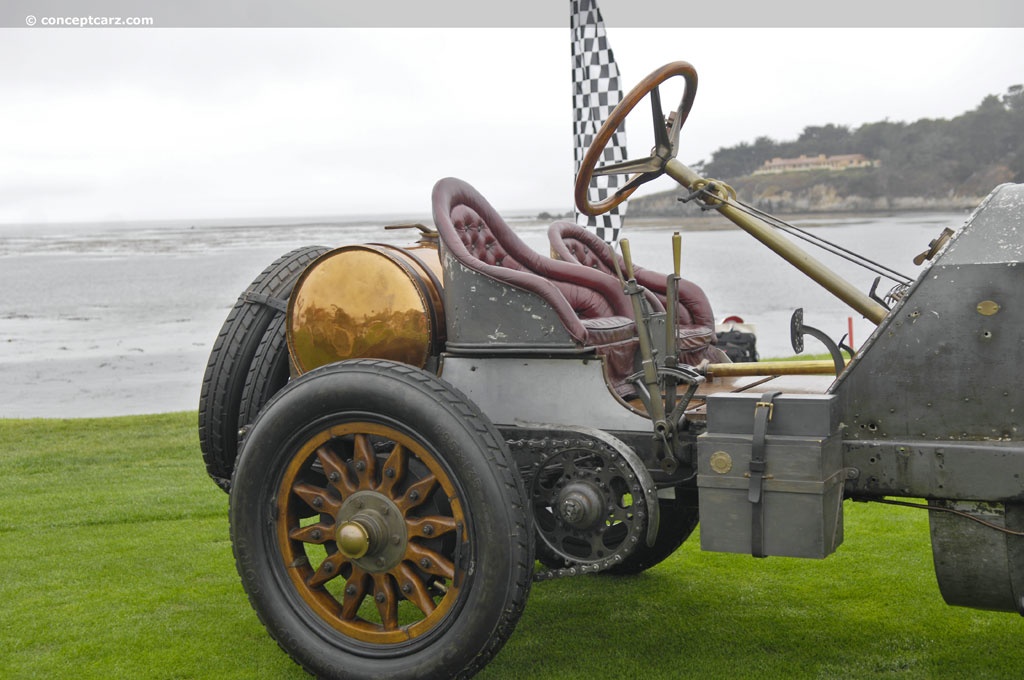
Chassis #: 1619
View info and history
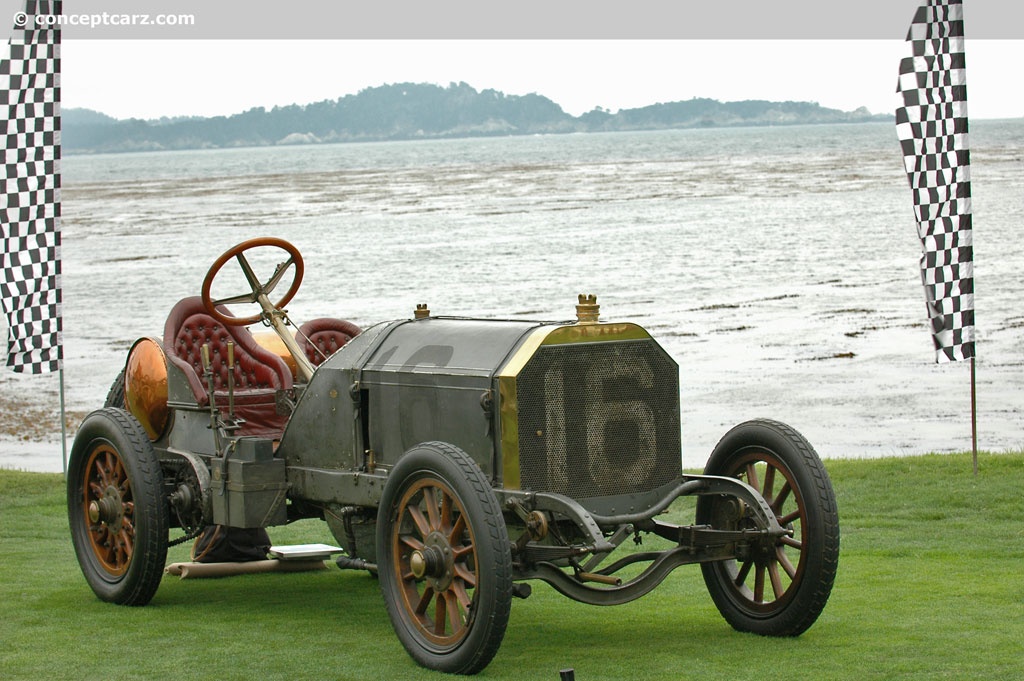
Chassis #: 1619
View info and history
Locomobile's success in motorsports led them to claim their product was 'Easily the Best Built Car in America.' This claim was backed up by winning America its first victory in a major international race, making Locomobile the first American racing car to triumph over European competition. In 1908 a Locomobile wearing number 16 and driven by racer George Robertson won the grueling Vanderbilt Cup. From that day forward, the racer became known as 'Old 16' and instantly became a racing legend.
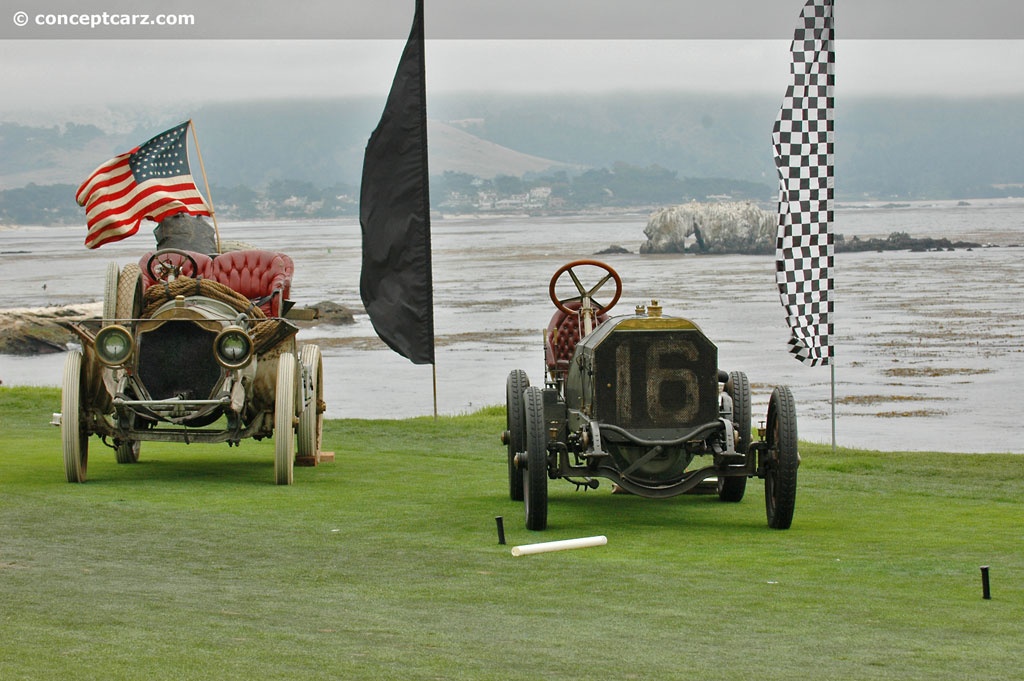
Chassis #: 1619
View info and history
by Daniel Vaughan | Dec 2007
- 1906 Locomobile Old 16 Menu
- Article
- Image gallery
- Specifications
Locomobile
Similar Vehicles
Similar Automakers


1906 Locomobile Old 16 Vehicle Profiles

Chassis #: 1619
Recent Vehicle Additions


Related Automotive News

The Best of the Brass Era: Gooding & Company Announces a 1914 Mercer Type 35-J Raceabout and a 1913 Lozier Type 72 Meadowbrook Runabout for Its 2023 Pebble Beach Auctions
This August, the auction house will present a 1914 Mercer Type 35-J Raceabout and a 1913 Lozier Type 72 Meadowbrook Runabout from the Jerry S. Foley III Estate, alongside a 1933 Alfa Romeo 8C 2300 Cabriolet and a desirable 1936 Hispano-Suiza J12 Cabriolet.
...

Lozier Honored By Silver Anniversary Amelia Concours d'Elegance
Jacksonville, FL - A special class of Loziers will help celebrate the Silver Anniversary Amelia Island Concours dElegance in 2020. Today, more than a century since Lozier left the American car catalog, Lozier is among the rarest of collectible...

Cobble Beach Concours : Best of Show
The 7th annual Cobble Beach Concours dElegance was held near Owen Sound in the Township of Georgian Bluffs at the Cobble Beach Waterfront Golf Resort Community in Canada. It is a luxury four-season resort nestled on 574 acres with an 18 hole links...
HILTON HEAD ISLAND MOTORING FESTIVAL & CONCOURS D'ELEGANCE ANNOUNCES EXPANSION OF 2014 SAVANNAH SPEED CLASSIC
Celebrating a decade of vintage racing, the Savannah Speed Classic boasts exciting additions, brings racing back to its roots
HILTON HEAD ISLAND, S.C. – The Hilton Head Island Motoring Festival %26 Concours dElegance (HHIMF), one of the...

Following 65 Years in One of America's Original Collections, the 'Austie' Clark 1911 Mercer Type 35R Raceabout Prepares for Auction Debut
RM Auctions secures one of the Great Mercers, the Austie Clark 1911 Mercer Type 35R Raceabout, for its flagship Monterey sale, August 15–16 in California
Boasting an outstanding provenance, the Mercer is offered fresh to the market following...