Packard was unquestionably one of the finest American car manufacturers of the pre-war era. The Eight, introduced in 1924, was the first Packard to employ four-wheel brakes. Its side-valve straight-eight engine displaced 5.9 liters and delivered 85 horsepower. Ten body styles were initially offered on two-wheelbase lengths. The engine grew to 6.3 liters in 1927 and a smaller 5.2-liter Standard Eight was introduced in 1929, with the larger engine powering the Custom and DeLuxe Eights. For 1933, it became known as the 'Super Eight,' by which time all Packards used synchromesh transmissions. 
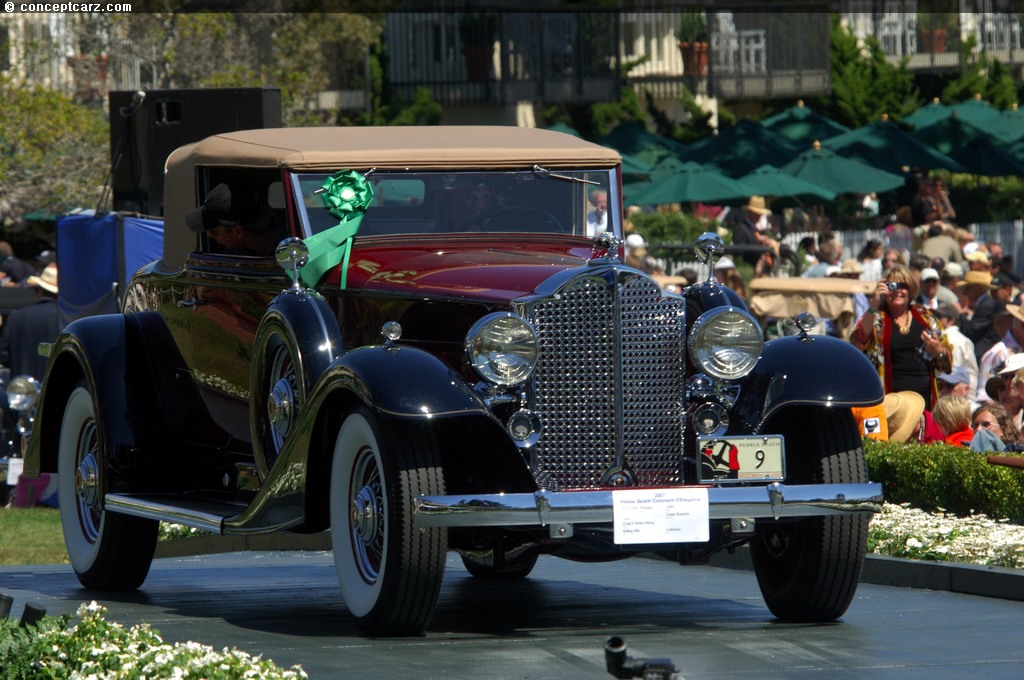
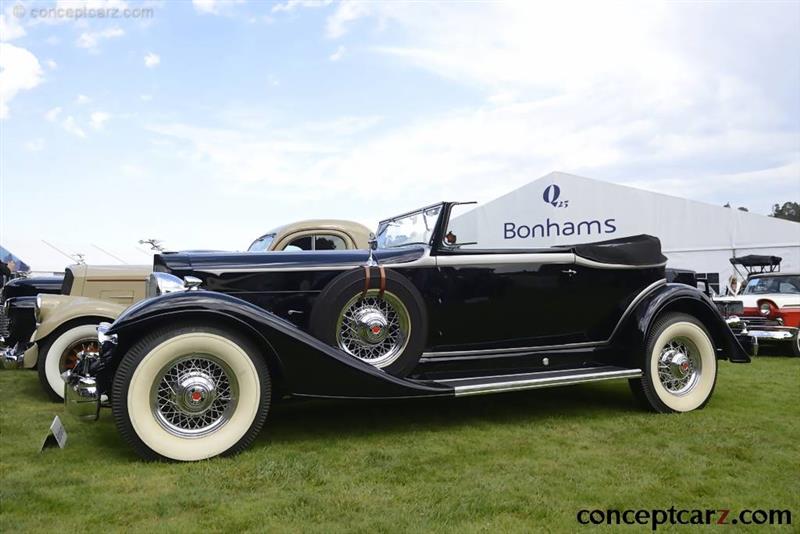
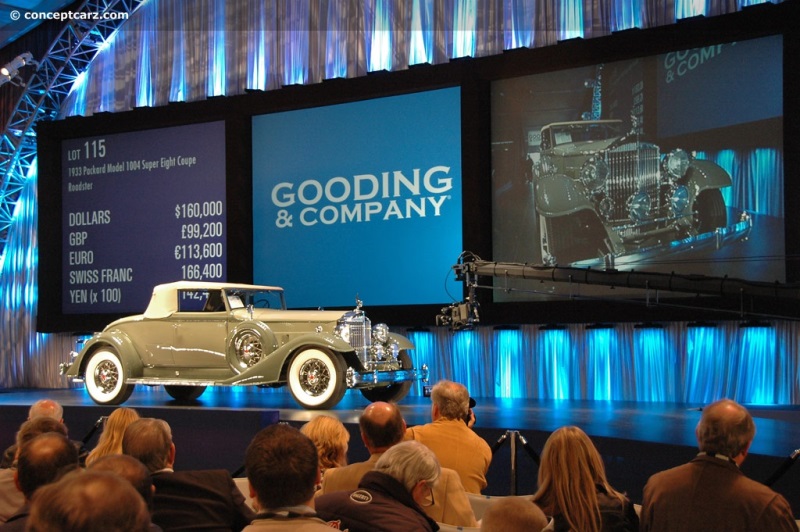
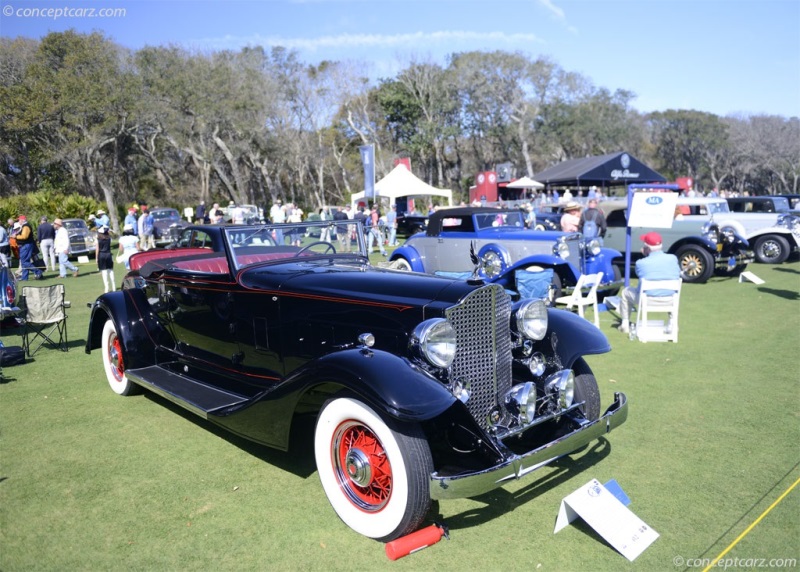
Coupe Roadster
View info and historyWhile the Great Depression was detrimental to the market, it did little to dampen the artistic inspiration that flourished throughout the industry. Arguably, some of the finest-styled automobiles ever produced were built during the 1930 through 1937 era. The Packard models were consistently at the pinnacle of the luxury car segment, renowned for their performance, durability, style, grace, and elegance. Packard's Tenth Series lineup of 1933 included the Eight, the Super Eight, and the Twelve. The Eight was available on a 127.5-inch (Series 1001) and 136-inch (Series 1002) platforms. Its L-head straight-eight engine displaced 319.2 cubic inches with nine main bearings, solid valve lifters, revised manifolding, a smaller flywheel, an automatic choke, a dual downdraft Stromberg carburetor, and delivered 120 horsepower at 3,200 RPM. The Bendix-BK vacuum booster brakes of the previous year's Twin Six were now standard, along with wire wheels, and an angleset hypoid differential. Prices ranged from $2,150 to $3,100. The top-of-the-line model was the Twelve, equipped with a 445.5 cubic-inch twelve with four main bearings, a cast-iron monobloc, and 160 horsepower at 3,200 RPM. The Series 1005 used a 142-inch wheelbase while the Series 1006 had a 147-inch platform. New X-braced frames and three-point engine mountings enhanced Packard's already renowned smoothness and near-silence. The brakes were driver-adjustable and power-assisted, the engine received dual-coil ignition and automatic chokes, and the former two-plate clutch was replaced by a single dry-plate unit. Prices ranged from $3,790 to $7,000, available with both factory-built and custom coachwork. Among the list of coachbuilders were Dietrich and LeBaron.
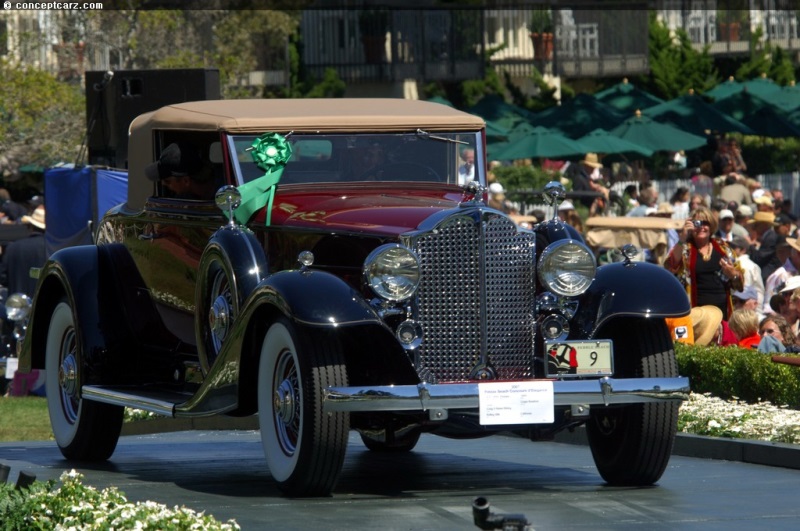
Convertible Victoria by Dietrich
Chassis #: 750055
Engine #: 750056
View info and history
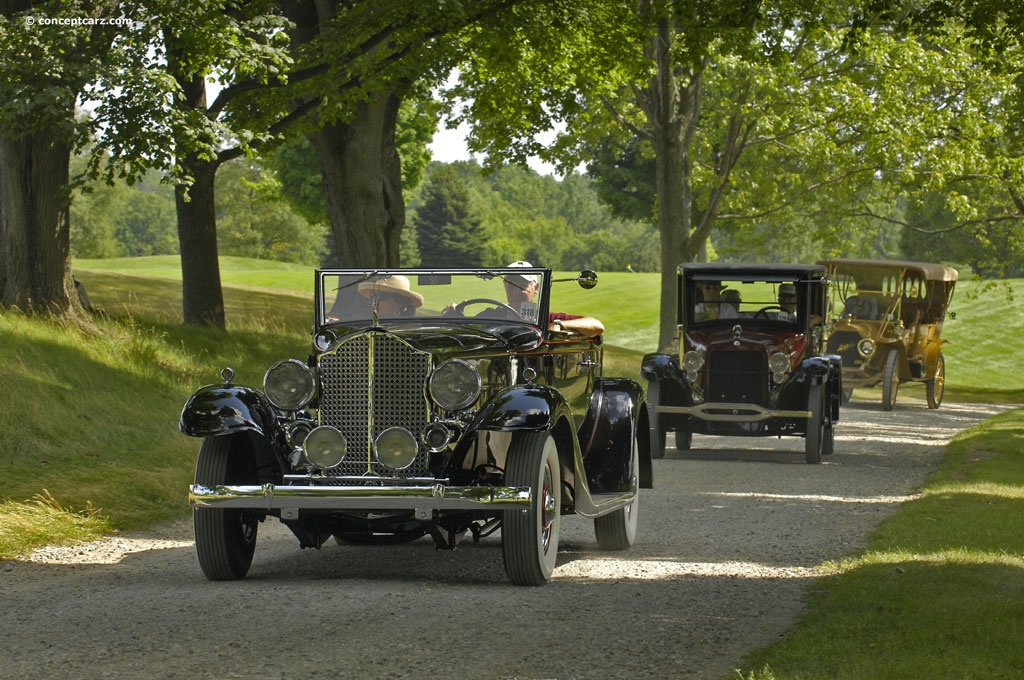
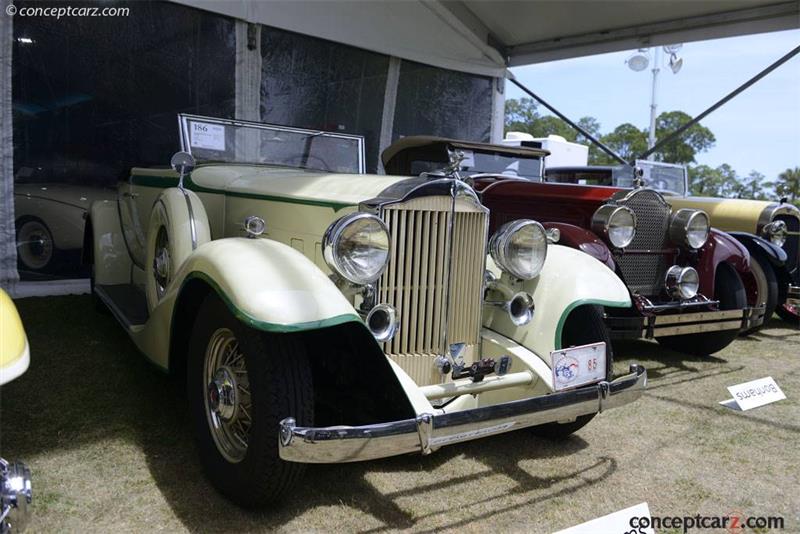
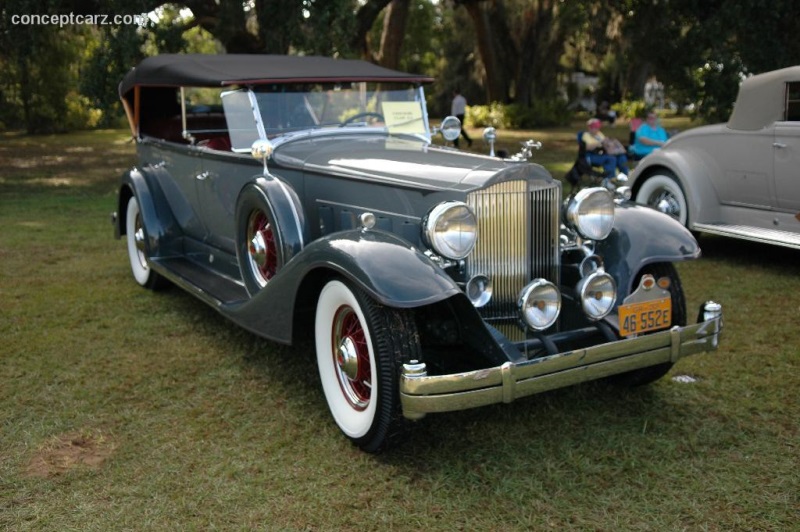
Auction entries : 4Between the Eight and the Twelve was the Packard Super Eight, available on a 142-inch wheelbase (Series 1003) and a 142-inch (Series 1004) wheelbase. The 384.8 cubic-inch straight-eight engine had nine main bearings, a Stromberg carburetor, a standard 6.0:1 compression ratio, and delivered 145 horsepower at 3,200 RPM. The engineering refinements applied to the Eight were incorporated into the Super Eight. The three-speed selective synchromesh transmission had a single-plate clutch and an angleset hypoid differential. Mechanical brakes on all wheels provided the stopping power. Prices ranged from $2,750 to $3,600.The five-passenger sedan was priced at $2,750 and the coupe was listed for $2,780. A five-passenger coupe was $2,980 and a coupe roadster version was $2,870. The phaeton was $2,890 and the Sport Phaeton was $3,150. The most expensive body style was the seven-passenger formal sedan with seating for seven, listed for $3,600. The seven-passenger limousine was $3,280, and the seven-passenger tourer was $2,890. The convertible victoria was $3,440 and the convertible sedan was $3,590. A seven-passenger sedan was nearly $3,100 and the club sedan was $2,975. Only the five-passenger sedan was offered on the shorter 135-inch wheelbase of the Series 1003. The remainder rested on the larger 142-inch (Series 1004) platform.
Coupe Roadster
View info and historyThe most popular Packard model for 1933 was the Eight with 1,881 examples of the Series 1001 and 1,099 of the Series 1002. The most exclusive and expensive model, the Packard Twelve, had just 520 examples built. Of the Super Eight, the larger Series 1004 proved more popular than the Series 1003, with 788 units built compared to 512 of the Series 1003.
by Daniel Vaughan | Sep 2021
Coupe Roadster
View info and history

Convertible Victoria by Dietrich
Chassis #: 750055
Engine #: 750056
View info and history
Auction entries : 4
Coupe Roadster
View info and history
by Daniel Vaughan | Sep 2021
Related Reading : Packard Eight History
The Packard Motor Company relied on making luxurious cars that were highly refined, fitted with luxurious coachwork, and powered by proven engineering. This belief had placed them among the elite in the auto industry during the early 1900s. As the world entered the Great Depression, the Packard Company was one of the few that managed to survive. In fact, they outsold all of their competitors combined.....
Continue Reading >>
Continue Reading >>
Similar Automakers
Similarly Priced Vehicles


1933 Packard 1004 Super Eight Vehicle Profiles





Recent Vehicle Additions


Performance and Specification Comparison
Price Comparison
$2,200 - $2,300
$2,350 - $3,085
$3,700 - $4,700
$4,085 - $7,034
Super Eight Specification Comparison by Year
Year
Production
Wheelbase
Engine
Prices
Related Automotive News

Gooding & Company Proudly Announces a Geared Online Auction – The European Sporting & Historic Collection From 28 January to 5 February 2021
Hailing from a private UK-based collection, these nine cars represent the very best of motorings most prosperous era, with highlights from Ferrari, Mercedes-Benz, Aston Martin, Bentley, and Rolls-Royce.
Gooding %26 Company, the internationally...

American Muscle Roars its Way to Gooding & Company's 2019 Scottsdale Auctions
Exceptional Offerings that Include Road and Racing Cobras, Chevrolet Muscle Cars, and a Historic Dry Lakes Roadster
Santa Monica, Calif. (December 11, 2018) – Gooding %26 Company, the auction house acclaimed for selling the worlds most...

The World's Best Packard: Pebble Beach Best Of Show-Winning 1934 Packard Set For RM Sotheby's Monterey Stage
RM Sothebys announces two Pebble Beach award-winning cars from collection of Judge Joseph and Margie Cassini for flagship Monterey sale, 24-25 August
1934 Packard Twelve Individual Custom Convertible Victoria by Dietrich returns to Monterey Peni...

Blue-Chip Collector Cars Revealed for Gooding & Company's Scottsdale Auctions
The first Bugatti Type 55 Roadster ever built will be presented at Gooding %26 Companys marquee this January
SANTA MONICA, Calif. (December 8, 2017) – Gooding %26 Company, the auction house acclaimed for selling some of the worlds most significant...

Extremely Significant, Early Shelby Cobra Roadster an Exceptional and Early Headline Consignment to Russo and Steele's Upcoming Monterey Auction
Scottsdale, Arizona – With his AC Ace-derived, Ford-powered Cobra, Carroll Shelby and his racing team spearheaded Fords Total Performance campaign of the 1960s on the world stage and ended Ferraris dominance of the World Sportscar Championship for...