1972 McLaren M8F pictures and wallpaper 1972 McLaren M8F pictures and wallpaper 1972 McLaren M8F pictures and wallpaper 1972 McLaren M8F pictures and wallpaper
More Photographs    Interior Photos   Engine Photos   

Lola won the inaugural year of the Can-Am racing series. In 1967 the McLaren M6A captured the first Can-Am series championship victory for McLaren, a trend that would continue for five years. There were only four factories that scored championship victories in the original Can-Am series, and they were Lola, McLaren, Porsche and Shadow. Shadow won the last original Can-Am championship that concluded in 1974.

In 1967 a production version of the M8A factory was produced, dubbed the M8C. The racing version was introduced followed by the production version. Becuase of this the M8D could be seen on the racing circuit while the production of the M8C was being produced.

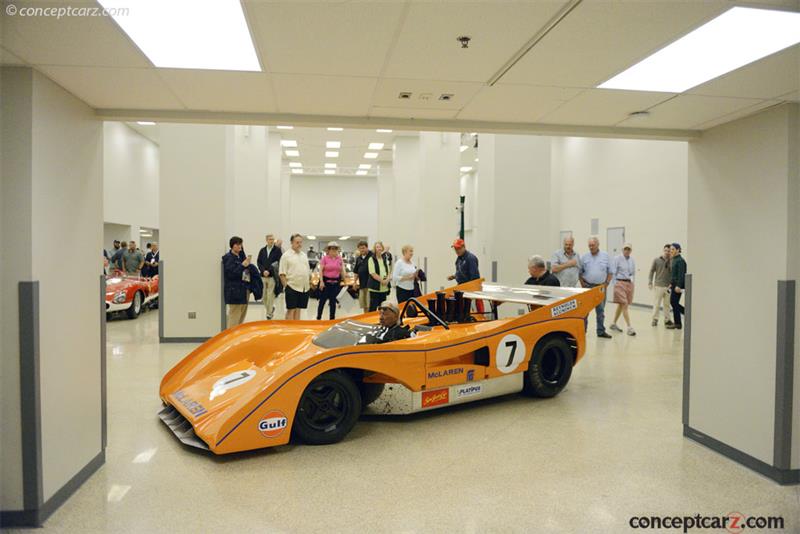
In in 1971 McLaren introduced the M8E, which shared many similarites to the M8D. The next iteration was the M8F which was similar to the M8D but had a slightly updated design and a wing extension, also known as fences. Gordon Coppuck designed the McLaren M8F for the purposes of competing in Can-Am racing. The Chassis was comprised of monocoque and a Reynolds aluminum body. The Group 7 8360 cc alloy Chevrolet V8 engine was capable of producing around 750 horsepower. A 72 gallon fuel tank was dispersed on either side of the driver. Packed in rubber cells and padded with layers of foam, it added to the distribution of weight throughout the vehicle improving braking and handling. A Hewland LG500 MKII transmission helped disperse the horsepower to the rear wheels. The aerodynamics of the body and the wing created over one and a half tons of downforce, which kept the 1850 pound vehicle firmly planted on the track at speeds. In 1971 Peter Revson drove a McLaren M8F to the Can-Am championship where he emerged as champion after winning eight of ten races. This meant he was the first American to win the title. His teammate Denny Hulme finished second. This would be the final year for the McLaren dominance in Can-AM racing.
McLaren had done extremely well during the 1967 CanAm season with their M6A Works Team cars. They had secured a championship victory with their three cars. For 1968, McLaren put this design into production as a customer car and dubbed them the M6B.

Bruce McLaren was the youngest Grand Prix winner who would eventually become a car manufacturer. His resume includes racing on the Cooper Works F1 team during the era of the very competitive mid-engined Coopers. He was a works driver for a few years before purchasing his own Cooper in 1963, a car known as the Zerex Special. He campaigned the car in the American sports car series for a few years, modifying it as needed, and eventually building a new racer from the group up. The car has a spaceframe chassis and was named the M1. It was first seen in 1964 and it quickly proved it was a very capable machine earning a reputation and a contract with Elva/Trojan for the production of customer versions. This gave the Works team the financial backing and the time to focus on their racing program.

Within a few years, McLaren had diversified into other racing segments, building monoposto's that could be used in Formula 1 competition. The M1 was used in the newly formed CanAm Series with some success, but the Lola T70 ultimately proved too competitive. The M1 was replaced by the M6 that featured an aluminum monocoque and fiberglass body. This setup was similar to the T70. The McLaren Oldsmobile V8 engines that powered the M6 cars had been lightweight but lacking in power compared to other team cars. A change was made to Chevrolet engines that offered large displacement sizes. The chassis of the M6A was brought to life in just eleven weeks. The design had been made by Robin Herd. Bruce McLaren and teammate Denny Hulme fine-tuned the design through rigorous testing session. The chassis was aluminum monocoque which was both lightweight and strong. During the 1967, McLaren and Hulme dominated. McLaren earned 30 points and Hulme was close behind with 27. The McLarens and their Gulf-sponsored cars had won five of the six qualifying races and easily outclassed the competition.

Trojan handled the production of the M6B customer cars, again freeing McLaren for new development work and to concentrate on racing. The next McLaren racer was the M8A introduced in 1968. It had a big-block V8 engine that produced 620 horsepower. It had an aluminum monocoque, independent suspension, and ventilated disc brakes on all four corners. The entire package was clothed in a fiberglass body which was wider than its predecessors. The increased width helped conceal the very wide tires and also aided in vehicle aerodynamics.

Bruce McLaren and Denny Hulme drove the Works M8A to the Championship, winning four of the six rounds. The other two races were won by customer driven McLarens. An added bonus for the team was that their M7 Cosworth powered racer had also won the Formula 1 Championship that year.

The M8B McLaren was the next iteration of the M8 series. It drew its inspiration from the Chaparrals, being given a large wing, a slightly increased width, and an increase in power. These small changes kept the car competitive, well, dominate! McLaren won all eleven races during the season with Bruce winning six of the races and his second CanAm title.

The suspension mounted wings were deemed too dangerous and banned for the 1970 season. The customer cars this season were the M8C while the Works drove the M8D. The M8C models, the first customer cars of the M8 model-line, featured a chassis mounted wing and a body design similar to the prior McLaren M8 cars. The Works cars again grew in width to accommodate the wider tires. The engines received an increase in power which made the wider tires even more necessary to help alleviate wheel-spin and to keep the vehicle stable during heavy cornering. The 7-liter engine was enlarged to 7.6-liters resulting in a very impressive 670 horsepower. The body was new, with a design that earned it the nickname 'Batmobile.'

The season would begin with tragedy, as Bruce was killed during a test session in the M8D at Goodwood. The season would continue for the McLaren marque, with Dan Gurney filling the void left by Bruce during the first race. Peter Gethin would take over for the remained of the season. Denny Hulme won six victories with Gethin/Gurney winning three.

For 1971, the M8F was introduced. It was an evolution of the M8D with many changes to the engine. The V8 unit was constructed from lightweight aluminum and had a displacement size over 8 liters. The result was a staggering 740 horsepower making this the first CanAm car to exceed the 1000bhp/ton mark. Trojan continued to build the customer cars which were now called the M8E. This versions were similar to M8C but fitted with a new strut mounted rear wing. Two of the M8E cars were modified to similar design of the M8D cars; these two cars are known as the M8E/D.

The factory drivers for 1971 were Hulme and Peter Revson. Hulme won three races with Revson winning four. This made Revson the first American to win the CanAm Series title.

For 1972, the factory cars were the newly introduced M20 which featured a turbocharged V8 engine and side-mounted radiators. By now, other marque's had caught up to McLaren in terms of design and development, and the McLaren winning streak would come to an end. Leading the pack were the very powerful Porsche 917s which had over 900 horsepower at their disposal. The McLarens, producing just under 800 horsepower, were unable to keep pace as they once did.

When the 1972 season came to a close, McLaren withdrew from the series. Instead, they turned their attention to monoposto racing. The CanAm series would continue for only a short time longer, as sponsorship continued to decline resulting in the season ending prematurely.
Can-Am

CanAm, short for Canadian-American Challenge Cup, was a sports car racing series that persisted from 1966 through 1974. It used the FIA Group 7 category with two races occurring in Canada and four races in the United States. Funding was initially provided by J-Wax.

The CanAm series was astonishing and 'wide open.' There were minimal regulations on the aerodynamics, engine sizes, and vehicle mechanics. The main rules were a body that enclosed the wheels, complied with the safety requirements, and had seating for two.

In Europe, the Group 7 cars were mostly designed for short distance races rather than the endurance racing. There were no homologating requirements and limited regulations.

In North America, the CanAm series was appealing for many reasons. The price money was good and the competition and the races were exciting. The cars were faster than the Formula 1 cars of that era. The sport evolved to having cars well over 1000 horsepower with low weight, aerodynamic bodies, and large wings to create necessary down-force. Turbo-charging and supercharging were widely used. The bodies and mechanical components were made of exotic metals such as titanium. The series became a testing ground for many manufactures interested in examining technology without the worries of new or imposing regulations. Among the top manufacturers in the series were BRM, Shadow, Porsche, Chaparral, Lola, and McLaren.

The first Can-Am race was on September 1966 at St. Jovite Raceway. Famous drivers, manufacturers, and cars were entered, totaling 34 entrants. John Surtees of England entered a Chevy small-block powered V8 Lola T-70. George Follmer, Kiwis Bruce McLaren, Chris Amon, and John Cannon also showed up with powerful cars ready to contend for the first ever Championship of Can Am Racing. At the end of the season it was Surtees who was crowned the champion after winning three of the races. Dan Gurney captured a victory at Bridgehampton while driving a Ford powered racer.

For 1967, McLaren entered a potent M6A racer which dominated the season with Bruce McLaren easily capturing the championship. The M6A was powered by a small-block Chevy V8 capable of producing over 520 horsepower.

McLaren continued their dominance for the next four years. Dennise Hulme won the Championship in 1968 and 1970 with Bruce McLaren securing another championship victory in 1969. Bruce McLaren was was killed while testing a McLaren Can-Am car and was not around to compete during the 1970 season.

Many of the cars were quick but suffered from either reliability issues or were underdeveloped when compared to the McLarens. The Chaparrals and Lolas were especially fast and offered plenty of competition for the McLarens. By 1968, most of the cars were powered by all-aluminum big-block Chevrolet engines producing over 620 horsepower. Manufacturers from other racing series were lured into CanAm racing due to the prize money. Ferrari even entered the ring with their 612P driven by Chris Amon. With a V12 engine and using engines that were 6.2 and 6.9 liters in capacity, it was very quick but not as perfected as some of the other cars in the circuit.

The Porsche 917/10 was similar to other 917's but purposely built for Group 7 of American CanAm racing. It used even more lightweight materials and a larger fuel tank. The larger tank allowed the vehicle to complete a 200 mile race without needing to refuel. During its first season of racing, it was not as successful as hoped. The 12-cylinder engine was not powerful enough to compete for first place. So the 917 was fitted with turbochargers. With the turbochargers and 950 horsepower, the driver needed to be very cautious due to the sudden power increases produced by the turbochargers.

The Lola T220 provided the most competition for the McLaren team but was unable to secure the championship. One of the team drivers for Lola, Peter Revson, left Lola in 1971 to drive for McLaren in their new M8F car. Lola entered their newest creation, the T260 driven by F-1 Champion Jackie Stewart. The cars once again provided McLaren with competition but it was not enough. Revson finished first in the championship followed by Hulme, both in McLarens. Stewart and his Lola finished in third place.

During the 1972 season Mark Donohue and George Follmer drove the Porsche's in competition. Donohue was faster but due to an accident was unable to complete the season. Follmer was left to capture the championship, which he did.

In 1973, Porsche 917/30 was outfitted with twin-turbochargers and a 5.4 liter, 12-cylinder engine. It was capable of produced between 1100 and 1500 horsepower. It could go from zero to sixty in 2.1 seconds and had a top speed of 238 mph. The 917/30 was only available for Team Penske's driver Mark Donohue. It dominated and demolished the Can-Am series with Mark Donohue winning the championship.

In 1974 it was banned from racing in the CanAm series because the CanAm series had begun to lose its fan base since there was no competition. Regulations were created that limited the fuel capacity of the vehicles. The Chevrolet powered vehicles were again contenders. Jackie Oliver and George Follmer, driving a Shadow DN4, proved to be the fastest of the season. The other manufacturers were using outdated cars and were unable to keep pace. 1974 was the final year for the CanAm series.

The demise of the Can Am Championship series was due to a number of issues. North America was experiencing a recession and an oil crisis. The cost of creating competitive cars had skyrocketed. The general public was loosing interest and sponsorship was withdrawing. At the close of the 1974 season, the Series was canceled.

In 1977 the SCCA reintroduced a revised Can Am series allowing Formula A/5000 series cars to be entered. The series never gained much popularity had a limited lifespan.

In modern times many of these Can Am race cars are still being raced at vintage races. Their legacy and power are still impressive and the ear-deafening roar of the engine is enough to put a smile on any enthusiasts face.

Photos grouped by event

Monterey Historic Automobile Races at Laguna Seca

Zippo U.S. Vintage Grand Prix at Watkins Glen

Motoring Festival at Roebling Road Raceway

2005 Hilton Head Island Concours d'Elegance

1972 McLaren M8F

Year1972
MakeMcLaren
ModelM8F
Engine LocationMid
Drive TypeRear Wheel
Production Years for Series1971 - 1972
Weight1850 lbs | 839.2 kg
Combined MPG0.00

Chassis / Engine Numbers Shown
Chassis Number10-72

Performance
Top Speed225 mph | 362 km/h Similar top speeds

Engine  
Engine ConfigurationV
Cylinders8
EngineAluminum Alloy Chevrolet big block
Aspiration/InductionNormal
Displacement8360.00 cc | 510.2 cu in. | 8.4 L.
Horsepower750.00 BHP (552 KW)
HP to Weight Ratio2.5 LB / HP (Vehicles with similar ratio)
HP / Liter89.3 BHP / Liter
Fuel TypeGasoline - Petrol
Vehicles with similar horsepower and weight

Standard Transmission
Gears4
TransmissionManual
LG-600


View more photographs
View Specifications
Similar Automakers
Add Review
McLaren History
Manufacturer Website
Other models by McLaren
AddThis Social Bookmark Button

Related Articles and Event Coverage
Monterey Historic Automobile Races at Laguna Seca
Zippo U.S. Vintage Grand Prix at Watkins Glen
Motoring Festival at Roebling Road Raceway
2005 Hilton Head Island Concours d'Elegance


Other Model Years
1971 M8F
Vehicle Spotlight
Kicherer CL 60 CoupeAll-New Mazda3 Sedan to Debut at the 2008 Los Angeles Auto ShowFord Ka Tattoo
Ford Ka Digital ArtFord Ka Grand PrixPininfarina B0 Concept
Ford Kuga Show CarVenturi Volage ConceptNissan Nuvu EV Concept
Audi A1 Sportback ConceptRenault Megane TrophyRenault Z.E. Concept
Renault Mégane CoupéBMW X1 Concept2009 Lotus Exige Cup 260
Lamborghini Estoque ConceptPeugeot Prologue ConceptSpyker C8 Laviolette LM85
Peugeot 908 HYCitroen Hypnos Hybrid ConceptRenault Ondelios Concept
Chevrolet Orlando ConceptMazda Kiyora ConceptMazda Kazamai Concept