Concept Cars Home
 

Image credits: © Toyota.

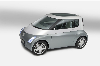
2006 Toyota F3R Concept news, pictures, and information

The essential Toyota values of roominess, style and environmentally advanced performance come together in a dynamic new way in the F3R, the latest concept vehicle from Toyota.
The surprising F3R, which makes its debut at the North American International Automobile Show in Detroit January 9, is an exercise in providing maximum space, efficiency and athletic style from the combined concepts of 'box'and 'wedge.'It is a creative, sporty extension of a concept all but forgotten in today's automotive world – that of the minivan.
The project was a joint undertaking of Calty Design Research Inc., Toyota's California design studio, and the company's California-based Advanced Product Strategy group. It was commissioned because of changes in the minivan market.

'While the loyalty of minivan buyers is very high, the inflow of new buyers to the §egmènt is low,'said John Simmons, national manager, Advanced Product Strategy, Toyota Motor Sales, Ú.S.A., Inc. 'It continues to fall from a high of about 900,000 new buyers to the §egmènt in 1994 to about 500,000 in 2005. Additionally, the median age of the minivan buyer, currently 51, is increasing more rapidly than in other §egmènts of the .'Yet we know that in spite of their stigma, minivans are great vehicles. The fundamentals make total sense. There is no more efficient vehicle,' said Simmons.

'The F3R is about taking a mainstream product wîth a specific identity and trying to go way beyond that image,' said Kevin Hunter, vice president, Calty Design Research Inc. 'With its expressive design and excitement, we think it's something you'd want to drive because you desire it, not just because you need it for its function. We think that it expands the boundaries of the genre.'

Starting wîth a simple, blue-sky request for a three-row concept vehicle, Ian Cartabiano, the Project Chief Designer for the vehicle's exterior, and Alan Schneider, Project Chief Designer for the F3R's interior, began readying sketches depicting an adaptable performance vehicle oriented toward a young family.

The decision to explore the possibilities of three-row seating made sense. 'It's the most practical package there is. It's useful and versatile. But it's most often associated wîth minivans, and there's a stigma associated wîth minivans,'said Cartabiano. 'I think that today's young drivers see the minivan as the vehicle they were carted around in when they were kids. It's their parents' car. They don't want anything to do wîth one.'

Cartabiano and Schneider began the project by listing positive attributes of the minivan. These included its space efficiency, versatility, roominess, handling, fuel efficiency and ride quality.

'We wanted to keep those, but we wanted to add styling and image. We needed performance and aggressive, upscale styling to attract male buyers, young professional women and families,' said Cartabiano.

'So the challenge was to revitalize what a three-row vehicle could be. We needed to appeal to more people, wîth more functions for the lifestyles of buyers who are outside the definition of the usual minivan buyer. This vehicle needed to show the advantages of what three rows can do as a way of serving a market that's mostly being ignored,' said Schneider.
Hunter explained, 'We know how vans are used and how they're configured. We wanted to look at the social aspect, and at how we could use an interior to bring families closer together to enhance their experience. So we created this relaxed lounge environment.'

Which raises the question, why a lounge interior in a motor vehicle?

Schneider has a ready answer: 'Younger people are hanging out in their cars. When they do that, the car becomes an entertainment area. The F3R expands on that concept. It's a sophisticated extension of the home.'
To create that extension, the design team came up wîth three very modern lòòking sets of seats. Each is unique, composed of modern, metal-edged bottoms and asymmetrical backs whose symmetry is completed by semi-integrated headrests. They can provide roomy, comfortable seating for eight adult passengers.

Úp front, the driver's seat reclines and swivels, and the passenger seat reclines to form a comfortable chaise. In the middle, the right and center sections of the 40/20/40-percent second-row seats fold into the floor and the left-hand seat reclines fully to form, wîth the rearmost or third row, an avant-garde sofa built around the sort of conversation area you might find in an upscale home.

This is surrounded by a casual, wrap-around backrest formed by the continuous, flowing curve of the instrument panel, doors and rear seatback panels. These are accented by fiber-optic lighting panels in the seat sides, and in the F3R's right-center grand entry, that can be lit to provide illumination during lounge chat sessions.

But there's more to do here than just chat. That's because Schneider equipped the F3R wîth two track-mounted flat-panel video screens. These allow the vehicle's occupants to enjoy movies or games whenever they want, and to do so in complete comfort, wîth control supplied by an audio/video/lighting remote unit that docks in the F3R's dash.

The lounge mode would be useful any time the vehicle is not moving, Schneider said, adding, 'It would be ideal when you take the kids to games or sporting events, or when you're just hanging out wîth friends. It's a living room away from home.'
But if the F3R is a living room away from home, it also offers a very comfortable and very useable motor-vehicle interior. Seating, in transport mode, is stadium-style, wîth each row just a little higher than the row in front of it to provide optimal passenger comfort and visibility.
And it provides convenient three-door access on both sides to reflect adult-size space in all three rows.

To enhance the F3R's utility, its center-row seats stow individually, and the center seat in the middle row can be configured as a 'front-and-center'child seat.

Schneider took special care to design a unique three-tier instrument panel that is, like the interior itself, dual-mode.
He explained, 'The upper strip, right below the windshield, has two modes – one for driving and one for lounge. When driving, it has warning lights, the transmission shift indicator, a clock and some audio. When in lounge mode, it turns an ambient blue.

'The second tier is the main meter panel for the driver. It houses all the driving functions - the speedometer, the tachometer, the fuel gauge, the screen for a navigation system and the multi-info screen for the hybrid system monitor. The lower tier is the control board wîth switches for controlling lights and the climate control, supplemented of course by §teering-wheel switches.'

But that's not all. On the far right-hand side of this lower panel is the detachable remote-control module that can be taken into the F3R's lounge to control the audio and video systems and the lounge lighting.

Schneider's design emphasizes environmentally sensitive materials, in keeping wîth the theme of environmental sensitivity suggested by the Hybrid Synergy Drive badging on the F3R. These materials include floor panels made from Ecoresin, a specially formulated resin that can be recycled; and a skin-friendly simulated leather seating material called Mythos that, unlike most plastics, does not produce the harmful chemical dioxin when it is burned.

Cartabiano's starting point for the F3R's exterior shape, meanwhile, featured a van that conveyed maximum volume, wîth a tall, wedged body shape that incorporated wide, dynamic shoulders, wîth its sporty 22-inch wheels and wide performance tires planted at the extreme boundaries of all four corners.

'Our thought was, don't lose the space, do gain the performance,' explained Cartabiano.
He added, 'But we needed to package all that interior space. So we started wîth that iconic wedge shape and a high beltline. And I wanted it to have an aggressive, strong face.'

Cartabiano continued, 'Today's minivans have a needle-nose quality. Everybody is trying to push the front really low to try to disguise the fact that the vehicle is a van. We didn't want to do that. We wanted this bold, in-your-face front end. We wanted to create presence. We want this thing recognizable. When they see it in their rearview mirrors, we want people to say, 'Oh yeah, that's the Toyota F3R!''

Additionally, said Hunter, the design team wanted to add a quality known as 'the J-factor'to the design of the F3R's nose.

Hunter explained, 'We define ‘J-factor' as design elements rooted in Japanese culture that are common to Toyota as a Japanese company and will appeal to American tastes. There are a lot of vans wîth robust noses driving around in Japan and we are trying to impart some of that thinking into the F3R.'

What the team wound up wîth just might be one of the more unique and recognizable front-end treatments to be seen in a while. To get there, Cartabiano started wîth a front-three-quarter view so he could concentrate on a nose wîth sculpted, high-mounted headlamps, which help hide the front fascia's corners, and on its wedge profile.

Cartabiano explained, 'One of our main things is the wedge, the iconic profile. Most minivans taper toward the back. We tried to go against that grain. The sideline of the roof rises toward the back to provide room for our three rows of seating. The floor rises for stadium seating, and this wedge allows you do to this. The result is that the third row no longer is punishment, no longer is the penalty box that you don't want to ride in. It has just as much room as the first and second rows.'

With the basic shape of the F3R set in his mind, and wîth a front-end concept sketched, Cartabiano began thinking of the rest of the F3R's surfaces, using what he describes as 'wet and dry surface taste.'

For the F3R's flanks, he chose a highly sculpted, flowing – or wet – shape, wîth fender flares smoothly integrated into the body. And for the nose and rear he went the opposite direction, choosing very clean lines and surfaces that are very simple – or, in designer-speak, dry.

Then he applied some three-dimensional shaping to the beltline, or shoulder, to get the cabin inset, so that the lower body looks wider than the greenhouse, or upper cabin.

And he came up wîth a rocker-panel section that incorporates what he calls a comet light-catch.
Cartabiano said, 'I wanted a really strong rocker panel that plants the car on the ground, gives it a stable stance. I call it ‘comet' because it catches a highlight and it has a comet shape. It goes from thin to thick and then trails off like a comet tail.'

'From a conceptual point of view, this an extremely roomy vehicle in an intelligently sized exterior. It has more interior space than you normally would have,' said Cartabiano. 'That was done wîth a long wheelbase, which gives you more length inside. Moving those wheel wells out of the way is how we get the third-row row seating wîth a lot of legroom. And we needed headroom, so thanks to the wedge shape, the roof is higher, floor is angled and elevated to provide a better view from all the rows. Then there's the door arrangement, wîth three per side, allowing access to all three rows. This is much better than what you normally would have, and it creates more the sense of a personal and sporty vehicle.'

The result is that the F3R looks like a stylish performance vehicle. But the feeling inside is very airy and light.

Part of that feeling is because the D pillar is angled rearward to create a wraparound rear glass that provides a widescreen view of the world outside when the vehicle is reversing.

And though the F3R seems to have a high beltline, it isn't as high as it looks. That's the result of what the vehicle's designers call proportion tuning. Said Cartabiano, 'The cabin kind of looks chopped, but the beltline is not much higher than that of the current Sienna. This look is a trick done by lowering bottom of the car, making the body look a little thicker.'

The result, of course, is a concept vehicle filled not only wîth intelligent drama, but wîth exactly the fresh take on three rows of seating, and on the usable space that vans so effectively provide, that Toyota executives were lòòking for. They wanted anything but a minivan. What they got was a sporty new vehicle that defies an easy label. With a dramatic, iconic shape that is as distinctive as that of the Toyota Prius and an interior that is more adaptable and more family friendly than anything previously seen, it's reasonable to suspect that the automotive world could soon be seeing styling elements from the F3R on future Toyota production vehicles.

'Certainly we are developing concept cars wîth the intent that they influence production cars. So we take the F3R's packaging very seriously,' said Hunter. 'We're lòòking at that design very seriously to gauge its potential as a base for a production vehicle.'

Source - Toyota Motor Europe
Ford Fusion, C-Max Hybrids Attracting New Companies Searching For Savings At The Fuel Pump
- Ford's new hybrids can save business customers as much as 45 percent in operational costs - Ford expects to double hybrid vehicle production as companies procure Fusion and C-MAX for their company fleets, and as model year market share, according to R.L. Polk, has grown 13 percent since 2012 - Ford C-MAX Hybrid and Fusion Hybrid have been purchased by a variety of companies including Con-way, Esurance, Quest Diagnostics and AT&T for fleet use since their introductions last fall - Fleet op...[Read more...]
#TOYOTA AND #LEXUS IN THE U.S. ACCOUNTED FOR NEARLY 2 MILLION OF TOTAL 5 MILLION GLOBAL HYBRID SALES REVEALED TODAY
Torrance, Calif., April 16, 2013 - Nearly 2 million (1,951,243) Toyota and Lexus hybrid vehicles have been sold in the United States, significantly reducing CO2 emissions and fuel consumption. The announcement was made today by Toyota Motor Sales (TMS), U.S.A, Inc. in conjunction with Toyota Motor Corporation's announcement in Japan that it has sold 5 million hybrid vehicles worldwide. Toyota estimates that its global fleet of nearly 20 hybrid vehicles has resulted in approximatel...[Read more...]
TOYOTA AVALON HYBRID NAMED 2013 'BEST GREEN CAR' AT ATLANTA INTERNATIONAL AUTO SHOW
The all-new Toyota Avalon Hybrid was named the 'Best Green Car' at the 2013 Atlanta International Auto Show by the Greater Atlanta Automotive Media Association (GAAMA). The group of automotive journalists has been awarding 'best of show' vehicles for four years running, said Davis Adams, president of GAAMA. 'The Avalon is an impressive option in the green car category, with size, luxury and fuel efficiency that make it a standout in a segment otherwise crowded with smaller economy cars,' Adam...[Read more...]
VOLKSWAGEN CLAIMS BEST HIGHWAY FUEL EFFICIENCY, WITH SEVEN MODELS THAT ACHIEVE MORE THAN 40 MPG
• New Jetta Hybrid earns EPA fuel economy rating of up to 48 mpg; the first compact hybrid available with a turbocharged engine
Herndon, VA - With EPA estimated fuel economy ratings of 48 mpg on the highway, 42 mpg in the city, and a combined rating of 45 mpg, the Jetta Hybrid becomes the most fuel-efficient vehicle in the Volkswagen lineup and the seventh model capable of more than 40 mpg on the highway. With sales of the Jetta Hybrid beginning later this month, Volkswagen wil...[Read more...]
Toyota Motor Sales Outpaces Industry with 17.2 Percent November Sales Increase
 Best-Ever RAV4 November, Strong Camry and Corolla Sales Among Highlights TORRANCE, Calif. (Dec. 3, 2012) – Toyota Motor Sales (TMS), U.S.A., Inc., today reported November 2012 sales results of 161,695 units, an increase of 17.2 percent compared to the same period last year on both a daily selling rate (DSR) and a raw volume basis. The Toyota Division posted November total sales of 138,976 units, an increase of 17.3 percent on a DSR basis from November 2011. 'Replacement...[Read more...]

Arrow Right 2006 Toyota models
Toyota 4Runner
Toyota Avalon
Toyota Camry
Toyota Camry Solara
Toyota Corolla
Toyota FJ Cruiser
Toyota Highlander
Toyota Hilux
Toyota Land Cruiser
Toyota Matrix
Toyota MR2
Toyota Prius
Toyota Ractis
Toyota RAV4
Toyota Sequoia
Toyota Sienna
Toyota Tacoma
Toyota TF106
Toyota Tundra
Toyota Tundra NASCAR Craftsman Truck Series
2006 Toyota Concepts
Toyota Endo Concept
Toyota Fine-T Concept
Toyota Fine-X Concept
Toyota FJ Cruiser Soft Top
Toyota Urban Cruiser Concept

Similar Vehicles
Toyota Endo Concept2006 Toyota Endo Concept

Similar Automakers
HondaJaguar
NissanSaab
SubaruVolkswagen
Volvo
 
Toyota: 2001-2010
Similar Automakers
Toyota History
Other models by Toyota
Manufacturer Website

Related Articles and Event Coverage
2006 Chicago Il
2006 New York City, NY
2006 North American International Auto Show

Toyota
Monthly Sales FiguresVolume
May 2013185,723 
April 2013158,069 
March 2013182,152 
February 2013149,038 
January 2013141,514 
December 2012163,536 
November 2012138,976 
October 2012135,392 
September 2012151,524 
August 2012164,283 
July 2012146,663 
June 2012157,773 
(More Details)

 
2000 GT
4Runner
Avalon
Camry
Celica
Coaster
Corolla
Corona
FJ Cruiser
GT-One
GT86
Highlander
Land Cruiser
Land Cruiser 40 Series
Land Cruiser 70
Matrix
MR2
Prius
RAV4
Sequoia
Sienna
Starlet
Supra
Tacoma
Tundra
Venza
Yaris

© 1998-2012. All rights reserved. The material may not be published, broadcast, rewritten, or redistributed.