Concept Cars Home
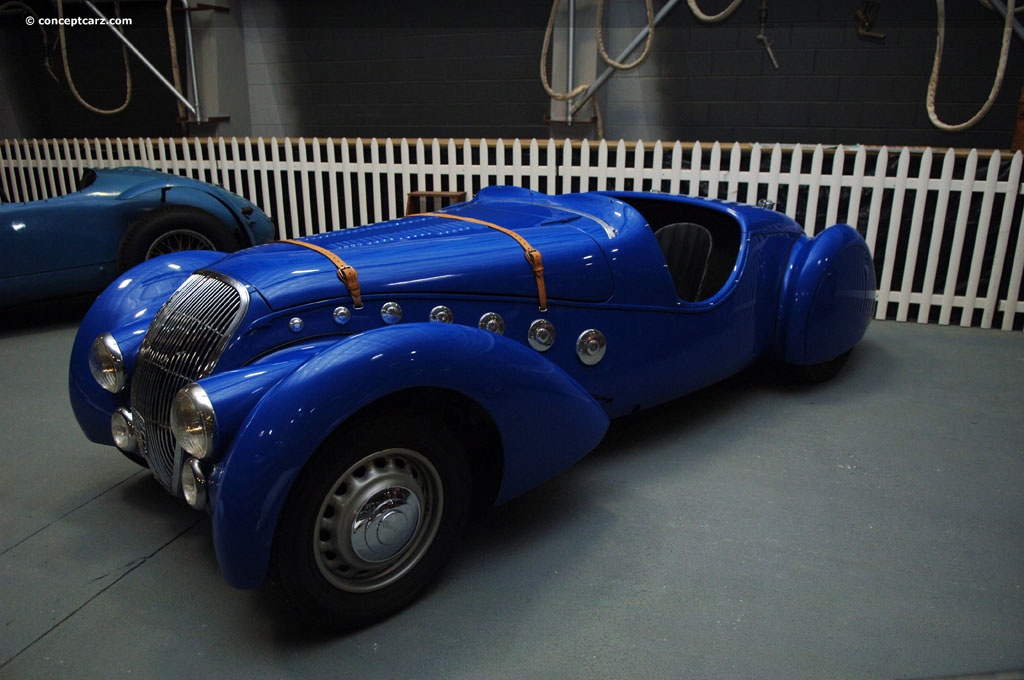
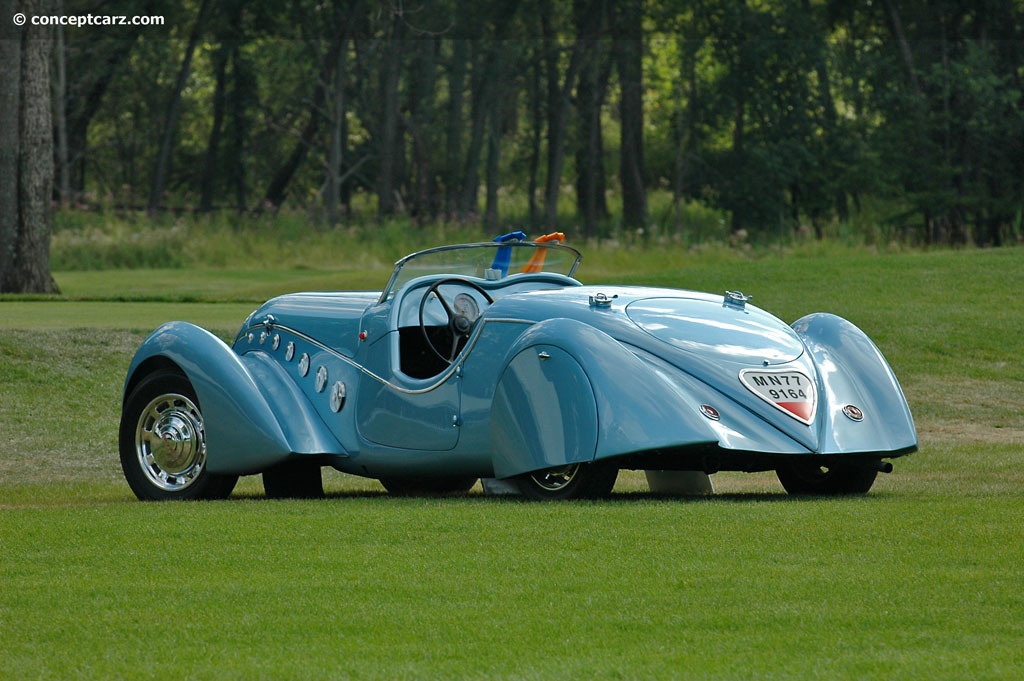
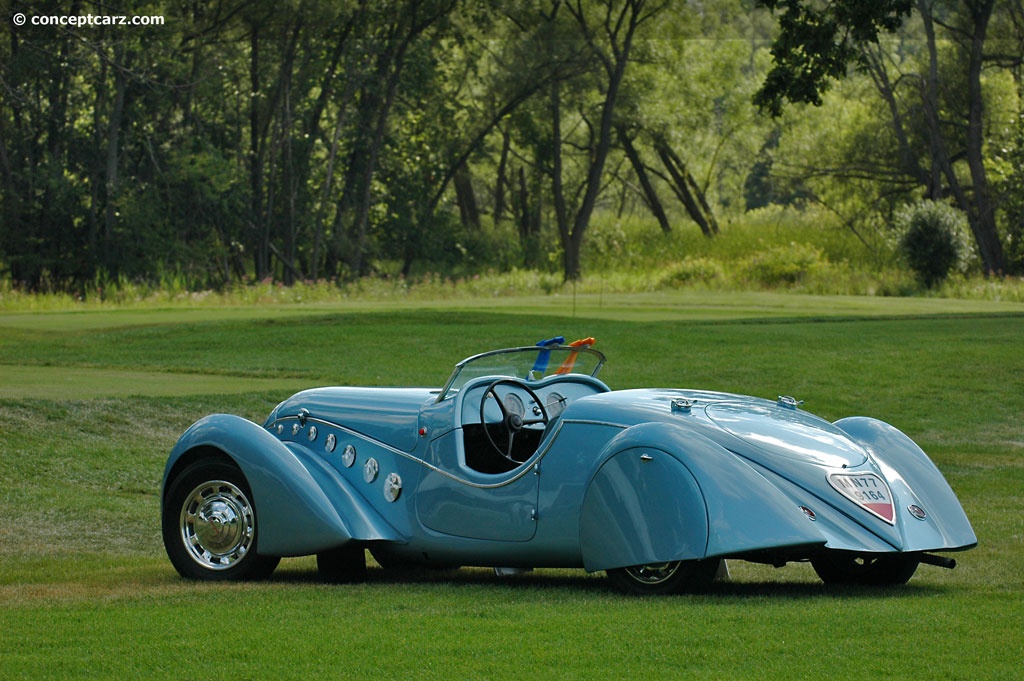
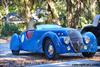
Image Left 1937 402 Darl MatImage Left 1937 402 Darl'Mat Pourtout
 

1938 Peugeot 402 Darlmat Pourtout news, pictures, and information

Racing Roadster
Coachwork: Pourtout
Designer: Georges Paulin
 
The 402 series was first introduced in 1936. This rare example has a special sports body by famed French coachbuilder Marcle Pourtout who was a hero with the French resistance. This 402 Racing Roadster has a 4-cylinder, single-overhead valve engine with two-liter capacity. It is one of three cars with an aluminum body in the 1938 24-Hour Lemans race and won its class.

Powered by a 1,991 cc overhead cam inline four-cylinder engine which produces 73-horsepower.

A total of 104 Peugeot 402 Darl'mat Special Sport Roadsters were crafted from 402 chassis. They were upgraded at Darl'mat's shop with Cotal four-speed electro-mechanical gearboxes, before being shipped to pourtout and fitted with the Paulin-designed bodies, formed from pieces of sheet aluminum hand-shaped and then nailed to wooden structures of ash framing that were then attached to the chassis.

Three Darl'mats finished in the top 10 overall at the 24 hours of Le Mans in 1937. Approximately 30 still survive today.
Roadster
Designer: Georges Paulin
Chassis Num: 400247
 
In 1936 Peugeot launched the short wheelbase 302 model, which would be the basis for the next Darl'mat, Pourtout (coachbuilder) and Paulin (designer) project. A dental technician by trade, Paulin was very passionate about creating very aerodynamic and efficient shapes.

This was very useful for Darl'mat as he wanted to create a racing car based on the 302 chassis, powered by the slightly larger two-liter engine from the 402 model. It would be the first time a Peugeot would be seriously raced again since the early teens when the company built some of the most advanced Grand Prix cars of the day. The car has an approximate weight of 2248 pounds.

In November of 1936 the first example was produced, and soon after it was decided that the 'Darl'mat' would be produced in limited numbers for the road in Cabriolet, Roadster and Coupe form. This example is the larger engine 402 model.

A racing car for the road appealed to customers and a hundred road cars on the Peugeot 302 and 402 chassis were produced between 1937 and 1939. Of those 100 cars, 53 were Roadsters. It is estimated that around 30 examples still exist today.

Georges Paulin's design is Peugeot's most elegantly designed two-seat roadster. 104 of these Darl'mat Special Sport Roadsters were built by hand-shaping aluminum sheets and then nailing them to frames made from Ash. Approximately 30 of these cars survive, and this car is a multiple award winner including Best in Class at Pebble Beach.

This car was Pourtout commission number 1639. It would lead a secluded existence in France for much of its life before surfacing at a Peugeot dealership in Nice around 2 decades ago. When discovered, the rare Peugeot had been in static storage for a number of years after having been retired from its service as an occasional rally car. At the time, the car was rather complete and intact, retaining the vast majority of its original components and Pourtout coachwork. The car has a unique feature of having a folding soft top.

The car was eventually purchased by a group of dealers and collectors in an effort to avoid a bidding war. The deal was spearheaded by Christophe Pund and Frankie du Mouton. The car would remain in Europe until Mr. Edward Fallon of Phoenix, Arizona, discovered the Peugeot 42 while attending Retromobile in 2001. It was purchased and shipped to the US, and soon after it was restored in aim of showing at the 2004 Pebble Beach Concours d'Elegance. By August of that year, around 2,500 man-hours had been spent in restoration and was ready for being shown at the Pebble Beach Concours. It was shown in a class devoted to the designs of George Paulin. It was awarded with Best of Class honors, an impressive accomplishment considering the list of cars it defeated including a very rare Darl'mat Coupe.

It was later shown at Meadow Brook, Amelia Island and the Palm Beach International Concours. The elegant alloy bodywork attracts crowds wherever it goes. Though beautiful, the car was designed for road use and is eligible for tours and rallies. The four-cylinder engine and the Cotal gearbox makes it delightful to drive at speed. There is a removable low-raked windshield, pontoon fenders, cut-down doors, a grille shell, twin fuel-fillers and a large dashboard with just two Jaeger gauges to monitor the car's mechanical status.

In 2010, this Porsche 356 Pre-A was offered for sale at Gooding & Company Auction held in Amelia Island, Florida. The car was estimated to sell for $650,000 - $850,000. As bidding came to a close, bidding had reached $600,000, but was not enough to satisfy the car's reserve. It would leave the auction unsold.

Peugeot 402, 1935-1940

With a rich history of technical innovation, Peugeot's 402 cars have become some of the most respected Peugeots that France ever produced. But even more impressive than the cars themselves were the people behind the curvaceous vehicles. World War II was swinging closer when the 402 was released in 1935, and by the end of the car's production run in 1940 the world had already fallen into one of the most devastating and atrocious struggles that humanity had ever known. Key individuals involved with the development of the 402, particularly with the stunning 402 Darl'mat, were dangerously intertwined with the growing war effort. The personal difficulties faced by these few key men helped make the Peugeot 402's story transcend the realm of automotive history and become a troubling example of the long-reaching effects of war.

The most intriguing story of the 402's past was the tale surrounding the creation of the 402 Darl'mat. Automotive journalist and historian Jim Donnelly wrote a colorful and detailed history of the car in the September, 2005 issue of Hemmings Sports & Exotic Car magazine. In his article, Donnelly mentions three men in particular as being responsible for the creation of the special 402. These men were Emile Darl'mat, Georges Paulin, and Marcel Pourtout.

Darl'mat, whose name made it onto a series of special Peugeot 402 models, was a renowned Peugeot dealer. Darl'mat was an avid and passionate auto enthusiast, and was constantly working in the garage at his dealership to improve his own cars with careful modifications. He became well-known to a few Peugeot lovers as the man to see about high-quality improvements.

Paulin was a stylistic genius with a functional flair who had developed the first retractable hardtop (forget everything you've heard about the Ford Fairlane), which he called the Eclipse roof system. Paulin received a patent for his novel idea, which landed him a partnership with Pourtout.

Pourtout was a French coachbuilder and longtime friend of Darl'mat. Though Pourtout was skilled, his works initially lacked the high style and creative originality that Paulin would later provide. When Pourtout needed a chassis on which to display Paulin's Eclipse roof design, Darl'mat was contacted and subsequently became involved with the development of the Peugeots to bare his name.

After the three men decided to build cars together, Peugeot would send 402 chassis to Darl'mat's garage. There, Cotal MK-25 electromechanical transmissions were mated to the 402 engines in the fashion of Darl'mat's superb modifications. The advanced transmissions were four-speeds, with no dedicated reverse gear. Instead, any gear could be used for reversing, with Cotal suggesting the selection of second gear whenever moving backwards was required.

After they were finished receiving the new gearboxes, 402 chassis were sent from Darl'mat to Pourtout. At Pourtout's coachbuilding facility, hand-shaped aluminum bodies were fitted to ash wood frames that were then attached to the waiting chassis. The attractive and aerodynamic bodies were designed by Paulin, and affixed to the ash frames simply by nails. Production of the 402 Darl'mat cars lasted from 1937 to 1938, with 106 produced.

Though Paulin's greatest accomplishments were in the area of design, he was actually trained as a dentist. His dentistry skills had little to do with his aesthetic genius, but they did help him land a job as a French spy working under Charles de Gaulle at the outset of World War II. Fearlessly, Paulin made detailed drawings of German equipment and bases. He passed these German secrets on to a posing dental patient who was actually a French railroad worker. His skills as a dentist, designer, and patriot all helped him successfully deliver important information to France. If espionage seems an unlikely livelihood for a gifted designer, consider the men with whom Paulin worked. Joseph Figoni and Jacques Kellner, both highly skilled coachbuilders, were essential spies that dealt closely with Paulin.

It became known that Paulin and his co-spies were on the verge of being discovered, and Paulin was offered the chance to be quickly removed to safety by the British. The man whom Paulin and the rest were working for was a double agent who had been supplying information to French Vichys and German Nazis. Paulin knew that if he left, Kellner and Figoni would be caught and killed. Paulin bravely remained in France, where he was soon arrested by Vichy mercenaries along with Figoni and Kellner. In 1942, Kellner and the Paulin were shot and killed by firing squad. Only Figoni managed to survive, thanks to a Gestapo officer who had been on the Mercedes-Benz racing team recognizing him.

Paulin's was a devastating loss to France and to the world of automotive design. Though Pourtout would resume production after the war, he was never as successful as he had been with the skilled Paulin working by his side. Darl'mat continued the postwar operation of his garage, but never ventured into auto production again after Paulin's tragic death. The last car produced by Darl'mat, in 1939, was designed by Paulin.

The cars of the 402 series earned the nickname 'Sochaux rockets.' Peugeot's primary assembly plant was located in Sochaux, and the aerodynamic streamliners had an advanced, rocket-like look to their bodies that garnered respect and praise. Many different models were built on the 402 chassis. There were 4-doors, 2-doors, cabriolets, roadsters, and the important retractable hardtop models with Paulin-designed Eclipse tops. The first of the 402 models were powered by a 1,991cc four with overhead cam that produced about 70hp, a respectable figure for such a small engine in the 1930's. Later models, using the 402B designation, were fitted with 2,142cc mills. Peugeot's business was going well during the time of the 402, with annual production reaching 50,000 units by 1938. In June of that same year, a 402 Darl'mat took first place in the 1,500cc to 2,000cc class at Le Mans.

All 402 bodies were carefully streamlined. On models with the Eclipse retractable hardtop, the roof lowered as a single, unbroken piece into a tapered trunk area. Top up or down, even the Eclipse-equipped vehicles looked distinctively aerodynamic. Though the 402 Darl'mat bodies had headlights mounted low and flanking the grille, other 402 models had headlights mounted within the grille. This gave the cars a unique look and provided the wind with one less obstacle as it flowed seamlessly over the slippery bodies. The 402 Andreau, designed by Jean Andreau, had the most radical styling of the closed, 4-door 402 bodies. The Andreau had a split rear window with an enormous dorsal fin running between the glass.

The 402 and its advanced forms bettered Peugeot's prewar image as a fine automaker. Mechanically the 402 chassis was not particularly impressive, but the voluptuous sheathings fitted over those chassis were remarkable. The team of Paulin, Pourtout, and Darl'mat was gifted at producing its own version the 402, and had Paulin not fallen to the terrors of an apocalyptic war the history of French design surely would have grown even more intriguing.

Sources:

Donnelly, Jim. 'Of Paulin, Pourtout, and Peugeot.' Hemmings Sports & Exotic Car Sep 2005: 22-29. Print.

'1936 Peugeot 402 Andreau.' Serious Wheels Web.7 Aug 2009. http://www.seriouswheels.com/cars/top-1936-Peugeot-402-Andreau.htm.

'Peugeot 402.' Phil Seed's Virtual Car Museum Web.7 Aug 2009. http://www.philseed.com/peugeot402.html.

'Peugeot History.' Peugeot Fans Club Web.7 Aug 2009. http://peugeot.mainspot.net/hist12.shtml.

By Evan Acuña
For more information and related vehicles, click here

Lincoln at Los Angeles Auto Show Press Days: Celebration of Its Past and Future As Brand Rolls Out Its Reinvention
> The brand pays tribute to its heritage today, displaying seven of the most influential Lincoln designs > Thursday sees a display full of the all-new MKZ premium midsize sedan and MKZ Hybrid, the future of Lincoln, on the Lincoln stand > Lincoln launches on Tumblr http://lincolnnow.tumblr.com beginning with the visually stunning classic Lincolns shown on the stand and select images from archives. Continues with an all-new collection of photographs by photographers Jamie Beck and Kevin Burg ...[Read more...]
Jaguar Land Rover Debuts Three All-New British Vehicles At 2012 Los Angeles International Automobile Show
Jaguar Land Rover introducing three new vehicles with special focus on the U.S. Market •High-performance 2014 Jaguar XFR-S makes its world debut •All-new two-seat sports car, the Jaguar F-TYPE, makes its U.S. Auto Show Debut •The world's first all-aluminum SUV, the 2013 Range Rover makes its U.S. Auto Show Debut •The U.S. will be the world's largest market for the three vehicles Jaguar Land Rover is debuting at the 2012 Los Angeles International Auto Show (MAHWAH, N.J.) – November...[Read more...]
Mercedes-Benz at Pebble Beach Automotive Week: An Expression of Fascinating Design and Innovation
•Historical Tribute to SL: W194 Chassis No. 2, 7 and 11 among 300SL vehicles on display •The Concept Style Coupé opens a new chapter and generation of Mercedes-Benz vehicles •AMG 45 year anniversary highlights the pinnacle of performance and style A tribute to Mercedes-Benz SL Roadsters is set for Pebble Beach Automotive Week with three 1952 W194 vehicles among a mix of vintage and new vehicles bearing the three-pointed star that express the marque's breadth and depth of fascinating desi...[Read more...]
Famous Bentley 4¼-Litre 'Embiricos' Special Makes Star Appearance At Crewe Factory
One of the rarest and most valuable Bentleys in the world, the 4¼-Litre 'Embiricos' special, is making an historic appearance at the marque's home in Crewe. Fresh from taking part in the Louis Vuitton 'Serenissima Run' in Venice and featuring at the Le Mans Classic as part of the Bentley lineup, this magnificent car takes pride of place in the Lineage Showroom at the firm's Pyms Lane factory until September. Throughout the 1930s Bentley Motors, then owned by Rolls-Royce, was producing fast,...[Read more...]
Mercedes-Benz at Pebble Beach: An Expression of Fascinating Design and Innovation
• Historical Tribute to SL: W194 Chassis No. 2, 7 and 11 among 300SL vehicles on display • The Concept Style Coupé opens a new chapter and generation of Mercedes-Benz vehicles • AMG 45 year anniversary highlights the pinnacle of performance and style A tribute to Mercedes-Benz SL Roadsters is set for Pebble Beach weekend with three 1952 W194 vehicles among a mix of vintage and new vehicles bearing the three-pointed star that express the marque's breadth and depth of fascinating design and ...[Read more...]
145S
402 Darl^mat Special Sport Roadsters
905 LM
Bebe
Type 3

Image Left 1937 402 Darl MatImage Left 1937 402 Darl'Mat Pourtout
© 1998-2012. All rights reserved. The material may not be published, broadcast, rewritten, or redistributed.