1968 Porsche 908
1968 Porsche 908 Navigation
The Porsche 906 of 1966 and the Porsche 910 of 1967 both used variants of the flat-six-cylinder engine sourced from the 911. However, to remain competitive among the world's elite manufacturers and teams, a competition-specific engine was required. Using the flat-eight Formula 1 engine used in the Porsche 804 of 1962 as design inspiration, Porsche began work on a new flat-eight. It was given a 2.2-liter displacement and initially installed in the 907, itself a development of the 910. In this guise, it won at Daytona and Sebring in 1968. 
Coupe
Chassis #: 908-019
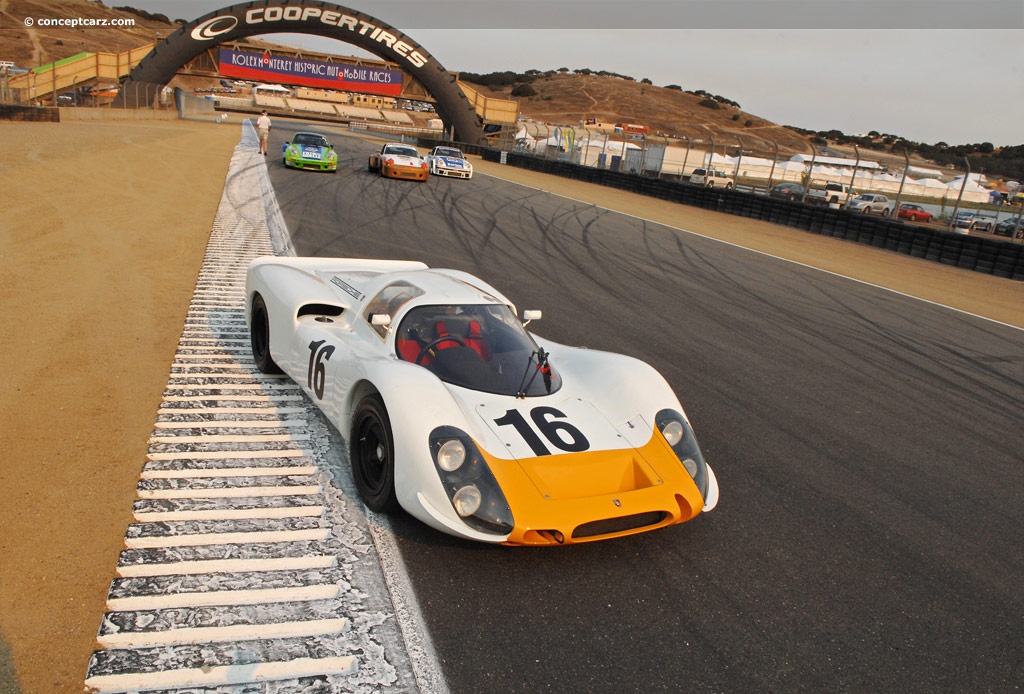
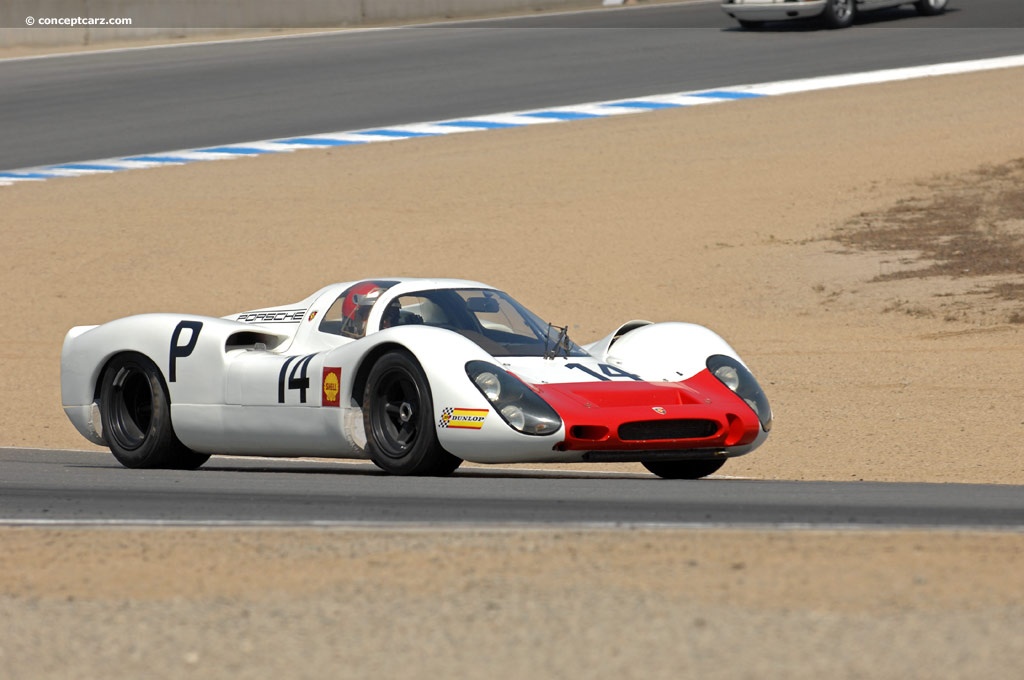
View info and historyPorsche boss Ferdinand Piëch decided in mid-1968 that the company would build a race car that could be a contender for overall victory. The new model was to be called the 917, and at least 25 copies of the new 4.5-liter car were needed to be built to satisfy homologation requirements. The goal was to win the 24 Hours of Le Mans in 1970. In the meantime, Chief Engineer Hans Mezger worked to keep Porsche competitive by developing a larger thee-liter variant of the flat-eight that would satisfy new FIA rules limiting engine capacity for Group 6 Prototypes to three liters. This new engine was to be installed in a mildly updated version of the 907 known as the 908, initially wearing closed coupe bodies with low drag intended for high-speed tracks. A total of 31 examples were eventually built in both long-tail and short-tail coupe and Spyder configurations from 1968 to 1973. The mid-mounted engine was basically a larger version of the 2.2-liter unit found in the 907. It was, however, the first racing engine from the company to meet a class displacement maximum. The new 3,000cc engine was ready for its first appearance during Le Mans testing in April of 1968. The early examples of the all-alloy, dry-sumped, twin-ignition, four-cam, eight-cylinder boxer engine revealed severe vibration. This issue was resolved by changing the firing order and using the 66-mm crankshaft of the 907. With 10.4:1 compression and Bosch Kugelfischer indirect fuel-injection, the engine offered around 350 horsepower at 8,500 RPM and 232 foot-pounds of torque at 6,600 RPM. Tipping the scales at 1,300 lbs, the 908 offered an impressive horsepower-to-weight ratio. To achieve optimal weight balance, the engine was mated to a five-speed gearbox with the clutch and final drive at the rear. In this configuration, the engine was installed much farther forward in the chassis. As a result, the driver was nearly between the front wheels. Larger brakes (than the ones found in the 907) were installed to cope with the more powerful engine and increase in weight. The early cars used steel for the spaceframe chassis while later examples used aluminum, further reducing the vehicle's overall weight.
Coupe
Chassis #: 908-010
Engine #: 908-034
View info and history
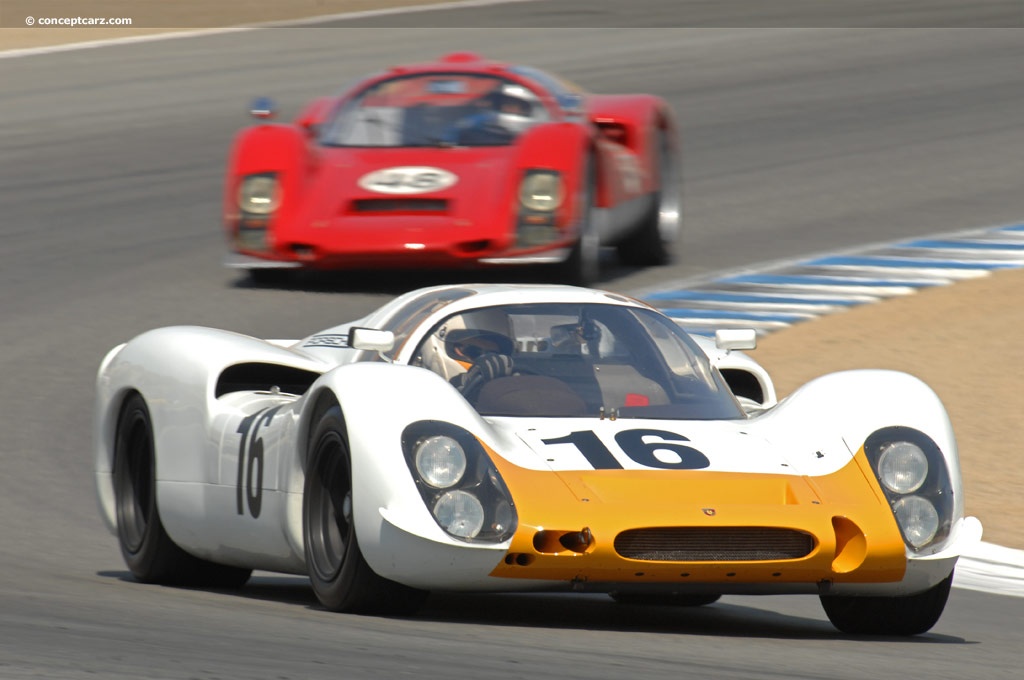
Auction entries : 1By the time the 908 was ready for competition mid-way through the 1968 season, the eight-cylinder 907s had already scored a 1-2-3 victory in the Daytona 24 Hours race. The LeMans testing revealed the aforementioned vibration along with problems with the six-speed gearbox. The Works drivers refused to drive the 908 at its inaugural race, at Monza. The longtail coupe proved difficult and unpredictable, and the driver's much preferred the short-tailed coupes. Porsche engineers revised the moveable wing system on four of the coupes to help ensure stability at speed. These four cars were also given the aluminum spaceframe and made ready for the Le Man's race, which had been postponed due to political unrest in France to September from June. The Porsche 908 LH Long Tails proved to be very quick, setting the fastest times in qualifying. At LeMans, the 908s led for the first two hours before suffering engine and gearbox-related problems which prematurely sidelined their racing endeavors. One 908 managed a respectable third-place finish behind a 907 Long Tail and a V8-powered Ford GT40. Work continued on the 908 over the off-season, including a new 5-liter example (called the 908/2) that would comply with new Group 6 prototype rules. Dubbed the 908/02, the overall weight was reduced further by removing the long tails, roof, and using the aluminum tube frames. The troublesome six-speed gearbox was replaced by a more reliable five-speed unit, and the engine vibration issues had been resolved with a new crankshaft. Three examples were brought to the 1969 24 Hours of Daytona but all three failed to finish. Three 908/2s were brought to the 12 Hours of Sebring but were beaten by a Ford GT40. By this point in history, Porsche was revealing the 908/02 replacement, the 917 in Geneva. While the 917's teething problems were being resolved, the 908/2 had evolved into a finely-tuned competitor. The next race for the 908 was at the BOAC500 at Brands Hatch, where they finished 1-2-3. Additional wins followed at the 1000km Monza, the Targa Florio, the 1000km Spa, and a convincing 1-2-3-4-5 at the 1000 km Nürburgring. By the close of the season, Porsche's had been named the 1969 International Championship for Makes.
Coupe
Chassis #: 908-010
Engine #: 908-034
View info and history
Auction entries : 1At LeMans, the 908 driven by Hans Hermann challenged the Ford GT40 for overall victory, coming in a close 2nd behind Jacky Ickx. Development work on the 908 continued during the off-season, resulting in the 908/03 for 1970. Working in tandem with its larger sibling, the 917, the 908/03 would prove to be very useful on the smaller, slower, and twisty tracks where its nimble size and lightweight persona proved to be better suited. For the high-speed tracks, the 917K and its top speed of approximately 240 mph was often the frontrunner. The 908/03 - unlike the 917K was of exclusive use for the factory teams - used the new open cockpit setup of the Porsche 909 hillclimbing car. It was shorter than the 908/02 and weighed a mere 500 kg.
Coupe
Chassis #: 908-008
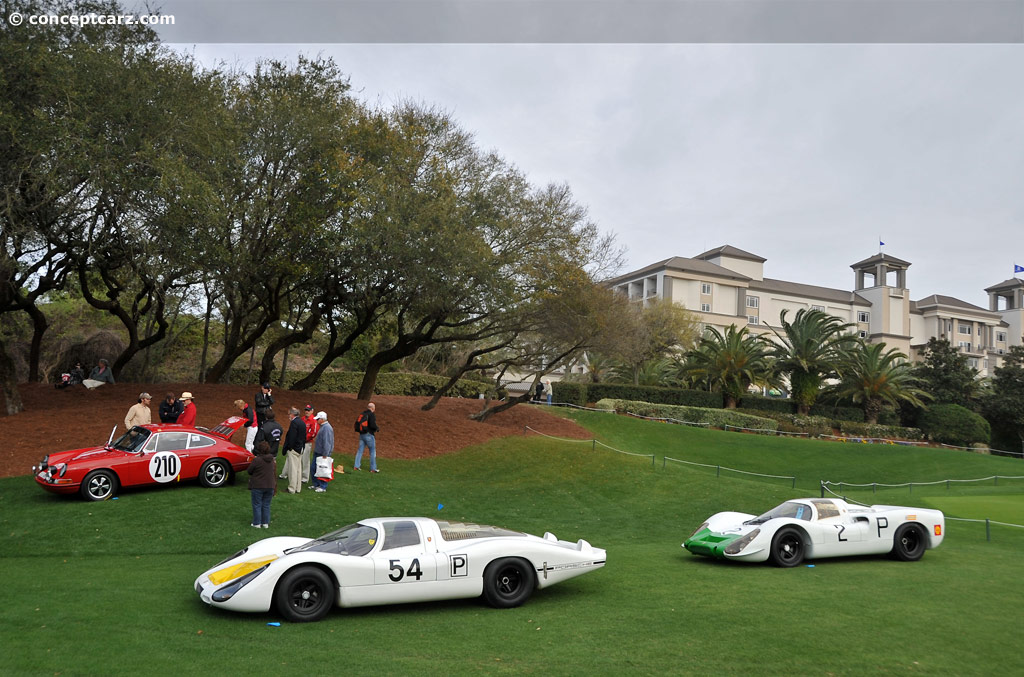
View info and historyThe Porsche 908/03 made its racing debut in 1970 at the Targa Florio, where Porsche motorsports chief Ferdinand Piëch and his team brought four examples. Three were assigned to John Wyer and his factory-supported team while the other was raced as an official works car. Jo Siffert and Brian Redman of the Wyer team qualified pole position, followed by the official Porsche works 908/03 of Vic Elford and Hans Hermann. Racing in the 3-liter prototype class (one of 12 different classes of racing), Jo Siffert and Brian Redman finished first overall followed by Leo Kinnunen and Pedro Rodriquez in another 908/03. A 908/02 finished fourth followed by Bjorn Waldegard and Richard Attwood in fifth driving a 908/03. This marked the 10th time a Porsche had captured the overall victory at the Targa Florio, their first victory was in 1956. The final victory was in 1973, with a Porsche 911. The 908/03 was used for the Nurburgring race. During qualifying, a 908/02 driven by Finnish driver Hans Laine was involved in a fatal accident, sending the car into the air where it did a full backflip and landed back on the track and rolled several times. One of the works Ferrari 512S Spyders was also involved in an accident during practice, and neither Jacky Ickx or Peter Schetty took part in the race.
Coupe
Chassis #: 908-019
View info and historyThe Porsche cars dominated the qualifying session taking the first four positions on the grid. Jo Siffert and Brian Redman capture the pole position, followed by Pedro Rodriguez/Leo Kinnunen, Vic Elford/Kurt Ahrens, Jr., and then Hans Herrmann/Richard Attwood. The overall victory would go to Vic Elford and Kurt Ahrens, Jr. in a 908/03. The second place went to another 908/03, driven by Hermann and Attwood. A pair of Ferrari 512S models took the next two spots, followed by 908/02's in fifth through 8th position. A Porsche 907 finished in 9th. The Group 5 Sports Car category was discontinued in 1972 making the 917 and the Ferrari 512 obsolete. The 3000cc category was renamed to the Group 5 Sports Car category and due to the new rules which required a much higher weight than cars in the Porsche stable, the advantage went to Ferrari, Alfa Romeo, and Matra. Having achieved a victory at Le Mans and numerous overall victories and championships, Porsche decided to end its factory sports car racing. The 908/03 were sold to customers, and apart from the 917/10 turbo Can-Am cars, Porsche's attention was focused on the 911. The Porsche 908 continued to compete at the highest levels of international racing well into the early 1980s with considerable success. Reinhold Joest entered a 908LH Coupe at the 1972 24 Hours of LeMans and finished 3rd overall.
Coupe
Chassis #: 908-010
Engine #: 908-034
View info and history
Auction entries : 1Although the 908 is often overshadowed by the Le Mans-winning 917, the 908 holds the distinction of winning the 1000km Nürburgring in three different decades, winning four years in a row from 1968 to 1971 and again in 1980.
by Daniel Vaughan | Oct 2006
Coupe
Chassis #: 908-019
View info and history
Coupe
Chassis #: 908-010
Engine #: 908-034
View info and history
Auction entries : 1
Coupe
Chassis #: 908-010
Engine #: 908-034
View info and history
Auction entries : 1
Coupe
Chassis #: 908-008
View info and history
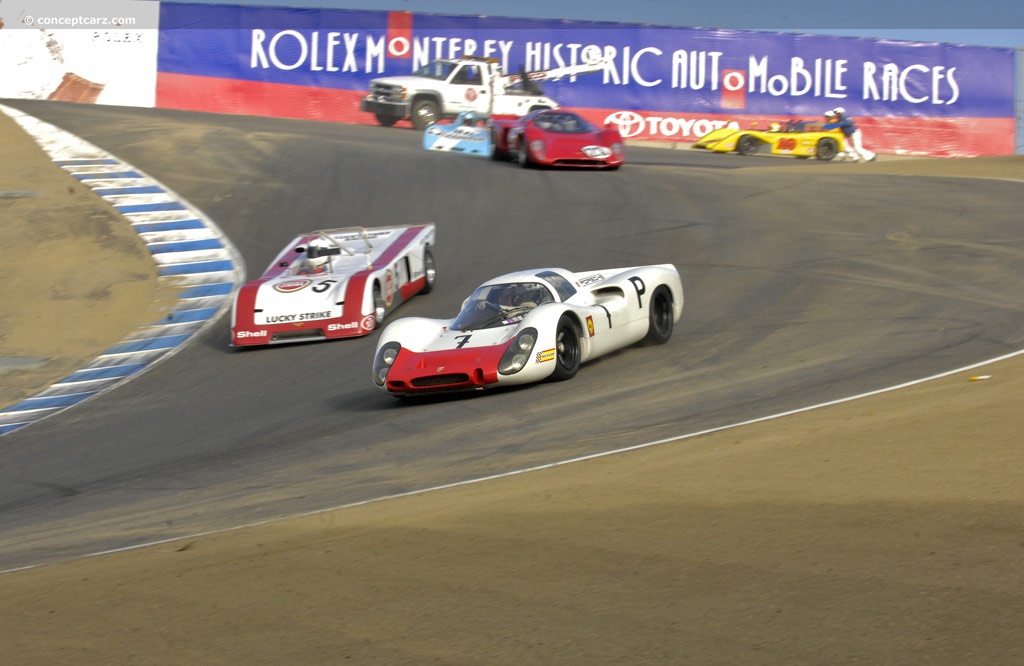
Coupe
Chassis #: 908-019
View info and history
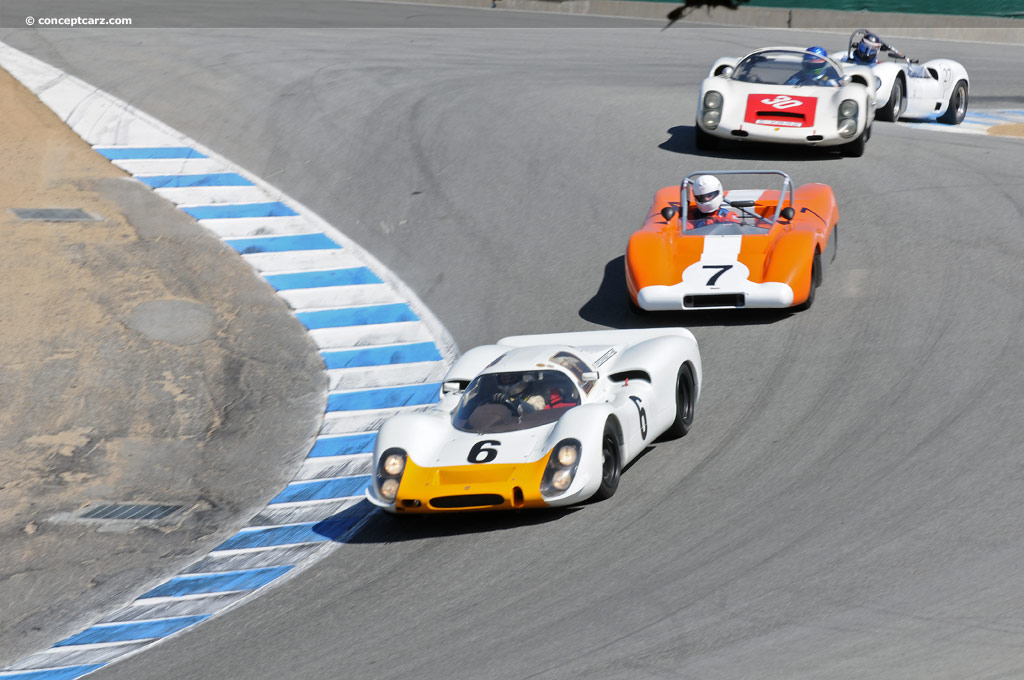
Coupe
Chassis #: 908-010
Engine #: 908-034
View info and history
Auction entries : 1
by Daniel Vaughan | Oct 2006
Related Reading : Porsche 908 History
The Porsche racing legacy began with the very first cars that it produced. Dr. Ferry Porsche was the company creator and a racing enthusiast who understood the benefits of racing participation. Prior to the 908, the Porsche victories had been in their class rather than overall wins, due to their small engines when compared with their competition. The 908 was identical to the 907 both in long and....
Continue Reading >>
Continue Reading >>
- 1968 Porsche 908 Menu
- Article
- Image gallery
- Valuation
- Specifications
- Profiles



1968 Porsche 908 Vehicle Profiles




Recent Vehicle Additions


Related Automotive News

Fast-Track To Monterey: RM Sotheby's announces Porsche 908 Works 'Short-Tail' As Early Star Entrant For Flagship Sale
RM Sothebys secures Porsche 908 Works Short-Tail Coupe, chassis 908-010 as featured entry for 2018 Monterey sale, 24-25 August
Early iteration of legendary 908 model was campaigned by Porsche factory team at 1968 Spa 1000 KM and remains ready...
All-Star Cast of Cars, Drivers at Porsche Rennsport Reunion V
The Porsche highlights for a weekend full of highlights
Atlanta, Georgia. For the Porsche Rennsport Reunion V taking place at Mazda Raceway Laguna Seca this weekend, both the men and the machines they drove are expected to outdraw one...

BONHAMS TO OFFER FOR SALE BY AUCTION SIR STIRLING MOSS's 1961 PORSCHE RS-61 SPORTS-RACING CAR
The Bonhams Motor Car Department is delighted to announce that it has been commissioned to offer one of the greatest and most charismatic of all small-capacity sports-racing cars – Porsche RS-61 chassis number 718-070 – at the companys Goodwood Festival...

VIC ELFORD RECEIVES RRDC'S 2015 PHIL HILL AWARD
DAYTONA BEACH, Fla. (Jan. 22, 2015) - Vic Elford, considered one of the fastest race-car drivers of the Sixties and Seventies, was honored by the Road Racing Drivers Club with the 2015 Phil Hill Award. RRDC president Bobby Rahal made the presentation...

Gooding & Company's 2014 Scottsdale Auctions Bring More Than $49.4 Million
11 new auction records set at Gooding %26 Companys two-day sale in 2014
Six cars sell above the %242 million mark and 13 cars sell above %241 million
Scottsdale, Ariz. (January 19, 2014) – Gooding %26 Company, the auction house acclaimed...

1969 24 Hours of Le Mans: A Traditional Statement Provides a Memorable Race
What if a statement ended up costing one of the biggest victories of ones career Would it be worth it Jacky Ickx would come close to finding out as he approached the checkered flag on the afternoon of the 15th of June in 1969.
Ford had determined...


