1957 Maserati 200 SI

1957 Maserati 200 SI Navigation
Maserati's heritage is firmly rooted in motorsport competition, dating back to the mid-1920s when the Maserati brothers (Alfieri, Bindo, Carlo, Ettore, and Ernesto) birthed the marque. Their mechanical prowess and technical expertise were immediately proven when the first Maseratis built, driven by Alfieri, won the Targa Florio in 1926. A range of 4, 6, 8, and 16 cylinders powered vehicles followed competing in a wide range of disciplines. 
Spyder by Fantuzzi
Chassis #: 2416
View info and historyAlfieri Maserati passed away in 1932, and the three other brothers, (Bindo, Ernesto, and Ettore) kept the firm going until 1937 when they sold their shares in the company to the Adolfo Orsi family. In 1940, the company headquarters were relocated to the Orsi's hometown of Modena, where it remains to this day. Although the brothers had sold the company, they continued to lend their engineering expertise, resulting in back-to-back victories in 1939 and 1940 at the Indianapolis 500 with an 8CTF. Numerous other victories were achieved, often against more powerful cars and better-funded teams. After World War II, when the Maserati brother's 10-year contract with Orsi expired, they left to form O.S.C.A. Their engineering roles at Maserati were replaced by Alberto Massimino, a former FIAT engineer with both Alfa Romeo and Ferrari experience, along with engineers Giulio Alfieri, Vittorio Bellentani, and Gioacchino Colombo. Under their guidance, Maserati entered a new era of racing and road-going successes, with projects that included the 4CLT, the A6 series, the 8CLT, and the A6GCS. During the 1950s, the company enjoyed a very successful, albeit expensive, career with their 200S, 300S, 350S, and 450S, followed in 1961 by the Tipo 61. The 250F brought the company its greatest notoriety by winning the world championship in 1957. Despite its successes and heritage, Maserati withdrew from factory racing participation during the later-1950s as they focused on profitability by building road-going grand tourers in greater quantities. The Maserati 200S (Tipo 52)
Following World War II, Maserati introduced the A6 series named in honor of Alfieri Maserati and for their straight-six engine. The 1.5-liter unit was named A6 TR (Testa Riportata for its detachable cylinder head) and based on the pre-war Maserati 6CM; its first appearance was in 1947 powering the A6 Sport (or Tipo 6C2/46). This later became the A6 1500 Pinin Farina-designed two-door Berlinetta that was introduced at the 1947 Salon International de l'Auto in Geneva.
Spyder by Fantuzzi
Chassis #: 2425
View info and historyThe A6 GCS was a two-seater equipped with a two-liter straight six initially offering 120 horsepower. The 'G' represented Ghisa (cast iron block) and 'CS' denoted Corsa & Sport. In 1952, Maserati began working on the successor to the A6GCS, codenamed Tipo 52. Engineering was handled by Giulio Alfieri around a four-cylinder light-alloy engine with dual overhead valves per cylinder and dual overhead camshafts. The early examples received double Weber 50DCO3 carburetors while later examples were equipped with 45DCO3 carburetors. Depending on the configuration, the engine developed approximately 190 horsepower at 7,500 RPM and was backed by a four-speed synchromesh manual transmission (later examples used a five-speed). To reduce cost and speed up development time, many mechanical components, including the chassis, were sourced from the Maserati 150S. The rigid rear axle, however, was courtesy of the Maserati A6. The first three tubular chassis were built by Maserati while later examples were outsourced to Gilco. The first five aluminum bodies were made by Celestino Fiandri, and the 23 final bodies were made by Medardo Fantuzzi. Drum brakes provided the stopping power.
Spyder by Fantuzzi
Chassis #: 2425
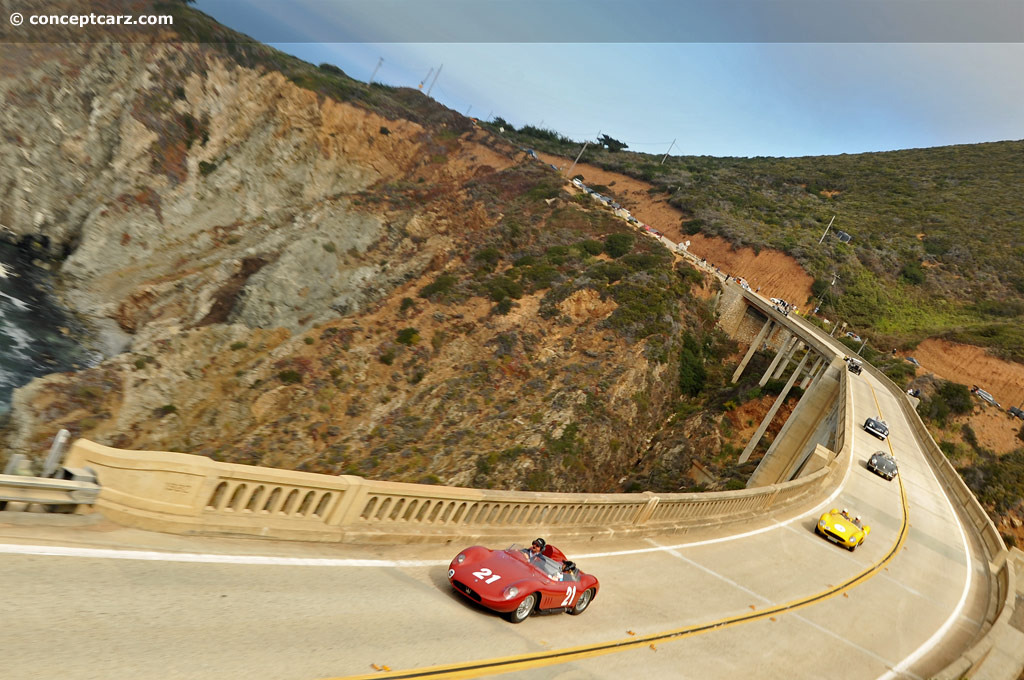
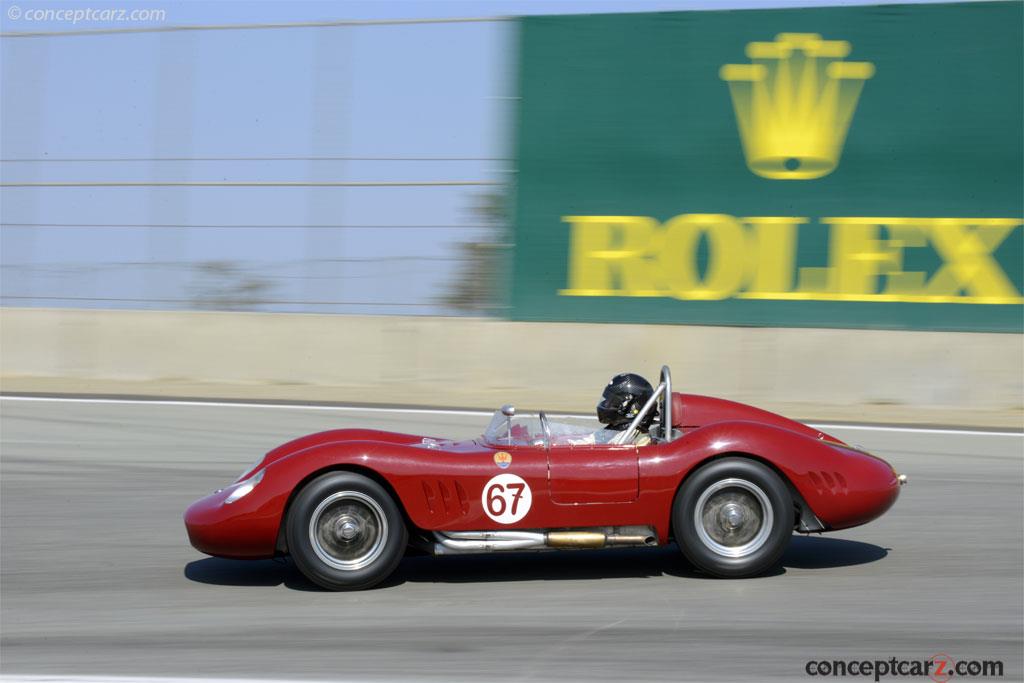
View info and historyThe front suspension was fully independent on all examples, while early examples received a live rear axle. A more advanced deDion axle was applied to most customer cars. Just like the 150 and 250 series of sports racers, the 200 was generally geared towards privateer owners. In its first competitive outing, a 150S was driven by Jean Behra at the Nürburgring, where he set a new 1,500 cc record in practice by a margin of nine seconds and went on to win his class by two minutes. The 200S that followed displaced nearly two liters and its output increased by 45 bhp. Competition successes for the new 200S were not immediate, but later included a class win at the 1956 Mille Miglia and a 1-2 finish by Behra and Cesare Perdisa at the Bari Grand Prix. Soon, a variant named the 200 SI was introduced, for Sport Internazionale, and denoting the model's compliance with new FIA Appendix C regulations. They had a wider windscreen, wipers, and doors. A hood (cloth roof) protected the car from the elements while parked. Maserati built eight examples of the 200S during 1955 and 1956, with the remainder (estimated at 20) being built to 'SI' specification. The 200 SIs received the five-speed gearboxes, an additional five horsepower, and larger brakes, however, specifications typically varied by car. The 200S and SI were bodied by Fantuzzi, with a sleek, aerodynamic shape with a long nose that was later incorporated on the later-production 300S and 450S models. Maserati later offered a 250S model and sold conversion kits to upgrade earlier cars in the series to the later 2.5-liter (2,498cc) specification. Most of the 250S cars were either 150S or 200S that had been converted to 250S specifications. Just two 250S cars were built from the ground up.
by Daniel Vaughan | Nov 2021
Spyder by Fantuzzi
Chassis #: 2416
View info and history
Following World War II, Maserati introduced the A6 series named in honor of Alfieri Maserati and for their straight-six engine. The 1.5-liter unit was named A6 TR (Testa Riportata for its detachable cylinder head) and based on the pre-war Maserati 6CM; its first appearance was in 1947 powering the A6 Sport (or Tipo 6C2/46). This later became the A6 1500 Pinin Farina-designed two-door Berlinetta that was introduced at the 1947 Salon International de l'Auto in Geneva.

Spyder by Fantuzzi
Chassis #: 2425
View info and history
Spyder by Fantuzzi
Chassis #: 2425
View info and history
by Daniel Vaughan | Nov 2021
Related Reading : Maserati 200 Si History
Maseratis aging but still impressive A6GCS needed improvement in order to remain competitive. The decision was made to address the 4C2F engine that had been in production since the early 1950s and used in Formula 2 racing. Development began and the project was codenamed Tipo 52, but commonly referred to as Tipo 200S. In order to speed up production and reduce costs, the project was divided into....
Continue Reading >>
Continue Reading >>
- 1957 Maserati 200 SI Menu
- Article
- Image gallery
- Valuation
- Specifications
- Profiles


1957 Maserati 200 SI Vehicle Profiles


Recent Vehicle Additions


Related Automotive News

Renowned Racing Legends Grant Exclusive Nod to the Rolex Monterey Motorsports Reunion for New Run Groups
As the Rolex Monterey Motorsports Reunion celebrates the Golden Anniversary of historic racing at Montereys WeatherTech Raceway Laguna Seca, the illustrious gathering also honors the history and significant achievements throughout time. It seems fitting...

For Road and Track: Ferrari 750 Monza and Ford GT40 Mk I Street Car Join RM Sotheby's Monterey Sale
RM Sothebys Monterey docket bolstered by a historic 1955 Ferrari 750 Monza Spider and a 1966 Ford GT40 Mk I
One of the most original 750 Monzas in existence, chassis no. 0510 M was campaigned by the big three of American driver talent in perio...
1956 Sebring 12 Hours: Musso Impresses on American Soil
Having more than proven himself within the 2.0-liter category with the factory Maserati team, Luigi Musso makes the short trip west from Modena to Maranello to drive for Ferrari. This would be a big step up in performance, for car and driver. Here Mussos...
RRDC VOTES IN 37 NEW MEMBERS FOR 2013
HILLIARD, Ohio (Nov. 7, 2013) - Thirty-seven race-car drivers and motorsports professionals have been voted into the Road Racing Drivers Club in 2013. The group includes 13 Regular Members from the open-wheel and sports-car racing ranks, 20 Associate...

Sonoma Historic Motorsports Festival Celebrates Corvette'S 60 Years At Sonoma Raceway
Fast cars, fine food and wine highlight May 18-19 weekend
Paul Reinhart is honored guest, popular racing seminar scheduled for second year
SONOMA, Calif. (April 27, 2013) - The Sonoma Historic Motorsports Festival returns to Sono...