Concept Cars Home
Image Left 1922 Model A1924 Model A Image Right
 

1923 Duesenberg Model A news, pictures, and information

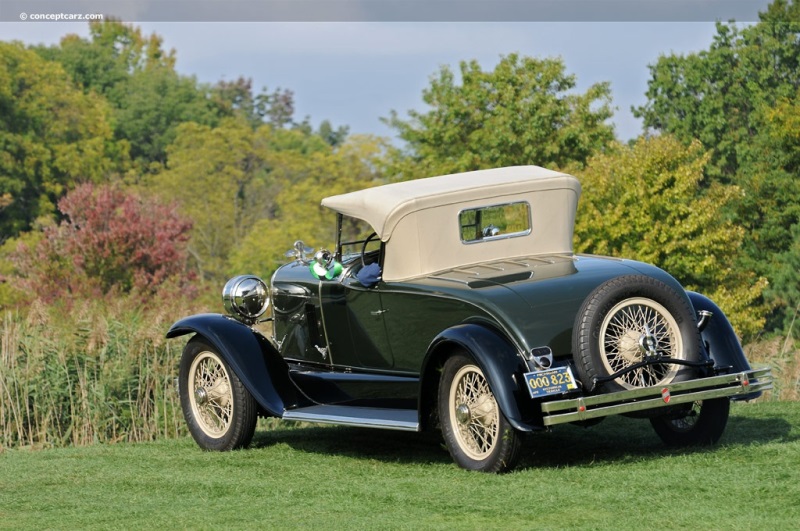
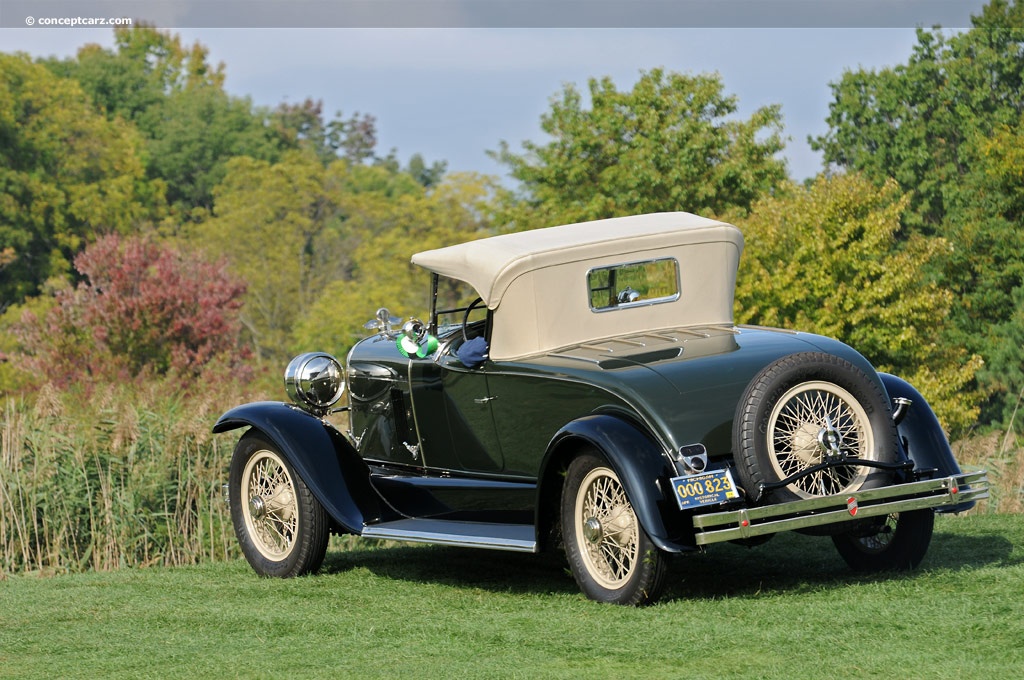
Roadster
Coachwork: Millspaugh & Irish
Chassis Num: A-773
 
A Fast Roadster With a Racing Heritage
The eight cylinder Duesenberg Model A was introduced in 1922. It was the first production car bearing the Duesenberg name. Prior to the Model A, Fred and August Duesenberg had designed and built cars for other companies such as Mason and May, and they built the famous four cylinder Rochester-Duesenberg engines which powered cars such as Roamer and Revere. The Duesenberg brothers also built many racecars and a Duesenberg became the first Indianapolis 500 winner to average over 100 miles per hour. Duesenberg also became the first American car to win the coveted LeMans French Grand Prix.

The Model A Duesenberg features an inline, eight-cylinder engine with a single, overhead camshaft. The engine developed 88 horsepower and had a cubic-inch displacement of 259.7 inches. The advertised top speed was 90 miles per hour.

This 1923 Model A Duesenberg features a roadster body that was built by the coach building firm of Millspaugh & Irish. It sold new for $6,850 and was one of the most expensive American vehicles of the period.

The early Duesenbergs, built between 1920 and 1926 and known as the model A's, are largely unknown except by serious automotive historians. These are the cars built while the Duesenberg brothers - Fred and Augie - were building their racing reputation at the Indianapolis Motor Speedway.

Slightly more than 600 Model A Duesenbergs were built, most with attractive custom coachwork such as this roadster - designed and built by the body-building firm Millspaugh and Irish of Indianapolis, Indiana. The current owner acquired the car nearly 25 years ago and spent eight years working and reworking the car a little each year to bring it to its present restored level.
Attractively styled, with cutting-edge engineering for its time, such as an overhead cam engine and hydraulic 4-wheel brakes, Model A Duesenbergs were available with custom coachwork and also a range of production bodies built by Millspaugh & Irish, another Indianapolis firm.

However, despite the luster of important racing victories, the Model A's limited sales success - only about 600 were built in five years - had more to do with the high factory price than anything else, for there was certainly nothing wrong with the design and engineering of the cars themselves.

The Model A, though, is historically important, as it paved the way for the Model J and also demonstrated the Duesenbergs' exceptional engineering prowess and forward thinking at a time when most cars' features, including the most costly marques, went little beyond pedestrian L-Head engines and primitive mechanical brakes.

Seven standard body styles were offered for the 1923 Duesenberg models, in price from $5,500 to $7,300.

The Duesenberg's impressive in-line eight featured a single overhead camshaft driven off the crankshaft via beveled gears. Displacement was a relatively small 260 cubic inches, but it developed impressive horsepower ratings and 170 foot pounds of torque at 1500 rpm. An interesting induction system incldued a single Stromberg 1.5-inch updraft carburetor, utilizing a firewall-mounted vacuum tank. The fuel link ran up through the exhaust manifold to be preheated. Pistons would have been aluminum, unless the customer ordered otherwise.

A bright spot in 1923 was an endurance run that took place at the Indianapolis Speedway in April. A fully-equipped standard-bodied touring car drove non-stop for 3,155 miles that took 50 hours and 21 minutes at an average speed of 62.7 mph and required two tire changes.

All Duesenbergs were delivered with knock-off wire wheels mounted to 33 x 5-inch cord tires. The orthodox ladder frame featured Watson Stabilator shock absorbers hooked to semi-elliptic springs front and rear. Brakes were an industry-leading four-inch hydraulic system with 16-inch drums and circumferential cooling fins. Dual sidelamps (Searchlight made by Stewart-Warner Speedometer Corp.) had mirrors designed into the back of each and were standard equipment.
Touring
 
At the turn of the last century, Iowa bicycle makers August and Fred Duesenberg tinkered with gasoline engines and by 1913 the Duesenberg Automobile & Motors company was manufacturing cars. The company failed, but they developed an engine which did well in the Indianapolis 500. They used their experience building aircraft engines during World War I for the military to design their famous straight-eight engine.

Manufactured by the Duesenberg Automobile and Motors Company, the early Duesenberg was designed to be the ultimate road car, based on the extensive racing experience of August and Fred Duesenberg. The Duesenberg Eight-in-a-Row motor car was advertised in 1920 as an 'Automobile for the Connoisseur, Built to Outclass, Outrun and Outlast any Car on the Road.' Although now referred to as the Model A, the company only called it the '8 in a Row' or the 'Straight 8.' The Model A designation was coined by the public, after the Model J was introduced in the late 1920s. The Model A is the first car built by the Duesenberg brothers from 1921 to 1926. It was an extremely advanced automobile with prices starting at $6,500 for the chassis only. The engine was the first 'mass-produced' straight eight cylinder engine in the United States and featured a single overhead camshaft and four-valve cylinder heads. It offered the first hydraulic brakes in a United States passenger car. It was lighter and smaller but more powerful than its competitors and the fastest car of its time. It won the Indianapolis 500 three out of four years it was entered and it was purchased by many celebrities including Rudolph Valentino. Only 650 Model As were built over the entire six year model run.

This car was owned by a Minneapolis family for many years. They reportedly made a number of vacation trips to Florida in this car pulling a camping trailer. The restoration didn't include the trailer hitch. The restoration began in the late 1980s by a former owner who, unfortunately, never saw it finished. The current restoration was an eight-year process completed in 2010 by Jerry Smith.
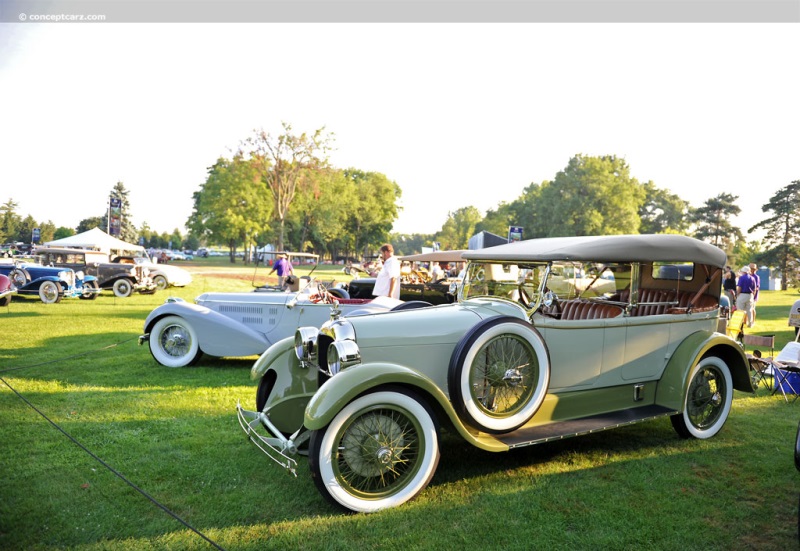
Touring
Coachwork: Fleetwood
 
This Fleetwood bodied Touring car was purchased in 1948 by the current owner's father who was employed by Duesenberg in 1929-1930. When acquired, the car lacked its original coachwork, so a period correct Cadillac phaeton body was fitted and the car was then used extensively for touring. It has recently received a restoration.
Brothers Fred and August Duesenberg will be remembered always for their outstanding motorcars. True perfectionists and genius engineers, the Duesenbergs were responsible for some of the very best racing and road-going cars in the world from the building of their first cars in 1913 until the last automobiles to bare their name were produced in 1937.

But while all Duesenberg cars were outstanding works of engineering excellence, not all are held in the same regard by automotive collectors and historians. The later Model J, and particularly the supercharged Model SJ, has all but eclipsed the first Duesenberg production car: the Model A.

Perhaps Models J and SJ have earned their greater fame. After all, they were utterly uncompromised cars—fast, fabulous, and enduringly fashionable thanks to beautiful coachwork by the likes of Rollston and Murphy, penned by such sensational designers as Howard Darrin and Gordon Buehrig. The J and SJ featured straight-eight engines with four valves per cylinder, operated by twin overhead camshafts. Built to win and dressed to kill, these later Duesenbergs have become highly-prized trophies for affluent car collectors.

Yet the Model A, at least for its time, was the equal of the later J and SJ in terms of innovation. It pioneered the use of hydraulic brakes, and was the first production car powered by a straight-eight. With this in mind, it would seem that the Model A has been held back primarily by its sedate (though still handsome) looks. The Model A's staid appearance may very well be the reason why it has not become as collectible as the Model J, but looks alone cannot explain why the Model A, which was technologically advanced and attractive for its time, was a commercial failure.

In reality, the Model A's inability to realize sales expectations was no fault of the car's. Rather, its poor commercial performance was the result of issues within the Duesenberg firm itself.

The Duesenberg brothers' engineering prowess far outweighed their business skills, leading to the brothers' well-intentioned decision to sell the rights to their name and designs to more experienced businessmen on March 8, 1920. It was then that the Duesenberg Automobile and Motors Company, Inc. was established to transfer control of the brothers' small car company to people who could supposedly run the operation with greater proficiency. Newton E. VanZandt became president and Luther M. Rankin vice-president and general manager. Both Duesenbergs were given salaried positions, with Fred serving as vice-president in charge of engineering and August acting as assistant chief engineer.

The presumably competent VanZandt and Rankin were able to raise money quickly, but they spent far too much building and equipping a new plant in Indianapolis, leading to insufficient working capital by the time the Model A was ready for production. Further complicating matters, the Model A was first shown to the public in 1920, long before the car was ready for production. This proved to be a glaring mistake, as it prevented the new Duesenberg from taking advantage of the sensation caused upon its initial showing.

Deliveries of the Model A did not commence until December of 1921. The long delay could be traced directly to Fred Duesenberg who, in a defining moment that emphasized his perfectionist tendencies, decided that the production Model A must have an engine employing an overhead camshaft instead of the side-rocker arm arrangement used on the prototype. The advantages of the overhead camshaft had been proven by Duesenberg racing cars, and it had been decided even before the Model A prototypes were shown that the production cars would receive the benefit of such an arrangement. But the fact that the engine redesign was planned did not make it timely, as it delayed production by ten months.

Once underway, Model A production was limited to about one car per day. This slow rate was far behind the initial sales projections that hoped for 2,400 cars per year. Slow sales failed to generate the funding required to run Duesenberg Automobile and Motors sufficiently, and as production continued new problems emerged. After only a year as president, VanZandt abdicated, replaced by B.A. Worthington. Also the president of a railroad, Worthington was unable to dedicate sufficient time to his Duesenberg duties. Though he remained president until 1923, the company was effectively being run by lower ranking employees who had no business heading an automobile company. In July of 1922, Chester S. Ricker became general manager, which gave him substantial influence over the company due to Worthington's lack of involvement. Ricker proved to be a competent leader, but by then Duesenberg Automobile and Motors was in deep financial trouble. In 1924, the company went into receivership.

This, of course, was not the end of Duesenberg, or even of the Model A. By 1925, a new firm had been organized called the Duesenberg Motors Company, with Fred Duesenberg serving as president. Model A production resumed for 1925 and 1926.

The Duesenberg Model A, with the tumultuous business endeavors that backed it, was arguably a better representation of the Duesenberg brothers than were the later Models J and SJ. In the autumn of 1926, luxury car tycoon E.L. Cord arranged the purchase of Duesenberg Motors Company, leading to yet another reorganization of the company, finally named Duesenberg, Inc. Cord was a superb businessman, and under his guidance the Duesenberg name was applied to America's most spectacular cars of the late-1920s and 1930s. These exemplary vehicles were created to act as halo cars for E.L. Cord's luxury motorcar empire, which also included Auburn and Cord. So while the cars of Duesenberg, Inc. featured the unbridled engineering magic of the Duesenbergs themselves, that company's splendid creations were perhaps too amply funded and well thought-out to have been as true to the spirit of the Duesenberg brothers as the Model A had been. The Model A illustrated the struggles and triumphs of Fred and August, while the J and SJ cars spoke only of success.

The J and SJ Duesenbergs will in all likelihood remain far more collectible than the Model A. This cannot diminish the historical significance of the Model A, though. With roughly 650 produced, the Model A was the highest production Duesenberg ever created. It will remain an excellent collector car capable of delivering the genuine engineering excellence of the Duesenberg brothers in a more conservative and far more attainable package than a later Duesenberg.

Sources:

Roe, Fred. Duesenberg: The Pursuit of Perfection. 1st. London: Dalton Watson Ltd, 1982. 73-106. Print.

Vance, Bill. 'Motoring Memories: Duesenberg Model A .' CanadianDriver.com 15 Apr 2005: n. pag. Web. 27 Jul 2010. http://www.canadiandriver.com/2005/04/15/motoring-memories-duesenberg-model-a.htm.

By Evan Acuña
For more information and related vehicles, click here

Mercedes-Benz Classic: Topics for 2013
The main topics: • The tradition of the Mercedes-Benz S-Class • Mercedes-Benz Silver Arrows in the 1930s • Originals – authentic vehicles tell authentic stories • Classic vehicles kept in perfect condition with Mercedes-Benz Genuine Parts Important anniversaries: January 75 years ago – on 28 January 1938: With a flying start, Rudolf Caracciola achieved a speed of 432.7 km/h over one kilometre on the Frankfurt–Darmstadt motorway. This is the highest speed ever ach...[Read more...]
Mercedes-Benz Classic at the 2012 Grossglockner Grand Prix
• Revival of the mountain race from the 1930s • Mercedes-Benz SSK and W 125 at the start • 92 bends, 14 hairpins, 15 kilometres and a 1300-metre altitude difference The Grossglockner mountain race was one of the most prestigious motor sports events of the 1930s. This year it will be revived with the 2012 Grossglockner Grand Prix to be held from 20 to 22 September 2012 and Mercedes-Benz will be there with some famous cars. In 1938, the brand took part for the first time. As a classic c...[Read more...]
JAGUAR EXPANDS POWERTRAIN CHOICE WITH TWO ADDITIONAL FORCED-INDUCTION PETROL ENGINES
As Jaguar expands its product offer in key global markets it is introducing two additional petrol units to its range to enhance customer choice; the new 3.0-litre V6 Supercharged Petrol, and the 2.0-litre I4 Turbocharged Petrol. Adrian Hallmark, Global Brand Director, Jaguar Cars, said: 'Jaguar currently has its strongest range of products for several decades. Our continued growth is dependent on two things; activating the awareness of the brand, and expanding our range to enable us to access...[Read more...]
The Champion in Touring Car Racing : The BMW M3
In August 1985, a rumour surfaced in motor magazine Auto-Deutschland which emanated from a new sports car. An A Group Car from BMW that was a thoroughbred racing car according to the rules but was also to be produced in a version licensed to drive on open roads for everyday use. Speculation about this dream car that could take to normal roads and was intended for the 'Most dynamic among BMW 3 Series drivers' was right on target. But the pundits missed the mark about the motor-sport car by a mile...[Read more...]
Auctions America By RM's 2012 Auburn Spring Auction
'Variety' is the buzzword for this year's Auctions America by RM June 1-3 Auburn Spring auction, which will offer a huge range of collector vehicles and an enormous private collection of automotive memorabilia. More than 600 American muscle cars, Classics, foreign sports cars and hot rods will cross the block at the historic Auburn Auction Park, the company's national headquarters in Auburn, Indiana. 'Last year was our first spring event at the park,' said Auctions America by RM's President ...[Read more...]
Grand Prix Racers
Model A
Model J

Image Left 1922 Model A1924 Model A Image Right
© 1998-2012. All rights reserved. The material may not be published, broadcast, rewritten, or redistributed.