1932 Helicron No. 1
1932 Helicron No. 1 Navigation


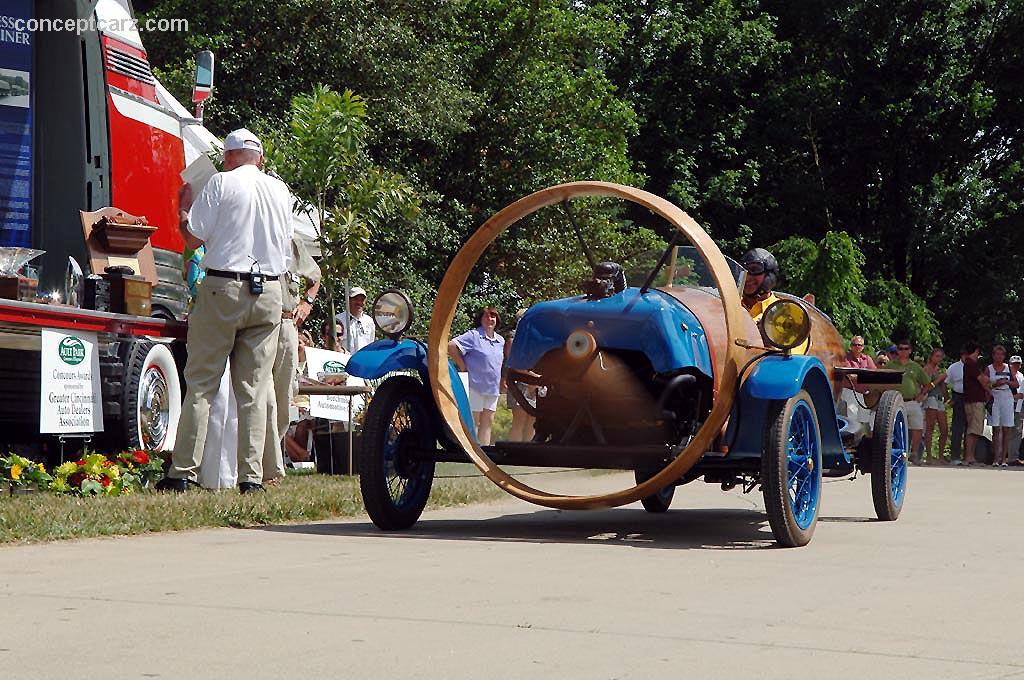
In the 1900s, France spent a significant amount of money on airplane development ($22 million compared to one-half million by the Ú.S.) Believing propeller power was the most efficient means of moving a vehicle, entrepreneurs built propeller-powered cars.
This car was built in France in 1932. Following the First World War, it was not uncommon for recently displaced airplane engines to look towards the burgeoning automobile industry for more lucrative employment. As in this example, a few entrepreneurs developed propeller-powered cars with the notion that a propeller was an efficient means of moving a vehicle.
This one-of-a-kind Helicron was discovered in 2000 in a barn where it had been placed by the original owners in the late 1930s. The Rosengart chassis, suspension, and brakes are original although the builder turned the frame around 180 degrees to allow the rear wheel to steer. This meant significant modifications needed to be made to the chassis. After discovery, the Helicron was completely rebuilt using many of the original components. Únfortunately, the original motor is lost to time; in its place is a 1980s Citroen GS 4-cylinder motor that will propel this 1,000-pound vehicle to 75 mph. The original builder's plans to produce this car were never accomplished.
 This car has been completely rebuilt but many of the mechanical components are original, including the frame, wire wheels, dashboard, steering wheel, steering gear, brake pedal, light switch, headlights, and the type plate.
The wood frame was sandblasted and treated, the steering gear was rebuilt, and the interior was upholstered. The car steers with the rear wheels and only those wheels have springs. It is currently equipped with a Citroen GS engine with the propeller coupled directly to the crankshaft.
This Helicron passed the French safety inspection in 2000 and is approved for use on the roads. When the wooden propeller is spinning at full rpm, this little 1,000-pound boat-tailed skiff can hit freeway speeds exceeding 75 mph. As you might expect, this is the one and only Helicron in existence.Source - Lanemotormuseum.org
- 1932 Helicron No. 1 Menu
- Article
- Image gallery
- Specifications
- Production figures



1932 Helicron No. 1 Vehicle Profiles

Recent Vehicle Additions


Related Automotive News

100 Years of the Bugatti Type 30 – A Cornerstone of Bugatti's Evolution
Eight cylinders, a displacement of two liters, 100 PS and speeds up to 145 kmh – the figures of a true sports car for the road of 100 years ago. Bugatti rolled out the Type 30 in 1922 as its latest production automobile. In addition to its increased...

1926 Hispano-Suiza H6B Cabriolet And 1974 Shadow DN4 Named Best In Show At The 26th Annual Amelia Island Concours d'Elegance
Jacksonville, FL - A 1926 Hispano-Suiza H6B Cabriolet and 1974 Shadow DN4 were crowned this years Best in Shows on May 23, 2021 at the 26th annual Amelia Island Concours dElegance. Moved from March to May in light of the global pandemic, the...

Bugatti Chiron Sport 'Les Légendes du Ciel' meets Dassault Rafale Marine: A match-up of Two Superlatives
Two machines at the pinnacle of engineering – the Bugatti Chiron Sport and the Dassault Rafale Marine – face each other at a naval base in Landivisiau, north-west France. The ultimate high-octane rendezvous between Frances top machines is a spectacle...

The Elegance at Hershey Announces 2017 Show Results
(HERSHEY, PA - June 2017) The Elegance at Hershey hosted another successful and eye-popping weekend of activities. Even though the temperatures reached into the 90s, attendance was high and spectators enjoyed some of the most exquisite and grand...
TAMA EV'S AERODYNAMIC HERITAGE
The Nissan restoration teams Masahiko Isobe explains the unique characteristics of the Tama electric vehicle, including the work of airplane engineers, which helped to pave the way for Nissans lineup of zero-emission vehicles.
The Tama EV is a car...