1963 Watson Indy Roadster news, pictures, and information | ||
| Tweet | ||
![]() | ![]() | ![]() | Roadster |
The engine is a 168 C.I.Offy Turbo installed in 1965 which replaced the 252 Offy.
YEAR - No - Driver - Car/Entrant - Engine - Start/Finish
1963 - 46 - Ebb Rose - Racing Associates - Offy 252 ci - Bumped
1964 - 86 - Johnny Rutherford - Bardahl/Racing Associates - Offy 252 ci - 15/27
1965 - 86 - Bobby Grim - Racing Associates - Offy 252 ci- N.Q.
1966 - 39- Bobby Grim - Racing Associates/Herb Porter - Turbo 168 Offy - 31/7
1966 - Bobby Grim also raced this car at Milwaukee, Atlanta, IRP, Trenton, Fuji Japan and Phoenix.
![]() | ![]() | ![]() | Roadster Chassis Num: 112157115 |
| High bid of $240,000 at 2007 RM Auctions. (did not sell) High bid of $185,000 at 2010 RM Auctions. (did not sell) | |||
The first car he built designed for racing was a Ford based Hot Rod prepared for oval track racing. In 1948 he went to the Indianapolis Motor Speedway serving as a mechanic. By 1950, he had designed and built his own Indy competitor. The cost of building and campaigning the car was too great so Watson eventually returned to the assembly line at Lockheed Aircraft. He left on day prior to the Indy 500 in 1951, with his sole focus turned on automotive racing. In 1954 he signed with John Zink Jr.'s team serving as the chief mechanic. Using a Kurtis Roadster, he made several modifications and improvements, and in the capable hands of Bob Sweikert, the vehicle emerged from the 1955 Indy 500 in first place. The following year he built a Indy roadster of his own design. The car would emerge victorious. His cars would win again in 1959, 1960, 1962, and 1963. In total, there were 23 Indy Roadsters created by A.J. Watson.
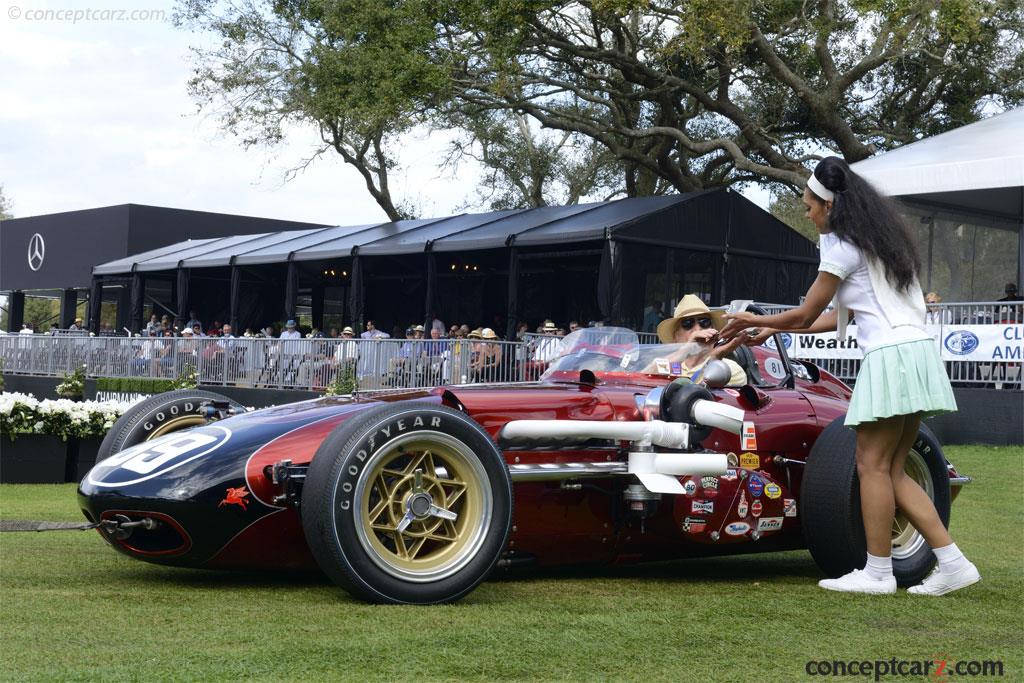
This A.J. Watson Indy Roadster was driven by Len Sutton as the number 7 Leader Card team car. It is shown restored in the 1964 Diet Rite Cola #95 style, as driven by Chuck Stevenson. The car ran the Champ Car circuit through 1966, and was then run as a 'super modified' at Oswego before being restored.
![]() | ![]() | ![]() | Roadster |
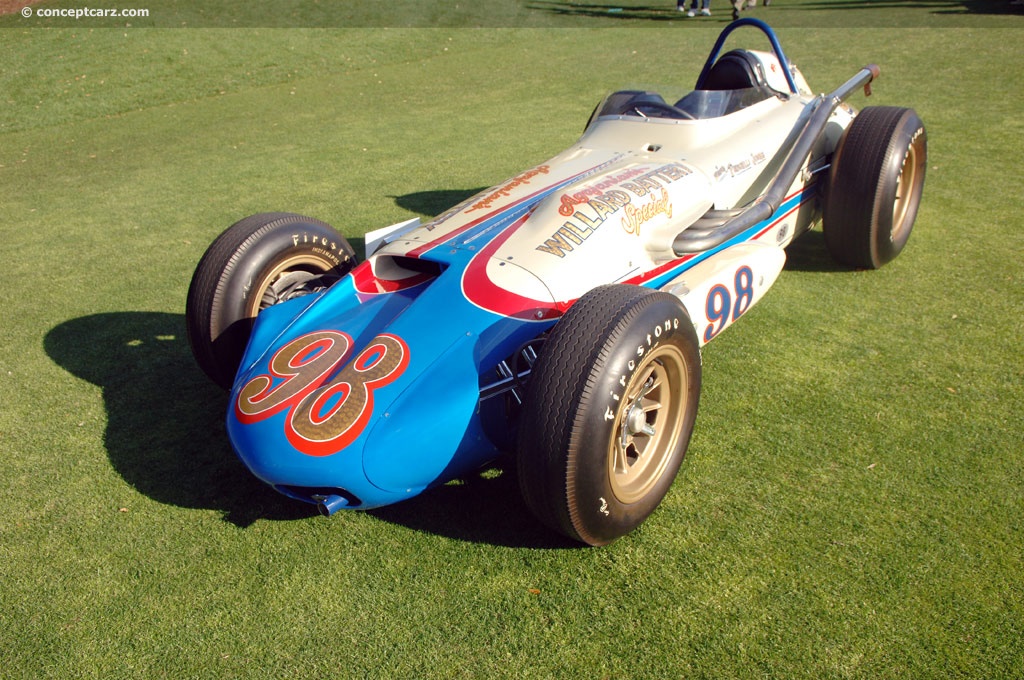
1963 WATSON 'Agajanian Willard Battery Special'
SummaryBuilt by A.J. Watson for car owner J.C. Agajanian in 1960, the 252 cubic-inch Offenhauser-powered machine nicknamed 'Calhoun' won the 1963 Indianapolis 500 in the hands of Parnelli Jones. After finishing seventh in its debut with Lloyd Ruby in 1960, it was driven for the next four years by Jones, who led at some stage every year. After being the first ever to officially lap the Indianapolis Motor Speedway in excess of 150 mph in 1962, Parnelli led virtually all of the first 300 miles until brake failure caused him to fade to seventh at the finish. Starting from the pole again in 1963, he led for 167 of the 200 laps and won at a then-record average speed of 143.137 mph.
Description
In 1963, AJ Watson's design dominated the Indianapolis 500, winning four times between 1956 and 1962. The era also brought transition, as rear-engine designed cars with sleeker aerodynamics emerged as a viable force. This was epitomized by what was considered the main battle at the 63 Indy: Parnelli Jones' 1960 Agajanian Willard Battery #98, powered by its Meyer-Drake Offenhauser engine versus Jim Clark's rear-engined Lotus-Ford: a novelty at the time, but a sign of things to come.
James qualified with then-record 151.153 mph, earning the Agajanian #98 the pole position of Indy two years in a row. Clark expected this, and was banking on the fact that the Agajanian would burn gas faster and require more pit stops during the race. This did indeed happen, but Jones was fortunate in that two of his three stops came under the yellow caution flag, costing Jones 10-20 seconds in total time verses the 50-60 he would have lost under customary racing conditions.
In one of the most contentious moments in Indy history, Jones' victory was tainted by the fact that the Agajanian #98 was accused of 'dropping oil' throughout the race. If this had been the case, the car should have received a black flag, dis-qualifying it from the race. Judges ruled that since no oil actually hit the track, no infraction occurred.
AJ Watson's 1600 lb, single-seat roadster was an exercise in elegant simplicity. Featuring a ladder frame, the roadster was 32' wide at the rear and 29' wide at the front. Four torsion bars were used, two in the front and two in the rear, and were alternately called '4-bars.' A crew member would adjust the torsion bar tension at each corner to increase or decrease roll stiffness.
The Meyer-Drake-Offenhasuesr engine was a double-overhead cam, Hilborn fuel-injected 16 valve, 4 cylinder with a 252 cubic inch engine. The reduction of regulation maximum engine size from 270 cubic inches to 255 cubic inches, as mandated by the United States Auto Club (USAC), inspired Watson to develop a short-stroke 252 cubic inch power plant that generated more horsepower than the more customary 255 cubic inch, long stroke counterpart.
A.J. Watson was the most successful builder of front-engined race cars for the Indy 500 during the fifties.
Watson served as a navigator in the Eighty Army Air Force during World War II. After the war, he returned to California and attended the Glendale College and worked at the Lockheed on their assembly line assembling aircrafts and parts. His entrance into the world of racing came in the late 1940s with the creation of his track roadster which he had constructed for oval-track racing. Within a year he was working at the famed Indianapolis Motor Speedway as a mechanic.
In 1950, at the tender age of 26, he constructed his first Indy Racer which was entered in the race. The costs were very steep and Watson was forced to return to Lockheed in an effort to make ends meet.
At the close of the 1954 racing season, Watson became chief mechanic for John Zink, Jr.'s racing team. Watson modified a roadster built by the legendary Frank Kurtis and in the capable hands of Bob Sweikert, it completed the race ahead of the competition. The following year, Watson constructed a racer of his own design. The racer was constructed to take advantage of proper weight distribution which allowed for higher speeds through the corners. During practice/qualifying, Pat Flaherty set a lap record and earned pole position by achieving 145.596 mph. The roadster went on to win the race.
For the following years to come, the Watson race cars were in high demand and often dominated the race and provided many podium finishes for the drivers and teams.
By Daniel Vaughan | Mar 2008
Watson served as a navigator in the Eighty Army Air Force during World War II. After the war, he returned to California and attended the Glendale College and worked at the Lockheed on their assembly line assembling aircrafts and parts. His entrance into the world of racing came in the late 1940s with the creation of his track roadster which he had constructed for oval-track racing. Within a year he was working at the famed Indianapolis Motor Speedway as a mechanic.
In 1950, at the tender age of 26, he constructed his first Indy Racer which was entered in the race. The costs were very steep and Watson was forced to return to Lockheed in an effort to make ends meet.
At the close of the 1954 racing season, Watson became chief mechanic for John Zink, Jr.'s racing team. Watson modified a roadster built by the legendary Frank Kurtis and in the capable hands of Bob Sweikert, it completed the race ahead of the competition. The following year, Watson constructed a racer of his own design. The racer was constructed to take advantage of proper weight distribution which allowed for higher speeds through the corners. During practice/qualifying, Pat Flaherty set a lap record and earned pole position by achieving 145.596 mph. The roadster went on to win the race.
For the following years to come, the Watson race cars were in high demand and often dominated the race and provided many podium finishes for the drivers and teams.
By Daniel Vaughan | Mar 2008
![]() | ![]() | ![]() | Roadster |
Of particular interest, this car's current restoration was completed in 2009 by the car's original builder, A.J. Watson, in his Indianapolis shop. The car is restored exactly to its debut livery in 1963 when it ran the Speedway for the very first lap.
| HONDA INDY GRAND PRIX OF LONG BEACH TALKING POINTS | |
| HONDA PERFORMANCE DEVELOPMENT 20TH ANNIVERSARY - In April, 1993, Honda Performance Development was founded in Santa Clarita, California as the competition arm of American Honda Motor Co., Inc. Starting this month, HPD will be celebrating its 20th anniversary with a variety of events and activities. - In 20 years, HPD has grown from just a handful of staffers to approximately 150 associates; and from an engine-rebuilding facility to a complete motorsports Research & Development organiza...[Read more...] | |
| SEBASTIEN LOEB OF FRANCE ENTERS PIKES PEAK INTERNATIONAL HILL CLIMB | |
![]() | One of the world's most decorated auto racing stars is coming to Pikes Peak this summer. Nine-time WRC World Rally Championship winner Sebastien Loeb of France has entered the 2013 Pikes Peak International Hill Climb, adding more international luster to the nation's second-oldest motor sports event behind the Indy 500 and helping to make the field the best in the race's storied history.. The 91st running of the race will be held on Sunday, June 30 with the help and support of title ...[Read more...] |
| HONDA INDY GRAND PRIX OF ALABAMA TALKING POINTS | |
| -This weekend's Honda Grand Prix of Alabama will be the fourth IZOD IndyCar Series event at the scenic, 2-3-mile Barber Motorsports Park circuit, and marks the third year American Honda has served as title sponsor of the event. -American Honda also sponsored last month's season-opening Honda Grand Prix of St. Petersburg; and will again be the title sponsor of the Honda Indy 200 at the Mid-Ohio Sports Car Course in August. In addition to these three events, Honda Canada entitles the Honda Indy T...[Read more...] | |
| ALL-AMERICAN CAR TO BE CONSERVED BY ALL-AMERICAN RACERS | |
![]() | One of the race cars American racing legend Dan Gurney is most closely associated with is the Ford Mark IV that he and A.J. Foyt took to a historic victory at the 1967 24 Hours of Le Mans. Gurney will get a chance to become even more familiar with the car he helped make famous when his All-American Racers shop in California takes possession of the car's conservation on behalf of Henry Ford Museum, it was announced today. 'I don't think we could have found a better person or better organiza...[Read more...] |
| Limited-Edition Ford Racing History Artwork Unveiled at SEMA; Limited-Edition Print Sales to Benefit JDRF | |
![]() | •Special limited-edition Ford Racing history artwork is unveiled at the annual SEMA show as part of the Ford press conference •Famed automotive artist Sam Bass created the artwork at the request of Edsel B. Ford II, with proceeds from sales of limited-edition autographed prints benefiting JDRF •Drivers and Ford race vehicles featured on the special artwork include Henry Ford (Sweepstakes), Trevor Bayne (No. 21 Fusion), Dan Gurney/A.J. Foyt (Ford Mark IV), Bob Glidden (NHRA Thunderbird), Jack...[Read more...] |
| View more Indianapolis vehicles |
| Watson: 1961-1970 |
| Similar Automakers |
| Other models by Watson |