1944 Bugatti Type 73C 1944 Bugatti Type 73C 1944 Bugatti Type 73C 1944 Bugatti Type 73C
1944 Bugatti Type 73C
More Photographs    Interior Photos   

The production of the Bugatti Type 73 began in 1943, right before the onset of World War II. Production was postponed during the war but began again in 1947 with the introduction of the Type 73A. Ettore Bugatti's death on August 21, 1947 spelled the demise of the Type 73.
The Type 73, Type 73B, and Type 73A were touring cars that came with seating for either two or four people. All the Type 73 (A, B, C) were given, or intended to have, four-cylinder engines. The Type 73 had twin overhead camshafts with four valves per cylinder. The Type 73B was similar but had single overhead camshafts. The Type 73A had single overhead camshafts with three valves per cylinder.
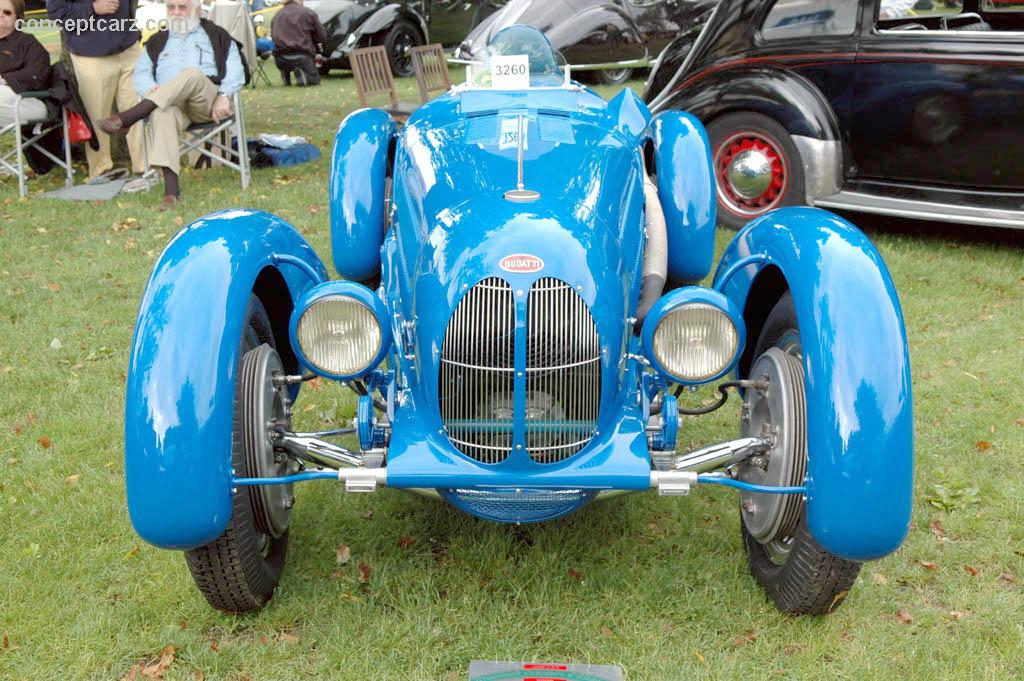
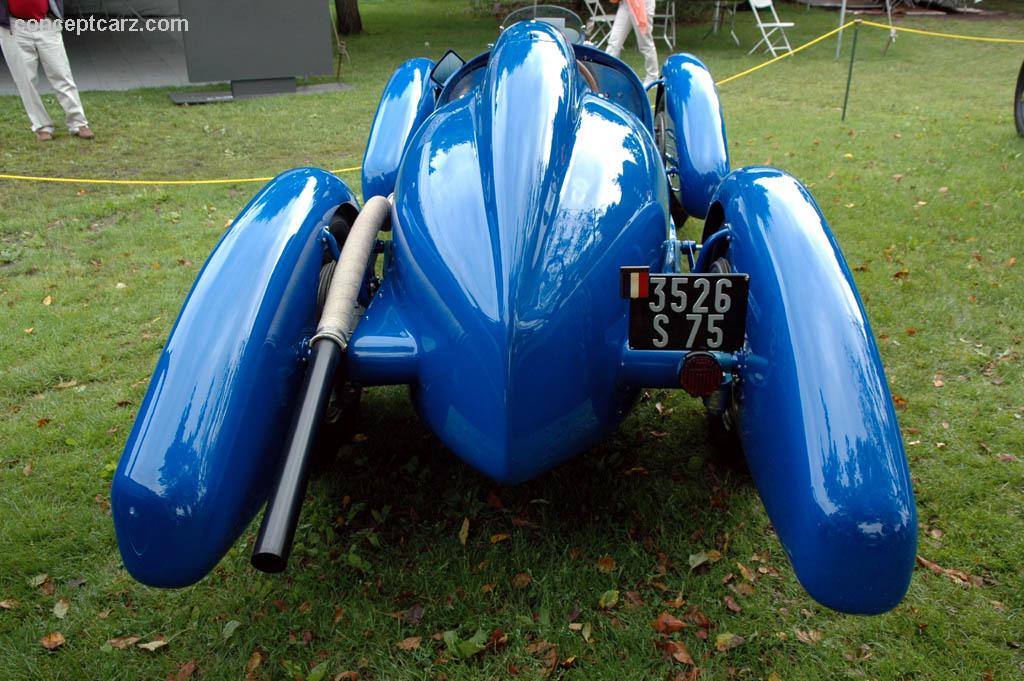
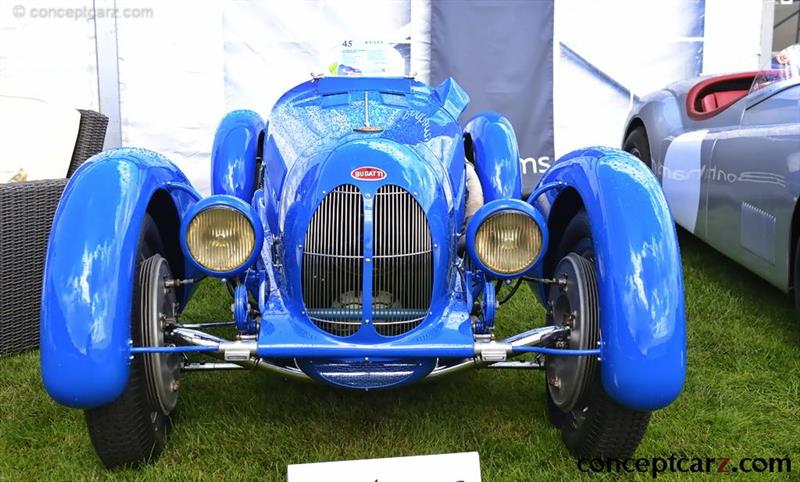
Five chassis of the Grand Prix, single seater Type 73C were constructed with only one (73002) receiving an engine and testing by the factory. The chassis numbers were 73001 through 73005. The supercharged engine was a 1.5 liter straight-four with twin overhead camshafts and four-valves per cylinder. It featured a detachable cylinder head, wet cylinder liners, and a exhaust manifold constructed of cast iron. The rest of the chassis were sold off as the company ceased production. Most of the chassis were later completed, some being given bodies true to the original Bugatti design.
A single Type 73 without engine was shown at the 1947 Paris Motor Show.
The Type 73C models are generally not held in high regards by Bugatti purists. Many of the reasons center on the fact that the chassis's were assembled by a dealer rather than the factory. These 'one-off' vehicles did not have the traditional Bugatti designs plus there are no competition records for these monoposto's.
They remain in history as the final but incomplete creations of the legendary Ettore Bugatti.
View more photos
Chassis Num: 73002
Engine Num: 2
 
1947 Bugatti Type 73C Racing Car

Ettore Bugatti had founded his reputation as a manufacturer of high quality performance automobiles with his earliest four cylinder models before WWI. He introduced his first eight cylinder cars in 1922, and within ten years his entire range was of this configuration. However, whilst attending the Bugatti Owners' Club's International Prescott meeting in July 1939 Ettore's talented son Jean had intimated that a new four cylinder racing car was planned for the following season. Tragically this was destined not to materialize because within the next two weeks Jean was killed in a testing accident, and some three weeks later Europe was once again plunged into war.

Bugatti, assisted by his designers Noel Domboy and Antoine Pichetto, spent the war years planning future models, one a 1,500cc car to be produced in a wide variety of forms ranging from a five-seater sedan to a single-seater racing car. By 1944 his plans for production were well advanced and he detailed his intentions in a letter dated February 1945 to Eric Giles, the Secretary of the B.O.C. The car was to have a supercharged 1500cc 16-valve engine, with a single overhead camshaft for the road cars but twin camshafts for the racing model.

Further details were released once the war had ended. In a letter dated 27 September 1945 to Laurence Pomeroy, the editor of The Motor, Monsieur R.A. Bouchard of the Bugatti Company in Paris advised that the racing chassis was to be of ultra-low build, being derived from that of the pre-war 4.7 liter Type 59/50 B racing car, whilst its engine was to feature all-alloy construction with detachable wet cylinder liners, a detachable head (a first for Bugatti) and a five-bearing crankshaft. Transmission was to be by a four speed all synchromesh gearbox, and the car's total weight was not to exceed 600kg.

No more than twenty examples were to be built in the old La Licorne factory in the Paris suburb of Levallois at a price of 500,000 French francs each. Five were to be delivered in April 1946, with five more during each of the next three months. Already fifteen French racing drivers had each lodged deposits of 25,000 francs, and English readers of The Motor were invited to order the remaining five planned. Inevitably this ambitious timetable floundered against the troubled post-war economic background when materials required for motor car construction were all in extremely short supply, and several orders were cancelled.

Eventually a batch of five complete sets of parts for the racing model was produced, whilst an artist's impression of a planned aerodynamic sports saloon appeared in several Continental motor magazines and at least two of their chassis were produced. However Ettore Bugatti died in August 1947 before a single example of either type had been fully assembled. The 1947 Paris Motor Show was held at the Grand Palais in early October and Bugatti displayed on their stand an engineless example of their Type 73 sports chassis together with a standard single-cam Type 73 and a racing twin-cam Type 73C engine. One hopeful racing car buyer, Serge Pozzoli, who had placed his order at the Paris Motor Show, recalled later that he had visited the Works and seen several chassis, and one complete racing car with a running engine. However, without Ettore's impetus the whole project slowly ground to a halt, the unfinished cars were dismantled, all their parts were stored at Molsheim and deposits were returned to the would-be owners.

All these parts and many others remained in storage at Molsheim for several years until one set of Type 73C parts was acquired in late 1960 by Belgian Bugatti dealer Jean de Dobbeleer of Brussels. There he assembled and fitted with a monoposto body featuring a typical Bugatti radiator shell based on one of a pair of 1945 Type 73C body drawings by Pichetto. After selling the finished car to a Frenchman, de Dobbeleer returned to Molsheim in 1961 and acquired the parts for another Type 73C, Chassis No 73002, which he proceeded to assemble, after which he sold its body-less chassis to the US via his American agent Gene Cesari.

This car was the only Type 73C to be listed in Hugh Conway's 1962 Bugatti Register, in which its owner was listed as Jerry Sherman of Pennsylvania. Thereafter it passed in 1969 to Eric Richardson, the leading American Bugatti authority of his day, before passing in 1973 by Tom Wheatcroft who was then in the process of both purchasing and assembling what was to become his famous Donington Collection of Grand Prix racing cars. The car was fully restored in the Donington workshops to the extremely high mechanical and cosmetic standard invariable achieved by Wheatcroft, who has always insisted his cars should perform and drive as well as they look.

The car was then fitted with a copy of the second of Pichetto's 1945 73C body designs, this one featuring a cowled radiator grill typical of the late pre-war and early post-war period.

Tom Wheatcroft often invited his many racing driver friends to private test sessions at his Donington Park track, and accordingly this particular car was driven from time to time on such occasions by Wheatcroft and his associates throughout his period of ownership. However, wishing to accommodate a selection of much more recent racing cars, Wheatcroft decided to sell several of the exhibits displayed in his Donington Collection, and in 1994 he sold his Type 73C Bugatti to Alberto Lenz of Mexico. Lenz in turn sold the car to its current owner in 2002. Over the last few years he has meticulously carried out numerous improvements, including fitting the car with piano wire wheels and hubs by Crosthwaite & Gardiner and cycle wings to make the car road-legal. It should be noted that a complete set of detailed pictures during the restoration by the present owner are on file.

Whilst the Type 73C Bugatti was in truth no more than an undeveloped factory prototype which fortune dictated was never to show its true potential, or even indeed ever to have the opportunity of competing in period motor racing, it does have one claim to fame which it will retain for all time. It was the very last racing car designed by perhaps the greatest and certainly the most successful racing car designer of all time - Ettore Bugatti.

Source - Christie's

Photos grouped by event

Christie's at The Monterey Jet Center

2006 Greenwich Concours d' Elegance

1944 Bugatti Type 73C

Year1944
MakeBugatti
ModelType 73C
Engine LocationFront
Drive TypeRear Wheel
Combined MPG0.00

Chassis / Engine Numbers Shown
Chassis Number73002
Engine Number2

Engine  
Engine ConfigurationS
Cylinders4
EngineWet cylinder liners, detachable cylinder head.
Aspiration/InductionNormal
Displacement1488.00 cc | 90.8 cu in. | 1.5 L.
Valves16 valves.
4 valves per cylinder.
ValvetrainDOHC
Fuel TypeGasoline - Petrol
Exhaust ManifoldSingle cast iron exhaust manifold

Standard Transmission
Gears4
TransmissionManual
Synchromesh


Similar Automakers
Add Review
Bugatti History
Manufacturer Website
Other models by Bugatti
View Specifications
AddThis Social Bookmark Button

Vehicle Ratings
Rate the Vehicle
Add Review

Articles and Event Coverage
Christie's at The Monterey Jet Center
2006 Greenwich Concours d' Elegance

Additional Resources and Links
Greenwich Concours d'Elegance Official Website
Christie's at The Monterey Jet Center Official Website


Recent Vehicle News
TechArt GTstreet RSMazda Kazamai ConceptMitsubishi Racing Lancer MRX09
Dallara Andretti Green Racing IndycarIFR Automotive AspidAudi R10
Lola B06/10Lotus EvoraDallara Doran Racing JE4 Prototype
Porsche 911 GT3 CupSMS Limited 25th Anniversary Mustang ConceptRolls-Royce Pininfarina Hyperion
Lamborghini Murcielago LP640 VersaceEdo Competition Gallardo Superleggera2008 Lamborghini Reventon
Spada Codatronca TS ConceptBugatti Veyron Sang Noir