The Bugatti Type 57 introduced an entirely new era at Molsheim and would serve as the company's primary road-going model along with the foundation for its Grand Prix and Le Mans racing cars. The racing variants of the Type 57 achieved international success including the achievement of many world records in 1936 and outright victory at the 24 Hours of Le Mans in 1937 and 1939. The bulk of the road-car production was comprised of the Galibier sedan, Ventoux coach, and Stelvio drophead coupé, followed in 1935 by the Atalante Coupé, with coachwork mostly built in Bugatti's Molsheim coachworks or in small numbers by Gangloff in nearby Colmar. 
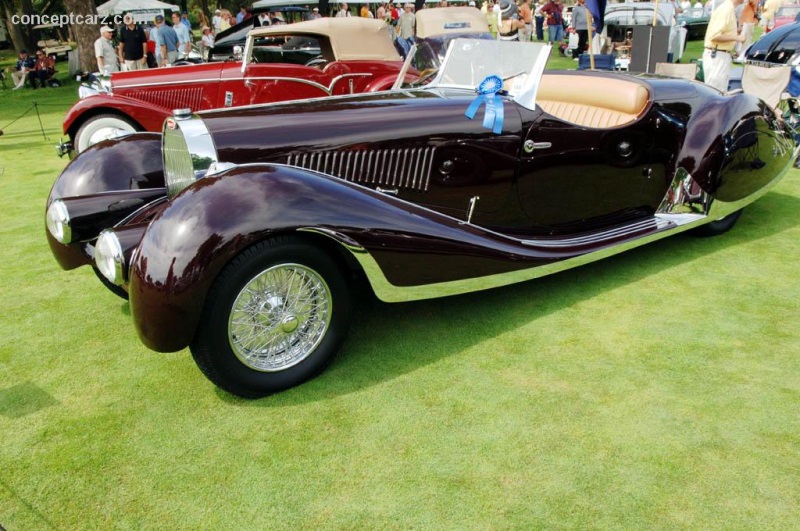
Roadster by Vanvooren
Chassis #: 57617
View info and history
Auction entries : 1Production began in 1934 and would continue through 1940 with 710 examples in all, along numerous road and competition variants. From the company's inception, the Bugatti automobiles had seamlessly combined high performance with bespoke luxury and cutting-edge styling. The Type 57 continued this tradition, exuding the excitement and racing heritage of the company while incorporating the refinement and drivability of a road car. It incorporated the character of the racing chassis with a level of comfort and style that the élite clientele expected and demanded. The Type 57 was among the finest grand tourers of the 1930s and represented the last Bugatti production car of the pre-World War era, and marked Jean Bugatti's emergence as Bugatti's leader and creative force. Jean Bugatti was the son of Le Patron, Ettore Bugatti and the Type 57 was the first new model built under Jean's direction, incorporating many features that were new to Bugatti. Italian-born engineer, Ettore Bugatti, was one of the early 20th-century vanguards of design and racing, and the vehicles he built were consistent Grand Prix winners, forging a reputation for the company as an industry leader in both technical development and aesthetic styling. The early Brescia and succeeding Type 37 and Type 51 were among the most dominant vehicles of their era, complemented by the subtle elegance of models such as the Type 46, and the imposing scale of the Type 41 Royale. Of all of Molsheim's road cars, the Type 57 ranks among the finest and were largely designed and engineered by Jean. Engine
The engine powering the Type 57 was reliable, durable, and powerful and it offered lower noise levels and reduced vibration than the preceding engines. The 3.3-liter (3,257 cc) inline eight-cylinder engine had dimensions of 72x100mm, Dual Throat Updraft Stromberg UUR-2 carburetor, dry-sump lubrication, magneto ignition, and its crankshaft ran in five main bearings. The camshafts were driven by a train of helical-tooth gears at the engine's rear with a further crankshaft bearing behind them. Finger cam followers minimized side thrust on the valve stems. Its dual overhead camshafts were inspired by the innovative designs of Harry Miller. Rated at 135 brake horsepower in naturally aspirated form, the 3.3-litre engine was initially fitted with a conventional clutch and a four-speed manual gearbox, while later Type 57 models offered the Cotal semi-automatic transmission as an option. In 1936, a second series of chassis was released, which now incorporated flexible engine mounts, replacing the earlier rigid engine mounting system, as well as Lockheed hydraulically-actuated brakes and improved telescopic shock absorbers. The beautiful and lightweight but expensive aluminum-spoked wheels and brake drums were replaced with Rudge-Whitworth center-lock wire wheels and separate brake drums.Body styles
The chassis had a 130-inch (3302mm) wheelbase with a 53-inch (1349mm) track, and road-going versions weighed approximately 2090 pounds (950 kg). The suspension was comprised of a front beam axle with semi-elliptic leaf springs and a rear live axle with reversed quarter-elliptic leaf springs, and front and rear De Ram shock absorbers. Early examples received a smaller version of the Royale's square-bottom horseshoe grille. The sides of the engine compartment were covered with thermostatically-controlled shutters. Three of the four original body styles were penned by Jean Bugatti. Named after Mont Ventoux, a grand mountain peak in the French Alps, the four-seat, two-door Ventoux body design was heavily influenced by sketches for the Type 50, and easily distinguished by its sharply raked windshield. The Galibier was a four-door saloon also named for locations within the Alps. The Ventoux and Galibier were the first designs, eventually followed by two sportier bodies made in far more limited quantities, a two-seat coupé called the Atalante and the highly celebrated Atlantic. To complement the closed coachwork, Jean designed a cabriolet entitled the Stelvio, yet another Alpine reference. While most of the bodies were built in-house at Bugatti's Molsheim facility, the production of the Stelvio was contracted to Gangloff, a coachbuilder located in nearby Colmar. Upon receiving an order for Stelvio coachwork, an employee would drive the Type 57 chassis to Colmar for its bodywork to be fitted.
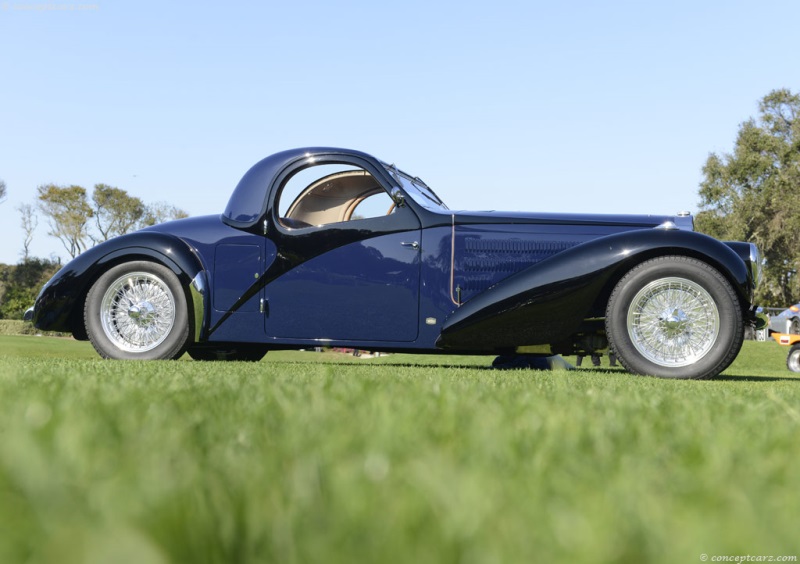
Ventoux Coupe
Chassis #: 57584
Engine #: 507
View info and history
Auction entries : 5Graber had around 50 workers and most were skilled specialists, and the firm regularly demonstrated and displayed its creations on its stand at the Geneva Salon. Graber gravitated towards well-balanced designs that focused on quality, rather than the flashy designs of the French coachbuilders, and the advanced styling of the Italian conglomerate. The success of Hermann Graber's company may be judged by the fact that it perpetuated comfortably into the 1970s, long after many of its pre-war contemporaries had ceased. Type 57 Variants
Although Paragons of styling and engineering and despite financial travail, the Type 57 was available in several upgraded mechanical variations, including the high-performance short-chassis Type 57S ('S' for 'Surbaissé' - 'Lowered' - alternatively, it references 'Sport'), as well as a supercharged version dubbed the Type 57C. Bugatti introduced the Type 57C engine in 1936 at the Paris Salon, installed in a Ventoux, and was soon available on the improved second-series Type 57 chassis that appeared in late-1936. The Type 57C racing car was built through 1940, with approximately 96 examples constructed. It used the 3.3-liter engine from the road-going Type 57 but added a Roots-type supercharger which boosted output to 160 bhp. The Roots-type supercharger ran at 1.17 times engine speed and provided a 5-6 psi boost. Type 57S
Bugatti built approximately 42 (or 43) examples of the Type 57S and they were equipped with an unsupercharged 3.3-litre dry-sump straight-8-cylinder engine with a higher compression ratio of 8.5:1. The lowered position of the chassis was achieved by its axle and suspension setup, with the rear axle mounted on the forward ends of two reversed quarter-elliptic leaf springs which passed through two large apertures in the deep-section chassis side members instead of being slung beneath them. The lowered stance reduced the car's center of gravity and enhanced its road-holding capabilities compared to its taller Type 57 siblings.
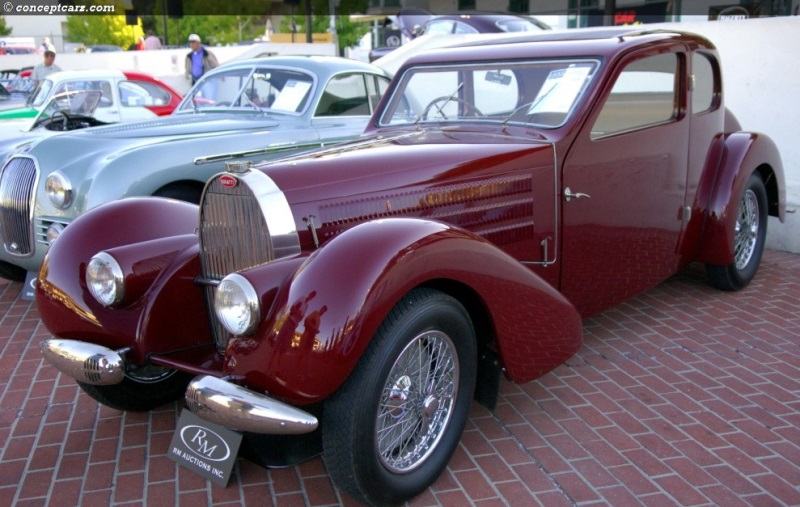
Ventoux Coupe
Chassis #: 57614
Engine #: 429
View info and history
Auction entries : 4The front axle was hollow and suspended upon two leaf springs, each passing through the axle tube in a conventional Bugatti fashion. Unlike the traditional Bugatti setup, however, the front axle was built up from two halves, with a centreline joint featuring external right- and left-hand threads supported internally by a double-ended tapering mandrel. A double-threaded external collar joined these two halves, allowing a limited degree of independent rotation as the springs flexed. De Ram shock absorbers damped suspension front and rear.The low-slung chassis received a low-mounted radiator that wore a V-shaped grille in the classic Bugatti motif. Of the 42 or 43 examples of the Type 57S built, 16 examples were finished with open coachwork. Corsica built a total of eight bodies on the Type 57S chassis, including four two-seat roadster bodies, two closed-car bodies, and two four-seat tourer bodies. Vanden Plas bodied a total of two Type 57S chassis (57541 with sports tourer coachwork and 57572 with two-seater cabriolet coachwork). Seventeen examples were completed with Jean Bugatti's Atalante coachwork.The engine powering the Type 57S delivered 175 horsepower, and when paired with the 'C' specification Roots-type supercharger, power output was raised to 200 horsepower. This enabled a top speed of some 120 mph, making Bugatti the fastest French production car of the period. Bugatti's with the 'S' and 'C' specifications are known as the Type 57SC. Of the circa-42 examples of 'Surbaisse' cars built, only two examples were originally manufactured with the supercharger. Many Type 57S owners desired the additional power and had their original Type 57S cars returned to Molsheim for the upgrade.
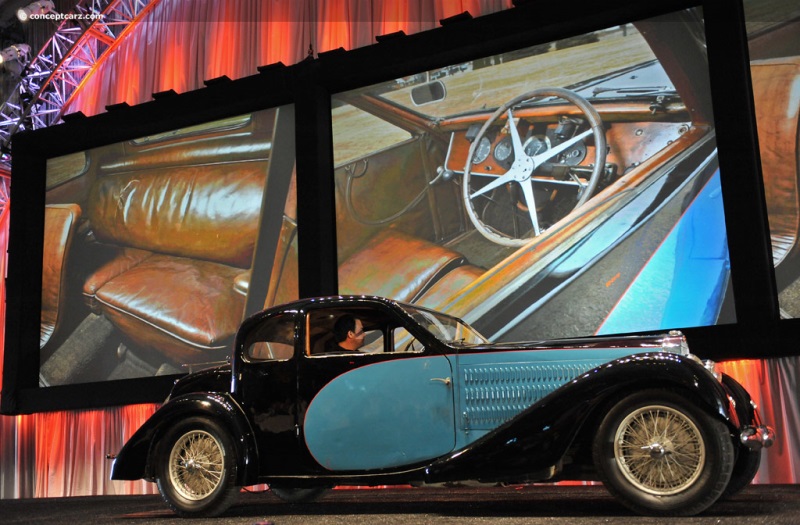
Ventoux Coupe
Chassis #: 57345
View info and history
Auction entries : 2The Type 57S proved its competition prowess by claiming three victories during 1936 (the French Grand Prix, La Marne Grand Prix, and the Comminges Grand Prix). The ultra-aerodynamic version of the Type 57S, called the 57G 'Tank,' won the 24 Hours of Le Mans in 1937. Additional victories were achieved at the Pau Grand Prix, Bone Grand Prix, and La Marne Grand Prix that same year, along with the 57S establishing records at some 14 different types of events, including a speed average of 85.07 mph at Le Mans. An overall victory at Le Mans was later repeated by a second incarnation of the Tank in 1939.After World War II came to an end and peacetime resumed, the Type 57 chassis and engine were revied in 1951 as the Bugatti Type 101.
by Daniel Vaughan | Nov 2021
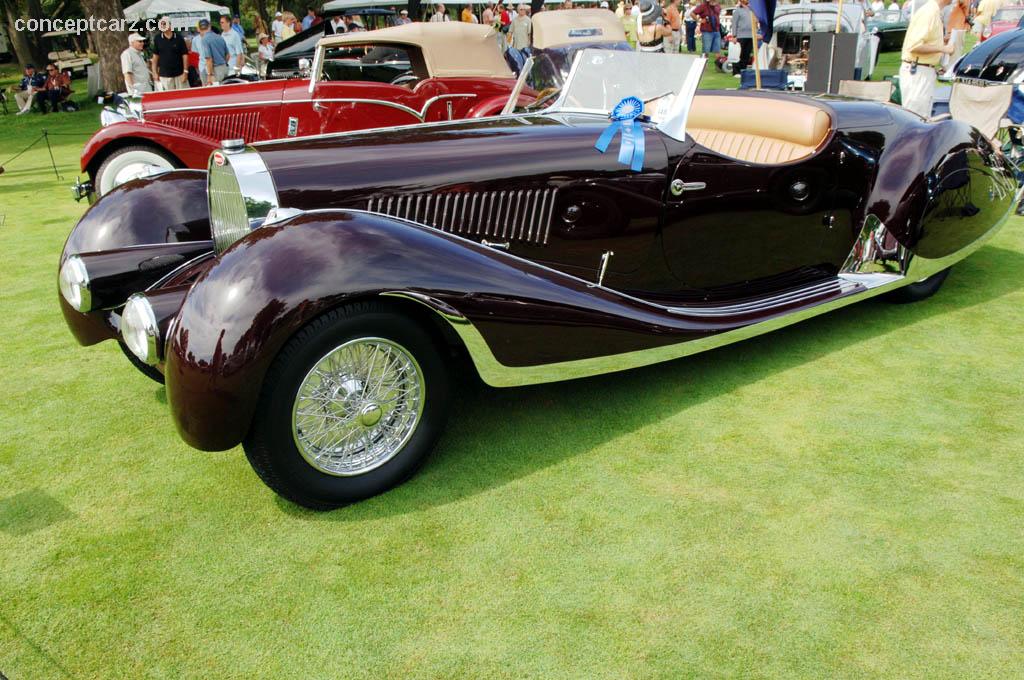
Roadster by Vanvooren
Chassis #: 57617
View info and history
Auction entries : 1
The engine powering the Type 57 was reliable, durable, and powerful and it offered lower noise levels and reduced vibration than the preceding engines. The 3.3-liter (3,257 cc) inline eight-cylinder engine had dimensions of 72x100mm, Dual Throat Updraft Stromberg UUR-2 carburetor, dry-sump lubrication, magneto ignition, and its crankshaft ran in five main bearings. The camshafts were driven by a train of helical-tooth gears at the engine's rear with a further crankshaft bearing behind them. Finger cam followers minimized side thrust on the valve stems. Its dual overhead camshafts were inspired by the innovative designs of Harry Miller. Rated at 135 brake horsepower in naturally aspirated form, the 3.3-litre engine was initially fitted with a conventional clutch and a four-speed manual gearbox, while later Type 57 models offered the Cotal semi-automatic transmission as an option. In 1936, a second series of chassis was released, which now incorporated flexible engine mounts, replacing the earlier rigid engine mounting system, as well as Lockheed hydraulically-actuated brakes and improved telescopic shock absorbers. The beautiful and lightweight but expensive aluminum-spoked wheels and brake drums were replaced with Rudge-Whitworth center-lock wire wheels and separate brake drums.Body styles
The chassis had a 130-inch (3302mm) wheelbase with a 53-inch (1349mm) track, and road-going versions weighed approximately 2090 pounds (950 kg). The suspension was comprised of a front beam axle with semi-elliptic leaf springs and a rear live axle with reversed quarter-elliptic leaf springs, and front and rear De Ram shock absorbers. Early examples received a smaller version of the Royale's square-bottom horseshoe grille. The sides of the engine compartment were covered with thermostatically-controlled shutters. Three of the four original body styles were penned by Jean Bugatti. Named after Mont Ventoux, a grand mountain peak in the French Alps, the four-seat, two-door Ventoux body design was heavily influenced by sketches for the Type 50, and easily distinguished by its sharply raked windshield. The Galibier was a four-door saloon also named for locations within the Alps. The Ventoux and Galibier were the first designs, eventually followed by two sportier bodies made in far more limited quantities, a two-seat coupé called the Atalante and the highly celebrated Atlantic. To complement the closed coachwork, Jean designed a cabriolet entitled the Stelvio, yet another Alpine reference. While most of the bodies were built in-house at Bugatti's Molsheim facility, the production of the Stelvio was contracted to Gangloff, a coachbuilder located in nearby Colmar. Upon receiving an order for Stelvio coachwork, an employee would drive the Type 57 chassis to Colmar for its bodywork to be fitted.
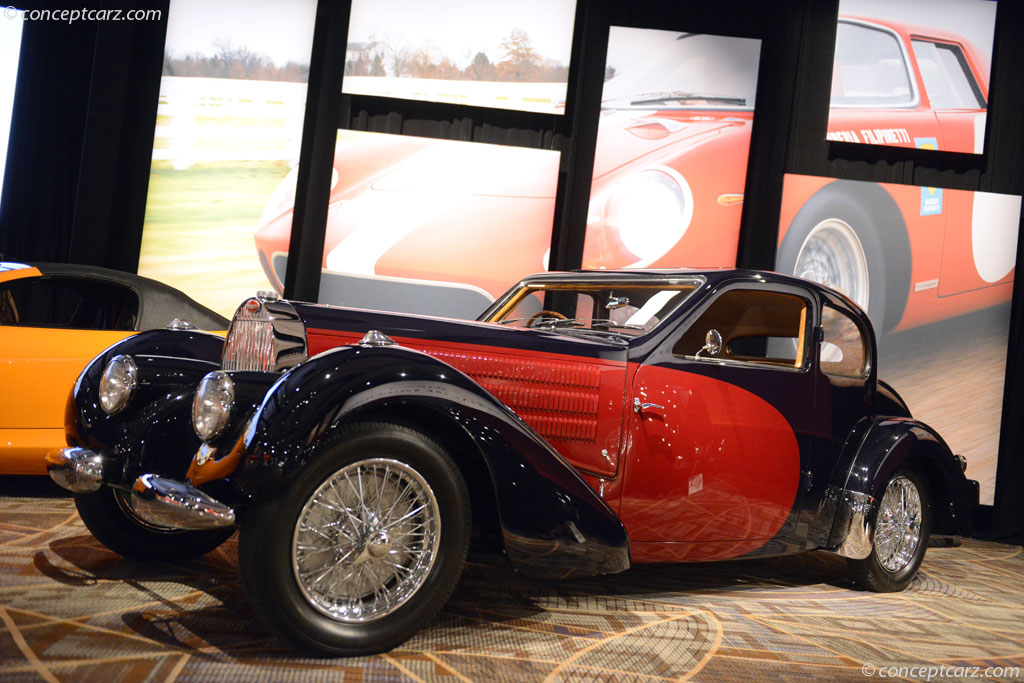
Ventoux Coupe
Chassis #: 57584
Engine #: 507
View info and history
Auction entries : 5
Although Paragons of styling and engineering and despite financial travail, the Type 57 was available in several upgraded mechanical variations, including the high-performance short-chassis Type 57S ('S' for 'Surbaissé' - 'Lowered' - alternatively, it references 'Sport'), as well as a supercharged version dubbed the Type 57C. Bugatti introduced the Type 57C engine in 1936 at the Paris Salon, installed in a Ventoux, and was soon available on the improved second-series Type 57 chassis that appeared in late-1936. The Type 57C racing car was built through 1940, with approximately 96 examples constructed. It used the 3.3-liter engine from the road-going Type 57 but added a Roots-type supercharger which boosted output to 160 bhp. The Roots-type supercharger ran at 1.17 times engine speed and provided a 5-6 psi boost. Type 57S
Bugatti built approximately 42 (or 43) examples of the Type 57S and they were equipped with an unsupercharged 3.3-litre dry-sump straight-8-cylinder engine with a higher compression ratio of 8.5:1. The lowered position of the chassis was achieved by its axle and suspension setup, with the rear axle mounted on the forward ends of two reversed quarter-elliptic leaf springs which passed through two large apertures in the deep-section chassis side members instead of being slung beneath them. The lowered stance reduced the car's center of gravity and enhanced its road-holding capabilities compared to its taller Type 57 siblings.
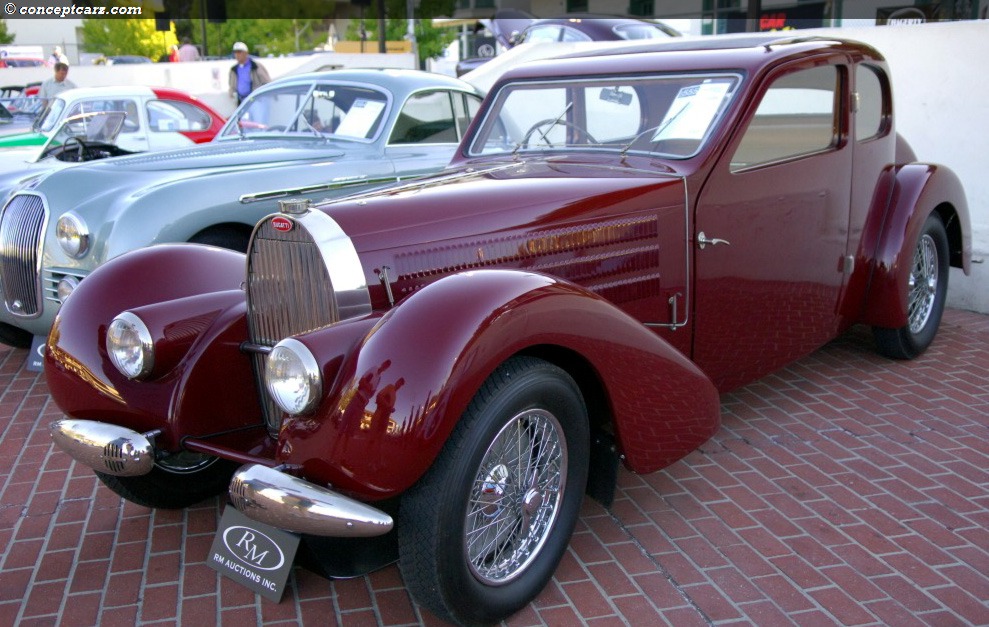
Ventoux Coupe
Chassis #: 57614
Engine #: 429
View info and history
Auction entries : 4
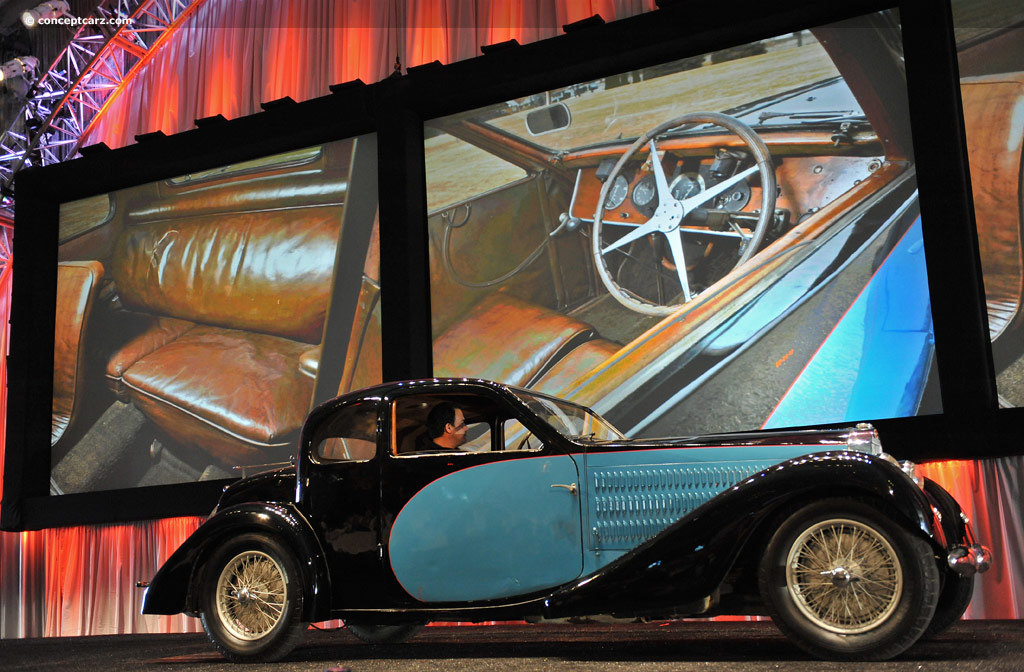
Ventoux Coupe
Chassis #: 57345
View info and history
Auction entries : 2
by Daniel Vaughan | Nov 2021
Related Reading : Bugatti Type 57 History
Many manufacturers during this time produced multi-purpose vehicles that could be driven to a race track, raced, and then driven home. The Bugatti Type 57, however, was solely a road-going vehicle and is considered the most celebrated non-racing Bugatti. Even though the Type 57 was strictly a road-going vehicle, a racing version was created for the 1937 24-Hours of Le Mans race. This vehicle, based....
Continue Reading >>
Continue Reading >>
Related Reading : Bugatti Type 57 History
Ettore Arco Isidoro Bugatti was born in Milan, Italy in 1881. His father, Carlo, was a furniture designer of some fame. The fathers brother, Rembrandt, was a gifted sculptor of animals. When he was old enough, Ettore attended the Brera Academy of Art where he studied sculpture. Soon, he turned his attention to mechanical endeavors. The first Bugatti motor car was built in 1899 though the....
Continue Reading >>
Continue Reading >>


1937 Bugatti Type 57 Vehicle Profiles

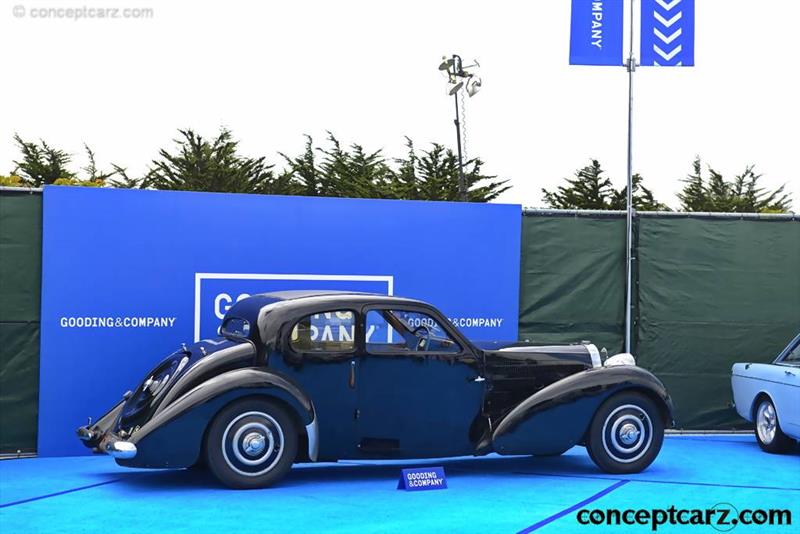
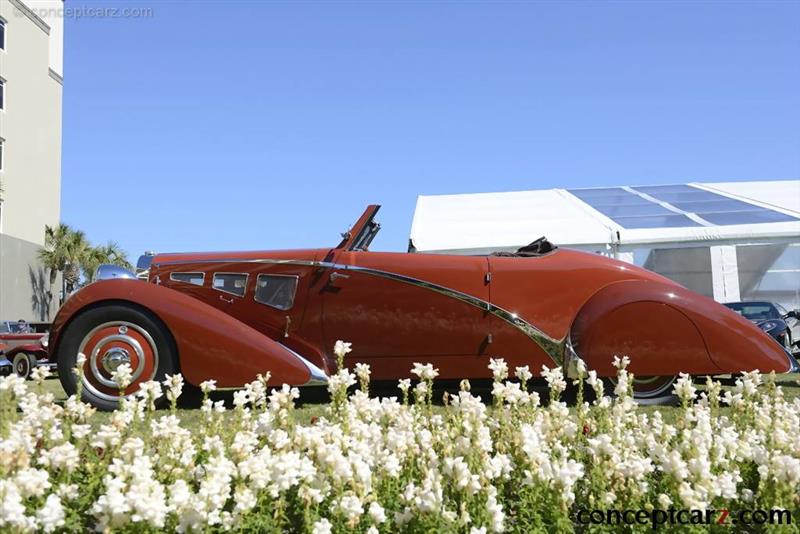
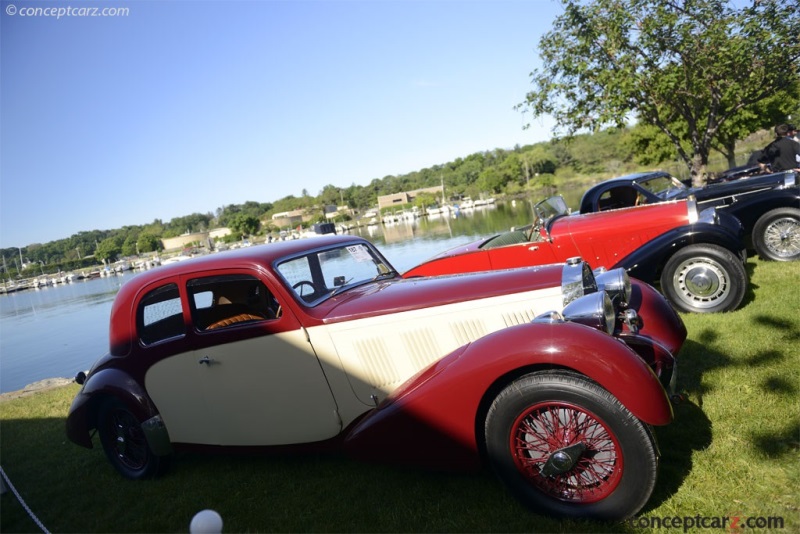

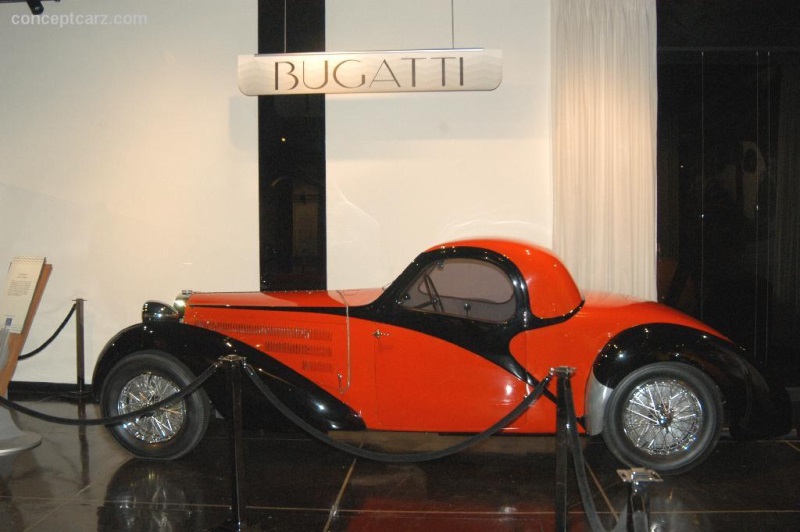


Recent Vehicle Additions


Performance and Specification Comparison
Type 57 C Specification Comparison by Year
Year
Production
Wheelbase
Engine
Prices
117.50 in., 129.90 in., 129.92 in.
8 cyl., 201.38 CID., 135.00hp
8 cyl., 198.75 CID., 170.00hp
8 cyl., 201.38 CID., 210.00hp
8 cyl., 198.75 CID., 170.00hp
8 cyl., 201.38 CID., 210.00hp
Related Automotive News

The Don Williams Collection of Stunning Pre-War Classics, Including 1937 Mercedes-Benz 540K, Will be Offered with No Reserve During Barrett-Jackson's 2024 Scottsdale Auction
Barrett-Jackson, The Worlds Greatest Collector Car Auctions, will offer seven stunning classic vehicles from the Don Williams Collection during the 2024 Scottsdale Auction held January 20-28 at WestWorld of Scottsdale. Each premium vehicle...

A Comparison of 1997 Best of Show and 2022 Best of Show Nominee at the Pebble Beach Concours d'Elegance
Left 1997 Best of Show Right 2022 Best of Show Nominee
The combined efforts of Talbot-Lago and Figoni %26 Falaschi resulted in many wondrous automotive creations, including the T150C model with goutte deau, literally a drop...

Historic and Prestigious Classics to Take Center Stage at Gooding & Company's Pebble Beach Auctions; Full Catalogue Launches Online Today
The undisputed star of the show is the 1937 Bugatti Type 57SC Atalante, alongside a 1930 Bentley 4 12 Litre Supercharged Blower Sports Tourer and a 1931 Bentley Eight Litre Sports Tourer.
The official auction house of the Pebble Beach Concours...

Gooding & Company Proudly Presents 'Passion of a Lifetime' – A Masterpiece Collection of Sixteen Substantial Automobiles for Sale on 1 April 2020
Santa Monica, Calif. (22 January 2020) – Gooding %26 Company, the internationally recognized auction house, is honored to reveal the automobiles comprising the companys first-ever London sale, Passion of a Lifetime, at Somerset House in central...

Techno Classica 2014: more than 30 racing cars to celebrate 120 years of Mercedes-Benz motor racing history
Cars that were the heroes of magical moments put their stamp on this high-powered, most comprehensive show presentation
With more than 30 vehicles, Mercedes-Benz Classic presents motor racing history in all its unique breadth and depth
120 years o...