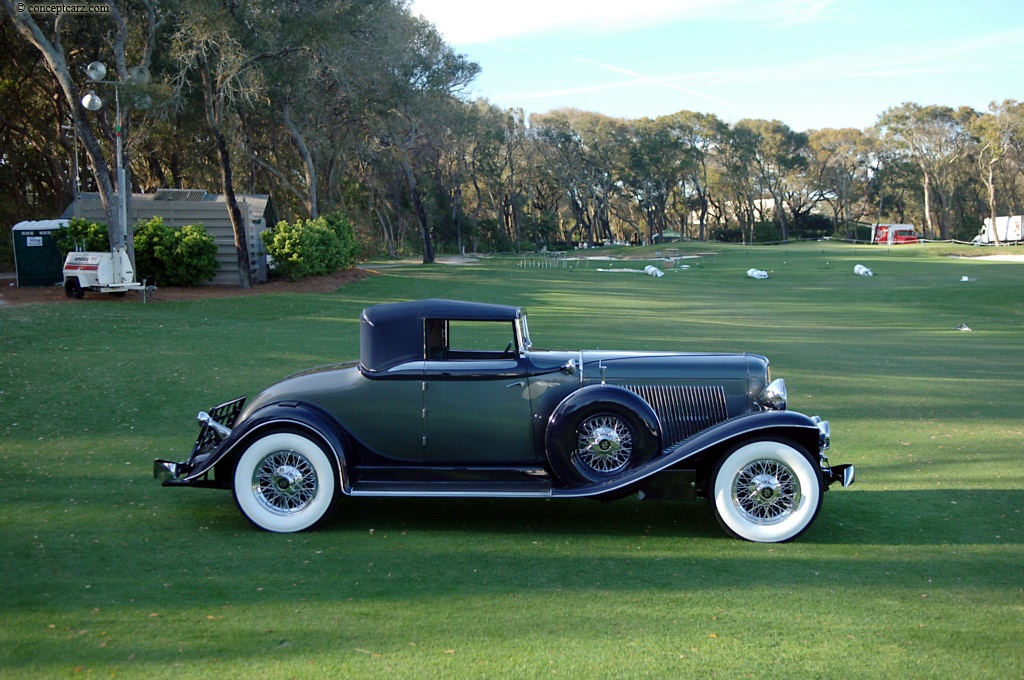
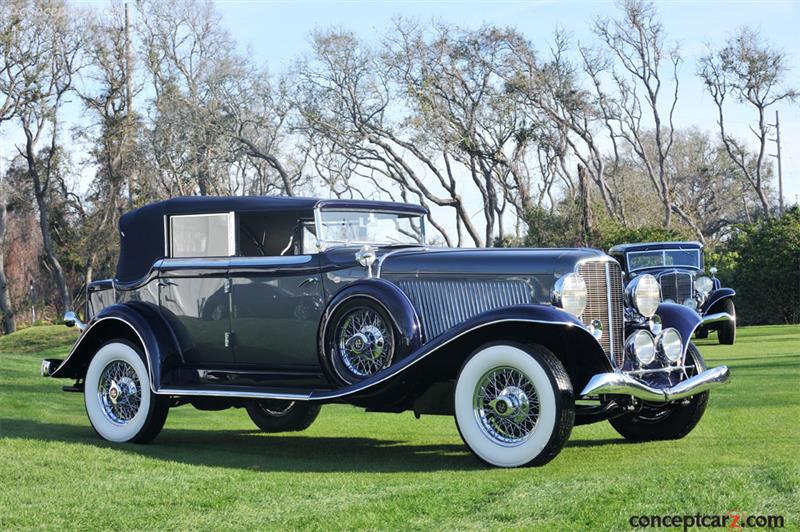
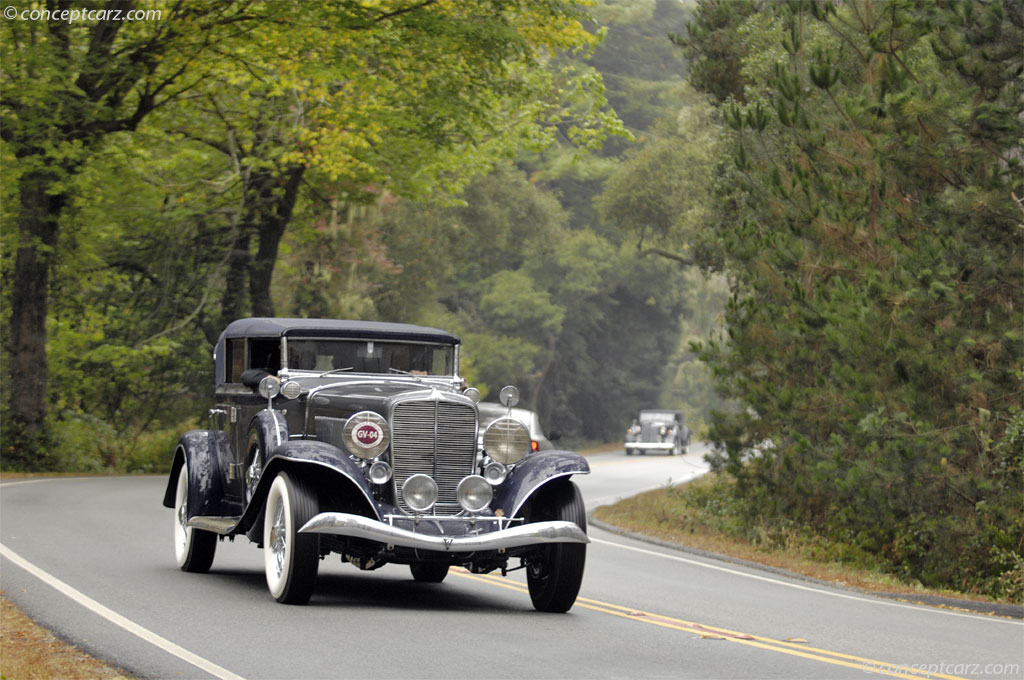
1934 Auburn 1250 Twelve news, pictures, and information | ||
| Tweet | ||
![]() | ![]() | ![]() | Sedan |
Despite the failing economy and declining sales caused by the Depression, luxury automakers such as Cadillac and Packard began introducing larger, more powerful 12 and 16 cylinder engines. To keep pace, Auburn unveiled its new V12 Lycoming engine in 1932, which became the least expensive twelve-cylinder engine ever marketed. The 391 cubic-inch engine offered 160 horsepower and cost the company over $1 million to design and tool, yet the lowest priced car sold for as little as $975. However, sales struggled and 1934 was the last year for the Auburn V12.
Auburn introduced an upscale Salon series for 1933 in an attempt to boost lagging sales. The Salon featured more chrome, fancier bumpers, upgraded interior and a v-shaped windshield and rode on a 127-inch wheelbase. The Salon series continued in 1934 on the Model 1250.
![]() | ![]() | ![]() | Salon Cabriolet |
The most distinctive characteristic of the new Auburn was its astounding price: the cheapest model, a two-passenger coupe, was only $975, making it only one-third or one-fourth the cost of a V12 Packard. Five versions were offered beside the coupe: a cabriolet, brougham, sedan, speedster and phaeton. None cost more than $1,145 in 1932. But as The Great Depression lengthened, Auburn sales fell from 28,103 in 1931 to 11,646 in 1932 and 6,000 in 1933. The V12's last year was 1934.
At the tender age of fifteen Errett Lobban Cord, commonly known as E.L. Cord, left school in pursuit of a job as a car salesman. After a successful stint in that profession he began working as a mechanic in a service station located in Los Angeles. This led to modifying his Model T's to include bodywork and engine modifications. He later moved to Chicago where he went back to selling vehicles. He moved to Milwaukee where he opened his own car distributor company and by 1924 was looking to purchase his own manufacturing company.
When the Auburn Automobile Company prompted him with an offer Cord a top level management position, he accepted but under conditions. He demanded that he be given 20% of the profits and complete control of the company. He also stated that he wanted the option to buy the company once it recovered. The partners, at this point, were on the verge of bankruptcy, so they accepted the offer.
Cord had a profound knowledge of marketing and was very business savvy. During his career he purchased Duesenberg, cab companies, Aircraft Company, and a New York shipyard. By 1932 he purchased controlling interests in the Aviation Corp, which later became American Airways and is currently known as American Airlines.
His fortunes turned during the mid-1930's as the stock market crashed and the Great Depression brought many of his business to a bitter end.
The Auburn Company had turned a considerable profit during the 1920s but keeping up with the changing market was difficult. The cylinder wars of the early 1930s sent many companies struggling to keep up with the changing technology and mechanical advancements. Auburn answered this challenge in 1932 with the creation of their twelve-cylinder engine in 'Vee' configuration. To stimulate even more interest, the 12-160A was offered at an incredibly low price, at just under a thousand dollars. At that price it has remained in history as the lowest 12-cylinder vehicle ever produced. Many people feared that the quality of the engine or the vehicle was reflective of the price. This mindset backfired and as a result did not sell as well as intended. By years end the company had lost more than a million dollars.
The 6.5-liter Lycoming engine produced a respectable 160 horsepower and enough torque to propel the vehicle to around 100 mph. One of the most ingenious components of the vehicle was the 'Dual Ratio' differential which was operated by a dashboard lever. There were high and low ratios available for each of the three gears which improved fuel and oil consumption. The end result was less strain and wear-and-tare on the engine.
Cord had encountered problems with the Securities and Exchange Commission and fled to England in 1933. Harold Ames was left in control, though times were difficult since production had fallen nearly 85%. The 12-161A was introduced in 1933 though never achieved the desired success. The Great depression, struggling economy, and near-bankrupt company were part of the problems.
The Auburn 12-160A Speedster body was the most exclusive of the offering. With its low price tag, the vehicles were a bargain. Tough times and consumer fears were its ultimate demise and its potential was never realized.
By Daniel Vaughan | Aug 2011
When the Auburn Automobile Company prompted him with an offer Cord a top level management position, he accepted but under conditions. He demanded that he be given 20% of the profits and complete control of the company. He also stated that he wanted the option to buy the company once it recovered. The partners, at this point, were on the verge of bankruptcy, so they accepted the offer.
Cord had a profound knowledge of marketing and was very business savvy. During his career he purchased Duesenberg, cab companies, Aircraft Company, and a New York shipyard. By 1932 he purchased controlling interests in the Aviation Corp, which later became American Airways and is currently known as American Airlines.
His fortunes turned during the mid-1930's as the stock market crashed and the Great Depression brought many of his business to a bitter end.
The Auburn Company had turned a considerable profit during the 1920s but keeping up with the changing market was difficult. The cylinder wars of the early 1930s sent many companies struggling to keep up with the changing technology and mechanical advancements. Auburn answered this challenge in 1932 with the creation of their twelve-cylinder engine in 'Vee' configuration. To stimulate even more interest, the 12-160A was offered at an incredibly low price, at just under a thousand dollars. At that price it has remained in history as the lowest 12-cylinder vehicle ever produced. Many people feared that the quality of the engine or the vehicle was reflective of the price. This mindset backfired and as a result did not sell as well as intended. By years end the company had lost more than a million dollars.
The 6.5-liter Lycoming engine produced a respectable 160 horsepower and enough torque to propel the vehicle to around 100 mph. One of the most ingenious components of the vehicle was the 'Dual Ratio' differential which was operated by a dashboard lever. There were high and low ratios available for each of the three gears which improved fuel and oil consumption. The end result was less strain and wear-and-tare on the engine.
Cord had encountered problems with the Securities and Exchange Commission and fled to England in 1933. Harold Ames was left in control, though times were difficult since production had fallen nearly 85%. The 12-161A was introduced in 1933 though never achieved the desired success. The Great depression, struggling economy, and near-bankrupt company were part of the problems.
The Auburn 12-160A Speedster body was the most exclusive of the offering. With its low price tag, the vehicles were a bargain. Tough times and consumer fears were its ultimate demise and its potential was never realized.
By Daniel Vaughan | Aug 2011
| VICARI AUCTION COMPANY OFFERS RARE '62 & '63 Z06 CORVETTES AT 2013 CRUISIN' NOCONA | |
![]() | In a recent rare find, two classic Chevrolet Corvettes (one '62 and one '63) - stored for decades-are being made available by the Vicari Auction Company. Both vehicles will cross the block during 2013 Cruisin' Nocona, a north Texas collector car auction and classic car poker cruise set for April 19th and 20th in historic Nocona, Texas. The Corvettes are virtually all-original, and have been stored in Texas by a classic-vehicle aficionado and collector since the 1980s. 'These...[Read more...] |
| Unique American Classics join Bonhams' inaugural automobile auction next week in Boca Raton, Florida | |
![]() | In just a few days Bonhams' anticipated automobile auction will take place at Florida's elegant Boca Raton Resort & Club. Held in conjunction with the Boca Raton Concours d'Elegance, the auction will host an impressive line-up of collectors' automobiles from around the world. In addition to the many headlining European cars, Bonhams has consigned many American cars of noteworthy status. The immaculately restored 1930 Duesenberg Model J Torpedo Phaeton (pictured) is a car that can only be d...[Read more...] |
| 2013 Palos Verdes Concours Celebrates 'The Age of Elegance' | |
![]() | Rolls Royce, Bentley, Duesenberg and coachwork of Ray Dietrich to be featured Rancho Palos Verdes, CA - February 14, 2013 - The 21st Palos Verdes Concours d'Elegance at the Trump National Golf Club, Rancho Palos Verdes on September 15 will celebrate the 'Age of Elegance' by showcasing some of the world's most luxurious classic automobiles, according to Chairman Peter Kunoth. The featured classes include Rolls-Royce, Bentley, Duesenberg and the coachwork of Raymond Dietrich. The Conc...[Read more...] |
| Barrett-Jackson Flavors Its January Scottsdale Auction With NASCAR Treats | |
![]() | • RACING HERITAGE, HIGH PERFORMANCE ARE RECIPES FOR CAR-COLLECTING FEAST • SPEED™ SET FOR 39 HOURS of LIVE COVERAGE STARTING JAN. 15 The great Henry Ford once said, 'Auto racing began five minutes after the second car was built.' And for more than 60 years, there are few entities that better represent auto racing in America than NASCAR. From the hallowed grounds of Daytona International Speedway, to Sonoma, California's intricate and picturesque road course, the sp...[Read more...] |
| TOPLINE COLLECTORS PLACE SPOTLIGHT on SPEED'S BARRETT-JACKSON BROADCAST FROM SCOTTSDALE | |
![]() | • TOPLINE COLLECTORS PLACE SPOTLIGHT on SPEED'S BARRETT-JACKSON BROADCAST FROM SCOTTSDALE • 'LOST' SHELBY DUAL PROTOTYPE, HAGERTY GIVEAWAY & SALON COLLECTION HIGHLIGHT 39 HOURS OF LIVE COVERAGE The 42nd annual Barrett-Jackson Scottsdale (Ariz.) Collector Car Event, the first of four set for live coverage in 2013, kicks off the auction season in grand style as some of the world's most sought-after machines cross the block starting Tuesday, Jan. 15 at 7 p.m. ET/4 p.m. PT. SP...[Read more...] |
1934
Auburn
models |
| Auburn 652X Standard |
| Auburn Model 652Y Custom |
| Similar Automakers | |
| Daimler | Delage |
| Delahaye | Duesenberg |
| Hispano Suiza | Hudson |
| Isotta | Packard |
| Peerless | Pierce Arrow |
| Talbot-Lago | Voisin |
| Similarly Priced Vehicles from 1934 |
| Studebaker Commander Land Cruiser ($1,200-$1,500) |
Average Auction Sale: $260,150 |
| Auburn: 1931-1940 |
| Similar Automakers |
| Other models by Auburn |
| Related Articles and Event Coverage |
| Concours d'Elegance of America at St. John's |
| Amelia Island Concours d'Elegance |
| 2006 Meadow Brook Concours d'Elegance |
| 12 | 6-39 | 6-51 | 654 | 850 Series | Beauty-SIX | Model 8 | Model G |
© 1998-2012. All rights reserved. The material may not be published, broadcast, rewritten, or redistributed.


1934