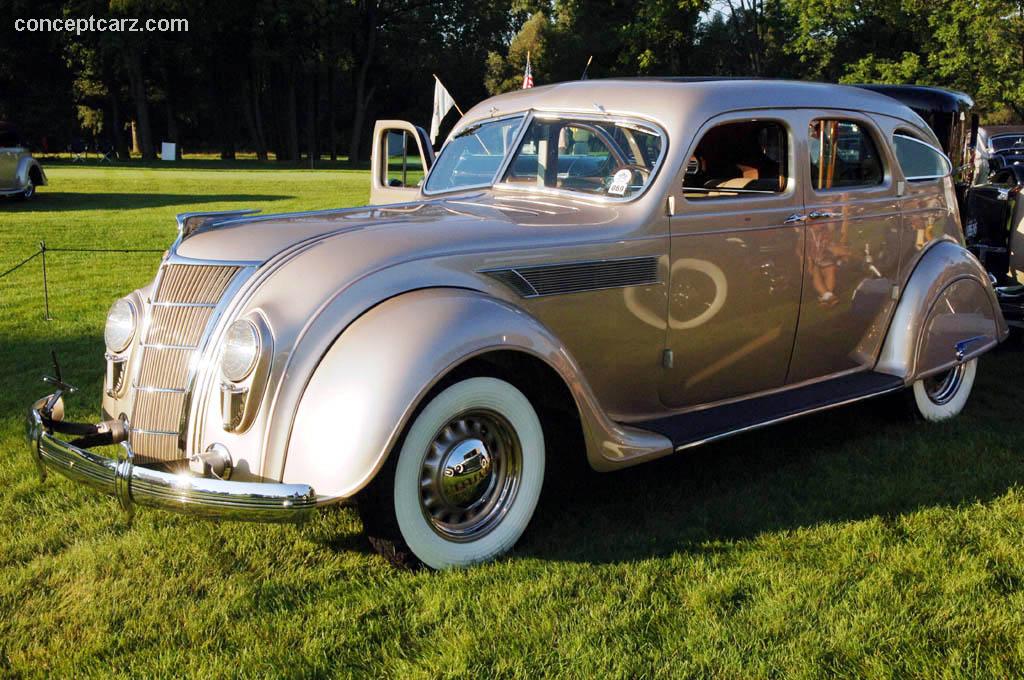
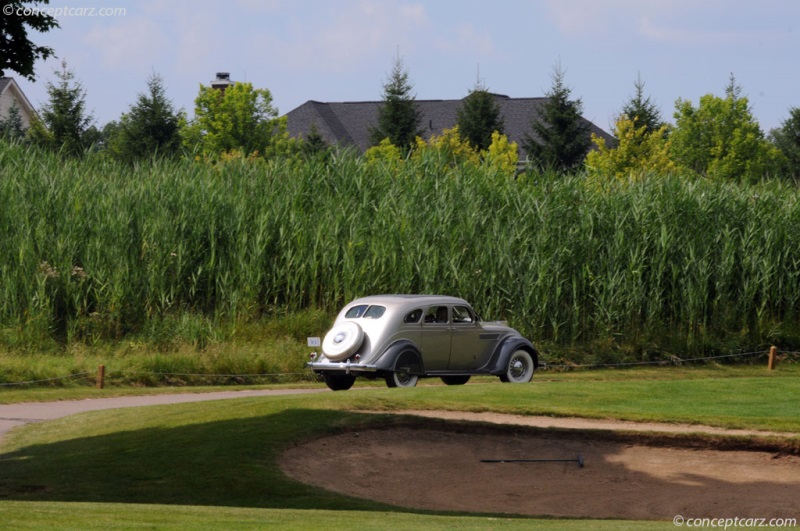
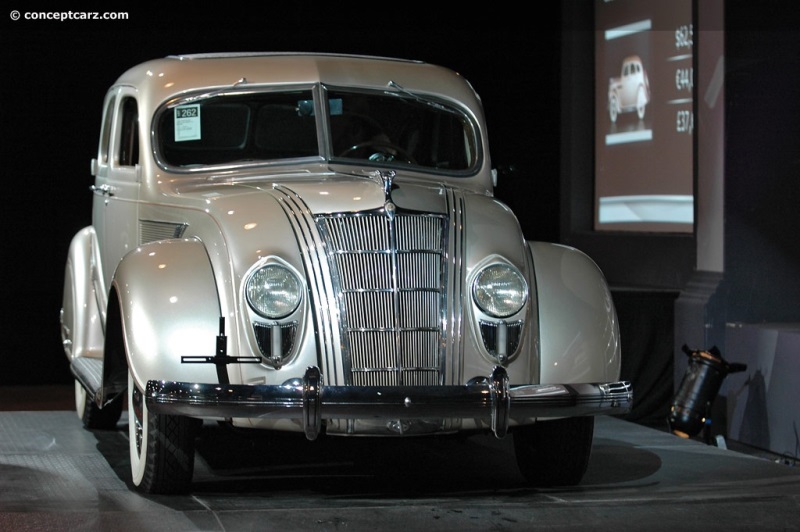
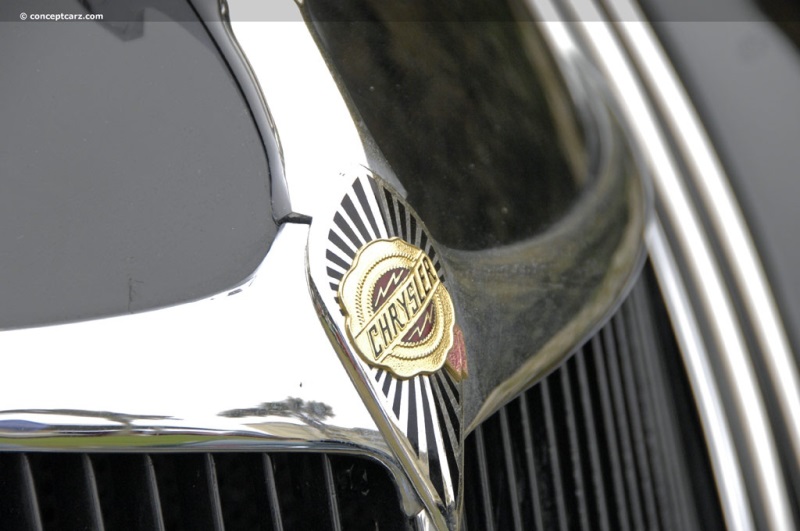
The Chrysler Airflow was among the first cars designed with aerodynamics in mind, with fluid shapes and wind-cheating features. A product of Chrysler designer Carl Breer, along with fellow Chrysler engineers Fred Zeder and Owen Skelton, the Airflow was a monumental breakthrough in automotive design. It featured an 8-cylinder engine, 3-speed transmission, and an innovative suspension system providing the passengers with a far better ride due to moving the engine and passengers further forward on the chassis. The world was not ready for its forward-thinking design, and production was brief, lasting from 1934 through 1937.Breer, Skelton, and Zeder - known as Chrysler's 'Three Musketeers' had first come to Walter P. Chrysler's attention when he was working for Studebaker in 1920 and followed him to Willys when he took over operations of that company. Joining the newly formed Chrysler Corporation, they were instrumental in its early success and helped it build a strong reputation. Although the car-buying public shied away from the Airflow when new, this dynamic model pioneered many new construction methods and the streamlined 'Art Deco' inspired styling was developed through one of the first uses of wind tunnel testing, later becoming commonplace in future automotive designs. Many elements, including the 'Vee'd' split windscreen, reduced air reliance and were considered revolutionary for their day. The curved 'waterfall' grille of the 1934 Airflows was among the purest expressions of the design. The truss bridge design was adapted from contemporary aircraft designs of the day, and the engine was positioned forward, over the front axle, and the seating compartment was placed completely between both axles, resulting in a smoother riding experience and additional room and comfort. Continuing Chrysler's reputation for well-appointed vehicles, the Airflow received plush fabrics, decorative chrome, many standard amenities, and a well-thought-out arrangement of dashboard gauges and controls. The quiet and cozy ride was further enhanced with tight-fitting doors, a benefit of the unibody construction technique. 
Sedan
Chassis #: 6605410
View info and history
Auction entries : 1The Chrysler Airflow was launched to great fanfare in 1934, offered in four series resting on different wheelbase sizes, all 'Eights' and three of them Imperials. One of Chrysler's companion models, the DeSoto, featured similar designs and was powered by a six-cylinder engine. The press was initially positive in its reaction however, the buying public was hesitant. Barely 11,000 examples of the Chrysler Airflow were sold, compared to 25,000 conventional six-cylinder models that had fortunately been continued. With sales failing to meet expectations, Chrysler ushered in new design improvements for 1935, including a revised and more vertical front grille design styled by Ramond Dietrich, improved baking systems, and a larger and more powerful engine. Despite the updates, sales continued to lag behind other more contemporary offerings from Chrysler. Chrysler called its line of conventional cars the Airstream for 1935 while their aerodynamic lines continued as the Airflow. Four wheelbase lengths were offered on the Airflow, with the C-1 resting on a 123-inch wheelbase, the C-2 on a 128-inch platform, the C-3's measured 130-inches, and the CW was the largest at 146.5-inches which was suitable for its eight-passenger coachwork. The C-1 was powered by an L-head inline-8 with a 323.5 cubic-inch displacement, five main bearings, solid valve lifters, a Stromberg carburetor, and delivered 115 horsepower with the standard 6.2:1 compression ratio or 120 horsepower with a 6.5:1 compression. The C-2 Imperial Eight and C-3 Custom Imperial Eights had a 323.5 CID inline-8 and delivered 130 horsepower (138 hp with raised compression). The large and stately Series CW Imperial received a 384.8 cubic-inch L-head inline-8 delivering 150 horsepower.All engines were backed by a three-speed manual transmission with a conventional clutch and floor shift controls. The Imperial Airflows had an automatic overdrive. Stopping power was by Lockheed brakes at all four corners. The C-2 had vacuum-assisted power brakes.
Sedan
Chassis #: 6605410
View info and history
Auction entries : 1The C-1 was offered as a business coupe, coupe, and sedan with factory base prices of $1,245. The sedan was the most popular with 4,617 examples sold. 307 were coupes and just 72 were business coupes. Body styles offered on the C-2 included a coupe and sedan, both priced at $1,475. Again, the sedan proved more popular with 2,398 examples built followed by 200 of the coupe.The range of styles offered on the C-3 included a sedan, Town Sedan, Sedan Limousine with seating for eight, or an eight-passenger Town Sedan Limousine. The Sedan and Town Sedan were priced at $2,245 and the other two body styles were $2,345. The body style with the highest number of sales was the sedan with 69. Just one town sedan and two town sedan limousines were built. The Sedan Limousine found just 53 willing buyers.
Coupe
Chassis #: 6602390
Engine #: C-1 1061
View info and history
Auction entries : 3A total of 125 examples of the CW were built, including 15 of the eight-passenger sedan and none of the town sedan, both having a base price of $5,000. The Sedan Limousine and Town Sedan Limousine were $125 higher in price, with 15 and 2 sales respectively.All Chrysler Airflows were closed models and the seats featured exposed chromed tubular frames. The cloth upholstery had leather accents and piping. Standard features included hydraulic brakes, an automatic choke, a stabilizer in the back of the front axle, Autolite ignition, and 'Floating Power.' The unique design and construction of the Airflow models resulted in some of the most comfortable, quietest, and smoothest rides on the road, and the well-appointed interiors and potent engines were among the best in the business. Although not an 'entry level' vehicle, their prices were affordable and among the lowest for the level of luxury, features, and size. Regardless, the buying public found it difficult to accept its radical appearance.
by Daniel Vaughan | Feb 2021
Sedan
Chassis #: 6605410
View info and history
Auction entries : 1

Sedan
Chassis #: 6605410
View info and history
Auction entries : 1

Coupe
Chassis #: 6602390
Engine #: C-1 1061
View info and history
Auction entries : 3
by Daniel Vaughan | Feb 2021
Related Reading : Chrysler Airflow History
The Chrysler Airflow was introduced in 1934 as an exercise in aerodynamics, form, and function. Soon, the Airflow would be used by the Chryslers counterpart, the DeSoto Motor Company. The interior was surprisingly roomy and comfortable. The eight-cylinder engine provided around 115 horsepower or more depending on the options selected. It was a design that was far ahead of its time. Unfortunately,....
Continue Reading >>
Continue Reading >>
Related Reading : Chrysler Airflow History
Produced from 1934 until 1937, the Chrysler Airflow was the original full-size American production vehicle that used streamlining as a basis for building a sleeker automobile, one less susceptible to air resistance. Though it ended up being what is considered by some a commercial failure, Chrysler did make an effort at a fundamental change in automotive design with the Chrysler Airflow. Chryslers....
Continue Reading >>
Continue Reading >>
Similar Vehicles
Similarly Priced Vehicles
LaSalle Series 50 ($1,255-$1,325)
Chrysler Airstream Series CZ ($910-$1,235)
Average Auction Sale: $67,719
Chrysler Airstream Series CZ ($910-$1,235)
Average Auction Sale: $67,719
Chrysler Monthly Sales Volume
March 2023
31,899


1935 Chrysler C-1 Airflow Vehicle Profiles
Recent Vehicle Additions


Performance and Specification Comparison
Price Comparison
$745 - $870
$910 - $1,235
Airflow Specification Comparison by Year
Year
Production
Wheelbase
Engine
Prices
128.00 in.
8 cyl., 323.50 CID., 130.00hp
8 cyl., 323.50 CID., 138.00hp
8 cyl., 323.50 CID., 138.00hp
$1,475 - $1,475
137.00 in.
8 cyl., 323.50 CID., 130.00hp
8 cyl., 323.50 CID., 138.00hp
8 cyl., 323.50 CID., 138.00hp
$2,475 - $2,575
1,700
123.00 in.
8 cyl., 273.80 CID., 105.00hp
8 cyl., 273.80 CID., 110.00hp
8 cyl., 273.80 CID., 110.00hp
$1,345 - $1,345
Related Automotive News

Past Best of Show Winners at The Pebble Beach Concours d'Elegance
overview1
The 70th anniversary of the Pebble Beach Concours dElegance was celebrated with a spectacular display of previous Best of Show winners. Thirty-seven examples graced the showfield and many were still with the same owners who raised the trophy...

115 years of automotive engineering in Mladá Boleslav: In December 1905 Laurin & Klement presented the Voiturette A
In December 1905, the Laurin %26 Klement Voiturette A laid the foundation stone for 115 years of automotive engineering at the Mladá Boleslav site
In 2020 ŠKODA AUTO celebrates the 125th anniversary of its foundation in 1895
Mladá Boleslav In Dece...

CHRYSLER BRAND CELEBRATES 90 YEARS OF STYLE, ENGINEERING INNOVATION AND GROUNDBREAKING PRODUCTS
September 22, 2015 , Auburn Hills, Mich. - Chrysler Six, Airflow, Imperial, New Yorker, 300 and Town %26 Country are just some of the nameplates that mark the rich history of the Chrysler brand.
2015 marks the 90th anniversary of Chrysler, which...

FCA US LLC LOOKS 20 YEARS INTO THE FUTURE WITH SRT TOMAHAWK VISION GRAN TURISMO
Single-Seat Hybrid Powertrain Concept Vehicle to be Released Exclusively in Gran Turismo®6
Engineered by the SRT (Street and Racing Technology) engineering team, the SRT Tomahawk Vision Gran Turismo is the latest vehicle to be released in Gr...

Gooding & Company Amelia Island Auction Preview
Gooding %26 Company, the auction house acclaimed for selling the worlds most significant and valuable collector cars, will hold its annual Amelia Island Auction on Friday, March 7 on the Omni Amelia Island Plantation.
David Gooding, President and founder...