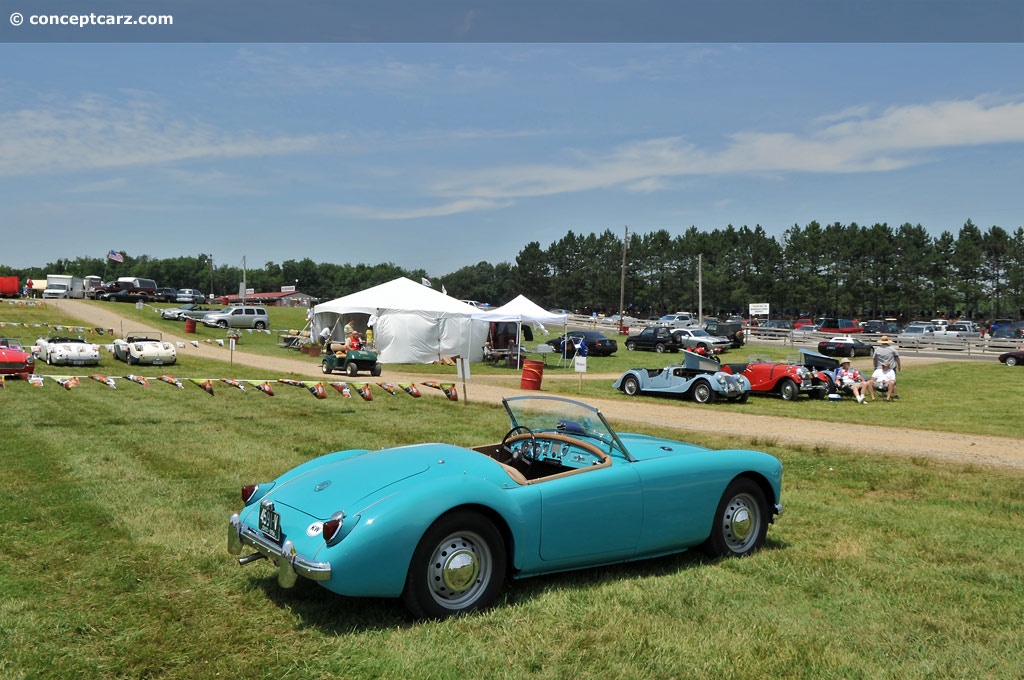
The arrival of the MGA Roadster in 1955 spelled the end for the pre-war appearance of the company's sports car, ushering in a modern design with a streamlined and aerodynamic shape. The old XPAG power plant was abandoned and replaced with a much more modern B-series engine, which had made its debut in the Magnette saloon. Announced on September 26th of 1955, production lasted from 1955 to 1962.
Roadster
Chassis #: HDA431/16810
View info and historyThe MGA served as a replacement to the MG TF 1500 Midget and was officially launched at the Frankfurt Motor Show. By the time production ended in July 1962, a total of 101,081 units had been built, with the majority being exported and just 5,869 examples sold on the home market. Specifications and Versions
The MGA used a body-on-frame design and was powered by the straight-4 'B Series' engine driving the rear wheels via a four-speed manual gearbox. The steering was by a rack-and-pinion system and the suspension was independent with wishbones and coil springs at the front while the rear used a rigid axle and semi-elliptic spring setup. Wire-spoked or steel-disc road wheels were available and Lockheed hydraulic drum brakes provided the stopping power. The wheelbase measured 94 inches and length of 156-inches. MG designer Syd Enever had created a streamlined body for George Philips' TD Midget Le Mans car in the early 1950s. Its fully enveloping body had ponton styling and a low bonnet line. The factory-built him a car, following several notable wins with his own TC fitted with a lightweight racing body. A road-going version of the Phillips car had been proposed to BMC in 1952 as a replacement for the TD Midget, but was rejected because of the corporation's plan to build the Austin-Healey 100. MG had experimented with the design by building a full prototype using TD running gear, a re-designed chassis, and an 1250 XPAG engine. Its favorable design was quickly ushered into production, and prior to the official launch of the MGA, three aluminum-bodied prototypes of the sports car were entered into Le Mans and were quite successful, finishing fifth and sixth in their class. Thus, when the MGA entered the marketplace, it already had an impressive racing pedigree, ensuring immediate acceptance by fans of the marque and the motoring public.
RoadsterThe MGA was built as a roadster or a coupe, with the convertible having no exterior door handles while the coupe did.Power was initially sourced from a 1,489cc engine with twin H4 type SU carburetors and delivering 68 horsepower, soon uprated to 72 hp. The MGA 1500 (named for its engine displacement size) was capable of sprinting from zero-to-sixty mph in 16 seconds and could nearly reach 100 mph, falling just shy of the magical number of 97.8 mph. The top speed rose to 113 mph by 1958 with the introduction of the high-performance Twin-Cam model which used a high-compression dual overhead camshaft aluminum cylinder head version of the B-Series engine. Compression was initially 9.9:1 but later reduced to 8.3:1 to aid in longevity and usability. The engine offered 108 horsepower with the higher compression and 100 bhp with the 8.3 version. To cope with the increase in power, Dunlop disc brakes were added, along with Dunlop peg drive knock-off steel wheels which were unique to the Twin-Cam and 'DeLuxe' MGA 1600 and 1600 MkII roadsters. The wheels were one of the distinguishable features of the Twin-Cam, along with 'Twin-Cam' logos located near the vent aside the bonnet. Although the Twin Cam engine allowed the MGA to crest the 100 mph barrier, it did detrimental damage to the model's reputation as it was notorious for engine detonation and burnt oil. MG rectified this issue by lowering the compression, but by then the damage had been done. Production of the Twin-Cam ended in April of 1960 with as many as 2,111 examples built. This was considerably lower than the 58,750 examples of the MGA fitted with the MGA 1500.
RoadsterEngine displacement grew to 1,588cc in May of 1959, ushering in the MGA 1600. The engine offered a reasonable 79.5 horsepower and performance heightened by the use of disc brakes at the front. Drum brakes remained in the rear. A higher specification, known as the MGA 1600 De-Luxe, added features of the Twin-Cam including the four-wheel disc brakes and the special wheels. A total of 70 roadsters and 12 coupes were the De-Luxe versions, making them much more exclusive than the 31,501 examples of the 1600.MG increased the displacement to 1,622cc in 1961 by increasing the bore slightly from 75.4mm to 76.2mm, birthing the Mark II version of the MGA 1600. Horsepower increase to 90 bhp, helped along with a revised cylinder head, re-engineered combustion chambers, and larger valves. A higher ratio 4:1 rear axle made the vehicle better suited for high-speed motoring. Styling remained unchanged, albeit with minimal distinguishable external cues distinguishing it from the previous version including the Morris Mini tail lamps appearing horizontally below the deck lid and an inset grille. By the time production of the Mark II came to a close, 8,198 examples were built as roadsters and 521 as coupes.
by Daniel Vaughan | Jan 2022

Roadster
Chassis #: HDA431/16810
View info and history
The MGA used a body-on-frame design and was powered by the straight-4 'B Series' engine driving the rear wheels via a four-speed manual gearbox. The steering was by a rack-and-pinion system and the suspension was independent with wishbones and coil springs at the front while the rear used a rigid axle and semi-elliptic spring setup. Wire-spoked or steel-disc road wheels were available and Lockheed hydraulic drum brakes provided the stopping power. The wheelbase measured 94 inches and length of 156-inches. MG designer Syd Enever had created a streamlined body for George Philips' TD Midget Le Mans car in the early 1950s. Its fully enveloping body had ponton styling and a low bonnet line. The factory-built him a car, following several notable wins with his own TC fitted with a lightweight racing body. A road-going version of the Phillips car had been proposed to BMC in 1952 as a replacement for the TD Midget, but was rejected because of the corporation's plan to build the Austin-Healey 100. MG had experimented with the design by building a full prototype using TD running gear, a re-designed chassis, and an 1250 XPAG engine. Its favorable design was quickly ushered into production, and prior to the official launch of the MGA, three aluminum-bodied prototypes of the sports car were entered into Le Mans and were quite successful, finishing fifth and sixth in their class. Thus, when the MGA entered the marketplace, it already had an impressive racing pedigree, ensuring immediate acceptance by fans of the marque and the motoring public.

Roadster
Roadster
by Daniel Vaughan | Jan 2022
Related Reading : MG MGA History
The MGA began production in 1955. The styling and mechanics were different from previous MG models. The public had been given hints of its new design during the 1951 Le-Mans 24 Hour endurance race. The car was driven by George Phillips and was actually a TD Midget with body modifications. The XPAG engine that had power many previous MGs was replaced by a new power plant. This 1489 cc four-cylinder,....
Continue Reading >>
Continue Reading >>
Similar Automakers
Similarly Sized Vehicles
from 1956
Similarly Priced Vehicles


1956 MG MGA 1500 Vehicle Profiles


Recent Vehicle Additions


Performance and Specification Comparison
Price Comparison
A 1500 Specification Comparison by Year
Year
Production
Wheelbase
Engine
Prices
Related Automotive News

Petersen Automotive Museum Gala Raises Record Funds & Includes Highest-Selling MGA In History
Sold for %24115,000 during the museums 26th Annual Gala Celebration, the 1961 MGA Outlaw marks the museums first frame-off restoration completed entirely in house 100 percent of the proceeds generated from the sale benefited The Petersen Automotive...

FROM SHELBYS TO SUPERCARS, RM SOTHEBY'S ARIZONA SALE OFFERS ICONIC COLLECTOR CARS OF EVERY ERA
Pure adrenaline 1965 Shelby 427 Competition Cobra, 1963 Shelby 289 Cobra Dragonsnake, and 1964 Shelby 289 Cobra lead recent entries for RM Sothebys Arizona Biltmore sale, January 28-29
Auction features more than 125 motor cars and offers incr...
RRDC VOTES IN 37 NEW MEMBERS FOR 2013
HILLIARD, Ohio (Nov. 7, 2013) - Thirty-seven race-car drivers and motorsports professionals have been voted into the Road Racing Drivers Club in 2013. The group includes 13 Regular Members from the open-wheel and sports-car racing ranks, 20 Associate...

Extremely Significant, Early Shelby Cobra Roadster an Exceptional and Early Headline Consignment to Russo and Steele's Upcoming Monterey Auction
Scottsdale, Arizona – With his AC Ace-derived, Ford-powered Cobra, Carroll Shelby and his racing team spearheaded Fords Total Performance campaign of the 1960s on the world stage and ended Ferraris dominance of the World Sportscar Championship for...

EXCEPTIONAL ROSTER OF PORSCHE RACE CARS JOIN THE STARTING GRID FOR RM'S EAGERLY AWAITED MONTEREY SALE
RM Auctions, the worlds largest collector car auction house for investment-quality automobiles, has announced more star consignments for its highly anticipated Monterey sale, August 17–18, in California, this time a remarkable group of Porsches. Comprising...