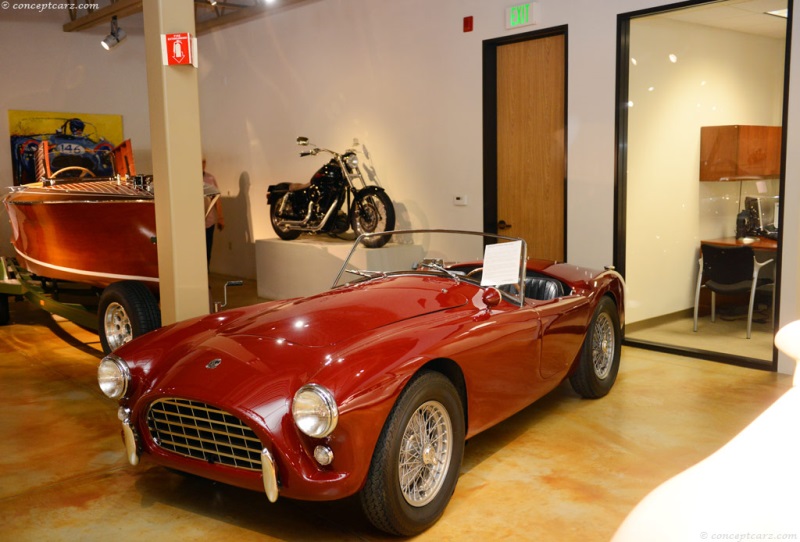
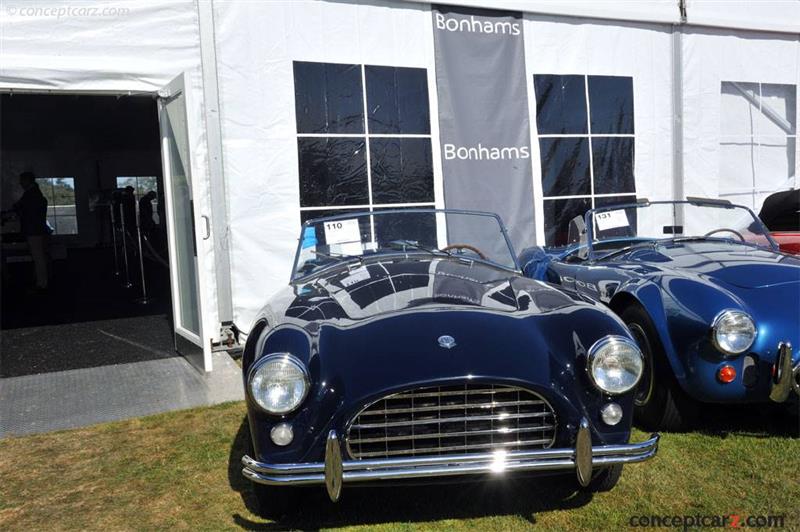
The AC Ace was first shown at the Earls Court Show in 1953 and began a new era of British post-war sports car production. The company's owners, Charles and Derek Hurlock, along with AC agent, Ken Rudd, transformed the company's reputation by using a racing special and putting it into production. The styling was influenced by Italian sports cars of the era and its racing chassis was courtesy of designer John Tojeiro. The AC used the same simple tubular ladder-type chassis with an aluminum body that had been used in his earlier specials. It was given an all-round independent suspension by transverse springs (which made it the first British sports car to employ this setup), offering minimal body roll and superb handling. The ACE chassis would later be used by Carroll Shelby for his Cobras and would be powered by over three times the power of the original 105 bhp, Weller-designed, six-cylinder engine.
The AC was later given a more refined Bristol straight-six powerplant, which had evolved from the pre-war BMW 328. This engine was better suited to racing, which had been proved with some success by Cooper. In standard form, the engine offered 128 horsepower at 6000 RPM. The engine was heavier and taller than AC's own engine, however, the BMW-based Bristol was more powerful thanks to its superior cylinder head design and downdraft carburetors. In road trim, the engine offered 130 bhp, which gave the Ace a top speed of around 120 mph. Racing versions had an engine that offered around 150 bhp.
The Ace Bristol enjoyed its own success in competition, being campaigned by enthusiastic club racers, private owners, and most famously by the Ken Rudd team at Le Mans in 1957 and 1958. They raced at Le Mans from 1957 to 1962 by various entrants.
Along with offering more power, the Bristol-engined Ace was considerably more expensive, costing an additional 22% over the price of the AC-engined version.
A hardtop version, called the fastback-style Aceca, was added in 1955. From 1956 onwards, both models became available with the more powerful Bristol 2-litre, six-cylinder engine with its pushrod-operated inclined valves.
By the time production of the Ace ceased in 1963, more than half the 723 cars built had left the factory fitted with Bristol engines. Near the close of production, the Ace was also available with the 2.6-liter overhead-valve Ford Zephyr engine installed. 223 examples were delivered with the 2.0-liter AC engine, 463 Bristol-engined cars, and 37 Ford-power examples.
by Daniel Vaughan | Oct 2019
The AC was later given a more refined Bristol straight-six powerplant, which had evolved from the pre-war BMW 328. This engine was better suited to racing, which had been proved with some success by Cooper. In standard form, the engine offered 128 horsepower at 6000 RPM. The engine was heavier and taller than AC's own engine, however, the BMW-based Bristol was more powerful thanks to its superior cylinder head design and downdraft carburetors. In road trim, the engine offered 130 bhp, which gave the Ace a top speed of around 120 mph. Racing versions had an engine that offered around 150 bhp.
The Ace Bristol enjoyed its own success in competition, being campaigned by enthusiastic club racers, private owners, and most famously by the Ken Rudd team at Le Mans in 1957 and 1958. They raced at Le Mans from 1957 to 1962 by various entrants.
Along with offering more power, the Bristol-engined Ace was considerably more expensive, costing an additional 22% over the price of the AC-engined version.
A hardtop version, called the fastback-style Aceca, was added in 1955. From 1956 onwards, both models became available with the more powerful Bristol 2-litre, six-cylinder engine with its pushrod-operated inclined valves.
By the time production of the Ace ceased in 1963, more than half the 723 cars built had left the factory fitted with Bristol engines. Near the close of production, the Ace was also available with the 2.6-liter overhead-valve Ford Zephyr engine installed. 223 examples were delivered with the 2.0-liter AC engine, 463 Bristol-engined cars, and 37 Ford-power examples.
by Daniel Vaughan | Oct 2019
Related Reading : AC Ace History
The Ace was introduced in 1953 at the London Motor Show and was produced beginning in 1954 and continuing through 1963. The vehicle consisted of lightweight tubular chassis with steel boxes in the front and rear which supported a transverse leaf and lower wishbone independent suspension system. The chassis was designed by John Tojeiro. Power was initially provided by a Welleter-designed engine and....
Continue Reading >>
Continue Reading >>
Related Reading : AC Ace History
The oldest British car manufacturer, AC has continuously produced vehicles since 1901 and the marque carries enormous prestige. The AC Aceca, a closed coupe, was unveiled in 1954 in London and only 328 prototypes were ever produced. Production of the Aceca Coupe commenced in 1955 and Le Mans 1957 was a lucrative one for AC, with an AC Bristol finishing tenth overall. 1958 was an even better year....
Continue Reading >>
Continue Reading >>


1958 AC Ace Vehicle Profiles

Recent Vehicle Additions


Performance and Specification Comparison
Price Comparison
$5,700
Ace Specification Comparison by Year
Year
Production
Wheelbase
Engine
Prices
Related Automotive News

Gooding & Company Presents the Best of American Motoring, from Brass Era Legends to Postwar Sports Cars, at Its Pebble Beach Auctions
An incredible 1912 Simplex 50 HP Toy Tonneau, offered for sale from 111 years of single family ownership, will come to market for the first time, alongside motoring icons from the greatest eras of American automotive history.
The official auction...

Blue-Chip Classics and Legendary 50s and 60s Sports Cars Added to Gooding & Company's Amelia Island Auction
Gooding %26 Company is revving up for its upcoming Amelia Island Auction with a stellar lineup of offerings. The auction house today announced yet another spectacular group of consignments, consisting of iconic sports and racing cars from the 1950s and...

BARRETT-JACKSON SCOTTSDALE AUCTION DOCKET TO INCLUDE HIGHLY DESIRABLE VINTAGE SHELBY MUSTANGS
Originally shipped to Peru, a 1966 Shelby GT350 (Lot #1324) headed to Scottsdale was raced extensively by Teodoro Yagali in the 1970s and was restored to its original build in 2015
A 1968 Shelby GT500KR Convertible (Lot #1368) was once owned by tenn...

THE FINEST CARRERA MODELS AND RARITIES FROM ITALY TO FEATURE PROMINENTLY AT BONHAMS SCOTTSDALE AUCTION
Impressive line-up of German and Italian sports cars headlines January sale in Arizona Select consignments still sought
Bonhams fifth annual Scottsdale auction will feature, among many exciting automobiles, an incredible selection of sports...

Carroll Shelby, Ford Family for More Than Half a Century
Carroll Shelby was a member of the Ford family for the better part of 60 years, producing stunning performance vehicles from concepts to production models.
He once said his energy and passion for performance products were always strongest when he was...