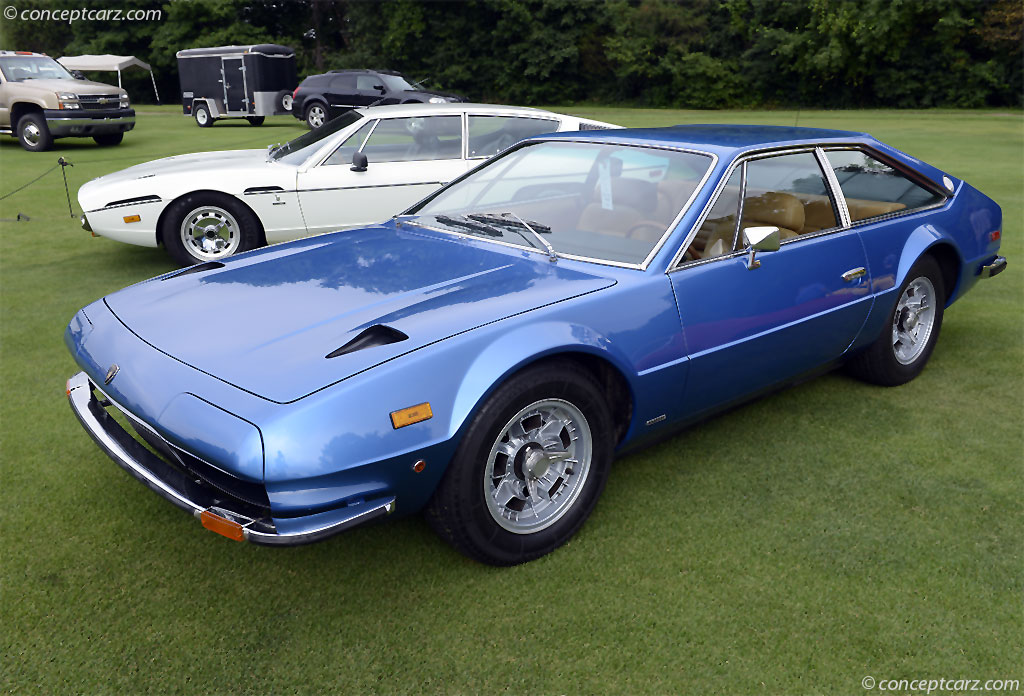
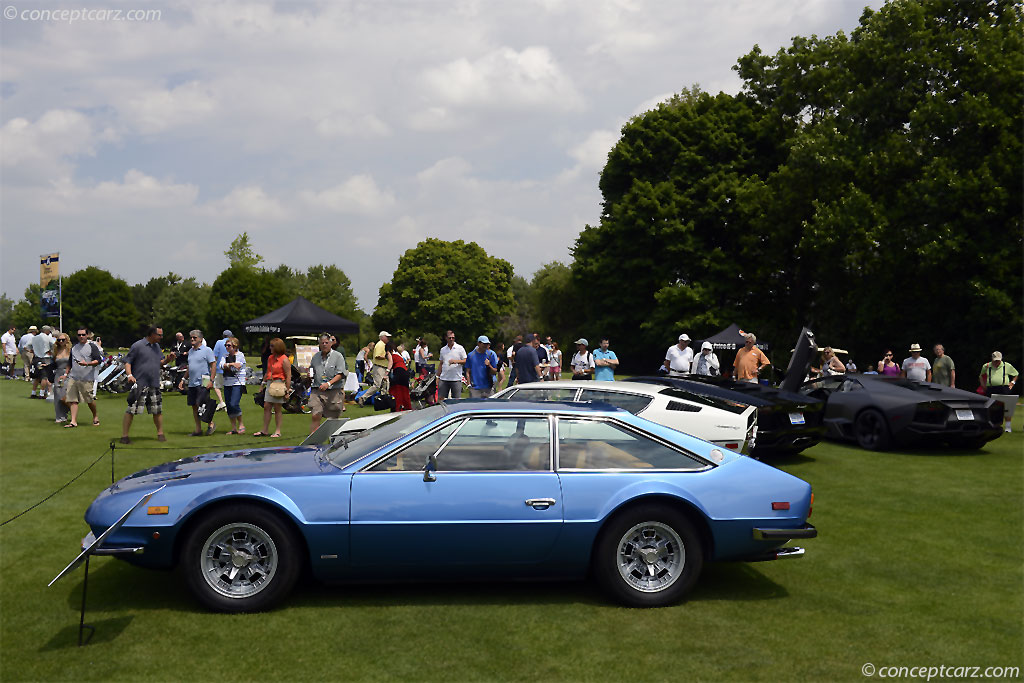
The list of Lamborghini's front engine, rear-wheel drive grand touring automobiles with twelve-cylinder power began with the 350 GT wearing coachwork by Carrozzeria Touring and introduced in 1964 at the Geneva Motor Show. Next came the 400 GT, followed by the Islero, and finally by the Jarama. Introduced at the Geneva Motor Show in 1970, production would continue through 1976 with a total of 176 examples built plus 152 examples of the Jarama S. The Jarama was an important replacement for the Islero as it complied with American safety and emission regulations. By this point in history, Giampaolo Dallara had left Sant'Agata, so the task of creating the Jarama fell to his former assistant and now chief engineer, Paolo Stanzini. A full 10.7 inches were removed from the Espada wheelbase, now measuring 93.7 inches and having an overall length of 176.6-inches (two inches shorter than the Islero). Both the Islero and the Jarama were styled by Marcello Gandini, with angular 2+2 design cues, flared wheel arches and NACA hood ducts. The Jarama received unique hooded headlights all its own. The wide track was shared with the Espada, giving the small Lamborghini a broad-shouldered look that was attributed to Bertone's Marcello Gandini. Marazzi, who designed and built the Islero's bodywork, handled the construction of the Jarama's body construction. The Lamborghini Jarama was not named after the famous race track outside of Madrid but after the Spanish district made famous for its breeding of fighting Bulls.Beneath the long and graceful bonnet was a twelve-cylinder engine with a displacement size of 3,929cc, the same engine powering the Islero and Espada and heavily derived from the 400 GT. With the help of six Weber 40 DCOE carburetors, it produced 350 horsepower which was sent to the rear wheels via a five-speed manual transmission. 177 examples of the Jarama 400GT were built from 1971 through to 1973 before the model was upgraded to the 400 GTS status. Modifications to the carburetors, heads, and the exhaust system added an additional 15 horsepower, now rated at 365 bhp. Minor styling updates were made to the exterior, including a hood scoop, relocated turn signals, exhaust vents in the fenders, and windshield position adjustments. The previous center-locking magnesium alloy wheels were replaced with new wheels on five-bolt hubs, the same as used on the Series 3 Espada. Updates to the interior were more extensive with a redesigned dashboard trimmed in aluminum, switches relocated to the center console, extra sound insulation, and improved rear seats and legroom. Mechanical updates included an optional Chrysler TorqueFlite automatic transmission, removable roof panels, and power-assisted steering (early into Jarama S production).
by Daniel Vaughan | Aug 2022
by Daniel Vaughan | Aug 2022
Related Reading : Lamborghini Jarama History
In the early 1970s, manufacturers that were producing vehicles for the United States had to comply with new government regulations and emission standards that not only made the vehicles safer but more fuel efficient. The Islero was forced to comply in order to continue to be sold in the United States. Marcello Gandini of Bertone was tasked with creating designs that would fit atop of a shortened....
Continue Reading >>
Continue Reading >>
Related Reading : Lamborghini Jarama History
With subdued looks that belied its V12 power, the Lamborghini Jarama was among the very last of Lamborghinis grand touring cars before the Italian carmaker decided to pursue fulltime the production of two-seat supercars. The Jarama was built in the same spirit as the very first Lamborghinis. It was comfortable and capable, with no more flash than necessary. Created to replace the Lamborghini Islero,....
Continue Reading >>
Continue Reading >>
Similar Automakers


1970 Lamborghini Jarama Vehicle Profiles
Recent Vehicle Additions


Performance and Specification Comparison
Price Comparison
$13,955
$19,506
$19,755
Jarama GT Specification Comparison by Year
Year
Production
Wheelbase
Engine
Prices
Related Automotive News

Lamborghini Celebrates The 50Th Anniversary Of The Jarama GT
This year marks the 50th Anniversary of the Lamborghini Jarama GT, presented for the first time at the Geneva Motor Show in March 1970.
The Jarama, whose name derives from an area north of Madrid famous for breeding fighting bulls, was the latest evolution...
Lamborghini Celebrates The 50Th Anniversary Of The Jarama GT
This year marks the 50th Anniversary of the Lamborghini Jarama GT, presented for the first time at the Geneva Motor Show in March 1970.
The Jarama, whose name derives from an area north of Madrid famous for breeding fighting bulls, was the latest evolution...

Alpine Announces UK Prices For A110 Pure And Legende
A110 Pure, providing a focused driving experience, priced from £46,905 on-the-road (OTR) A110 Légende, a more refined and sophisticated tourer, priced from £50,805 OTR A110 Premiere Edition sold out in five days with UK deliveries commenc...

FIAT 124 SPIDER ANNIVERSARY EDITION IS SOLD OUT
Revealed for the first time at the 2016 Geneva Motor Show in March, the FIAT 124 Spider Anniversary Edition was designed to commemorate the 50th anniversary of the unveiling of the original roadster in Turin in 1966.
The exclusive special edition, of...

THE 2016 NISSAN LINEUP: CHARTING THE CHANGES
Nissan is a brand on the move. And on a roll. The past two years have seen the back-to-back introductions of the segment-busting 2014 Rogue and 2015 Murano, which helped drive Nissan to record 2014 calendar year sales of 1,269,565 (12.2) in the United...
NEW YORK AUTO SHOW CONCEPT CARS: THE FUTURE STARTS HERE
NEW YORK, April 7, 2014 - With an awe-inspiring combination of new design ideas and technological innovation, this years concept cars at the New York International Automobile Show reveal whats to come in the automotive world.
The Auto Show...