1939 Lagonda V12 LeMans
1939 Lagonda V12 LeMans Navigation
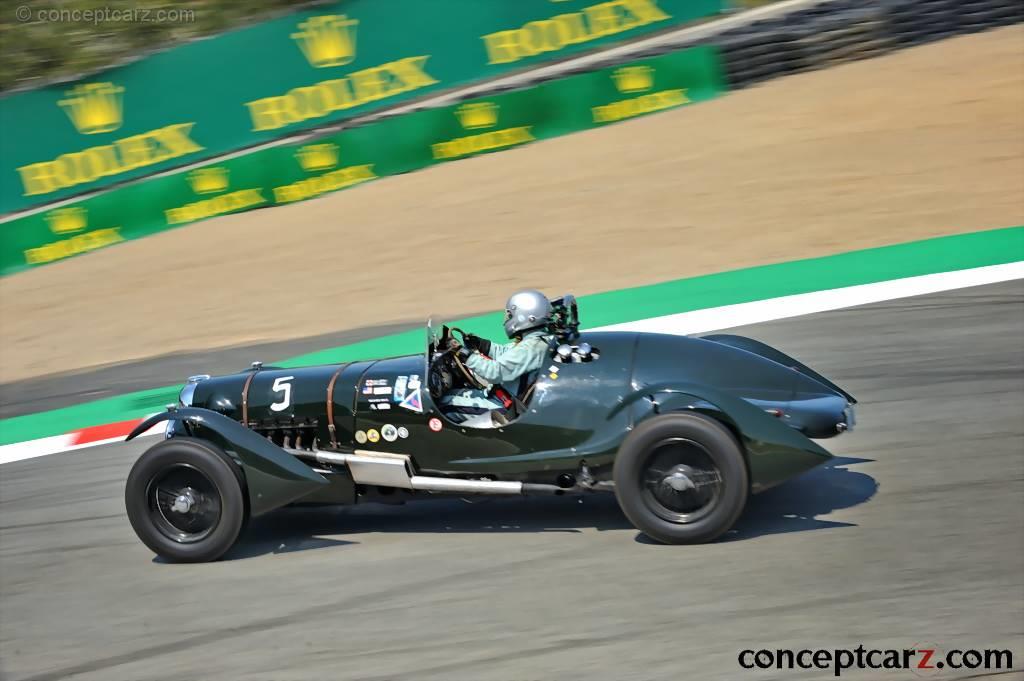
Alan P. Good outbid Rolls-Royce for Lagonda in 1935, gaining the company and W.O. Bentley as chief engineer. Rolls-Royce had successfully absorbed W.O. Bentley's namesake into its fold, but W.O. would remain elusive and in fact, was soon joined by many of his former engineering staff from Rolls-Royce, including engineers Stuart Tresilian and Charles Sewell. Working as technical director, W.O. infused his mechanical talents into the Lagonda offerings and mounted a motorsport campaign with sights set on the 24 Hours of Le Mans. 
Roadster
Chassis #: 14108
View info and historyThe British-based Lagonda company was established in 1906 by American-born Wilbur Gunn who had become a British national in 1891. The company's name was in recognition of the Shawnee settlement 'Lagonda' in modern-day Springfield (Buck Creek), Ohio, the town of Mr. Gunn's birth. His career as an opera singer brought him to England, but it was his expertise as a mechanic and engineer that kept him afloat after his singing career ended. Mr. Gunn worked as an engineer, mostly on motorcycles, before starting the Lagonda business. Motorcycle production was followed by automobiles, and the company's first motorcar was a six-cylinder, 20-horsepower Torpedo, which was used to win the Moscow to St. Petersburg trial of 1910. The company would build a reputation around its lightweight racing specials that were raced with much success at racing events worldwide. Even after Wilbur Gunn passed away on September 27th, 1920, the company continued down the performance path, gaining favor with like-minded and wealthy privateers along the way. The talents of W.O. Bentley perfectly aligned with the sporty nature of the company, but even with his team of talented and knowledgable engineers, faced the monumental task set forth by Mr. Good of creating the world's best motorcar in just two years. The engineering tour de force that followed ranks among the finest ever created, especially in the immediate prewar era, and rivaled the contemporary multi-cylinder products from the Paragons of the motoring industry of the era.The Lagonda V-12s of 1937 to 1940 are among the most sophisticated cars ever built, from mechanical prowess to streamlined designs. At the heart of the new Lagonda was an engine with a 60-degree Veed angle, single overhead camshaft per cylinder bank, and modern overhead-valve cylinder heads. A pair of new-design SU downdraft carburetors helped in developing 180 horsepower at 5,500 engine revolutions, with massive amounts of torque. With a four-carburetor setup, output rose to a claimed 220 horsepower. Along with power, the high revving, 4,480cc engine was durable and lightweight, making generous use of leading-edge metallurgy and materials, and rigorously tested and fined tuned. The four-speed gearbox was controlled by a centrally-mounted change lever.
Roadster
Chassis #: 14108
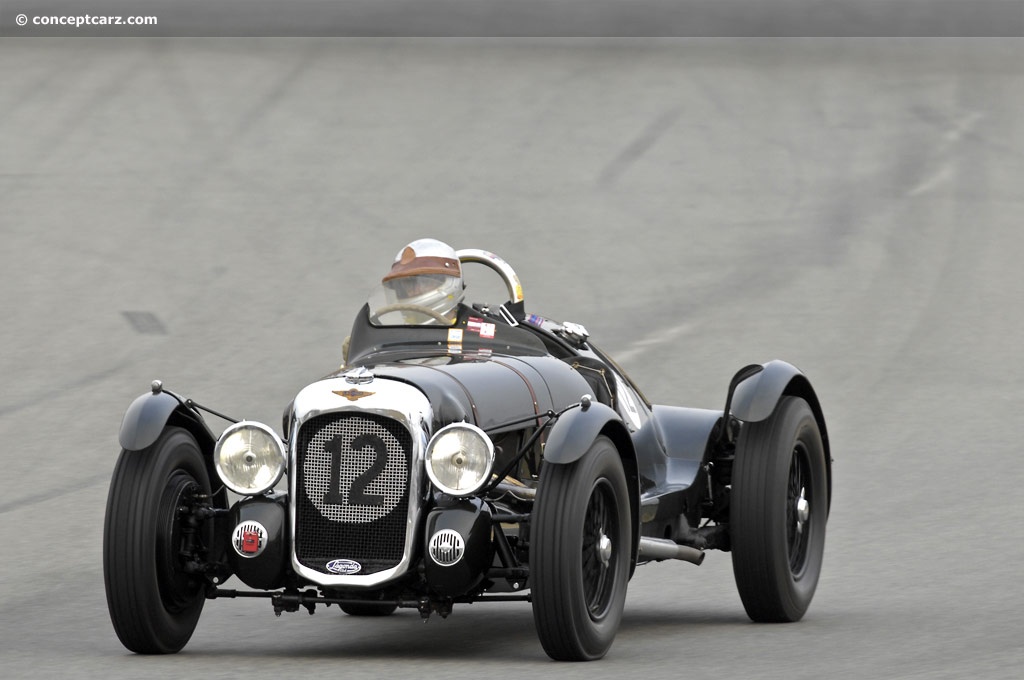
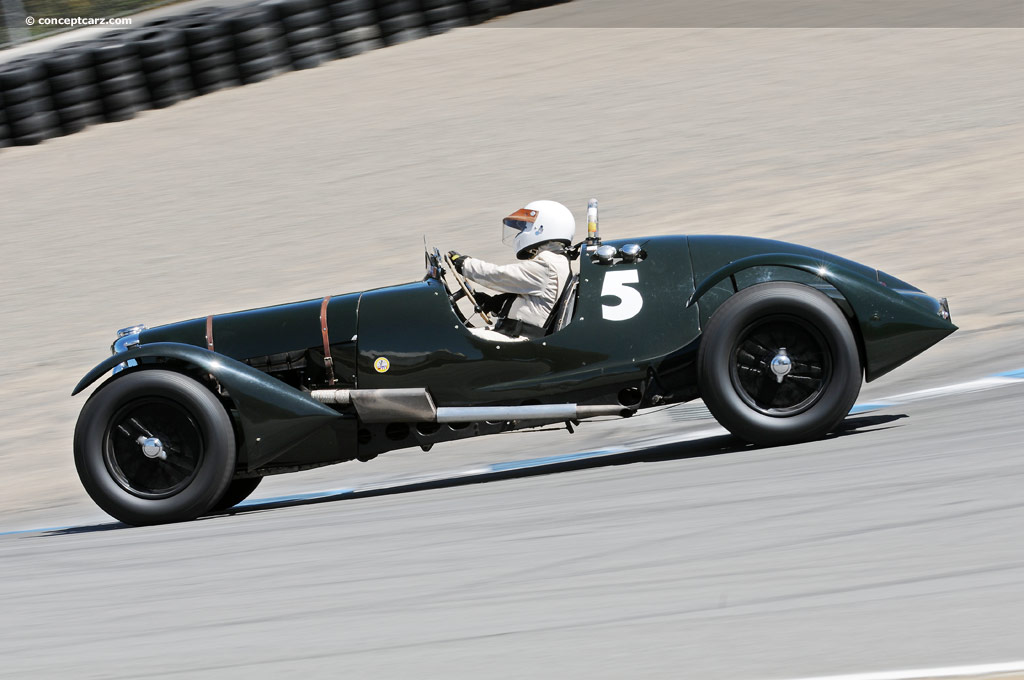
View info and historyThe box-section frame had cross members and cruciform bracing for strength and rigidity and was suspended by an advanced independent torsion-bar front suspension with a live rear axle with hypoid final driving. The stopping was handled by modern hydraulic drum brakes from Lockheed. Wheelbase sizes included 124-, 132, and 138-inches, with just ten examples utilizing the long-wheelbase platform. In comparison to the Lagonda V12's predecessor, it sat lower and was longer and wider, with the V12 engine installed low in the chassis, enhancing the vehicle's performance. Production of the V12 was brief, lasting from 1938 to 1940 with approximately 189 examples built. To compete successfully at Le Mans, W.O. Bentley employed every tactic to gain a competitive edge, including using lighter steel and drilling holes in the frame to reduce weight as much as possible. Narrow gauge steel was used for the ten-foot, four-inch wheelbase chassis frame and the brake drums had six holes drilled into each. To ensure water did not enter into the holes in the brakes, they were capped with light aluminum lids. In the front was the new two-leading shoe pattern by Lockheed with cooling air scoops on the backplates. The hand-formed, lightweight, streamlined bodywork was constructed in five major sections and secured directly to the chassis, with no interior framework, via quick-release fasteners.
Roadster
Chassis #: 14108
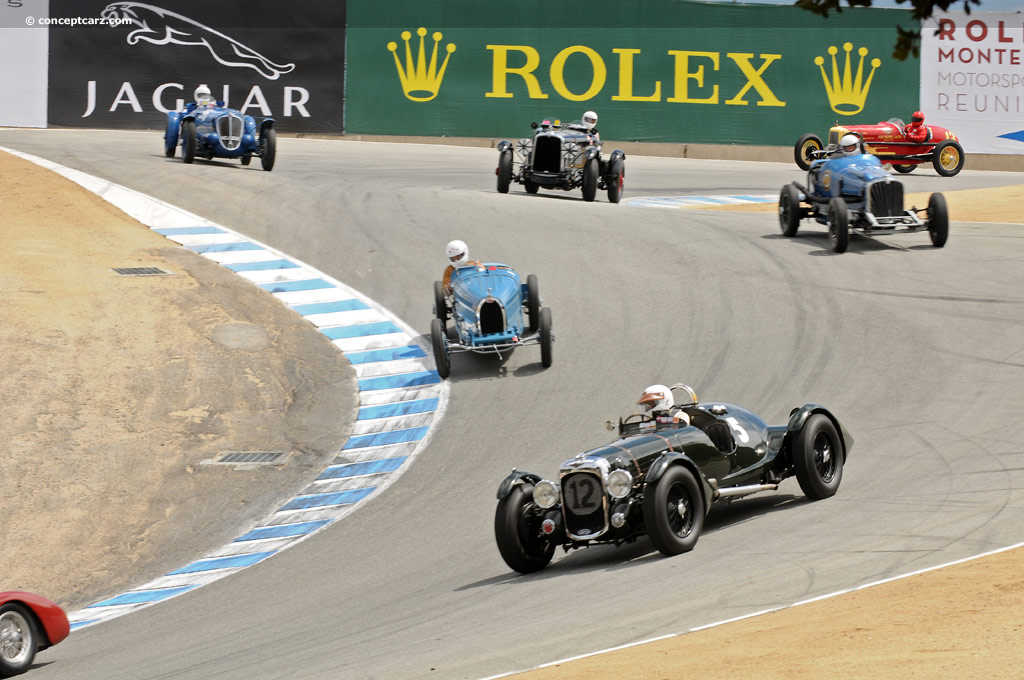
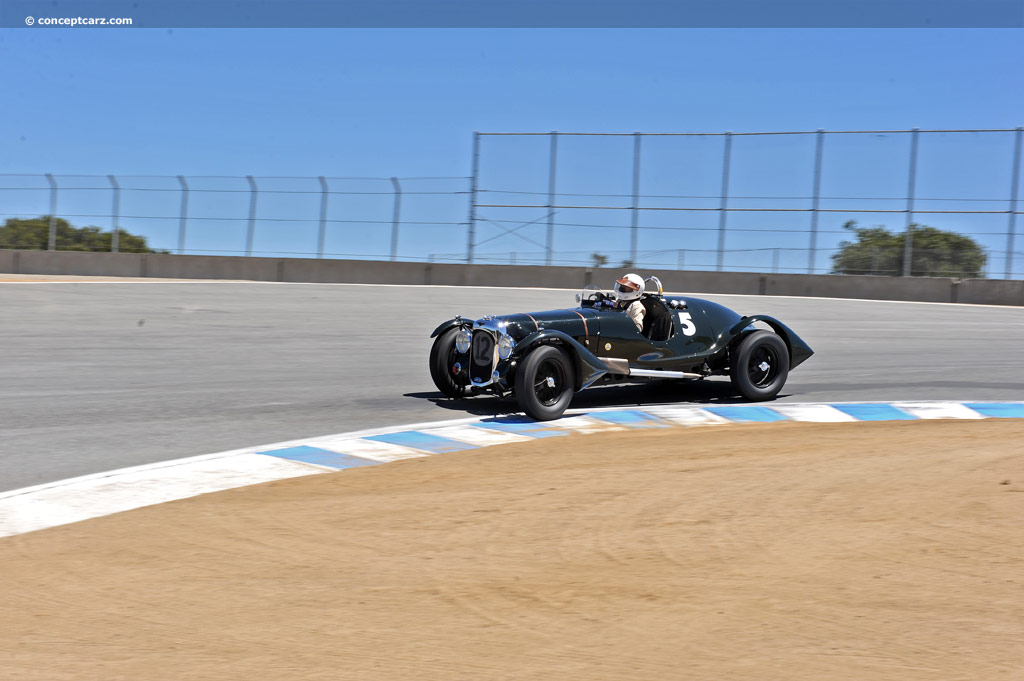
View info and historyInitially, plans were to build and race a single entry, but Lagonda was motivated by the deep pockets of newly titled Lord Selsdon. Born Peter Mitchell-Thomson in 1913, he acceded to his title as the 2nd Baron Selsdon in 1938, gaining a vast fortune in the process. With some motorsport success behind the wheel of Frazer Nash cars at Brooklands, the 26-year-old was now able to compete at Le Mans. Without a suitable mount, he approached Alan Good, who was very eager to accept the profitable challenge. The Lagonda Works Le Man's entry completed test laps around the factory site at Staines Bridge prior to setting off for Le Mans. With very little testing and having only recently been built, the two cars were given race numbers '5' and '6.' The number '5' was the works entry driven by Arthur Dobson and Charles Brackenbury, while the number '6' car was driven by Lord Selsdon and his 34-year-old friend, Lord Waleran (William George Hood Walrond). Their Lordship was making their racing debut at the high-speed circuit and used the drive to Le Mans as a means to gain experience and test their vehicle. Perhaps youthful ambition or the superior engineering prowess of the Lagonda, the number '6' placed fourth overall. The third-place finisher, and first in class, was number '5' who had covered 239 laps and 2,006 miles at an average speed of 83.21 mph.
Roadster
Chassis #: 14108
View info and historyThe outbreak of World War II and the damaging of circuit facilities meant the Le Man's race would not resume until 1949. The two Lagondas that raced at the 1939 Le Mans were part of the forty-two car field, fourteen of which were British cars. Of the fifteen cars that finished the race, ten of them were British. Both the number 5 and number 6 cars were later raced at the August Bank Holiday Brooklands race meeting. The number 5 now wore race number 8, while Lord Selsdon's number 6 car was renumbered as number 5. The car driven by Brackenbury won the race by 3.8 seconds over Seldson in the 2nd place car. In third place was G.L. Baker in a Graham-Paige. Unbeknownst to everyone at the time, this would be the final Brookland event on the old Motor Course. Lord Selsdon was scheduled to compete in the 1939 Liege Grand Prix in Belgium on August 27th, but it was canceled.
Roadster
Chassis #: 14108
View info and historyWith the outbreak of World War II in early September, the Lagonda factory turned its attention to aiding in the war effort and supporting the Royal Air Force. They were, however, able to complete a few more Lagonda LG6 and V12 vehicles in 1939 and even into 1940. Both 1939 Lagonda V12 Le Man's racers were extensively damaged in 1944 when a bomb fell near the factory, but thankfully the ensuring fire did not reach the cars. The cars had been resting dormant since the outbreak of war, with their tires and body parts removed. When the two Le Man's racers emerged from the damaged factory, they were brought to a nearby workshop and repaired. The works-entered Le Mans V12 was road-registered 'GRK 77' while Lord Selsdon's car had been registered pre-war as 'HPL 449.' The Works entry was chassis number 14089, and the Selsdon car was chassis 14090.
by Daniel Vaughan | Feb 2022

Roadster
Chassis #: 14108
View info and history
Roadster
Chassis #: 14108
View info and history
Roadster
Chassis #: 14108
View info and history
Roadster
Chassis #: 14108
View info and history
Roadster
Chassis #: 14108
View info and history
by Daniel Vaughan | Feb 2022
Related Reading : Lagonda V12 History
Wilbur Gunn constructed his first self-propelled vehicle in 1899 it was a motorized bicycle with an engine of his own design that powered the front wheel. Soon, his backyard greenhouse had been converted into a factory used for constructing belt-driven motorcycles. Gunn, an American opera singer living in England, had selected the name Lagonda from an Ohio creek. The creek had been named after....
Continue Reading >>
Continue Reading >>
- 1939 Lagonda V12 LeMans Menu
- Article
- Image gallery
- Valuation
- Specifications
- Profiles


1939 Lagonda V12 LeMans Vehicle Profiles

Recent Vehicle Additions


Performance and Specification Comparison
V12 Specification Comparison by Year
Year
Production
Wheelbase
Engine
Prices
12 cyl., 274.61 CID., 165.00hp
Related Automotive News

Speed Six Continuation Series starts testing as final 4½ Litre 'Blower' is completed
Speed Six Continuation Series begins durability testing, following debuts of Car Zero and Factory Works cars
Twelve-strong 4½ Litre Blower Continuation Series completes build
8.000 km of dynamic driving to be completed to prove engineering qual...

Historic and Prestigious Classics to Take Center Stage at Gooding & Company's Pebble Beach Auctions; Full Catalogue Launches Online Today
The undisputed star of the show is the 1937 Bugatti Type 57SC Atalante, alongside a 1930 Bentley 4 12 Litre Supercharged Blower Sports Tourer and a 1931 Bentley Eight Litre Sports Tourer.
The official auction house of the Pebble Beach Concours...
Britain's Automotive Greats to be Celebrated at London Concours in 2022
Rarest and most significant pre-war British cars to be savoured at Londons Honourable Artillery Company later this month.
Examples from this countrys great marques – from Rolls-Royce to Bentley - will be united at the capitals leading concours d...

Bentley Mulliner Prepares Trio Of Debuts For Salon Privé
Bentley to return to Salon Privé with Mulliner showcase
Three cars to make world public debuts on 22 September
New members of Bentley Mulliner Collections and Coachbuilt portfolios to be displayed
Bentley Mulliner Bacalar makes public debut
Res...

Bentley Ready For Classic Thousand Mile Challenge
Iconic Bentley Blowers ready for great Mille Miglia adventure
Bentley Continental W12 and V8 models join historic cars in Italy
(Crewe, England %26 Brescia, Italy. 16 May, 2012) W.O. Bentleys gift for creating cars that combined the speed o...