When World War II came to a close, most automakers resumed civilian automobile production using mildly updated versions of their pre-war products. Most introduced all-new products in either 1949 or 1950, with another major restyling styling occurring in the mid-1950s. Studebaker introduced new low-slung styling in 1953, followed by a takeover by Packard in 1954, and the introduction of the low-priced Lark in late 1958. The lower-priced Studebakers provided the company with the bulk of its sales during the late 1950s as the economy wrestled with the recession of 1958, also known as the Eisenhower Recession, which stretched beyond the borders of the United States, into Canada and Europe, causing many businesses to close. Victims caught in its wake include Imperial, Continental, DeSoto, and the ill-timed Edsel. 
Hardtop
Chassis #: 811
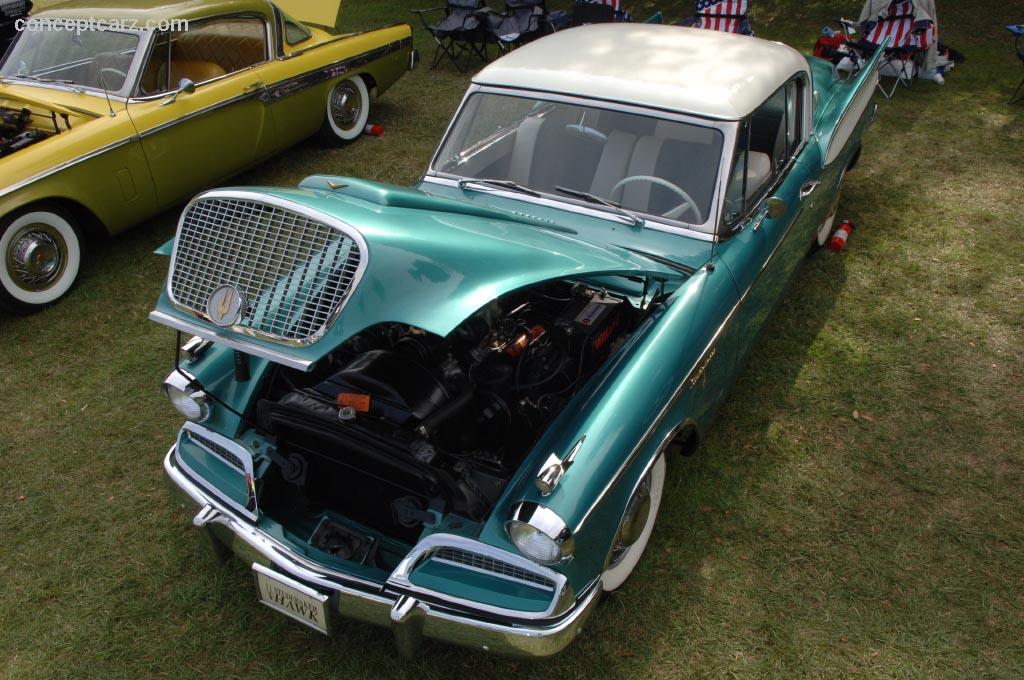
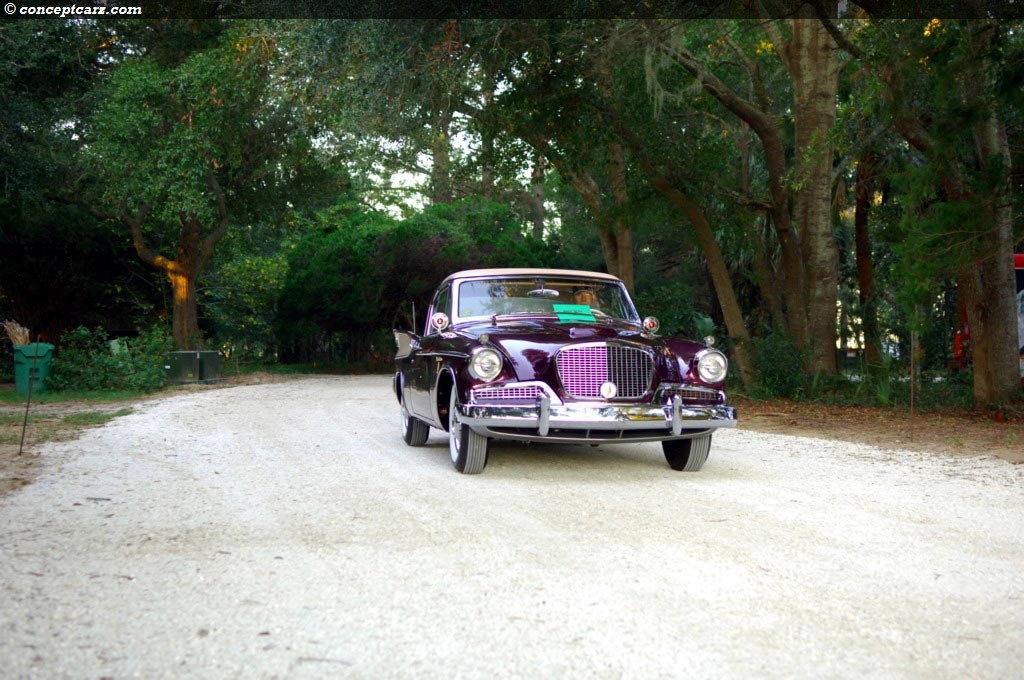
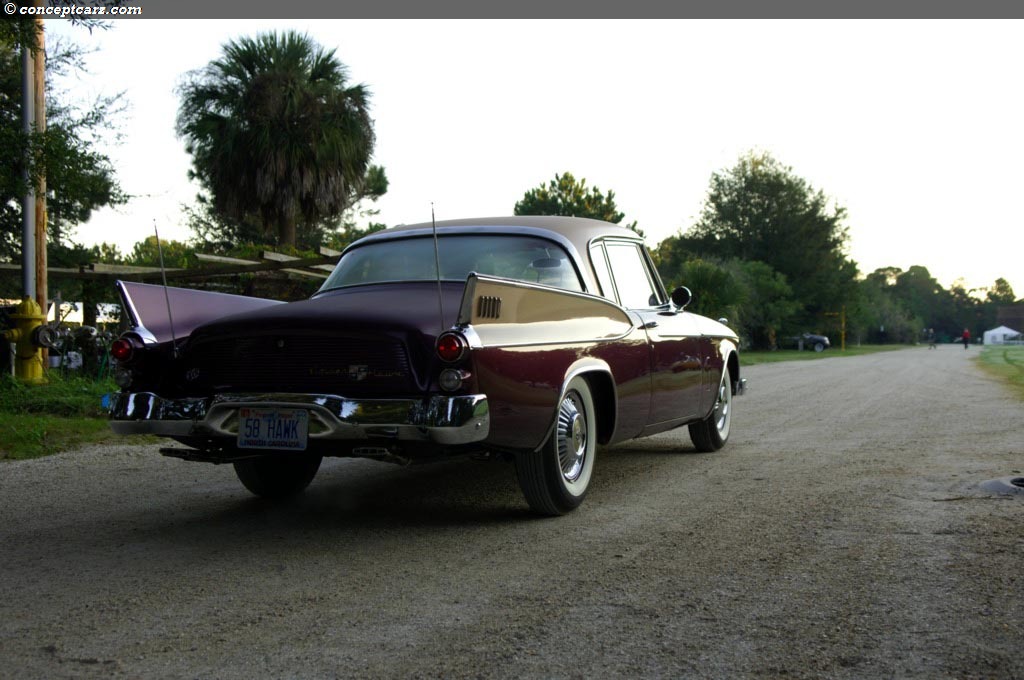
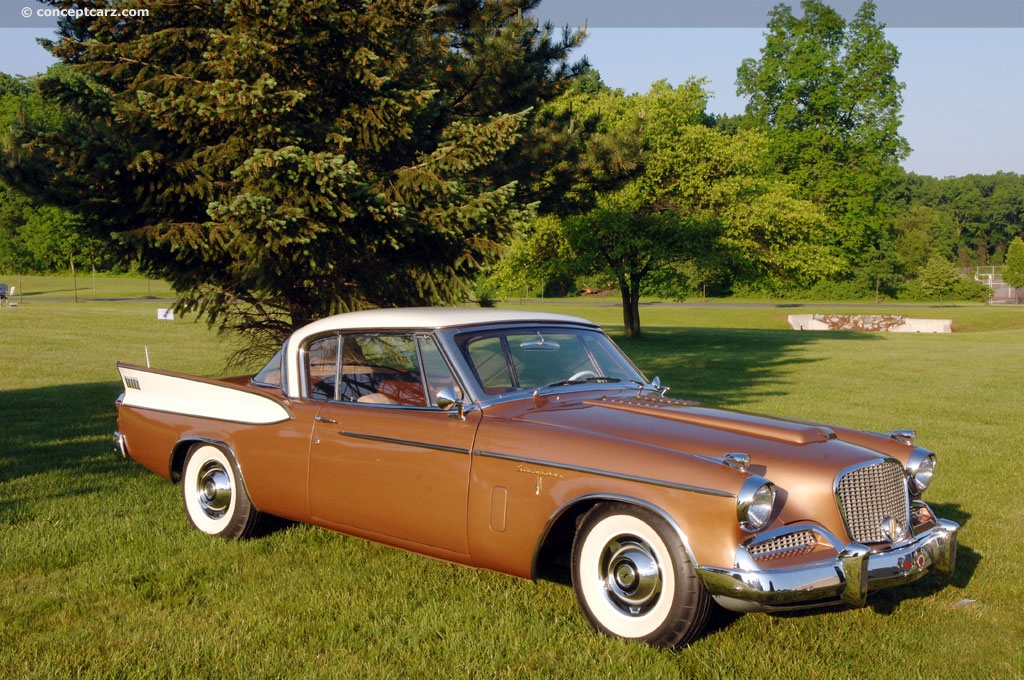
View info and historyThe mid-to-late 1950s witnessed memorable and iconic designs, including the Chevy Corvette, Ford Thunderbird, Chrysler 300 Series, DeSoto Adventurer, the Chrysler Corporation's 'Forward Look' design theme by stylist Virgil Exner, towering tail fins, space-age styling, and ever-increasing horsepower ratings. Although lacking the financial means of the Big Three, Studebaker employed creative and resourceful designers, such as Robert Bourke from Raymond Loewy Associates, who had a talent for transforming older models into much more modern-looking machinery on a low budget. Beginning with the 1953 Starliner, the design team bolted on a different set of fenders in the front and rear, altered the hood, deck lines, and roofline, and added a Mercedes-Benz style grille and fitted aluminum rocker covers to slim down the body. The result was a 2+2 coupe with a modern appearance that would be offered in several models and powertrains. The top-of-the-line version from 1956 to 1958 was the Golden Hawk featuring wide grooved, horizontal moldings located above the rocker panels and small upright fiberglass fins on the top of the rear fenders. Power was from a 352 cubic-inch Overhead Valve, Packard V8 with five main bearings, and hydraulic valve lifters, and it delivered 275 horsepower at 4,600 RPM. In 1957, the Golden Hawk received a 289 CID V8 equipped with a belt-driven McCullough supercharger, delivering the same 275 horsepower as its predecessor with fewer cubic inches. Packard's Utica, Michigan, engine plant had been leased to Curtiss-Wright during 1956 and was eventually sold to them, bringing the end of genuine Packard production. The addition of the supercharger meant a slight redesign for the hood, accomplished by using a fiberglass overlay. In the back were tailfins, now made of metal, that were concave, swept out from the sides of the car, and outlined in chrome trim.
Hardtop
Chassis #: 811
View info and historyMid-way through 1957, Studebaker introduced a luxury 400 model equipped with a leather interior, special trim, and a fully upholstered trunk. A mere 41 of these special editions were built.Going into 1958, Studebaker gave the Golden Hawk an even lower stance with 14-inch wheels replacing the prior 15-inch units. The 15-inch wheels were still available as optional equipment. In the front was a new, round Hawk medallion positioned in the lower center of the grille, and the available contrasting-color paint was now applied to both the tailfins and roof. Along with the minor styling updates, minor engineering changes were implemented, included to the driveshaft and suspension. These modifications allowed designers to create a three-passenger rear seat, finally doing away with the high driveshaft 'hump' and divided two-passenger seating. Earlier 1958 models had a fixed armrest between the rear passengers, later replaced by a third seat following customer prompting.
Hardtop
View info and historyThe Studebaker Golden Hawk was exclusive during all three years of its existence, with 4,071 examples built in 1956, 4,356 in 1957, and 878 in its final year. Prices began at $3,360 in 1956, rose to $3,180 in 1957, and peaked at $3,280 in its final year. Comparison
The 1958 Chrysler 300D was priced at $5,170 for its hardtop coupe and $5,600 for its convertible coupe. Six hundred eighteen examples of its hardtop coupe and 191 of its convertible were built. Power was from a 392 cubic-inch V8 with hemispherical combustion chambers and delivered 380 horsepower. The 1958 DeSoto Adventurer was priced at $4,070 for its hardtop coupe and $4,370 for its convertible coupe. Three hundred fifty examples of its hardtop coupe and 82 of its convertible coupe were built. Power was from a 361 cubic-inch V8 delivering 345 horsepower.
Hardtop
View info and historyThe 1958 Buick Roadmaster was priced from $4,560 to $4,680, offered as a two- or four-door hardtop and a convertible, and powered by a 364 CID V8 with 300 horsepower. A combined total of just over 14,000 examples were built.The 1958 Cadillac Series Sixty Special Fleetwood hardtop sedan listed for $6,230, and 12,900 examples were built. The engine was a 365 CID V8 with 310 horsepower. The 1958 Chevy Corvette convertible listed for $3,630 with 9,168 examples built. Power was from a 283 CID V8 offering 230 horsepower.
HardtopThe 1958 Ford Thunderbird, offered as a hardtop coupe at $3,630 and a convertible at $3,920, was powered by a 292 CID V8 with 205 horsepower (an optional 332 CID V8 delivered 240 hp and 265 hp depending on setup, and the 352 CID V8 had 300 horsepower).Conclusion
Although it lacked the resources of the Big Three, Studebaker produced a competitive product that was modern, attractive, and powerful at an affordable price. The sales figures were reflective of the value and on par with the rest of the industry.
by Daniel Vaughan | Dec 2020

Hardtop
Chassis #: 811
View info and history
Hardtop
Chassis #: 811
View info and history
Hardtop
View info and history
The 1958 Chrysler 300D was priced at $5,170 for its hardtop coupe and $5,600 for its convertible coupe. Six hundred eighteen examples of its hardtop coupe and 191 of its convertible were built. Power was from a 392 cubic-inch V8 with hemispherical combustion chambers and delivered 380 horsepower. The 1958 DeSoto Adventurer was priced at $4,070 for its hardtop coupe and $4,370 for its convertible coupe. Three hundred fifty examples of its hardtop coupe and 82 of its convertible coupe were built. Power was from a 361 cubic-inch V8 delivering 345 horsepower.
Hardtop
View info and history
Hardtop
Although it lacked the resources of the Big Three, Studebaker produced a competitive product that was modern, attractive, and powerful at an affordable price. The sales figures were reflective of the value and on par with the rest of the industry.
by Daniel Vaughan | Dec 2020
Related Reading : Studebaker Golden Hawk History
The Studebaker Golden Hawk was produced from 1956 through 1958. The styling was influenced by Raymond Loewys design studio who used the shape of the Champion and Commander of the early 1950s as its beginning point. The Golden Hawk had an egg-crate grille and a pointed front-end nose. In the rear were tailfins with integrated tail lights. The brake light and backup light were stacked in the rear.....
Continue Reading >>
Continue Reading >>
Related Reading : Studebaker Golden Hawk History
A two-door pillarless hardtop coupe-type vehicle, the Studebaker Golden Hawk was produced in South Bend, Indiana, from 1956 through 1958. This was the final Studebaker until the introduction of the Avanti which had its styling influenced by industrial designer Raymond Loewys studio. The Golden Hawk featured the basic shape of the 1953-55 ChampionCommander Starliner hardtop coupe but featured a large,....
Continue Reading >>
Continue Reading >>
Similar Vehicles
Similarly Sized Vehicles
from 1958
Similarly Priced Vehicles


1958 Studebaker Golden Hawk Vehicle Profiles

Recent Vehicle Additions


Performance and Specification Comparison
Price Comparison
$2,640 - $2,700
Golden Hawk Specification Comparison by Year
Year
Production
Wheelbase
Engine
Prices
Related Automotive News

Gooding & Company Presents the Best of American Motoring, from Brass Era Legends to Postwar Sports Cars, at Its Pebble Beach Auctions
An incredible 1912 Simplex 50 HP Toy Tonneau, offered for sale from 111 years of single family ownership, will come to market for the first time, alongside motoring icons from the greatest eras of American automotive history.
The official auction...

Four wheel drive, done differently
Two unlikely machines, matched up in the dirt
Houston. Monster Jam® driver Linsey Read – who has been at the wheel of monster trucks for a decade as part of the Monster Jam series – invited experienced,...

'Hellephant' In The Room: Mopar Stampedes Into SEMA With 1,000-Horsepower 426 Crate Hemi® Engine
Hellephant 426 Supercharged Mopar Crate HEMI® Engine and Kit revealed during Mopar press briefing at 2018 SEMA Show in Las Vegas
Hellephant Mopar Crate Engine delivers mammoth numbers 1,000 horsepower and 950 lb.-ft. of torque
New 1,000-horse...

RARE BUGATTI TYPE 57S CABRIOLET BY VANVOOREN OFFERED FOR PUBLIC SALE FOR FIRST TIME AT RM SOTHEBY'S AMELIA ISLAND
RM Sothebys returns to Amelia Island, Florida, March 11, 2017, for its 19th annual collector car sale
The official auction of the Amelia Island Concours dElegance, event to present some 80 blue-chip automobiles
One-of-three 1937 Bugatti Type...

The Tammy Allen Collection Consigns Over 80 Vehicles To Barrett-Jackson's Ninth Annual Las Vegas Auction
The collection, which includes over 80 vehicles, will be sold at No Reserve during the 9th Annual Las Vegas Auction at the world-renowned Mandalay Bay Resort and Casino
The vehicles were part of Tammy Allens car museum at Allen Unique Autos,...