2008 Ford Taurus
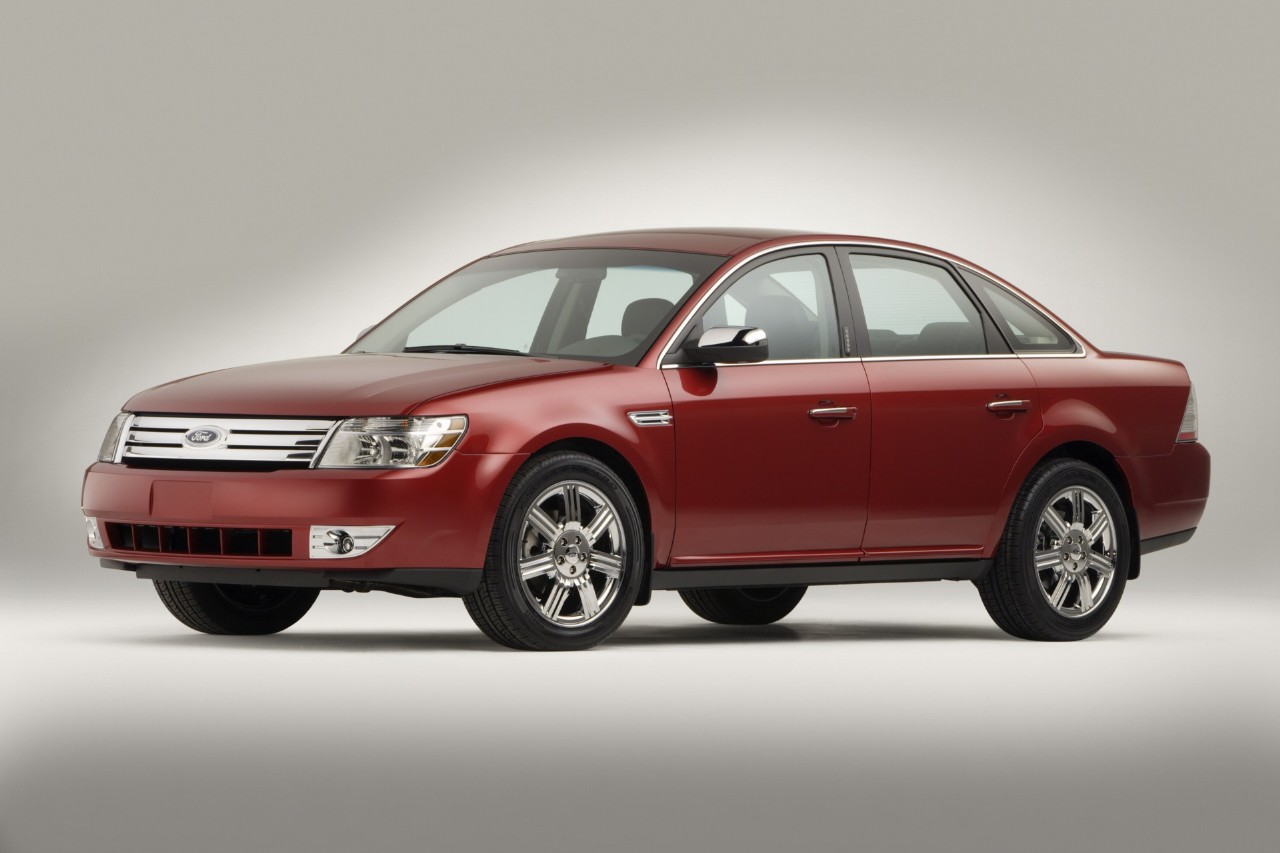
2008 Ford Taurus Navigation
2008 FORD TAURUS FEATURES MORE POWER, STYLE AND MORE STANDARD SAFETY FEATURES

- New Ford Taurus features more than 500 engineering changes, making it more distinctive, quieter, faster and safer.
- 3.5-liter Duratec V-6 delivers an estimated 260 horsepower – an increase of nearly 30 percent from the previous engine.
- Available electronic stability control and all-wheel drive provide confident ride and handling in all weather conditions.
- Ford Sync™ offers new levels of connection, control, simplicity and personalization for electronic devices such as cell phones and MP3 players
- Taurus will reach showrooms this summer.
The 2008 Ford Taurus features more than 500 improvements that make it more distinctive, quieter, faster and safer. Highlights include new exterior styling, a new powertrain, a new all-wheel-drive system, more standard safety features and structural upgrades to further enhance crash protection. 'Customers will find the 2008 Taurus delivers more of what they are looking for, including a strong design, high-quality interior, power and performance, must-have features like Ford Sync and a great safety reputation,' said Cisco Codina, Ford's group vice president, Marketing, Sales and Service. The 2008 Taurus features Ford's 3.5-liter Duratec V-6 that delivers an estimated 260 horsepower – an increase of nearly 30 percent from the previous engine – and 245 pound-feet of torque. It is mated to the same smooth shifting, six-speed automatic transmission as the new Ford Edge. Importantly to customers, even with more power and performance, the 2008 Taurus delivers real-world fuel economy similar to outgoing Five Hundred – thanks to advancements in powertrain technology. New exterior design is more emotional, more Ford The new look of the 2008 Taurus suggests the same proven emotional appeal of the popular Ford Fusion. The new Taurus features the Ford brand's signature three-bar chrome grille, a sculpted hood with crisp accent lines and a new front fascia chamfered at the outer edges, adding more structure to the design. New taillamps carry a strong, horizontal theme to the rear, while a new rear fascia houses dual chrome-tipped exhausts. Chrome side vents, door handles and mirror caps give the high-line model a more expensive appearance. Últra-quiet interior and plush ride

Interior quietness is often associated with a customer's perception of overall quality. For 2008 the Taurus team has delivered interior quietness that rivals many luxury cars. The new sound package includes such technologies as expandable foam pellets in the A-pillars to reduce wind noise and the use of an advanced sound-deadening material called Sonosorb™ in the doors, headliner and pillars. Sonosorb increases sound-deadening efficiency by 20 percent while retaining the same thickness as the material it replaces.

A large majority of customers shopping in the large car segment place front seat roominess as a key want (86 percent) while many also prioritize cargo capacity (63 percent). Answering these desires, the 2008 Taurus features the most spacious interior of any large sedan, with best-in-class legroom front and rear and 60/40-split fold-flat second-row of seats. With the fold-flat front-passenger seat, items up to nine-feet long can fit inside. Taurus also offers a number of must-have technologies. In addition to a standard auxiliary audio input jack, available convenience features include a voice-activated navigation system, a DVD entertainment system and factory-installed SIRIÚS® satellite radio. Ford Sync™ is also available on the new 2008 Ford Taurus. Sync is a voice-activated hands-free in-car communications and entertainment system which fully-integrates mobile phones and digital media players. The Sync in-car communications system was developed in collaboration with Microsoft and will be offered exclusively on 12 Ford, Lincoln and Mercury products in North America beginning this year. Building on safety leadership

Research routinely demonstrates that safety features are at the top of customers shopping lists. For example, nearly 70 percent of shoppers are interested in side air bags and 65 percent are interested in electronic stability control. With these standard airbags and available electronic stability control, the 2008 Ford Taurus is expected to be segment leader in safety, capable of achieving five stars ratings in all four categories for the Ú.S. government's crash tests. Ford's AdvanceTrac® electronic stability control system can predict the vehicle's intentions using a sensor to detect and measure oversteer and yaw by monitoring the vehicle's speed, throttle position and steering wheel angle. When the system senses wheel slip, engine torque is reduced and braking is applied where needed to help keep the car tracking safely on its intended path. Additional standard safety equipment includes dual-stage driver and passenger front air bags, seat-deployed side air bags for driver and front passenger, and Ford's Safety Canopy™ side curtain air bags for both rows. For an added measure of safety, a new steering wheel design recesses the air bag 15 millimeters farther away from the driver.Source - Ford
2008 FORD TAURUS, MERCURY SABLE EARN TOP SAFETY PICKS
• 2008 Ford Taurus and Mercury Sable earn 'Top Safety Pick' ratings from the Insurance Institute for Highway Safety (IIHS) for achieving the highest ratings in frontal offset, side and rear impact crash protection.• Ford Taurus and Mercury Sable are the world's only large family cars to earn both the IIHS Top Safety Pick rating and the Ú.S. government's highest available five-star ratings in all crash test categories.
• Ford and Volvo engineers worked together to create this innovative vehicle structure featuring crush zones so that energy is transferred around the passenger compartment.
• Class-leading affordability and safety combine to make Taurus and Sable two of the best choices for safety-conscious consumers looking for full-size family cars. The 2008 Ford Taurus and Mercury Sable will arrive in showrooms this summer bearing Top Safety Pick ratings by the Insurance Institute for Highway Safety (IIHS) and the government's highest available five-star ratings in all crash test categories.
The IIHS' 'Top Safety Pick' rating can only be earned by vehicles that achieve the best-available safety performance in frontal, side and rear collisions and offer electronic stability control. In addition to being the only large family cars to merit IIHS' Top Safety Pick rating, these sedans stand alone for also earning five-star driver and passenger crash test ratings from the National Highway Traffic Safety Administration (NHTSA).
'It's a true testament to the safety engineering of these vehicles that they achieved top crash test ratings from both IIHS and NHTSA,' said Sue Cischke, senior vice president of Sustainability, Environment and Safety Engineering, Ford Motor Company. 'Ford and Volvo worked together to leverage our technical and intellectual resources to create this outstanding vehicle architecture, and now it's better than ever. These cars offer it all: safety, power, spaciousness, comfort and great features, all at a great value.'
The Insurance Institute also gave both vehicles its highest rear impact rating for offering effective protection against neck injuries, as well as its highest front and side impact ratings for withstanding intrusion into the occupant compartment.
The structure of the Taurus and Sable is engineered with crush zones designed to direct excess energy around the passenger compartment into a high-strength safety cage. An innovative cross-car beam 'SPACETM Architecture' under the front seats reinforces the structure between the B-pillars, which helps direct energy away from passengers.
Both vehicles offer an industry first two-row Safety Canopy™ side air bag system that provides additional protection not only in side impact collisions, but also deploys in rollover accidents. Side-impact protection comes from a combination of air bag technology and structural features that help safeguard occupants from intrusion by channeling crash energy away from the passenger compartment.
 An advanced air bag controller uses front passenger classification sensing to determine if the seat is occupied, and if so, whether the passenger is a larger or smaller person. Air bag deployment is tailored – or altogether suppressed – to help provide an appropriate level of protection. The lower anchors and tethers for children, or LATCH system, provide mounting points for compatible child seats in the second row.
 Both cars are available with AdvanceTrac® electronic stability control and all-wheel drive to provide drivers with a confident ride and smooth handling in all weather conditions. All Ford, Lincoln and Mercury retail cars and trucks will have standard electronic stability control by the end of 2009. ESC currently is standard on all Ford sport utility and crossover vehicles.
Ford Motor Company and its global brands have built more than 4 million vehicles globally with electronic stability control systems. More than one million of those vehicles feature Ford's industry exclusive AdvanceTrac® with Roll Stability Control, the world's only system with two gyroscopic sensors to actively measure and help control both yaw and roll movements.
'We believe our electronic stability control systems enhance vehicle safety by helping the driver prevent many accidents from occurring in the first place,' Cischke §äid. 'Making families safer is a key part of our pledge to drive safety innovation.'
AdvanceTrac® with Roll Stability Control is standard equipment on most 2007 model year Ford Motor Company SÚVs and crossovers. ESC will be standard on the 2008 model year Taurus X. The 2008 Ford Taurus starts at $23,245 (MSRP); Mercury Sable, starts at $23,540.Source - Ford
Related Reading : Ford Taurus History
Introduced in December 1985 as a 1986 model, Ford unveiled the Taurus with its smooth, jellybean-like body. One of the slickest vehicles in the world, the Taurus had an aerodynamic drag coefficient of only 0.29. Instantaneously winning over thousands of fans, the Taurus was a huge success. The name Taurus came from the Latin word meaning ‘bull. During its 20 years of production, Ford sold nearly....
Continue Reading >>
Continue Reading >>
- 2008 Ford Taurus Menu
- Article
- Image gallery
- Specifications
- Recalls
Ford
Similar Automakers
Similarly Sized Vehicles
from 2008


Recent Vehicle Additions


Performance and Specification Comparison
Related Automotive News

2017 GENESIS G80 EARNS THE INDUSTRY'S HIGHEST SAFETY DESIGNATIONS
FOUNTAIN VALLEY, Calif., Oct. 21, 2016 – The 2017 Genesis G80 holds two of the highest safety honors in the auto industry – the Insurance Institute for Highway Safety (IIHS) 2016 Top Safety Pick and the National Highway Traffic Safety Administrations...

ALL-NEW 2017 HYUNDAI ELANTRA BRINGS ADVANCED TECHNOLOGY AND PREMIUM CONVENIENCE TO THE COMPACT CAR SEGMENT
IMPERIAL BEACH, Calif. January 26, 2016 – The all-new 2017 Hyundai Elantra arrives in dealerships this month, featuring a bold aerodynamic design, a comprehensive suite of safety features, modern interior styling with class-above features, and...

2016 HYUNDAI GENESIS ADDS TO EXCEPTIONAL VALUE EQUATION WITH STANDARD PREMIUM LIGHTING APPEAL
Standard LED Daytime Running Lights and HID Headlights Elevate Premium Road Presence
Automatic Emergency Braking, Heads-up Display, Blind-Spot Detection, Cabin CO2 Sensor and Lane-Keep Assist Available as Suite of Active Safety Features
Genesis 5.0...

ALL-NEW CHRYSLER 200 EARNS FIVE-STAR OVERALL SAFETY RATING FROM U.S. NATIONAL HIGHWAY TRAFFIC SAFETY ADMINISTRATION
2015 Chrysler 200 mid-size sedan earns five stars overall, the highest possible score in NHTSAs safety rating program
Approximately 65 percent of all-new Chrysler 200s body structure consists of hot-stamped, high-strength, advanced high-strength...
2014 MAZDA6 NAMED TO WARD'S ‘10 BEST INTERIORS' LIST
The all-new 2014 Mazda6 today was named to WardsAuto Worlds 10 Best Interiors list, as chosen by the publications editors. The redesigned mid-size sports sedan features Mazdas new design language called KODO Soul of Motion, which translates muscular...