The Porsche 917 Sports Prototype gave the German manufacturer its first overall victory at the 24 Hours of Le Mans in 1970 and 1971. Powered by the Type 912 flat-12 engine and in its most potent form was capable of accelerating from zero-to-sixty mph in 2.3 seconds. The long tail Langheck version could achieve a top speed of 240 mph. Porsche produced a total of 25 examples of the 917 and 12 of the 917 K. 
Coupe
Chassis #: 962-108 (962-108C / 108C-2)
View info and history
Auction entries : 4The Porsche 917 was eventually succeeded by the Porsche 936 Group 6 sports prototype racing car in 1975. The Porsche 936 driven by Jacky Ickx won the 24 Hours of Le Mans in 1976, 1977, and 1981. After the new 2,650cc engine designed for Indycar was tested in the 1981 winning chassis 003, Porsche introduced its new Group C sports-prototype racing car dubbed the 956. It was designed by Norbert Singer and used a chassis comprised of an aluminum monocoque (a first for the company) and powered by a Type 935 2.65-liter turbocharged Flat-6 producing approximately 635 horsepower (the same engine as the one powering the Porsche 936/81). Among the accolades achieved were a 1-2-3 finish at the 24 Hours of Le Mans in 1981 after leading the entire race. Stefan Bellof set a lap record at the Nürburgring Nordschleife that would stand for 35 years.The Porsche 962
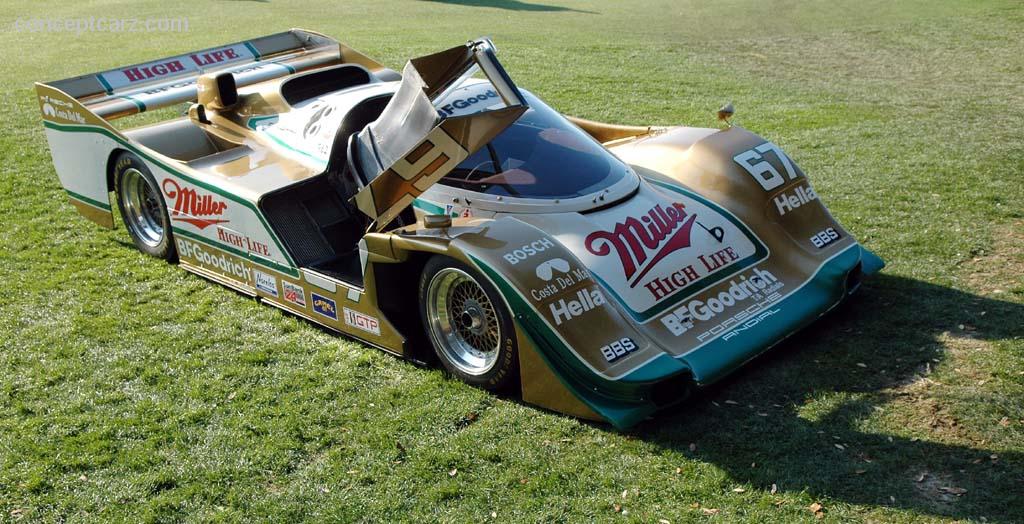
The Porsche 962 arrived near the close of 1984 and was raced into the mid-1990s, later replaced by the Porsche WSC-95. A total of 91 examples of the 962 were built with 16 examples used by the factory team, while the remaining 75 were sold to privateers. A few 956s were rebuilt to 962 specifications. Porsche created most of the chassis, but Fabcar in the United States built a few due to the high demand.
Coupe
Chassis #: 962-108 (962-108C / 108C-2)
View info and history
Auction entries : 4The Porsche 962 was designed to comply with IMSA's GTP regulations and later, in Group C racing (in 962C configuration). The 956 had been banned from the U.S. IMSA GTP series due to its design which placed the driver's feet ahead of the front axle center line. The 956 resolved this 'safety issue' when Porsche extended the 956's wheelbase and moved the front wheels ahead of the pedal box. The new aluminum chassis received an integrated steel roll cage and a body created from Kevlar, glass-reinforced plastic and aluminum panels. The suspension used double wishbones at the front with coil springs over dampers and an anti-roll bar while the rear used lower wishbones and top rockers, an anti-roll bar, and coil springs over dampers. The engine, placed mid-ship, was a Porsche 934-derived Type 935 2.8-liter flat-6. The Group C 956 had used a twin-turbo setup but this was not allowed under IMSA's GTP class at the time, so instead, the 956 received a single Kühnle, Kopp und Kausch AG K36 turbocharger.The engine powering the IMSA GT 962s used an Andial-built 3.2-liter fuel injected flat-6. This engine was eligible under IMSA's Group 3 engine rules initially but was banned in 1987 by IMSA. Following threats of Porsche's withdrawal from the sport, IMSA allowed water-cooled twin-turbocharged engines. The design of the 962 was visually similar to the 956Motorsport Accomplishments
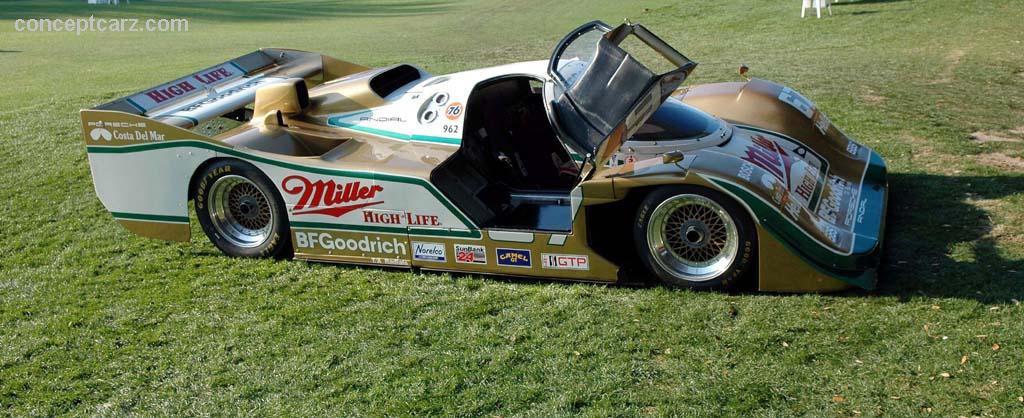
Between 1982 and 1987, the Porsche 956 and 962 won Le Mans six times, finishing 1-2-3 every year except 1987 (1st and 2nd). The Porsche 962 won 48 out of 68 IMSA GTP races in North America between 1984 and 1987, including a 1-2-3 finish at both Daytona and Sebring for three consecutive years. Together with the 956, they captured the World Endurance Manufacturers' and Drivers' Championship (1982–1985), the World Sports Prototype Manufacturers' and Drivers' Championships (1986–1987), the IMSA GTP Manufacturer's Championship (1985–1988), and the IMSA GTP Driver's Championship (1985–1987). Between 1985 and 1987, factory driver Derek Bell drove the 962 to 21 victories.
Coupe
Chassis #: 962-108 (962-108C / 108C-2)
View info and history
Auction entries : 4Porsche completed five 962s for the 1984 IMSA season, with Al Holbert and Bell scoring four victories. During the 1985 World Endurance Championship, the 962C was very successful and driven by drivers that included Jackie Ickx, Bell, and Hans-Joachim Stuck. At LeMans, however, the 962C was outpaced by the 956, which scored its fourth consecutive victory. The 962 won in 1986 and again in 1987, this time powered by a more powerful and durable 3.0-liter engine, earning Porsche its seventh consecutive victory at the race.The 962s continued to win races into 1993, scoring lone victories in the Interserie and IMSA GT series. Team Taisan would score the final victory for the original 962C, winning an All Japan Grand Touring Car Championship event at Fuji Speedway in August of 1994. The Jochen Dauer modified versions of the 962 (known as the Dauer 962 Le Mans) would achieve an overall victory at Le Mans in 1994. The Dauer-modified 962 would be used for both road and race use.Along with factory success, customer cars achieved numerous victories by such top-echelon teams as Joest, Kremer, and Walter Brun's Repsol Petroleum-sponsored Brun Motorsport team.
by Daniel Vaughan | Jan 2022
Coupe
Chassis #: 962-108 (962-108C / 108C-2)
View info and history
Auction entries : 4
The Porsche 962 arrived near the close of 1984 and was raced into the mid-1990s, later replaced by the Porsche WSC-95. A total of 91 examples of the 962 were built with 16 examples used by the factory team, while the remaining 75 were sold to privateers. A few 956s were rebuilt to 962 specifications. Porsche created most of the chassis, but Fabcar in the United States built a few due to the high demand.

Coupe
Chassis #: 962-108 (962-108C / 108C-2)
View info and history
Auction entries : 4
Between 1982 and 1987, the Porsche 956 and 962 won Le Mans six times, finishing 1-2-3 every year except 1987 (1st and 2nd). The Porsche 962 won 48 out of 68 IMSA GTP races in North America between 1984 and 1987, including a 1-2-3 finish at both Daytona and Sebring for three consecutive years. Together with the 956, they captured the World Endurance Manufacturers' and Drivers' Championship (1982–1985), the World Sports Prototype Manufacturers' and Drivers' Championships (1986–1987), the IMSA GTP Manufacturer's Championship (1985–1988), and the IMSA GTP Driver's Championship (1985–1987). Between 1985 and 1987, factory driver Derek Bell drove the 962 to 21 victories.
Coupe
Chassis #: 962-108 (962-108C / 108C-2)
View info and history
Auction entries : 4
by Daniel Vaughan | Jan 2022
Related Reading : Porsche 962C History
Porsche met Group C regulations introduced by FISA in 1982 with a fresh concept. This new car would be the focal point of factory racing efforts. These new Group C regulations led to the re-birth of the two-seat, special race sports car which no longer had to be declared a prototype for some future production car, but rather was seen as a high-performance vehicle in its own right. The 956 from....
Continue Reading >>
Continue Reading >>
Related Reading : Porsche 956 and 962 History
Porsche created the 956 during the early 1980s for FIA Group C competition. The design and components of the vehicle would further evolve over the years and become known as the 962. The 956 project was led by a very determined and experienced project manager named Norbert Singer, who had his sights set on winning the 24 Hours of LeMans race. With Derek Bell and Jacky Ixckx, the factory team drivers,....
Continue Reading >>
Continue Reading >>


1989 Porsche 962 Vehicle Profiles


Recent Vehicle Additions


Related Automotive News

DAYTONA 24 HOUR-WINNING PORSCHE 962 HIGHLIGHTS MECUM KISSIMMEE 2016
Two Porsche Carrera GTs also on offer at the Worlds Largest Collector-Car Auction, Jan. 15-24
Walworth, Wis. – Dec. 15, 2015 – Its not every day that you can buy a Daytona 24 Hour-Winning Porsche 962 that master endurance-racer Der...

Classic 24 Hour at Daytona presented by IMSA Produces Great Competition from Record Number of Teams and Drivers
More Than %24120,000 worth of BRM Chronographes Watches Presented to Top Performing Classic 24 Hour Competitors
DAYTONA BEACH, Florida – Six run group champions, which were among the weekends 29 different class winners, were crowned after the...

PORSCHE MOTORSPORTS PRE-EVENT NOTES. 24 HOURS OF LE MANS
The #20 Porsche 919 Hybrid with drivers (left to right) Mark Webber, Timo Bernhard, and Brendon Hartley, at Le Mans tech inspection earlier today in the town of Le Mans.
Dateline. Le Mans, France
Circuit. Circuit de la Sarthe
Track LengthTurns....

1989 24 Hours of Le Mans: Mass and Mercedes Slay its Dragons
It had been nearly 35 years since Mercedes-Benz had made an appearance at Le Mans as a factory team. It had been longer than that since the German manufacturer had taken victory in the famed event. To return to the top the manufacturer needed speed,...

1982 24 Hours of Le Mans: Capping Off Le Mans in the Most Dominant Way
Group 6 cars had long been ruled out by the rules makers. Yet, despite the normal amount of investment and evolution that would normally take place, the Porsche 936 would continue to be a dominant force at Le Mans throughout the late 1970s. But then...

1996 24 Hours of Le Mans: Finally a Victory, Still 2nd
Thierry Boutsens first encounter with the 24 Hours of Le Mans would come only after a few years of his being involved in racing. In 1981, Boutsen would partner with Serge Saulnier and Michel Pignard to drive the WM P81. It would prove to be an introductory...