1937 Bugatti Type 57S
1937 Bugatti Type 57S Navigation
Ettore Bugatti built automobiles of uncompromised elegance and sporting competence from 1911 to 1939. He was a mildly eccentric individual and an utterly brilliant Italian engineer; his automobiles were temperamental, technically complex, and very expensive. 
Atalante
Chassis #: 57562
View info and historyThough he clung to mechanical brakes, he experimented with aerodynamics and the use of lightweight metals such as magnesium. During the early 1930s, as the luxury automobile market dwindled, Ettore and his son Jean went to the extreme by producing a very special model - the Type 57. The Type 57 was introduced in 1934 and was the first new model built under Jean Bugatti's direction and incorporated numerous new features. The dual overhead camshaft eight-cylinder engine had dimensions of 72x100mm resulting in a 3,257cc displacement, with a five-main bearing crankshaft. The camshafts were motivated by helical-tooth gears at the engine's rear with another crankshaft bearing behind them. Side thrust on the valve stems was minimized through the use of finger cam followers. The Type 57 was the first Bugatti equipped with a transmission fixed to the engine crankcase and a single plate clutch. The four-speed gearbox had constant mesh on the top three gears. The semi-elliptical front setup suspended the hollow tube live axle while reversed quarter-elliptical rear leaf springs were in the back. Cable-operated mechanical drum brakes provided the stopping power.
Atalante
Chassis #: 57562
View info and historyAt the time, the world was in the midst of the Great Depression, soon to be thrust into a war that would halt civilian automobile production, destroy factories, bring about a shortage of raw materials, and bring an end to many legendary automakers. Despite enduring financial shortcomings, the development of the Type 57 continued.The second-series iteration of the Type 57 was introduced in October of 1936 at the Paris Auto Salon wearing designs by Jean Bugatti and powered by a 3.3-liter dual-overhead-camshaft eight-cylinder installed in a competition-inspired chassis. Along with the second-series Type 57, the Italian company introduced two sporting variants of the model, the Type 57C and the Type 57S. The Bugatti Type 57C was equipped with a supercharger, thus the 'C' representing 'compressor.' The Roots-type supercharger, driven by the camshaft drive at the rear of the engine, operated at 1.17 times engine speed. The result was a 5-6 psi boost and 160 bhp which - depending on the coachwork - made 120 mph possible.
Atalante by Gangloff
Chassis #: 57501
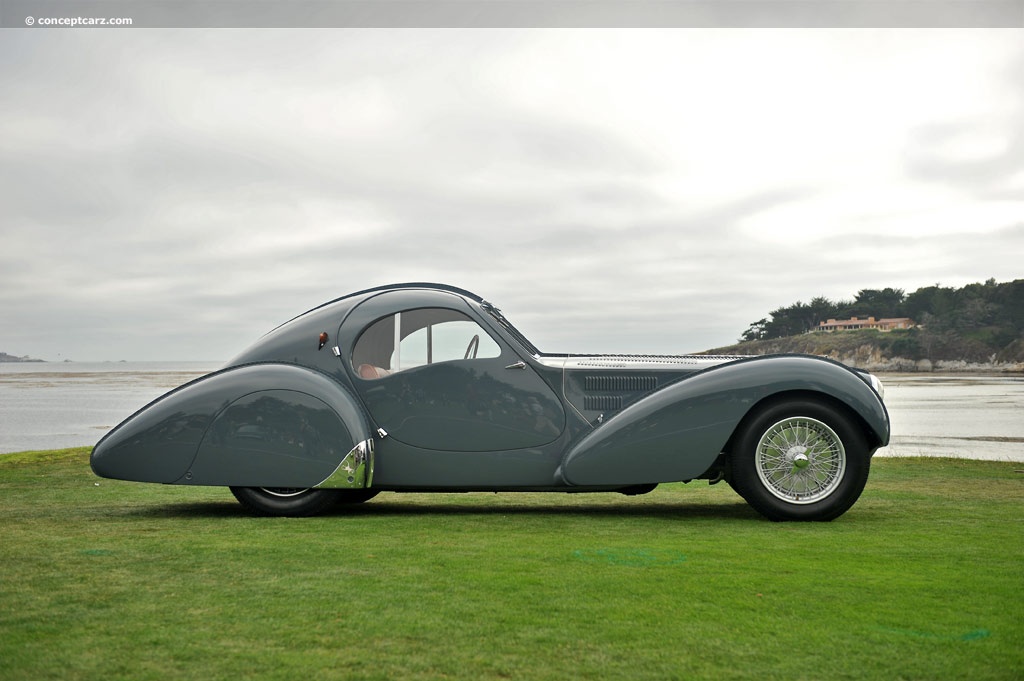
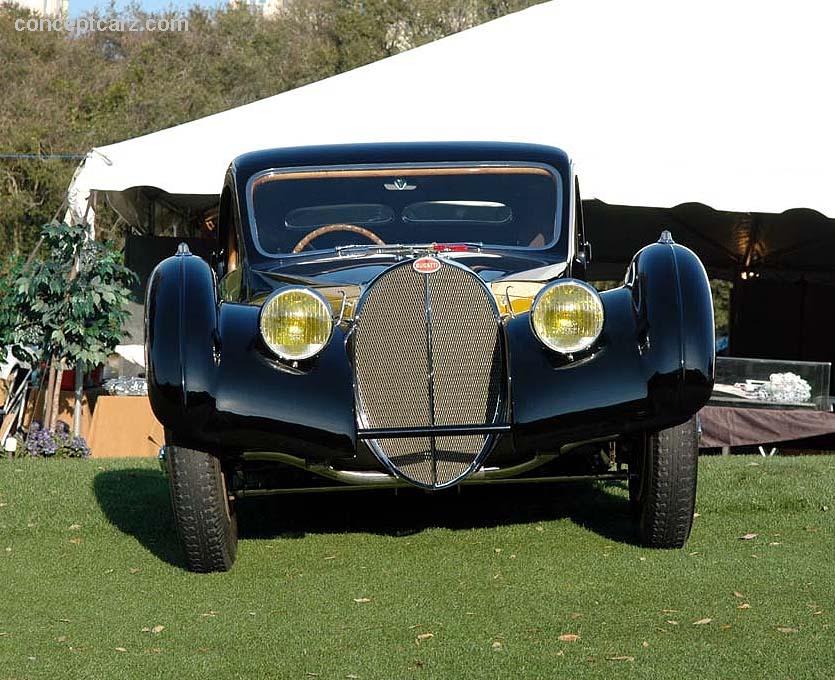
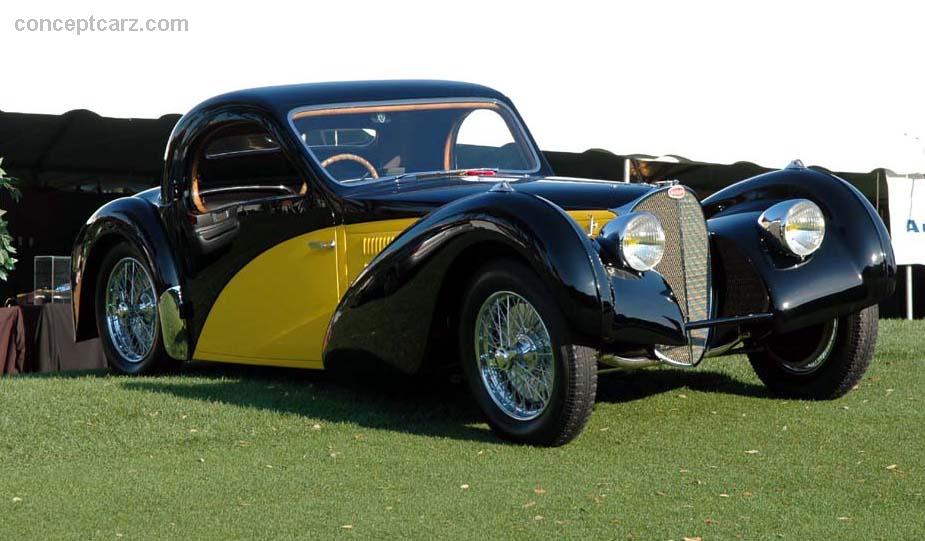
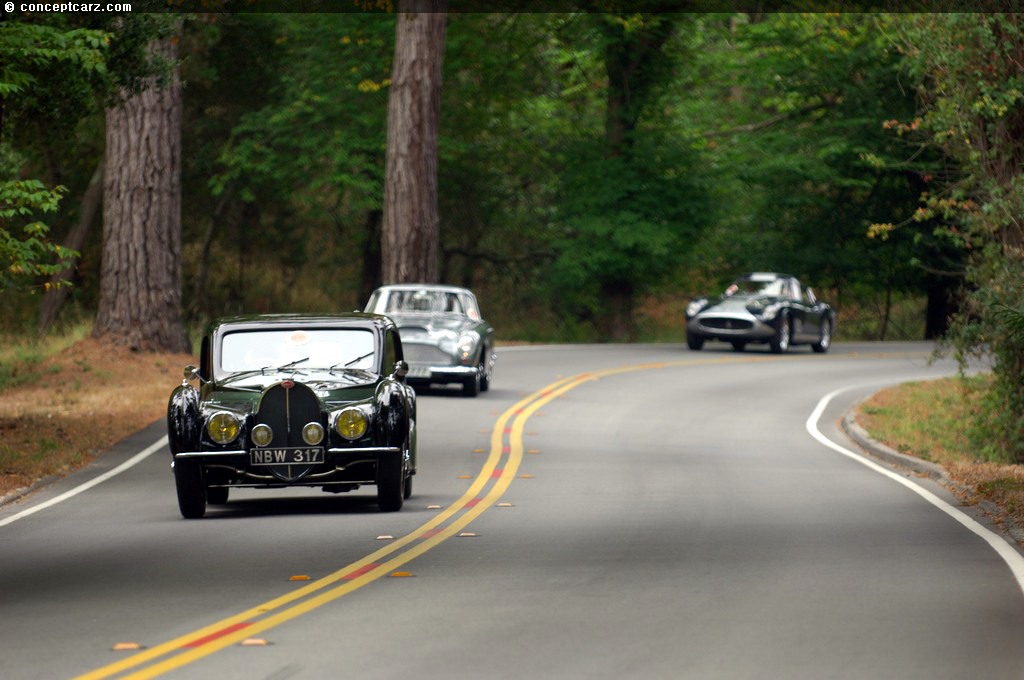
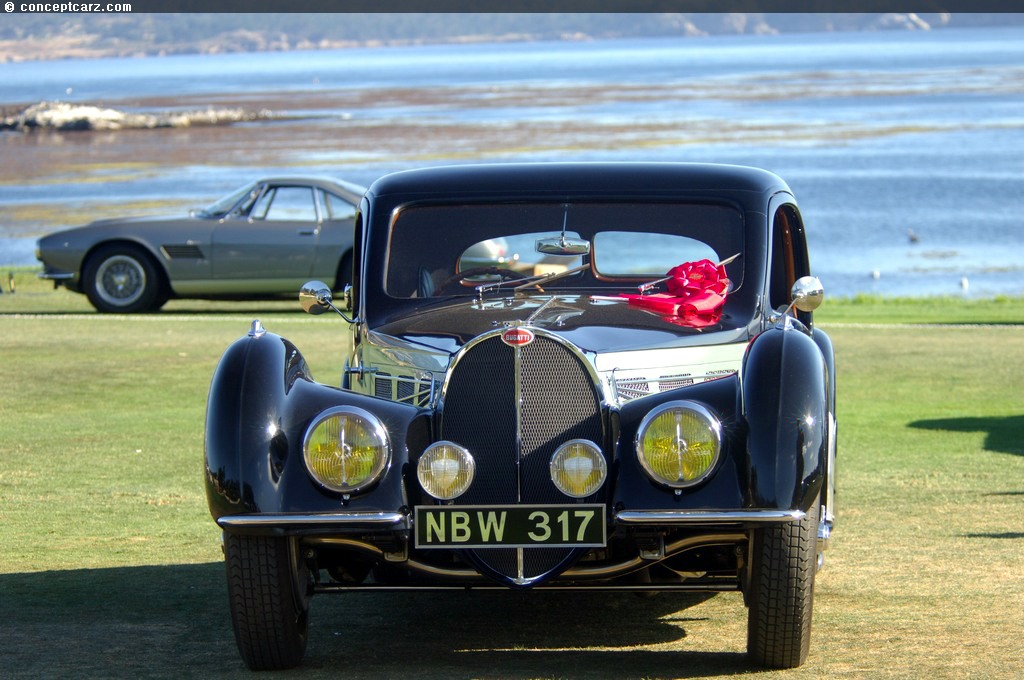
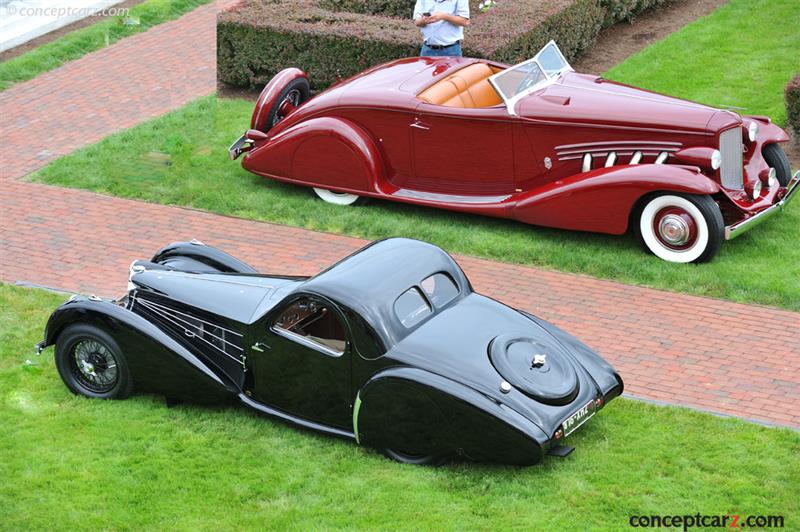
View info and historyThe Bugatti Type 57S represented 's'urbaissé, or lowered. Although the 57S shared some features with its progenitor, it was virtually a Grand Prix car in touring car guise. The engine received high-compression pistons and a modified crankcase with dry-sump lubrication sourced from the T59 Grand Prix car, including separate scavenge and pressure oil pumps supplied from a 20-liter tank. This meant the high-capacity oil pan was no longer needed. Ignition was by a Scintilla Vertex magneto driven from the left-hand camshaft. With the improvements in place, the engine delivered about 25 more horsepower, and to cope with the increase, the transmission received a reinforced clutch. Although the mechanical modifications were impressive, it was the low-slung frame design and a shorter wheelbase that provided the fundamental difference between the Type 57S and the standard Type 57. This configuration allowed the rear axle to pass through the frame, and de Ram shock absorbers provided damping, engineered to increase with speed. It used C-channel, gondola-shaped frame rails formed from thinner and lighter material than the Type 57 frame. Due to the lower chassis, the exhaust system used special baffles with a thinner casing and a horizontal row of five small-diameter tailpipes, allowing 10cm of ground clearance.The vee-shaped radiator gave the Type 57S a distinctive appearance, inspiring some of the most elegant and sporty sculpted designs of the era. Among them was the Jean Bugatti-influenced Atalante Coupe, applied to 17 of the Type 57S chassis. Just 48 examples of the Type 57S chassis were built before the outbreak of hostilities, including two constructed as Type 57SC models, combining the supercharged 200-horsepower engine with the lowered chassis.
Atalante by Gangloff
Chassis #: 57501
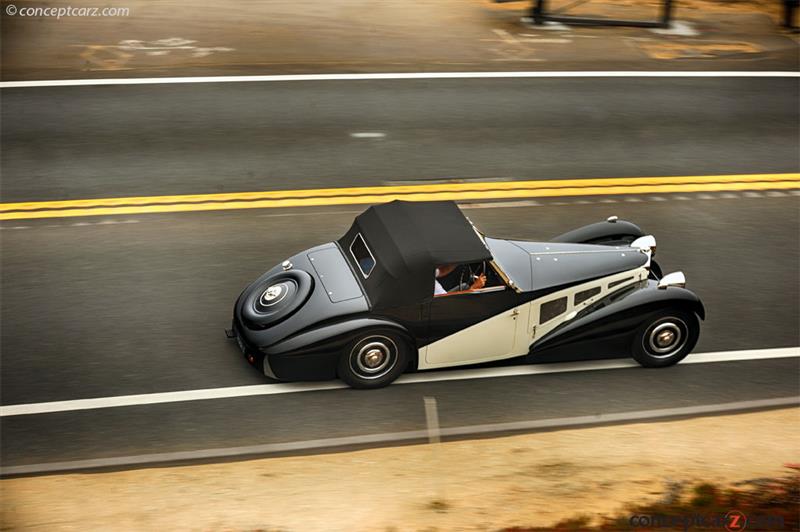
View info and historyBugatti introduced the Type 57S at the 1935 London Motor Show. The car on display wore fastback Aerolithe coachwork, a style that was eventually refined into the Atlantic coupe. Eventually, three forms of factory coachwork were offered on the Type 57S, including a roadster, the Atalante coupe, or the rare Atlantic coupe. The latter two coupe styles accounted for approximately 20 chassis built through May 1938, when the competition-oriented 57S was quietly discontinued as 57 and 57C road car sales flourished. Coachbuilders who created bodies for the Type 57S include Gangloff, Corsica, Letourneur et Marchand, and Vanvooren of Paris.
Atalante
Chassis #: 57562
View info and history
Atalante
Chassis #: 57562
View info and history
Atalante by Gangloff
Chassis #: 57501
View info and history
Atalante by Gangloff
Chassis #: 57501
View info and history
Related Reading : Bugatti Type 57 History
Many manufacturers during this time produced multi-purpose vehicles that could be driven to a race track, raced, and then driven home. The Bugatti Type 57, however, was solely a road-going vehicle and is considered the most celebrated non-racing Bugatti. Even though the Type 57 was strictly a road-going vehicle, a racing version was created for the 1937 24-Hours of Le Mans race. This vehicle, based....
Continue Reading >>
Continue Reading >>
Related Reading : Bugatti Type 57 History
Ettore Arco Isidoro Bugatti was born in Milan, Italy in 1881. His father, Carlo, was a furniture designer of some fame. The fathers brother, Rembrandt, was a gifted sculptor of animals. When he was old enough, Ettore attended the Brera Academy of Art where he studied sculpture. Soon, he turned his attention to mechanical endeavors. The first Bugatti motor car was built in 1899 though the....
Continue Reading >>
Continue Reading >>
- 1937 Bugatti Type 57S Menu
- Article
- Image gallery
- Valuation
- Specifications
- Profiles
- Production figures


1937 Bugatti Type 57S Vehicle Profiles




Recent Vehicle Additions


Performance and Specification Comparison
Type 57 S Specification Comparison by Year
Year
Production
Wheelbase
Engine
Prices
Related Automotive News

Past Best of Show Winners at The Pebble Beach Concours d'Elegance
overview1
The 70th anniversary of the Pebble Beach Concours dElegance was celebrated with a spectacular display of previous Best of Show winners. Thirty-seven examples graced the showfield and many were still with the same owners who raised the trophy...

Gooding & Company Proudly Presents 'Passion of a Lifetime' – A Masterpiece Collection of Sixteen Substantial Automobiles for Sale on 1 April 2020
Santa Monica, Calif. (22 January 2020) – Gooding %26 Company, the internationally recognized auction house, is honored to reveal the automobiles comprising the companys first-ever London sale, Passion of a Lifetime, at Somerset House in central...

Coachbuilding – New Interpretation Of A Long-Established Tradition
Bugatti has been focused on delivering custom-tailored cars and extraordinary individualisation for 110 years
Since Bugatti was founded 110 years ago, its vehicles have been beyond compare – both technically and aesthetically superior. As company...

Sportiness In The Brand DNA: Game-Changer With Mercedes-Benz At Goodwood Festival Of Speed 2017
With a dozen racing cars and sporty vehicles from over 100 years, Mercedes-Benz Classic sums up the motto of this years Goodwood Festival of Speed Peaks of Performance – Motorsports Game-Changers celebrates competition vehicles that have written...

PEBBLE BEACH 2015: BUGATTI PRESENTS SUCCESSFUL SUPER SPORTS CARS FROM THE COMPANY'S HISTORY
The most successful racing car ever built, the Type 35, and the fastest production car in the world, the Veyron 16.4 Super Sport, are two of the record holders featured in the Bugatti line-up
Other highlights include a Type 57SC Roadster and Type 5...