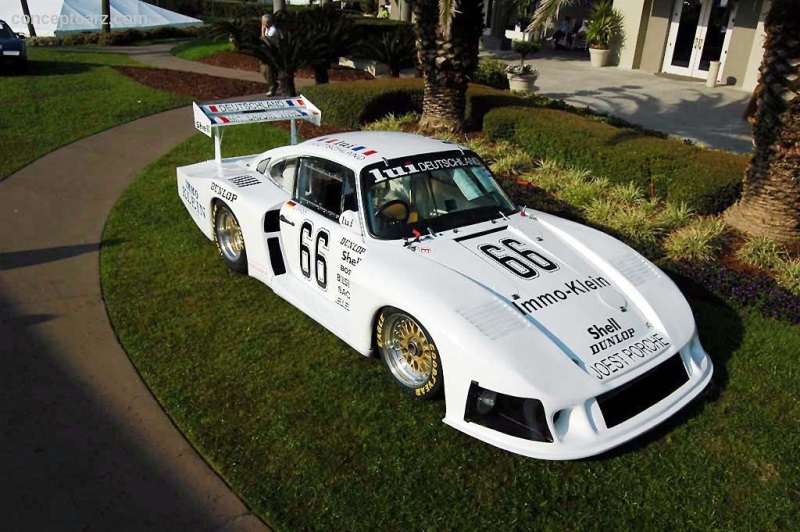
1980 935 |
1981 Porsche 935 news, pictures, and information | ||
| Tweet | ||
![]() | ![]() | ![]() | IMSA Group 5 Racer Chassis Num: JLP-3 |
| High bid of $1,125,000 at 2012 RM Auctions. (did not sell) | |||
The FIA had had enough of the prototypes in sportscar endurance racing. And, starting with the 1976 season, would change the regulations creating a new Group 5 for 'Silhouette' race cars. These cars would be based upon those models that qualified for Groups 1 through 4. Such regulations perfectly suited Porsche at the time.
At the Frankfurt Motor Show in 1973, Porsche would unveil the 930 Turbo Porsche. The turbo technology in the car had drawn from the experience the factory had gained with the 917. Then, using a 930/911 body structure and suspension, Porsche would develop its Turbo Carrera Group 4 competition car.
The Turbo Carrera would make use of an engine of just over 2.1-liters. However, with the turbocharging, the dual ignition and Bosch Fuel Injection the car would produce more than 500 bhp. This would be more power than that produced by the 4.5-liter flat twelve engines that powered the 917 just a few years prior.
But then there was the new Group 5 and the 'silhouette' race cars. In its battle against the prototype, the Group 5 rules would make for a production-based car that could be modified, but would still need to be based off a car qualifying for Groups 1 through 4. Those of the new Group 5 category would then be competing in the World Championship for Makes in the IMSA GT Championship and the German Deutsche Rennsport Meisterschaft.
Porsche's answer to this new Group 5 category would be an evolution of the Carrera RSR first introduced in 1974. Under 'silhouette' rules a number of significant modifications would be allowed. These would include modifications to the car's bodywork and would also include the use of larger wings, wider axles and even water cooling. Minimum weight for the category was set at 970 kg. Porsche's answer would be the 935. And when empty, the car only weighed in at 900kg. This would create an advantage for the car as the additional 70kg needed to make the car legal according to the regulations could be positioned wherever it best helped with the stability and handling of the car.
The other advantage the 935 had was in its engine and turbo technology. The FIA, SCCA and IMSA would all follow their own rules and would evolve them over the years, which would make things difficult. However, at one point in the 935's history its flat-six was noted to produce in excess of 800 bhp! This would make the 935 one of the most powerful race cars in Porsche's race history.
While initially the Group 5 cars shared a good deal in common with the production-based brethren of Groups 1 through 4, later models, especially of the 935, would share only the very basic elements, especially those mandated by the rules, with its production-based relation. Some of the most famous of these, those that would become referred to as 'Moby Dick' because of their long tails, would take the regulations to the absolute limit and would become a matter of interpretation more than a strict adherence to the letter of the law.
The Porsche 935 would enjoy a period of dominance unheard of. This would be mostly due to the fact that Porsche not only entered factory 935s but also made the car available to a number of customers. Therefore, it was not at all surprising to find more than a handful of 935s entered in every single endurance race. Therefore, odds were in its favor even before the start of a race. However, by the early 1980s, Porsche was beginning to switch its focus back to prototypes with the 956 and 962. This meant the majority of the 935 customers would be left looking elsewhere to have their cars built. So, in many ways, the customer 935s would become particularly identifiable with particular teams because of the fact there 935 had been custom-built by smaller shops in which the teams had a relationship. One such privately-built 935 would be JLP-3.
At the 2012 RM Auctions event held in Monterey the 1981 Porsche 935 known as JLP-3 would become available for purchase. This would give a blessed person the opportunity to own a truly successful and historic 935.
Throughout motor racing, especially sportscar endurance racing, there have been more than a few successful father/son partnerships. Toward the late 1970s and early 1980s, one of those successful father/son combinations would be John L. Paul Sr. and Jr. And, in 1981, the pair would turn to Graham 'Rabbit' Bartrills and his GAACO company of Norcross, Georgia to build their own special Porsche 935.
Bartrills would push the boundaries of the regulations at the time and would come to use just the cowl, windshield pillars, roof and door frames of a 1972 911 T. The rest of the car, however, would be anything but stock.
Bartrills would then build a high-tech tube frame and would custom build the race car using lightweight fiberglass bodywork and would feature the latest in suspension technology and aerodynamics. The result would be, arguably, the most successful of all the Porsche 935 race cars.
JLP-3 would take part in the 1982 24 Hours of Daytona and would bring home the overall victory in that event. That success would then be followed up with an overall victory in the 12 Hours of Sebring, also in 1982. This would make JLP-3 the only car to achieve the feat of winning the 24 Hours of Daytona and 12 Hours of Sebring all in the same year.
But the car's success wouldn't end there. In fact, the car would go on to score an unprecedented run of seven consecutive race victories, from Pocono in 1981 through to Charlotte in May of 1982. Out of a total of 27 races, JLP-3 would record a total of 9 wins and would end up on the podium no less than 16 times. What that translated into was a victory in every three races it entered and a remarkable 60 percent rate of finishing on the podium.
In addition to being driven by the Pauls, the car would be driven by the great Derek Bell, Mauricio de Narvaez and Rolf Stommelen. And it would be the performance of the car and the ability of its drivers that would lead to John Paul Jr. scoring the 1982 Camel GT Championship and his father earning the 1982 International Triple Crown of Endurance Championship.
Some years ago, JLP-3 would be restored by the Porsche specialists at Gunnar Racing and has since been maintained by them and Canepa Design. While in the possession of its current owner, the Porsche 935 has undergone an exhaustive and painstaking race preparation. Part of the process would include a rebuild of the car's twin-turbos, 3.2-liter engine, four-speed transaxle, suspension and brakes.
Considered the 'definitive Porsche 935', Bartrill's creation would perfectly maximize handling, balance and performance. The work would lead to a veteran 935 racer who had the opportunity to drive JLP-3 to say the car was, 'well balanced and easy to throw around, not like most 935s.' Additionally, the 935 veteran would remark, 'It is fast, fast, fast.'
Given its remarkable racing history, list of drivers to have driven it and its performance in its restored state, catching a glimpse of JLP-3 would be nothing short of one of the most memorable moments in motor sports history. And, given that it is considered to be the most dominant of all 935s, the car certainly deserves a prominent and proud place in any collection.
Estimated to draw between $1,300,000 and $1,800,000 heading into auction, JLP-3 certainly deserves a handsome sum, just out of honor for all the car has managed to achieve throughout its short racing history.
Sources:
'Lot No. 216: 1981 Porsche 935 JLP-3 IMSA Racing Car', (http://www.rmauctions.com/FeatureCars.cfm?SaleCode=mo12&CarID=r219). RM Auctions. http://www.rmauctions.com/FeatureCars.cfm?SaleCode=mo12&CarID=r219. Retrieved 3 January 2013.
'Lot 450: 1980 Porsche 935 IMSA Racing Coupe', (http://www.bonhams.com/auctions/20322/lot/450/). Bonhams. http://www.bonhams.com/auctions/20322/lot/450/. Retrieved 3 January 2013.
Wikipedia contributors, 'Porsche 935', Wikipedia, The Free Encyclopedia, 28 December 2012, 09:51 UTC, http://en.wikipedia.org/w/index.php?title=Porsche_935&oldid=530120739 accessed 3 January 2013By Jeremy McMullen
![]() | ![]() | ![]() | IMSA Group 5 Racer Chassis Num: 01 |
However, a demand still existed for the continued development of the 935 design. So with Porsche's blessing, a number of racing teams with close ties to the factory purchased various new components and drivetrains. These teams designed and produced their own upgraded chassis and bodywork. While these newly constructed vehicles were still generally referred to as Porsche 935's, in reality, they were entirely new designs that advanced the 935 concept to a new level of speed and sophistication.
Foremost amongst these constructors were the Kremer Brothers of Cologne, Germany. Having enjoyed a close relationship with the factory since 1970, Kremer was allowed to proceed independently with further development of many models of racing Porsches. By 1981, Kremer was ready to produce its fourth version (K4) of the Porsche 935.
01 is the first of two K4's produced, and as a result of Kremer's constant development, bore little resemblance to an early 935. The K4 had evolved into a totally different vehicle, but on a full tubular chassis, with only a roof and windshield being supplied by the Porsche factory. While the bodywork was entirely Kremer's design, it was inspired by the special 'Moby Dick' style bodies produced by Porsche in 1978. 01's body was continually upgraded by John Fitzpatrick during the 1982 season as he further refined the aerodynamics. Mechanically the K4 continued to develop the 'tried-and-true' 935 Turbo motor by using enhanced air-to-air intercoolers. 01 uses special ductwork through the doors to channel cool air to the intercoolers, resulting in a 50 horsepower advantage over other 935s.
01 was raced by Kremer in Europe during 1981, usually driven by Bob Wollek. John Fitzpatrick bought the car for the 1982 season and contested at least 15 events, primarily in the United States, with 5 wins and only one DNF. 01 continued to race sporadically in 1983 and 1984 with appearances at Riverside, Sebring, Miami and Road Atlanta. With drivers such as Bob Wollek, John Fitzpatrick, David Hobbs, Derek Bell, Al Holbert and Preston Henn, this Kremer K4 represents the end of one of the greatest eras of GT racing.
This vehicle is fitted with a Porsche four-speed synchromesh, ZF transmission with a limited-slip differential. The flat-six engine has an aluminum block and head, dry sump lubrication, dual ignition, and a Kugelfisher Fuel Injection system. The 2994cc unit has twin turbochargers and around 850 to 900 horsepower. The car weighs just 2100 pounds and has a top speed of 220 mph when fitted with the LeMans gearing. There are Type 917 disc brakes on all four corners to help keep the car in the drivers control.
By Daniel Vaughan | Feb 2008
![]() | ![]() | ![]() | IMSA Group 5 Racer Chassis Num: JLP-3 |
| High bid of $1,125,000 at 2012 RM Auctions. (did not sell) | |||
In 1982, this car won the Sebring 12 Hours and the Daytona 24 Hours; it is the only car to ever win both of these races. From September of 1981 through May of 1982, it captured first place seven times. Of the twenty-seven races in which it competed, it won nine times and provided podium finishes sixteen times.
This car has been piloted by Derek Bell, Mauricio de Narvaez and Rolf Stommelen.
Power comes from a IMSA-spec 3.2-liter engine with Bosch mechanical fuel injection. There are twin-turbochargers that help produces over 750 horsepower. There is a four-speed transaxle and four-wheel disc brakes. It was recently entered in the 2005 Monterey Historics.
This car was offered for sale at the 2007 RM Auctions held in Amelia Island, Florida where it was estimated to sell between $750,000 - $950,000. This historically significant racer did well at stirring interest at the auction, though bidding fell short of the estimated value and the car was left unsold. A high bid of $680,000 was not enough to satisfy the reserve.
By Daniel Vaughan | Jan 2013
In 1976, Porsche introduced a racing version of the Porsche 930/911 Turbo which they dubbed, the 935. It was designed for FIA-Group 5 competition and was constructed in similar fashion to the Porsche 934, which was used in Group 4 competition.
The works team, with sponsorship by Martini, entered the 935 in the FIA World Championship for Makes with team drivers, Jacky Ickx and Jochen Mass in one car and Rolf Stommelen and Manfred Schurti in another car. The Porsche 935 was an evolutionary process, as its original nose was later replaced with more aerodynamic versions better suited to high speed competition. The bodywork changed and a large wing was added to the rear of the vehicle. The rear fenders were expanded and the car was given a wider axle. The Porsche 935 won all of the major endurance races that included LeMans, Nurburgring, Daytona, Sebring, and Watkins Glen.
Group 4 competition was created for production-based GT cars and the Group 5 was for race cars based on production models. For the 1976 season, the FIA declared that the World Champion of Makes would be won from the Group 5 class, which Porsche won with their 935.
For the 1977 season, the Porsche 935's were sold to privateer teams, such as Georg Loos and Kremer Racing. The single turbo was replaced by two KKK units and the body was again changed. The privateers were using the older cars while the factory raced with the newer machines. This left the privateers unhappy, but since the Porsche 935/77 machines were not as reliable, they could be beaten.
For 1978, the famous 'Moby Dick' styling of the Porsche 935 appeared. The Porsche 935/78 had a long tail, and a frontal area that had been lowered by 10cm. The car had been optimized for low drag and its appearance earned it the nickname, Moby Dick. Powering these cars were a 3.2-liter, water-cooled, four-valve cylinder head engine capable of generating 895 horsepower. The cars reached speeds of 360 km/h at LeMans and were capable of passing the prototype cars such as the Renault and their own Porsche 936.
Throughout the seasons, the FIA, SCCA, IMSA, and CSI continued to modify the rules, which had the teams struggling to maintain a compliant group of cars. The 935, over the years, came in many different configurations powered by a wide variety of engines that included a 2.0-, 2.2-, 3.0-, and 3.2-liter size.
Factory development of the 935 slowed and eventually stopped, and tuner development continued where they left off. The most famous iteration came from Kremer Racing of Cologne, Germany. They were powered by twin-turbocharged 3.2-liter six-cylinder engine capable of producing 740 horsepower.
In 1982, the FIA discontinued Group 5 competition. The 935 continued its racing career in the IMSA GTP category. They continued to race until 1986, though their racing career had ended in 1984. Privateers entered the car in 1985 and for two races in 1986.
From 1976 through 1984, the Porsche 935 won over 150 races which includes over twenty class victories. The 935 was the overall victor at the 24 Hours of LeMans, the 12 Hours of Sebring, and the 24 Hours of Daytona.
By Daniel Vaughan | Apr 2007
The works team, with sponsorship by Martini, entered the 935 in the FIA World Championship for Makes with team drivers, Jacky Ickx and Jochen Mass in one car and Rolf Stommelen and Manfred Schurti in another car. The Porsche 935 was an evolutionary process, as its original nose was later replaced with more aerodynamic versions better suited to high speed competition. The bodywork changed and a large wing was added to the rear of the vehicle. The rear fenders were expanded and the car was given a wider axle. The Porsche 935 won all of the major endurance races that included LeMans, Nurburgring, Daytona, Sebring, and Watkins Glen.
Group 4 competition was created for production-based GT cars and the Group 5 was for race cars based on production models. For the 1976 season, the FIA declared that the World Champion of Makes would be won from the Group 5 class, which Porsche won with their 935.
For the 1977 season, the Porsche 935's were sold to privateer teams, such as Georg Loos and Kremer Racing. The single turbo was replaced by two KKK units and the body was again changed. The privateers were using the older cars while the factory raced with the newer machines. This left the privateers unhappy, but since the Porsche 935/77 machines were not as reliable, they could be beaten.
For 1978, the famous 'Moby Dick' styling of the Porsche 935 appeared. The Porsche 935/78 had a long tail, and a frontal area that had been lowered by 10cm. The car had been optimized for low drag and its appearance earned it the nickname, Moby Dick. Powering these cars were a 3.2-liter, water-cooled, four-valve cylinder head engine capable of generating 895 horsepower. The cars reached speeds of 360 km/h at LeMans and were capable of passing the prototype cars such as the Renault and their own Porsche 936.
Throughout the seasons, the FIA, SCCA, IMSA, and CSI continued to modify the rules, which had the teams struggling to maintain a compliant group of cars. The 935, over the years, came in many different configurations powered by a wide variety of engines that included a 2.0-, 2.2-, 3.0-, and 3.2-liter size.
Factory development of the 935 slowed and eventually stopped, and tuner development continued where they left off. The most famous iteration came from Kremer Racing of Cologne, Germany. They were powered by twin-turbocharged 3.2-liter six-cylinder engine capable of producing 740 horsepower.
In 1982, the FIA discontinued Group 5 competition. The 935 continued its racing career in the IMSA GTP category. They continued to race until 1986, though their racing career had ended in 1984. Privateers entered the car in 1985 and for two races in 1986.
From 1976 through 1984, the Porsche 935 won over 150 races which includes over twenty class victories. The 935 was the overall victor at the 24 Hours of LeMans, the 12 Hours of Sebring, and the 24 Hours of Daytona.
By Daniel Vaughan | Apr 2007
A development of the 935/77 racer, the Porsche 935/2.0 Baby was built late during 1977. Both of these vehicles were very highly modified Group 5 racing versions of the road going 911. Beginning in the mid 1970's, a silhouette vehicle, the original 935s bore a close resemblance to the 911 Turbo Carrera. As the development on the 935 progressed, a bit of freedom was taken with the CSI regulations in which an allowance had been made for modifications to the front fenders. As a way to incorporate larger wheels and tires, the rule was that ‘the material and shape of the fenders is free'.
The 935 was then modified so that it didn't feature the near vertical headlamp housings, a feature that was unmistakably a 911 characteristic. Completely new fenders that now curved in unison with the shape of the bonnet replaced the housings. These new fenders improved the airflow at the front of the car, and multiplied the downforce significantly. Now incorporated into the front air dam, the headlamps were positioned more effectively, and coincidentally, in a more elegant placement.
The dominant vehicle in endurance races of the World Championship for Makes, the Porsche 935 was the prime factor in Porsche's success from 1976 through 1981. Porsche made the monumental decision to leave the battle for this World Endurance Championship for Makes to focus instead on their private tuners and customers with the only exception that the 935 would be entered once more in the 1978 24 hours of Le Mans.
The radical looking first version of the 935/78 was a product of a broached idea by Norbert Singer, the Porsche factory team's chief engineer. His plan involved cutting the side panels of their front-engined vehicle to allow the exhaust to run through. Singer presented this idea at a meeting of the FIA Technical Commission during the end of 1977, and following some discussion, the decision was made to pass this amendment. The plan was to counteract the advantage that rear-engined vehicles had over the front engined ones.
Now that Singer had an in, he went farther and created the perfect vehicle for the high-speed straights at Le Mans. The team was already planning a light aluminum-framed ‘Baby' and by cutting the panels would allow the car to become even lower by 8 or 10 cm. Definitely lower, the vehicle now looked wider. Completely new bodywork was installed to highlight the lower profile with an extended tail that went much farther beyond its rear wheels.
New features installed on the 935/78 included Singer's ‘additional rear aerodynamic aid', which was as wide across the doors as across the bonnet and tail, and was a continuous fair that ran the length of the vehicle. An uninterrupted flow of air to the rear end of the body was resulted by this ‘double-door' which also permitted the inclusion of a slippery low-mounted and full-width rear aerofoil. Along with the addition of larger brakes, and an ‘upside down' transmission which was utilized to reduce the severe angle of the rear drive axles by lowering the vehicle just as much as they had with the larger diameter 19 inch wheels and tires were new mechanical modifications that were added to the vehicle.
At first, Porsche heads were disturbed at the sight of the car, especially after so much money was invested in the vehicle, afraid that during the races it would be considered illegal. But, along with the FIA, they were pleasantly surprised at the design of the vehicle.
Following concerns about the door fairing, alternative configurations were tested by Singer. The end result was cutting the original fairing vertically so that only the front part of the door was faired-in over a length of 470mm. The classic 'Moby Dick' shape was born in the combination of a higher and slightly narrower rear wing with deep side fences.
The model from the year before, the new 935 had a bodywork with a more favorable aerodynamic shape that achieved lower wind resistance. For the first time in Porsche history, this was the most powerful version of their classic six up then which used water-cooled cylinder heads with four valves for each cylinder. Able to achieve a top speed of 350 km/h, the ‘Moby Dick' had a 3.2 liter, water/air-cooled, four-valve, six-cylinder engine with two overhead camshafts on each bank that produced 750 hp and with cylinders that cooled themselves with air.
Unfortunately, even with the new nickname, the new 935 was unable to repeat its past success at the Le Mans of the previous year. The Coupe was driven by Stommelen/Schurti to the eighth place in the overall standings.
The 935/78 had been race-tested in the 6 hour event at Silverstone before Le Man, which Ickx/Mass had won. Though it dominated the 1976 and 1977 World Championship for manufacturers, the 'Moby Dick' was retired to a museum in 1978 following the lack of success achieved at the Le Mans effort.
A handful of 935 vehicles were found in private ownerships, without the super-powerful, four-valve six that continued to capture countless national and international victories and championships. During the 1980's, the 935 Porsche continued to prove their durability and efficiency. This feat helped Porsche win every single World Championship for Makes up until 1981. The successful racing tradition continued for the Porsche 956, which was built to new motor racing regulations.By Jessica Donaldson
For more information and related vehicles, click hereThe 935 was then modified so that it didn't feature the near vertical headlamp housings, a feature that was unmistakably a 911 characteristic. Completely new fenders that now curved in unison with the shape of the bonnet replaced the housings. These new fenders improved the airflow at the front of the car, and multiplied the downforce significantly. Now incorporated into the front air dam, the headlamps were positioned more effectively, and coincidentally, in a more elegant placement.
The dominant vehicle in endurance races of the World Championship for Makes, the Porsche 935 was the prime factor in Porsche's success from 1976 through 1981. Porsche made the monumental decision to leave the battle for this World Endurance Championship for Makes to focus instead on their private tuners and customers with the only exception that the 935 would be entered once more in the 1978 24 hours of Le Mans.
The radical looking first version of the 935/78 was a product of a broached idea by Norbert Singer, the Porsche factory team's chief engineer. His plan involved cutting the side panels of their front-engined vehicle to allow the exhaust to run through. Singer presented this idea at a meeting of the FIA Technical Commission during the end of 1977, and following some discussion, the decision was made to pass this amendment. The plan was to counteract the advantage that rear-engined vehicles had over the front engined ones.
Now that Singer had an in, he went farther and created the perfect vehicle for the high-speed straights at Le Mans. The team was already planning a light aluminum-framed ‘Baby' and by cutting the panels would allow the car to become even lower by 8 or 10 cm. Definitely lower, the vehicle now looked wider. Completely new bodywork was installed to highlight the lower profile with an extended tail that went much farther beyond its rear wheels.
New features installed on the 935/78 included Singer's ‘additional rear aerodynamic aid', which was as wide across the doors as across the bonnet and tail, and was a continuous fair that ran the length of the vehicle. An uninterrupted flow of air to the rear end of the body was resulted by this ‘double-door' which also permitted the inclusion of a slippery low-mounted and full-width rear aerofoil. Along with the addition of larger brakes, and an ‘upside down' transmission which was utilized to reduce the severe angle of the rear drive axles by lowering the vehicle just as much as they had with the larger diameter 19 inch wheels and tires were new mechanical modifications that were added to the vehicle.
At first, Porsche heads were disturbed at the sight of the car, especially after so much money was invested in the vehicle, afraid that during the races it would be considered illegal. But, along with the FIA, they were pleasantly surprised at the design of the vehicle.
Following concerns about the door fairing, alternative configurations were tested by Singer. The end result was cutting the original fairing vertically so that only the front part of the door was faired-in over a length of 470mm. The classic 'Moby Dick' shape was born in the combination of a higher and slightly narrower rear wing with deep side fences.
The model from the year before, the new 935 had a bodywork with a more favorable aerodynamic shape that achieved lower wind resistance. For the first time in Porsche history, this was the most powerful version of their classic six up then which used water-cooled cylinder heads with four valves for each cylinder. Able to achieve a top speed of 350 km/h, the ‘Moby Dick' had a 3.2 liter, water/air-cooled, four-valve, six-cylinder engine with two overhead camshafts on each bank that produced 750 hp and with cylinders that cooled themselves with air.
Unfortunately, even with the new nickname, the new 935 was unable to repeat its past success at the Le Mans of the previous year. The Coupe was driven by Stommelen/Schurti to the eighth place in the overall standings.
The 935/78 had been race-tested in the 6 hour event at Silverstone before Le Man, which Ickx/Mass had won. Though it dominated the 1976 and 1977 World Championship for manufacturers, the 'Moby Dick' was retired to a museum in 1978 following the lack of success achieved at the Le Mans effort.
A handful of 935 vehicles were found in private ownerships, without the super-powerful, four-valve six that continued to capture countless national and international victories and championships. During the 1980's, the 935 Porsche continued to prove their durability and efficiency. This feat helped Porsche win every single World Championship for Makes up until 1981. The successful racing tradition continued for the Porsche 956, which was built to new motor racing regulations.By Jessica Donaldson
| Wec Spa: Audi Presents Long-Tail R18 | |
![]() | • First fielding of three Audi R18 e-tron quattro cars
• Premiere of a new aerodynamic variant • Last race preparation for the Le Mans 24 Hours Ingolstadt, April 25, 2013 – Audi is pursuing ambitious aims at round 2 of the FIA World Endurance Championship (WEC) on May 4 at Spa. The version of the Audi R18 e-tron quattro that was victorious at the season opener is to extend Championship leader Audi's points advantage. At the same time, a new long-tail variant of t...[Read more...] |
| ALMS – Ferrari triumphs in the Petit Le Mans | |
![]() | The Extreme Speed Motorsport Ferrari secured a fantastic win in the fifteenth running of the Petit Le Mans, one of the most important rounds of the American Le Mans Series, held at the Road Atlanta circuit in Georgia, USA. Toni Vilander, teamed in the Ferrari with Scott Sharp and Johannes Van Overbeek, had already looked good in qualifying, setting the second fastest time of 1.18.729, before taking the 458 GT2 to the win, even though the final stint was run at a more sedate pace, in order to...[Read more...] |
| THE VIPER GTS-R IS BACK IN 2012 | |
![]() | •Two identical SRT Viper GTS-R race cars will compete in this weekend's American Le Mans Series event at the 2.54-mile Road Atlanta circuit. •The driver lineup for Petit Le Mans: Tommy Kendall and Marc Goossens will be joined by Jonathan Bomarito in the No. 93 Pennzoil Ultra Viper GTS-R. Dominik Farnbacher and Kuno Wittmer will share driving duties with Ryan Hunter-Reay in the No. 91 Hewlett Packard Viper GTS-R. •This is the first on-track, factory-based participation for the SRT Viper GTS-R...[Read more...] |
| EXCEPTIONAL ROSTER OF PORSCHE RACE CARS JOIN THE STARTING GRID FOR RM'S EAGERLY AWAITED MONTEREY SALE | |
![]() | RM Auctions, the world's largest collector car auction house for investment-quality automobiles, has announced more star consignments for its highly anticipated Monterey sale, August 17–18, in California, this time a remarkable group of Porsches. Comprising twelve examples in total and spanning 48 years of production, the offering is headlined by an exceptional group of racing greats from the sixties, seventies, and eighties. Continuing RM's commitment to present the world's finest automobiles, ...[Read more...] |
| Carroll Shelby, Ford Family for More Than Half a Century | |
![]() | Carroll Shelby was a member of the Ford family for the better part of 60 years, producing stunning performance vehicles from concepts to production models. He once said his energy and passion for performance products were always strongest when he was working with Ford. Shelby most recently collaborated with the company on the 2013 Ford Shelby GT500 Mustang, the most powerful production V8 in the world. Working with SVT engineers at Sebring and the Arizona Proving Grounds, at times he drov...[Read more...] |
| View more IMSA Group 5 vehicles |
| View more FIA Group 5 vehicles |
1981
Porsche
models |
| Porsche 911 SC |
| Porsche 924 |
| Porsche 928 |
| Porsche 935/78 Moby Dick |
| Porsche 944 GTP |
| Similar Automakers | |
| Aston Martin | Bentley |
| Bugatti | Devon |
| Ferrari | GTA |
| Koenigsegg | Lamborghini |
| Lotus | Maserati |
| Maybach | McLaren |
| Rolls-Royce | Spyker |
| Tesla | |
| Similarly Sized Vehicles from 1981 |
| Aston Martin V8 |
| Lincoln Town Car |
| Lola T600 |
| Porsche: 1981-1990 |
| Similar Automakers |
| Porsche History |
| Other models by Porsche |
| Manufacturer Website |
| ||||||||||||||||||||||||||||||||||||||||||||
| 356 550/718 Sports Racing Cars 597 904 | 906 907 908 911 | 912 914 917 924 | 928 934/935 944 956 and 962 | 968 Boxster Carrera GT Cayenne | Cayman GT3 Panamera Type 959 |
1980 935 |


1980 935


1981