Throughout most of Delahaye's early years, they produced solid cars for the middle class with its bread-and-butter being commercial vehicles and heavy trucks. Emile Delahaye founded the company in 1832 and initially setup in Tours, in Indre-et-Loire, and then moved to 10 rue du Banquier in Paris in 1898 when the business was bought by Georges Morane and Léon Desmarais. Their top-of-the-range car production was often unstable but supported by the constant and regular production of its heavy trucks. The economic crisis of the 1930s hit the French car production very hard and Delahaye lacked sufficient financial means to shield it from these effects. In a radical move, the brand decided to focus on building more prestigious models rather than its prior range. They decided to reduce production and increase quality, durability, reliability, and luxury. Delahaye's reputation quickly transformed from builders of dependable, pedestrian, and mundane vehicles to luxury sports car manufacturers. Handing off production to renowned bodywork specialists and basking in the glow of numerous competition wins elevated the company to a new tier in the industry.
Delahaye's Type 135 was introduced in 1935, powered by an engine initially designed for car use, although it had first appeared in a Delahaye commercial vehicle. The counter-balanced six-cylinder engine, formerly used in the earlier Type 138, had two-cylinder valves, and a four-bearing crankshaft. In twin carburetor form it produced 95 horsepower; with three downdraught Solex carburetors, it delivered 110 horsepower. The engine installed in an equally classic chassis designed by engineer Jean-Francois comprised of two main side frames according to the Bloctube principle borrowed from Peugeot. The welded box-section side members and pressed cross members were welded to a ribbed floor. The 114-inch wheelbase platform used an independent front suspension with transverse leaf springs and a live rear axle with quarter-elliptic springs. The stance was relatively low, thanks to the nearly underslung chassis, arched rear frame members, and the front independent setup improving the car's handling and performance. Four-wheel assisted mechanically-actuated fourteen-inch Bendix drum brakes provided the stopping power. The engine was backed by a four-speed gearbox or Cotal electro-magnetic pre-selector gearbox, the latter proving to be the better option as the four-speed lacked synchromesh on first and second.
The Delahaye Type 135 was also known as the 'Coupe des Alpes' after its success in the Alpine Rally. The driving characteristics of the T135 were delightful and spirited, thanks to its agile and lively chassis, light steering, smooth Cotal electromagnetic gearbox, and independent front suspension.
In racing guise, the 135 series was a formidable competitor, and by the close of 1935, Delahaye had won eighteen minor French sport car races, placed fifth at LeMans, and performed well in a number of hill-climbs. They took the first six places at the 1936 Marseilles race, placed second and third in the 1936 Mille Miglia, a second at Le Mans in 1937, and first, second and fourth place at Le Mans in 1938. Accolades at the 1936 Le Mans race were nearly guaranteed had the race not been canceled. They set the all-time record at the Ulster Tourist Trophy and René Le Bègue and Julio Quinlin won the 1937 Monte Carlo Rally driving a Delahaye. Prince Bira won the 1938 Donington 12-Hour Sports Car Race in Prince Chula's example and went on to take victory in Brooklands' 'fastest road car in England' race.
The Delahaye Type 135M was introduced in 1936, powered by a larger 3,557cc displacement engine, now offering 90 horsepower with a single carburetor, 105 hp with two, and 115 horsepower with a triple carburetor setup. At the Paris Salon in 1938, Delahaye introduced a new, top-of-the-line model of the Type 135 called the MS (Modifiee Speciale). The existing 3.5-liter six-cylinder engine was thoroughly updated with a larger cylinder head, bigger valves, and improved breathing, horsepower increased to 130 hp. Depending on the gearing and coachwork, it was now capable of 110 mph top speed. With triple carburetion, horsepower rose again to 160 bhp.
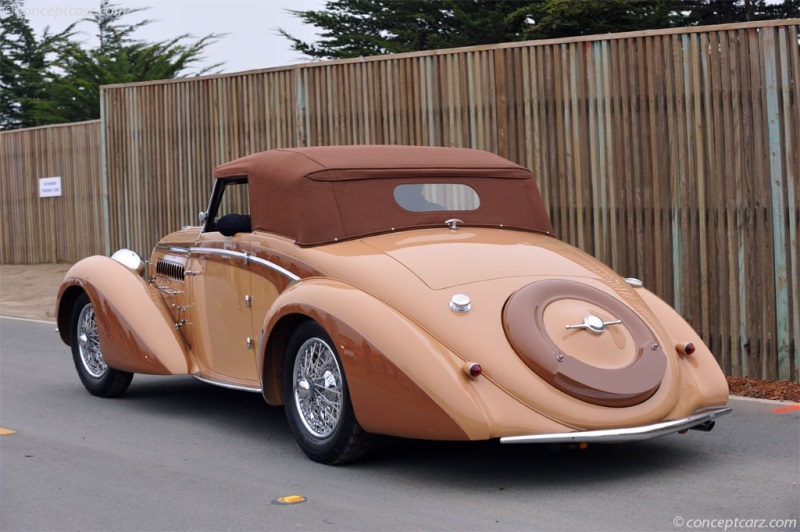
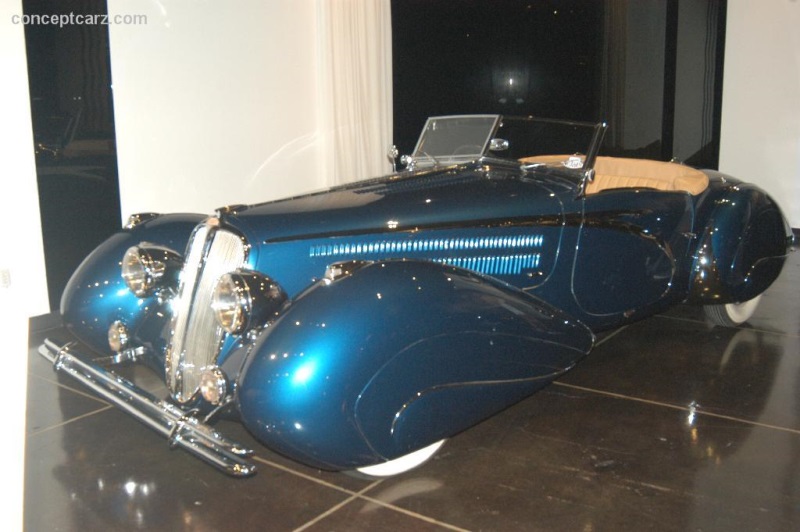
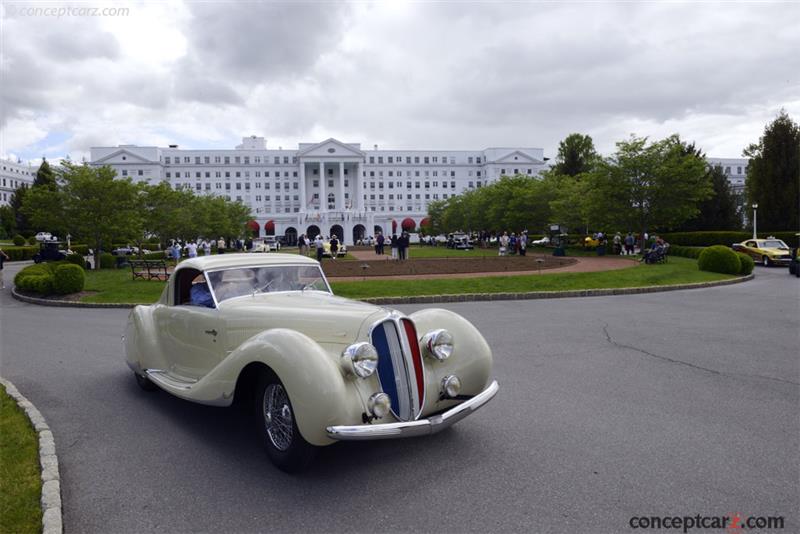
The Delahaye 135 was successful in the salesroom and the racing track with its longevity continuing into the post-war era. Among the legendary coachbuilders who created bodies for the Type 135 include Figoni et Falaschi, Henri Chapron, Marcel Pourtout, Gramond, Langenthal, Franay, Guilloré, Graber, deVillars, Antem, Letourner et Marchand, and J. Saoutchik.
by Daniel Vaughan | Nov 2020
Delahaye's Type 135 was introduced in 1935, powered by an engine initially designed for car use, although it had first appeared in a Delahaye commercial vehicle. The counter-balanced six-cylinder engine, formerly used in the earlier Type 138, had two-cylinder valves, and a four-bearing crankshaft. In twin carburetor form it produced 95 horsepower; with three downdraught Solex carburetors, it delivered 110 horsepower. The engine installed in an equally classic chassis designed by engineer Jean-Francois comprised of two main side frames according to the Bloctube principle borrowed from Peugeot. The welded box-section side members and pressed cross members were welded to a ribbed floor. The 114-inch wheelbase platform used an independent front suspension with transverse leaf springs and a live rear axle with quarter-elliptic springs. The stance was relatively low, thanks to the nearly underslung chassis, arched rear frame members, and the front independent setup improving the car's handling and performance. Four-wheel assisted mechanically-actuated fourteen-inch Bendix drum brakes provided the stopping power. The engine was backed by a four-speed gearbox or Cotal electro-magnetic pre-selector gearbox, the latter proving to be the better option as the four-speed lacked synchromesh on first and second.
The Delahaye Type 135 was also known as the 'Coupe des Alpes' after its success in the Alpine Rally. The driving characteristics of the T135 were delightful and spirited, thanks to its agile and lively chassis, light steering, smooth Cotal electromagnetic gearbox, and independent front suspension.
In racing guise, the 135 series was a formidable competitor, and by the close of 1935, Delahaye had won eighteen minor French sport car races, placed fifth at LeMans, and performed well in a number of hill-climbs. They took the first six places at the 1936 Marseilles race, placed second and third in the 1936 Mille Miglia, a second at Le Mans in 1937, and first, second and fourth place at Le Mans in 1938. Accolades at the 1936 Le Mans race were nearly guaranteed had the race not been canceled. They set the all-time record at the Ulster Tourist Trophy and René Le Bègue and Julio Quinlin won the 1937 Monte Carlo Rally driving a Delahaye. Prince Bira won the 1938 Donington 12-Hour Sports Car Race in Prince Chula's example and went on to take victory in Brooklands' 'fastest road car in England' race.
The Delahaye Type 135M was introduced in 1936, powered by a larger 3,557cc displacement engine, now offering 90 horsepower with a single carburetor, 105 hp with two, and 115 horsepower with a triple carburetor setup. At the Paris Salon in 1938, Delahaye introduced a new, top-of-the-line model of the Type 135 called the MS (Modifiee Speciale). The existing 3.5-liter six-cylinder engine was thoroughly updated with a larger cylinder head, bigger valves, and improved breathing, horsepower increased to 130 hp. Depending on the gearing and coachwork, it was now capable of 110 mph top speed. With triple carburetion, horsepower rose again to 160 bhp.
The Delahaye 135 was successful in the salesroom and the racing track with its longevity continuing into the post-war era. Among the legendary coachbuilders who created bodies for the Type 135 include Figoni et Falaschi, Henri Chapron, Marcel Pourtout, Gramond, Langenthal, Franay, Guilloré, Graber, deVillars, Antem, Letourner et Marchand, and J. Saoutchik.
by Daniel Vaughan | Nov 2020
Related Reading : Delahaye Type 135 History
was born in Tours, France in 1843. He studied engineering in Angers, France. In 1869 he began work with his engineering degree in applied arts and crafts. Emile Delahaye began business in Tours, France in the middle of the 19th century for the purpose of constructing engines for the ceramic industry. The company branched out and began constructing mechanical appliances such as pumps and engines.....
Continue Reading >>
Continue Reading >>


1938 Delahaye Type 135 Vehicle Profiles


Recent Vehicle Additions


Performance and Specification Comparison
Type 135 MS Specification Comparison by Year
Year
Production
Wheelbase
Engine
Prices
Related Automotive News

The Gregorie Neck Collection Joins The Amelia Auction Highlights
Broad Arrow Auctions, a Hagerty (NYSE HGTY) company, is thrilled to announce the consignment of the Gregorie Neck Collection of Richland, South Carolina to its upcoming Amelia Island Auction, March 1-2, 2024. The collection includes 16 outstanding,...

A Comparison of 1997 Best of Show and 2022 Best of Show Nominee at the Pebble Beach Concours d'Elegance
Left 1997 Best of Show Right 2022 Best of Show Nominee
The combined efforts of Talbot-Lago and Figoni %26 Falaschi resulted in many wondrous automotive creations, including the T150C model with goutte deau, literally a drop...

1932 Duesenberg J Figoni Sports Torpedo Named Best of Show at the 71st Pebble Beach Concours d'Elegance
2022 Charitable Donations Surpass %242.67 Million
A unique Duesenberg reprised its early role as Concours winner by taking the top prize at the Pebble Beach Concours dElegance.
This year, 40 classic cars from 18 countries and 33 states pulled...

The Narval Design by Figoni et Falaschi
One of their most flamboyant and artistic Figoni et Falaschi designs was the Narval or Narwhal, based upon the Delahaye 135M chassis and introduced at the 1946 Salon de Paris. It was named Narval for its prominent front treatment, like a Narwhal...

1929 Mercedes-Benz S Barker Tourer Named Best Of Show At The 67Th Pebble Beach Concours d'Elegance
PEBBLE BEACH, Calif. (August 20, 2017) — Just a week ago, Bruce R. McCaws 1929 Mercedes-Benz S Barker Tourer emerged from the restoration shop of Steve Babinsky in Lebanon, New Jersey. Today, having crossed the country, the boattailed beauty captured...

Concours d'Elegance of America : Best of Show
image0
The 38th Concours dElegance of America displayed over 300 of the worlds most spectacular contributions to automotive history. This year, the event paid tribute to many special features inclduing Ford GT-40s, Body by Dietrich, Rally Cars,...