History
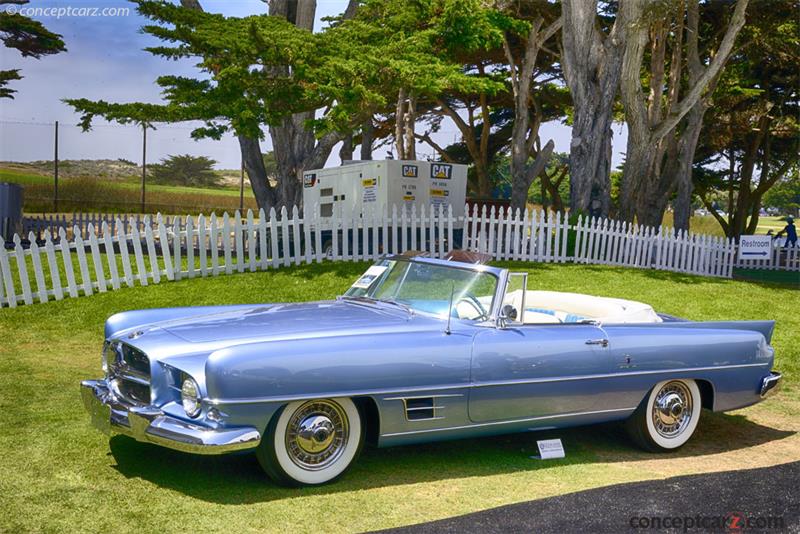
Eugene Casaroll, the proprietor of Automobile Shippers Incorporated, was the individual responsible for the creation of the Dual-Ghia. The design was inspired by Virgil Exner's Dodge Firearrow, later called the Firebomb, show car. When Chrysler decided not to produce the car, Casaroll purchased the original Firebomb show car. It was re-engineered for public sale by designer Paul Farago. The interior room was increased, as was the luggage space. The chassis was from Chrysler, which was sent to Turin, Italy to have Ghia create the coachwork. Ghia had created the original Firebomb body and thus was the perfect craftsman to create the production vehicle. When the bodies were assembled, they were shipped to Detroit where Dual Motors fitted the drive-train and interior trim. The first series was equipped with Chryslers D500 and D500-1 engines. The D500 displaced 315 cubic inches and produced 230 horsepower. The D500-1 had a larger, 325 cubic-inch displacement and 260 horsepower.
Production of this series lasted from 1956 through 1958 with a total of 117 examples constructed. There were two convertibles and the rest were coupes. The cars were competitively priced, considering they cost less than a Cadillac Eldorado and the Lincoln Continental. Just like many new automotive upstarts, the Dual Motors Company lost money on every car.
The concept was later revived in 1961. This time it was produced entirely in Italy in hopes of reducing the cost and expenses. This series is commonly known as the L6.4 as they were powered by Chrysler's 383 cubic-inch (6.4-liter) V8 engine. The chassis was its own, as Chrysler now used a unitary construction method. The cars were offered in hardtop coupe form only. Mr. Casaroll doubled the price in hopes of turning a profit or at least breaking even. Problems continued to escalate as overhead costs continued to soar. Production continued until 1963 with a total of 26 examples created.
By Daniel Vaughan | Apr 2008
Production of this series lasted from 1956 through 1958 with a total of 117 examples constructed. There were two convertibles and the rest were coupes. The cars were competitively priced, considering they cost less than a Cadillac Eldorado and the Lincoln Continental. Just like many new automotive upstarts, the Dual Motors Company lost money on every car.
The concept was later revived in 1961. This time it was produced entirely in Italy in hopes of reducing the cost and expenses. This series is commonly known as the L6.4 as they were powered by Chrysler's 383 cubic-inch (6.4-liter) V8 engine. The chassis was its own, as Chrysler now used a unitary construction method. The cars were offered in hardtop coupe form only. Mr. Casaroll doubled the price in hopes of turning a profit or at least breaking even. Problems continued to escalate as overhead costs continued to soar. Production continued until 1963 with a total of 26 examples created.
By Daniel Vaughan | Apr 2008
Similar Vehicles


1956 Dual Ghia Convertible Vehicle Profiles
Recent Vehicle Additions


Performance and Specification Comparison
Price Comparison
Sports Car Specification Comparison by Year
Year
Production
Wheelbase
Engine
Prices
Related Automotive News

Phenomenal Ferraris and Italian Thoroughbreds Offered at Gooding & Company's Pebble Beach Auctions
The auction house announced a stable of Italian star cars, including a 1950 Ferrari 166 MM Berlinetta Le Mans, a 1961 Ferrari 400 Superamerica Series I Coupe Aerodinamico, and a 1954 Ferrari 500 Mondial Series I Spider.
A stunning group of star...

From Lucybelle to DHL: Historic Porsche Competition Cars Race to Gooding & Company's Pebble Beach Auctions
The very best of Porsche excellence will come to Pebble Beach with a 1959 Porsche 718 RSK, a 1969 Porsche 90802, a 2007 Porsche RS Spyder Evo, and more.
Gooding %26 Company, the official auction house of the Pebble Beach Concours dElegance®,...

What Cars Can You Expect to See at The Elegance at Hershey?
HERSHEY, PA (May 2017) - The Elegance at Hershey is a celebration of a bygone era when the automobile stirred our imaginations and quickened our hearts. Today, people both young and old marvel at the extravagances of the automobiles of the past....

Very Rare and Highly Desirable Concours Level 1958 Dual-Ghia Convertible Set to Shine in Monterey at Russo and Steele's 15th Anniversary Auction Extravaganza
Scottsdale, Arizona (July 9th, 2015) – As a man possessed of virtually boundless vision and drive, Eugene Casaroll almost single-handedly invented the car-delivery business with his foundation of Auto Shippers and his Dual Motors Corporation built...

RARE REUNION: CHRYSLER CONCEPT CARS GATHER AT AMELIA, 2014
Nine rare and important Chrysler Concept Cars from the forties, fifties and sixties will be presented together for the first time at the 19th annual Amelia Island Concours dElegance on March 9, 2014.
From the two-seat Chrysler Thunderbolt roadster...