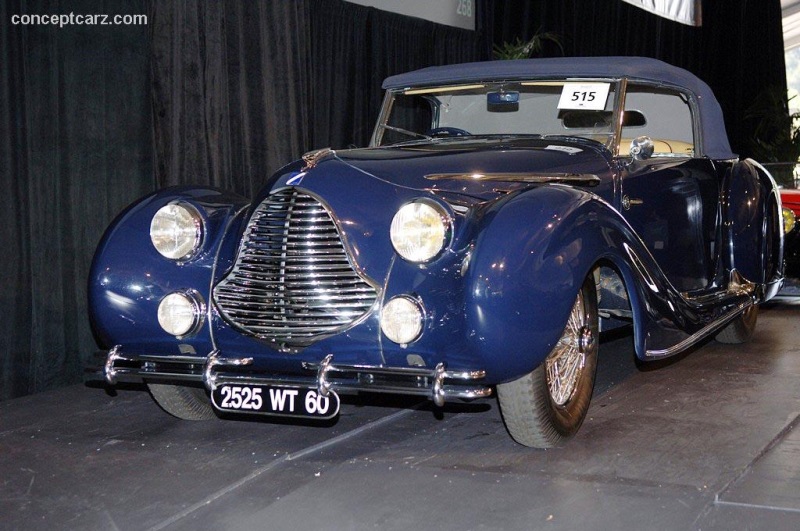
By the mid-1930s, a once prosperous Sunbeam-Talbot-Darracq company was on the verge of collapse when it sent engineer Antonio Lago to Talbot's Suresnes, France plant with the monumental task of restoring health to its operations. Embracing the task wholeheartedly, he completed a management buy-out from the receiver and renamed the company Automobiles Talbot-Darracq S.A., but commonly referred to as Talbot-Lago. In short order, he had injected a renewed focus on performance and racing to generate sales. An appearance at the 24 Hours of Le Mans in 1937 was followed by a focus on Grand Prix competition, often rewarded with podium finishes and overall victories (the company's greatest racing victory was a 1-2 finish at LeMans in 1950). The company's road-going vehicles benefited from the car's racing endeavors, with the design and mechanical sophistication closely based upon the marque's Grand Prix and sports racers. With similar performance and driveability, the high-performance Tablot-Lagos were popular with the wealthy and sporting individuals of that era.
Four-Seat Cabriolet by Figoni & Falaschi
Chassis #: 100047
View info and history
Auction entries : 1A talented engineer named Walter Becchia, who joined the company shortly after Antonio Lago's arrival, was an integral part of Talbot-Lago's success. The three-liter sportscar was quickly followed by a four-liter version of the straight-six engine. Beyond just an increase in displacement, it was given a cylinder head with hemispherical combustion chambers operated by crossed pushrods controlled by a single camshaft high in the block. With three carburetors installed, the engine delivered approximately 140 horsepower, and with high compression pistons, output rose to 165 bhp. Installed in a low-slung, short-wheelbase chassis with independent suspension at the front and an underslung rear axle, the T150 was one of the quickest and best-handling cars. Many prominent coachbuilders created equally impressive coachwork, including a series of coupes created by Joseph Figoni and Ovidio Falaschi and known as the Teardrop or 'goutte d'eau' (drop of water) coupes.The Talbot-Lago T150 was produced through 1939, with production halted due to hostilities in Europe. At the start of World War II, Becchia transferred to Citroen, and in 1942, Tony Lago was joined by engineer Carlo Marchetti. Together, they would work on the twin-camshaft 4,483cc six-cylinder engine that would power the post-war Talbot T26.Talbot-Lago T26
When peacetime resumed, the world was a very different place. The French government that came to power in 1945 took greater control of the cars being produced by creating a taxation regime that penalized cars with engine sizes above 2 liters. Additionally, the Pons Plan of January 1946 gave the government the ability to dictate what car types were built by different French automakers. Controlling material supplies, including steel, the government and its Pons Plan could not be ignored. Talbot, Hotchkiss, and Delahaye-Delage were tasked with building véhicules de classe exceptionnelle (high class vehicles). The heavy taxes imposed on these large and luxurious cars quickly brought about their demise, with Talbot Lago's end coming in 1958, selling the brand to Simca.
Coupe by Franay
Chassis #: 110123
Engine #: 123
View info and history
Auction entries : 3Although the post-war cars produced by Talbot-Lago differed from those built before the war, there were similarities between the T150 and the T26, including the dimensions of cylinders, the overall displacement, and the four-speed Wilson pre-selector gearbox. The latter offered fast shifting compared to conventional gearboxes at the time. The new engine design created during the war had a second lateral mounted camshaft (as opposed to the single one on the pre-war engine), which improved the efficiency of opening the valves in the hemispheric head. The T26 Record had a cast-iron head while the T26 Grand Sport received a lighter aluminum alloy head. The T26 Record produced approximately 170 horsepower and the T26 Grand Sport made around 190 bhp. The name 'T26' referred to the fiscal horsepower rating of the '26 cv' engine. The T26 Record was introduced in 1946, and the Grand Sport followed two years later. The Talbot-Lago T26 used a box-section chassis that was essentially a T150 C Grand Prix frame with transverse leaf front suspension that was widened and stretched to accommodate larger coachwork. The standard chassis measured 123 inches, and the sport chassis was much shorter at 104.3 inches (the same size used by the T150 Super Sport model). The Record was available with the 123-inch platform and a larger 135.8-inch platform which could accommodate seven-passenger coachwork.
Fastback Coupe by Antem
Chassis #: 110112
View info and historyThe T26 Record was offered both as a rolling chassis for custom coachbuilders to body or with factory-built bodies. Initially, the Grand Sport did not receive factory coachwork; the slightly larger Grand Sport of 1953 could be purchased with a factory coupe body. The list of coachbuildes who clothed the Grand Sport includes Saoutchik Chapron, Franay, Figoni, Dubos, Antem, and others. Exported chassis were bodied by Pennock, Van den Plas, Graber, and Stabilimenti Farina. Some of the T26 Grand Sports were used for rallies and races, while others were given voluptuous and extravagant bodies intended for spirited driving through cities and countryside. Throughout its existence, the T26 would remain out of reach for most consumers, selling for approximately four times the price of a six-cylinder sedan from the top end of the mainstream ranges. Around 32 examples of the T26 Grand Sprot were built between 1948 and 1953, with 29 resting on the original short 2.65-meter wheelbase and three towards the end on the larger 2.8-meter platform.
by Daniel Vaughan | Nov 2023
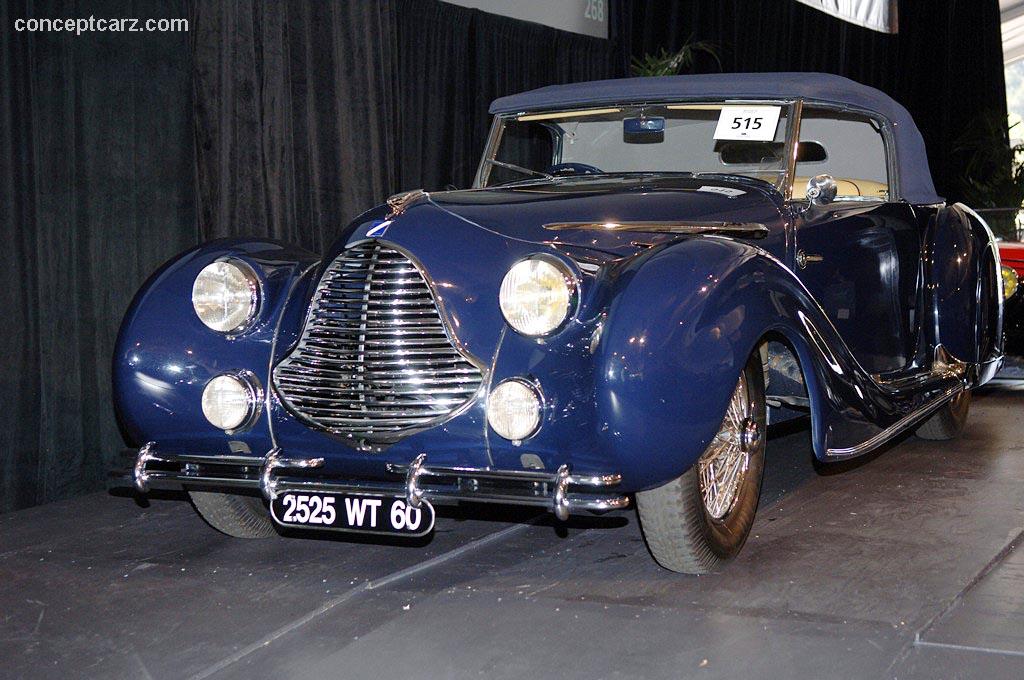
Four-Seat Cabriolet by Figoni & Falaschi
Chassis #: 100047
View info and history
Auction entries : 1
When peacetime resumed, the world was a very different place. The French government that came to power in 1945 took greater control of the cars being produced by creating a taxation regime that penalized cars with engine sizes above 2 liters. Additionally, the Pons Plan of January 1946 gave the government the ability to dictate what car types were built by different French automakers. Controlling material supplies, including steel, the government and its Pons Plan could not be ignored. Talbot, Hotchkiss, and Delahaye-Delage were tasked with building véhicules de classe exceptionnelle (high class vehicles). The heavy taxes imposed on these large and luxurious cars quickly brought about their demise, with Talbot Lago's end coming in 1958, selling the brand to Simca.
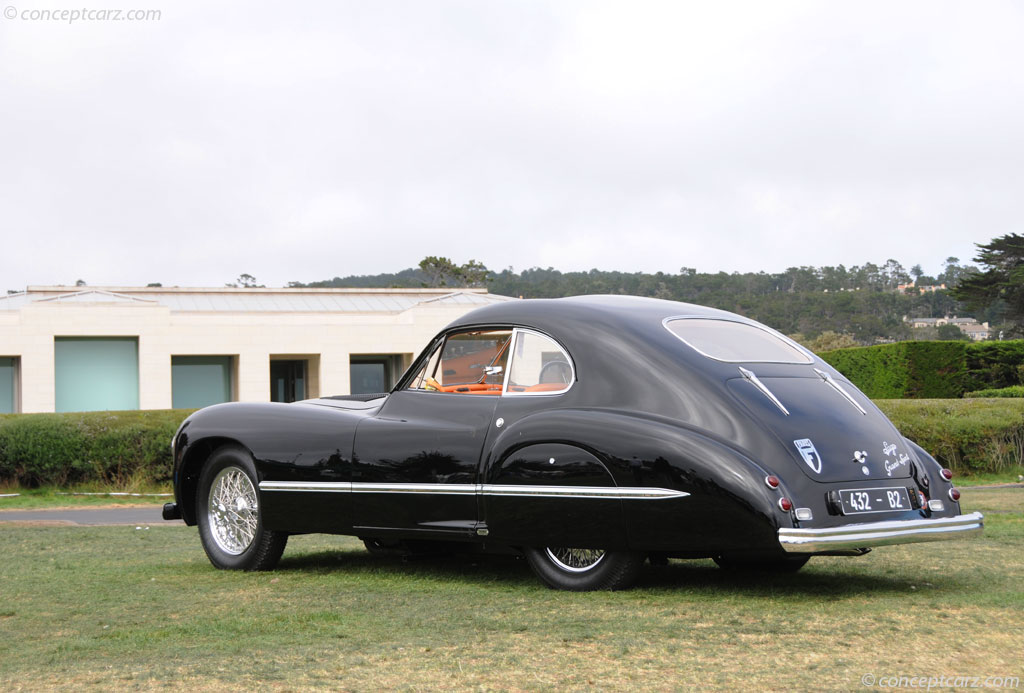
Coupe by Franay
Chassis #: 110123
Engine #: 123
View info and history
Auction entries : 3
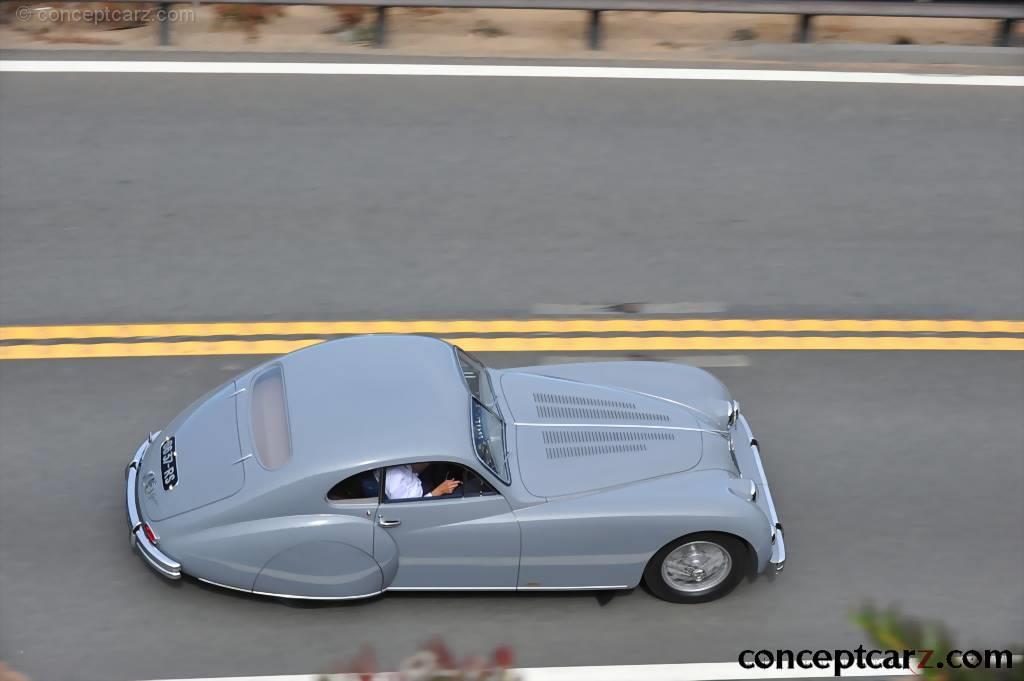
Fastback Coupe by Antem
Chassis #: 110112
View info and history
by Daniel Vaughan | Nov 2023
Related Reading : Talbot-Lago T-26 History
Anthony Lago had taken over control of the Talbot factory in Suresnes after the merger with Sunbeam and Darracq had collapsed in 1936. By 1937 he had introduced a new line of vehicles, two of which were entered in the grueling 24 Hours of Le Mans. He continued his racing endeavors by moving to single-seat racers, and by 1939, a purpose-built Grand Prix car had been completed. The onset of World War....
Continue Reading >>
Continue Reading >>


1949 Talbot-Lago T26 Grand Sport Vehicle Profiles


Recent Vehicle Additions


Performance and Specification Comparison
T26 GS Specification Comparison by Year
Year
Production
Wheelbase
Engine
Prices
Related Automotive News

1932 Duesenberg J Figoni Sports Torpedo Named Best of Show at the 71st Pebble Beach Concours d'Elegance
2022 Charitable Donations Surpass %242.67 Million
A unique Duesenberg reprised its early role as Concours winner by taking the top prize at the Pebble Beach Concours dElegance.
This year, 40 classic cars from 18 countries and 33 states pulled...

From pioneers to performance greats: Salon Privé unveils stellar entry for Concours d'Elégance
More than 100 years of motoring history on show at Blenheim Palace
Awards will be decided by ICJAG panel of world-leading experts and chief automotive designers
Coachbuilt beauties entered, along with competition legends on two wheels and four
Cl...

The Narval Design by Figoni et Falaschi
One of their most flamboyant and artistic Figoni et Falaschi designs was the Narval or Narwhal, based upon the Delahaye 135M chassis and introduced at the 1946 Salon de Paris. It was named Narval for its prominent front treatment, like a Narwhal...

Concours d'Elegance of America : Best of Show
image0
The 38th Concours dElegance of America displayed over 300 of the worlds most spectacular contributions to automotive history. This year, the event paid tribute to many special features inclduing Ford GT-40s, Body by Dietrich, Rally Cars,...

CHUBB INSURANCE CONCOURS D'ELÉGANCE AT SALON PRIVÉ CONFIRMS WORLD-LEADING COLLECTION OF CARS FOR 2015 EVENT
Outstanding line-up of cars will be paraded at new home of Blenheim Palace as Salon Privé celebrates 10th year anniversary
1937 Delahaye known as Star of India set to be one of the stars of the show, as well as Ferrari 250 GT Berlinetta Tour de...