


Sport Touring
Coachwork: Vanden Plas
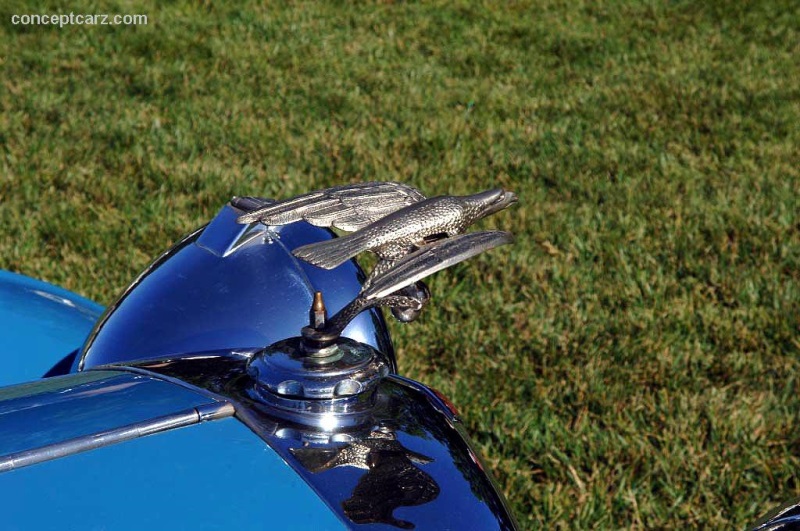
The first vehicles to bear the Alvis name, founded by Thomas George John and G. P. de Freville, appeared in 1920. Production of the Alvis vehicles would last for 47 years ending in 1967. The vehicles quickly built a reputation for performance and for their durability, and quality craftsmanship. The company, during its lifespan, would also be involved in the production of aero-engines and military vehicles.The Speed 20 was introduced in 1932 and were available in various configuration. Production would continue until 1936. The 4 door touring version was the standard configuration with Cross & Ellis handling these coachwork orders. The 4 door saloon was courtesy of Charlesworth. The two-door tourer, two-door sports saloon, and drophead coupe versions were created by Vanden Plas. When introduced the engine offered was a six-cylinder unit with pushrod overhead valves, three SU carburetors, and about 86 horsepower. Their engines were referred to as 'Silver Eagles'. The suspension was comprised of semi-elliptical springs in the front and rear. 14-inch drum brakes provided the stopping power. Specifications varied and were continually improved. In 1933 the Crested Eagle was introduced which used an independent suspension with a transverse leaf spring and wishbone setup.
In 1936 production of the Speed 20 ceased with around 750 examples being produced.
By Daniel Vaughan | Oct 2006
In 1933 Alvis introduced to the world a gearbox with synchromesh on all forward gears. This advancement made the vehicles much easier to drive and offered considerably better performance.
By Daniel Vaughan | Oct 2006


1935 Alvis Speed 20 Vehicle Profiles
Recent Vehicle Additions


Performance and Specification Comparison
Speed 20 Specification Comparison by Year
Year
Production
Wheelbase
Engine
Prices
6 cyl., 153.23 CID., 87.00hp
Related Automotive News

HRH the Prince of Wales's beloved DB6 Volante to feature in Aston Martin celebration at Concours of Elegance 2022
Automotive extravaganza to celebrate the most glamorous British marque of all Aston Martin
Line up to include rarest, most significant examples including, The Prince of Waless DB6 Volante
Display to also feature DB4 GT Zagato and one-off DB5 V8...

Austin-Healey 100S Powers into Bonhams Bond Street Sale
RARE BRITISH RACING CAR LEADS FLAGSHIP LONDON AUCTION
A 1950s Austin-Healey 100S with significant in-period competition history –– is in pole position at the forthcoming Bonhams Bond Street Sale on 4 December.
EVV 106, a 1955 100S Sports...

Gooding & Company Proudly Announces a Geared Online Auction – The European Sporting & Historic Collection From 28 January to 5 February 2021
Hailing from a private UK-based collection, these nine cars represent the very best of motorings most prosperous era, with highlights from Ferrari, Mercedes-Benz, Aston Martin, Bentley, and Rolls-Royce.
Gooding %26 Company, the internationally...

One Of The World's Most Desirable Collector Cars Comes To Auction
1937 Bugatti 57SC Sports Tourer By Vanden Plas - This ultimate pre-war supercharged rarity will be offered at Bonhams Amelia Island Auction on March 10th
New York – Bonhams is delighted to announce the addition of an extremely important...

63rd Pebble Beach Concours d'Elegance Names 1934 Packard 'Best of Show'
The competition showcased 248 cars, including 48 from abroad
PEBBLE BEACH, Calif. (August 18, 2013) -- A 1934 Packard 1108 Twelve Dietrich Convertible Victoria owned by Joseph and Margie Cassini III of West Orange, New Jersey, was named Best...