Brothers Benjamin and William Jowett, along with Arthur Lamb, established a company in 1901 with the intent of producing motorcycles. The venture evolved into building V-twin engines for larger driving vehicles, and by 1904 they had become the Jowett Motor Manufacturing Company. The first Jowett car was built in 1906.
Sport Convertible
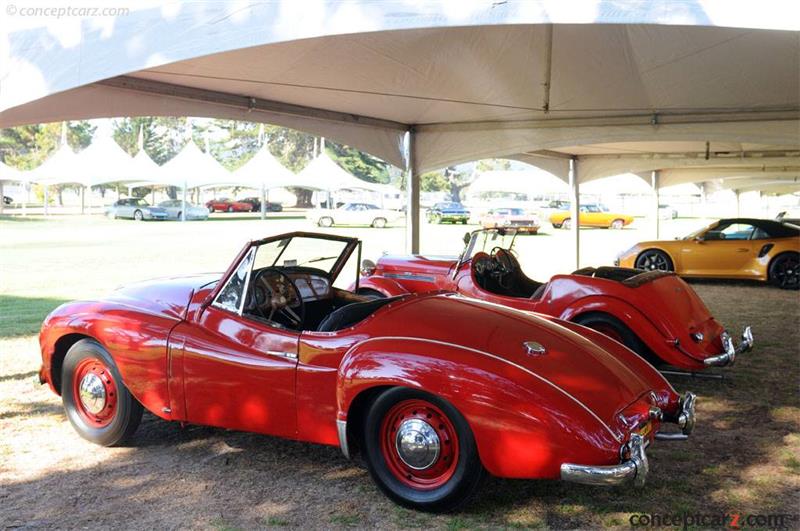
View info and historyJust prior to the start of World War II, Jowett Cards, Ltd. introduced a horizontally opposed four-cylinder car, a departure from their traditional two-cylinder models. When peace prevailed, Jowett began offering a fastback saloon powered by a 1,486cc overhead-valve engine. In 1951, a sports two-seater named the Jupiter was introduced, using the Javelin engine placed into a torsion-bar-suspended tubular chassis designed by Austrian engineer Robert Eberan von Eberhorst. Despite its small footprint, the Jupiter achieved a record-breaking class victory at the 1950 Le Mans 24 Hour race and repeated the feat in 1951 and 1952. The Jupiter was introduced in chassis-only form in October of 1949 at the London Motor Show, with the complete car being shown for the first time in New York in April of 1950. Production lasted from 1950 through 1954, with approximately 900 examples produced. 731 examples were MK1 and 94 were MK1a cars. The MK1a was introduced in late 1952 with a slightly higher horsepower rating and an opening lid to a larger trunk area. The first seventy-five chassis were sent to Stabilimenti Farina, Ghia Suisse, Abbott of Farnham, and others in Britain for coachwork.By 1955, Jowett had entered into receivership and ceased production.
by Daniel Vaughan | Oct 2019
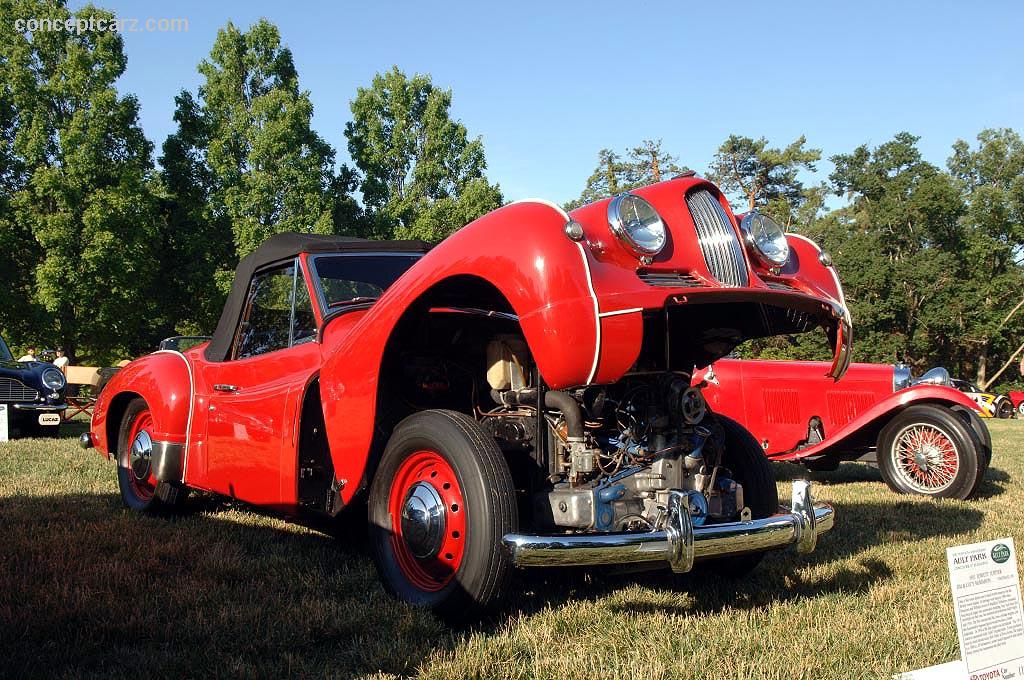
Sport Convertible
View info and history
by Daniel Vaughan | Oct 2019
Related Reading : Jowett Jupiter History
One of the rarest sports cars to reach North America was the British Jowett Jupiter. Its heritage goes back to 1906 when Benjamin and William Jowett of Bradford, Yorkshire, expanded from bicycle repair into automobile building. They built their first prototype car that year, but commercial production didnt begin until 1910. The first Jowetts had flat, twin-cylinder engines, and this horizontally....
Continue Reading >>
Continue Reading >>
Related Reading : Jowett Jupiter History
Produced by Jowett Cars Ltd. of Bradford, England, the Jupiter was a British Automobile that was produced from 1950 to 1954. Jowett produced commercial and light vehicles from 1906 until 1954. Riding high on the success of the Jowett Javelin, the Jowett Company chose to test the waters by using its power train in a sports car, the only one the company ever made. ERA was chosen to design the chassis....
Continue Reading >>
Continue Reading >>
Similarly Sized Vehicles
from 1951
Similarly Priced Vehicles
Hudson Hornet Series 7A ($2,545-$3,100)
Morgan Plus Four ($2,455-$2,655)
Average Auction Sale: $39,904
Morgan Plus Four ($2,455-$2,655)
Average Auction Sale: $39,904


1951 Jowett Jupiter Vehicle Profiles

Recent Vehicle Additions


Performance and Specification Comparison
Price Comparison
Jupiter Specification Comparison by Year
Year
Production
Wheelbase
Engine
Prices
Related Automotive News

A New Automotive Icon To Debut At Le Mans – First DB4 GT Zagato Continuation Set For Unveil At Circuit De La Sarthe
DB4 GT Zagato Continuation to make public debut at 24 Hours of Le Mans 2019
Race-goers will be first to see Aston Martins most expensive new car
DB4 GT Zagato Continuation extends Zagato bloodline in centenary year
11 June 2019, GaydonLe Man...

Excellence Reborn – Work Under Way On Iconic DB4 GT Zagato Continuation
First body completed as DB4 GT Zagato Continuation build commences at Aston Martin Works
Modern production systems meet artisan coachbuilding skills as Aston Martin optimises Zagato build process for 21st Century
DB4 GT Zagato Continuation extends...

DBZ Centenary Collection: Classic Joins Contemporary In Unique Centenary Tribute
DBZ Centenary Collection comprises of DB4 GT Zagato Continuation and DBS GT Zagato
Production strictly limited to 19 pairs - cars will not be sold separately
Conceived to mark Zagatos centenary in 2019
Track-only DB4 GT Zagato Continuation to be...

DB4 G.T. CONTINUATION: HISTORY IN THE MAKING
Iconic DB4 G.T. brought back to life by Aston Martin Works
Cars will be built at Newport Pagnell - home of the original DB4 G.T.
Strictly limited to 25 track-only cars
Newport Pagnell production re-starts after 10 years
09 December 2016, Newp...

THREE TIMES FOUR: RM SOTHEBY'S BRINGS ASTON MARTIN TRINITY TO LONDON SALE WITH DB4GT, DB4 CONVERTIBLE AND DB4 SERIES II COUPÉ
RM Sothebys assembles holy trifecta of DB4s for its 10th anniversary London sale, 7 September at Battersea Evolution
Trio led by original one-of-75 DB4GT, immaculate concours-standard Series V Convertible, and desirable left-hand-drive Series...