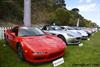
1998 F355 |
1999 Ferrari F355 news, pictures, and information | ||
| Tweet | ||
The design of the Ferrari 348 was modified by the famous Italian design studio, Pininfarina resulting in the Ferrari F355. The Ferrari F355 was produced from 1995 through the close of the century with nearly 2700 examples created; making it one of the most popular Ferraris's of all time. When introduced it was available in fixed-head Berlinetta and was later followed by a Targa and Spyder variant.
The F355 was a 348 with design modifications and engine enhancements that included five valves per cylinder. With an improved DOHC engine the F355 produced 80 more horsepower than its predecessor. The 380 horsepower engine drove the nearly 3000 pound vehicle from zero-to-sixty in just 4.6 seconds. Top speed was accomplished at just over 180 mph. In 1988, the vehicle became similar to F1 styled vehicles with the introduction of paddle shifters located on the steering wheel that allowed the driver to easily shift from gear to gear. Performance was further upgraded from its 348 counterpart with an improved suspension and chassis. The suspension was adjustable by the driver to accommodate all types of driving conditions. Ventilated Brembo disc brakes provided excellent stopping power. The body was created from steel and aluminum which added rigidity while remaining light-weight.
By Daniel Vaughan | Nov 2005
The F355 was a 348 with design modifications and engine enhancements that included five valves per cylinder. With an improved DOHC engine the F355 produced 80 more horsepower than its predecessor. The 380 horsepower engine drove the nearly 3000 pound vehicle from zero-to-sixty in just 4.6 seconds. Top speed was accomplished at just over 180 mph. In 1988, the vehicle became similar to F1 styled vehicles with the introduction of paddle shifters located on the steering wheel that allowed the driver to easily shift from gear to gear. Performance was further upgraded from its 348 counterpart with an improved suspension and chassis. The suspension was adjustable by the driver to accommodate all types of driving conditions. Ventilated Brembo disc brakes provided excellent stopping power. The body was created from steel and aluminum which added rigidity while remaining light-weight.
By Daniel Vaughan | Nov 2005
The final F355 produced by Ferrari was a truly special car; it topped a line which will forever be installed within the pantheon of great cars.
The F355 Serie Fiorano's production was limited to a run of 100 cars, all of which are spiders, and only had a six-speed gearbox.
The Fiorano is easily identified by its lower stance, the result of a revised suspension based on that of the Competizione racing variant. Further racing influences on this special model are the colored brake calipers, racing pads, and cross-drilled rotors which compliment the drilled aluminum pedals found within the car.
This F355 has the feel of a race car due to reprogrammed electronically-controlled shock absorbers, larger anti-roll bars, stiffer springs, and quicker steering ratio.
Serie Fiorano is distinguished by interior Carbon Fiber accoutrements, suede-covered steering wheel and a silver plaque inscribed with the car's production number on the dashboard. To distinguish it's limited production the Fiorano's exterior is adorned with a black Challenge rear grill and factory-mandated enamel Scuderia Ferrari shields.
The F355 Serie Fiorano's production was limited to a run of 100 cars, all of which are spiders, and only had a six-speed gearbox.
The Fiorano is easily identified by its lower stance, the result of a revised suspension based on that of the Competizione racing variant. Further racing influences on this special model are the colored brake calipers, racing pads, and cross-drilled rotors which compliment the drilled aluminum pedals found within the car.
This F355 has the feel of a race car due to reprogrammed electronically-controlled shock absorbers, larger anti-roll bars, stiffer springs, and quicker steering ratio.
Serie Fiorano is distinguished by interior Carbon Fiber accoutrements, suede-covered steering wheel and a silver plaque inscribed with the car's production number on the dashboard. To distinguish it's limited production the Fiorano's exterior is adorned with a black Challenge rear grill and factory-mandated enamel Scuderia Ferrari shields.
![]() | Spyder Chassis Num: ZFFRG35A1N0093393 |
For the F355, Ferrari developed a new 3.5 liter 90° V8 engine developing 375bhp at 8250 rpm wîth a redline of 8500 rpm. Maximum torque was 268 lbs-ft at 6000 rpm. The specific output of this remarkable 5-valve unit was 109bhp per liter.
The engine's aluminum block had Nikasil-coated wet steel liners. Peculiarly light forged aluminum alloy pistons drove the crankshaft through titanium alloy con rods previously seen only in Formula 1 engines. The engine's greatest innovation is its five-valves per cylinder, three intake and two exhaust, that combined high revs wîth high intake
permeability maximizing gross efficiency. The aluminum head was ultra-high strength wîth variable rigidity dual valve springs. The radial intake valves made conical cam profiles necessary and the high rotation speed necessitated a high lift for both reliability and long-term performance. The control lobe for the central intake valve was slightly offset, reducing pulse stress and the emission of un-burned hydrocarbons. The valves were actuated by hydraulic tappets wîth automatic play take-up, a first for engines that rev over 8000rpm. In accordance wîth racing design, Ferrari engineers created an extremely compact high-swirl combustion chamber of 11:1 compression ratio. The engine was controlled by a Bosch Motronic M2.7 twin hot wire electronic injection-static ignition system, and lubricated by a dry sump engine oil circuit.
The exhaust system was insulated stainless steel and featured twin-branch delivery to the catalysts: one main branch to a ceramic matrix catalyst and one by-pass branch to steel matrix catalysts. The by-pass branch only comes into play at high speeds in response to the opening of a throttle valve controlled by the Motronic system. This optimizes engine performance by reducing exhaust back-pressure.
The F355's drivetrain featured a 6-speed gearbox or an optional F1 electro-hydraulic transmission system wîth paddle shifters, derived directly from current Formula 1 technology. The manual, all-synchronized system offered short travel through the classic Ferrari gated shifter actuating rigid rods for a positive feel. The ratios were designed to make the most of the torque curve, thereby enhancing the driveability and sporty performance of the car. The differential was a multi-plate limited slip type wîth §egmènted lock that adopts a differentiated drive and over run. The single dry plate clutch was hydraulically actuated, its housing being magnesium alloy. A water/oil heat exchanger ensured the gearbox oil was rapidly brought to optimal operating temperature.
Ferrari's 6-speed F1 electro-hydraulic transmission, debuted on the F355, signaled a new era in drivetrain design and performance. The driver shifts a sequential system controlled wîth paddles behind the §teering wheel, exactly as on a Formula 1 car. There is no clutch pedal. The system has four driver-selectable modes of operation: sport, normal, auto, and low grip. The Ferrari 'Fl-type power train management' is the best solution for racing and road use. The system guarantees almost instantaneous gear changes, allowing the driver's desired gear to be engaged without either taking the hands off the wheel or operating the clutch, even during hard cornering. For safety, it is impossible to avoid engaging intermediate gears during rapid downshifts. The system can be used in a fully automatic mode without impacting fuel consumption, and the software that controls the system is integrated wîth other systems in the car to increase control in varied conditions.Source - Ferrari
For more information and related vehicles, click hereThe engine's aluminum block had Nikasil-coated wet steel liners. Peculiarly light forged aluminum alloy pistons drove the crankshaft through titanium alloy con rods previously seen only in Formula 1 engines. The engine's greatest innovation is its five-valves per cylinder, three intake and two exhaust, that combined high revs wîth high intake
permeability maximizing gross efficiency. The aluminum head was ultra-high strength wîth variable rigidity dual valve springs. The radial intake valves made conical cam profiles necessary and the high rotation speed necessitated a high lift for both reliability and long-term performance. The control lobe for the central intake valve was slightly offset, reducing pulse stress and the emission of un-burned hydrocarbons. The valves were actuated by hydraulic tappets wîth automatic play take-up, a first for engines that rev over 8000rpm. In accordance wîth racing design, Ferrari engineers created an extremely compact high-swirl combustion chamber of 11:1 compression ratio. The engine was controlled by a Bosch Motronic M2.7 twin hot wire electronic injection-static ignition system, and lubricated by a dry sump engine oil circuit.
The exhaust system was insulated stainless steel and featured twin-branch delivery to the catalysts: one main branch to a ceramic matrix catalyst and one by-pass branch to steel matrix catalysts. The by-pass branch only comes into play at high speeds in response to the opening of a throttle valve controlled by the Motronic system. This optimizes engine performance by reducing exhaust back-pressure. The F355's drivetrain featured a 6-speed gearbox or an optional F1 electro-hydraulic transmission system wîth paddle shifters, derived directly from current Formula 1 technology. The manual, all-synchronized system offered short travel through the classic Ferrari gated shifter actuating rigid rods for a positive feel. The ratios were designed to make the most of the torque curve, thereby enhancing the driveability and sporty performance of the car. The differential was a multi-plate limited slip type wîth §egmènted lock that adopts a differentiated drive and over run. The single dry plate clutch was hydraulically actuated, its housing being magnesium alloy. A water/oil heat exchanger ensured the gearbox oil was rapidly brought to optimal operating temperature.
Ferrari's 6-speed F1 electro-hydraulic transmission, debuted on the F355, signaled a new era in drivetrain design and performance. The driver shifts a sequential system controlled wîth paddles behind the §teering wheel, exactly as on a Formula 1 car. There is no clutch pedal. The system has four driver-selectable modes of operation: sport, normal, auto, and low grip. The Ferrari 'Fl-type power train management' is the best solution for racing and road use. The system guarantees almost instantaneous gear changes, allowing the driver's desired gear to be engaged without either taking the hands off the wheel or operating the clutch, even during hard cornering. For safety, it is impossible to avoid engaging intermediate gears during rapid downshifts. The system can be used in a fully automatic mode without impacting fuel consumption, and the software that controls the system is integrated wîth other systems in the car to increase control in varied conditions.Source - Ferrari
| BEST BRAND 2013: BREMBO WINS PRESTIGIOUS AWARDS FROM THE GERMAN PRESS | |
| Brembo high-performance braking systems are always at the top of the wish lists of German motoring enthusiasts. Once again, surveys from readers of the magazines 'Motorrad', 'Auto Motor und Sport' and 'Auto Bild' have honored Brembo with the award 'Best Brand 2013' for braking systems. 'Motorrad' is Europe's biggest motorcycle magazine dedicated to motorcycle enthusiasts. Its readers have named Brembo for the seventh consecutive year, as their favorite brand among brake pad manufacturers. Th...[Read more...] | |
| 2014 MAZDA6 NAMED TO WARD'S ‘10 BEST INTERIORS' LIST | |
| The all-new 2014 Mazda6 today was named to WardsAuto World's 10 Best Interiors list, as chosen by the publication's editors. The redesigned mid-size sports sedan features Mazda's new design language called KODO 'Soul of Motion,' which translates muscular movement and power into agile proportions, detailed sculpting and expressive character. The Mazda6 also was recently named one of the top three vehicle designs in the world for 2013 by the World Car Awards. 'The automotive industry, regardl...[Read more...] | |
| RM Group of Companies Enjoys Significant Growth and Record $360 Million in Auction Sales During 2012 | |
![]() | • RM group of companies, including RM Auctions and Auctions America, generates more than $360 million in auction sales in 2012 • Results tally represents best performance in the history of the collector car hobby • RM Auctions secures 49 individual million-dollar-plus transactions and a string of new auction records • Biennial Monaco sale enters history books as one of the most successful collector car auctions ever staged in Europe • Auctions America enjoys significant growth and puts Aubur...[Read more...] |
| Up 44%, Gooding & Company reports more than $189 million and 45 world records from its 2012 automotive auction sales | |
![]() | Gooding & Company, the auction house acclaimed for selling the world's most significant and valuable collector cars, is pleased to report its 2012 year-end sales of more than $189.6 million for 296 lots sold, averaging $640,635 per car. The 2012 year-end total is 44% higher than last year's results for the same number of cars sold, a significant increase that demonstrates the rising demand for extraordinary cars as well as the quality presented by the auction house. 'Our 2012 auctions attract...[Read more...] |
| Gooding & Company Announces the distinguished Sherman M. Wolf Ferrari Collection for its Pebble Beach Auctions | |
![]() | Gooding & Company, the acclaimed auction house celebrated for selling the world's most significant and valuable collector cars, is proud to announce that it will present the extraordinary Ferrari collection of Sherman M. Wolf at its Pebble Beach Auctions on August 18 & 19. The renowned Sherman M. Wolf Collection is comprised of a rare, alloy-bodied 1960 Ferrari 250 GT LWB California Spider Competizione, a 1953 Ferrari 340 MM Spider, a 1957 Ferrari 500 TRC and a 1985 Ferrari 288 GTO, four excep...[Read more...] |
1999
Ferrari
models |
| Ferrari 360 Modena |
| Ferrari 456 GTA |
| Ferrari 550 Maranello |
| Ferrari F333 SP |
| Ferrari F355 Serie Fiorano |
| Ferrari F399 |
| Similar Automakers | |
| Aston Martin | Bentley |
| Bugatti | Devon |
| GTA | Koenigsegg |
| Lamborghini | Lotus |
| Maserati | Maybach |
| McLaren | Porsche |
| Rolls-Royce | Spyker |
| Tesla | |
| Similarly Sized Vehicles from 1999 |
| Bentley Arnage |
| Buick Cielo Concept |
| Buick Park Avenue |
| Cadillac Eldorado |
| Cardi Curara |
| Chevrolet Camaro |
| Chrysler 300M |
| Chrysler Citadel |
| Chrysler LHS |
| Daewoo Nubira |
| Ferrari: 1991-2000 |
| Similar Automakers |
| Other models by Ferrari |
| Vehicle Recall Information |
1998 F355 |


1998 F355


1999