1971 Plymouth GTX
1971 Plymouth GTX Navigation
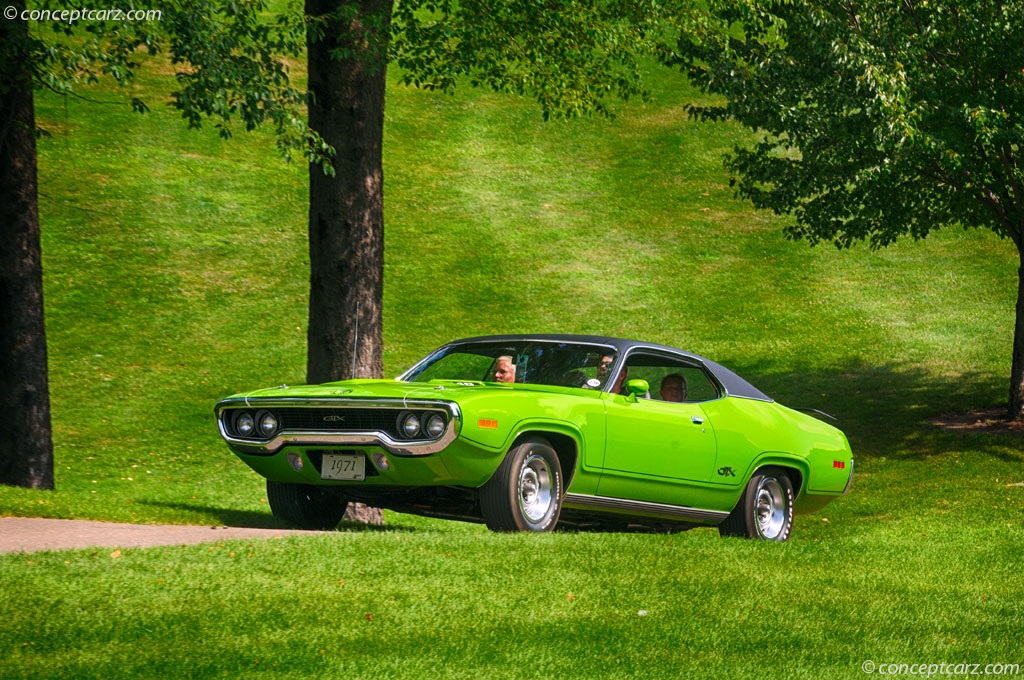
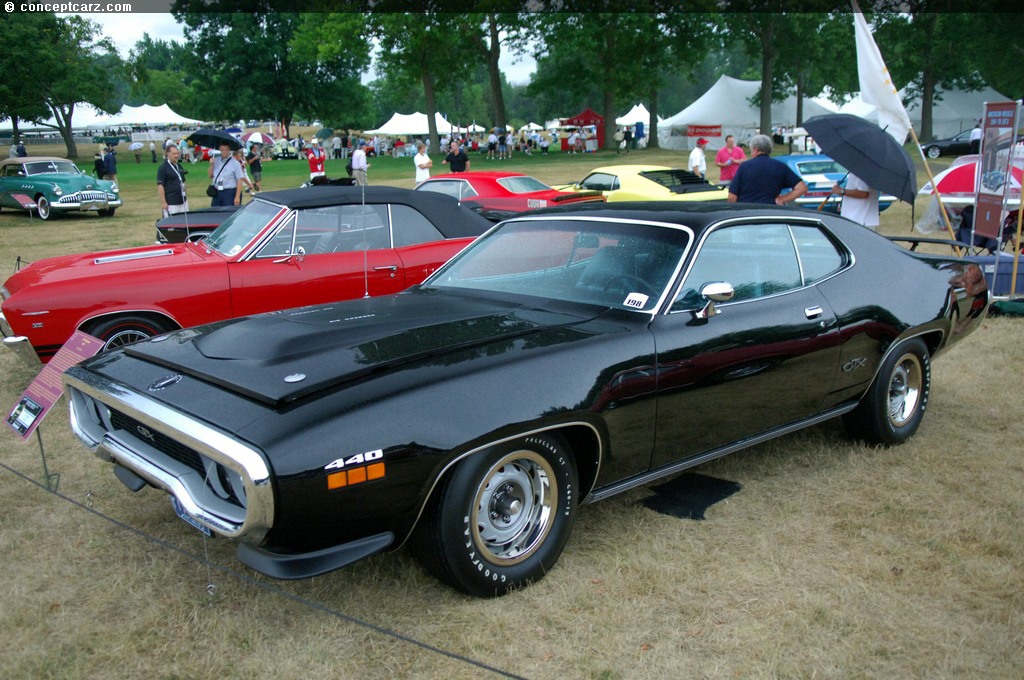
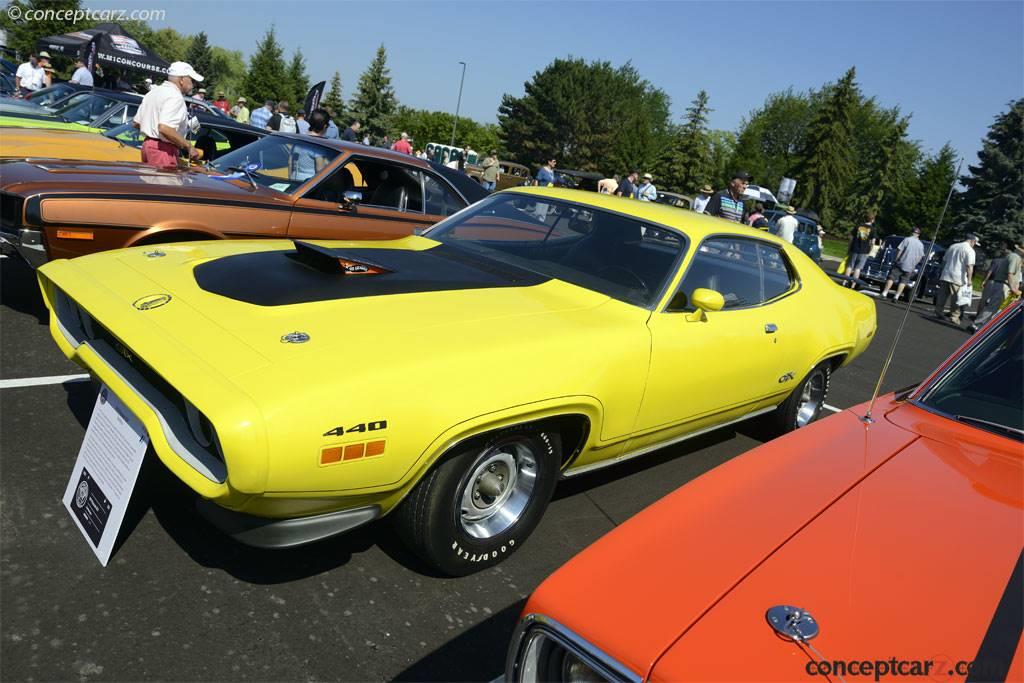
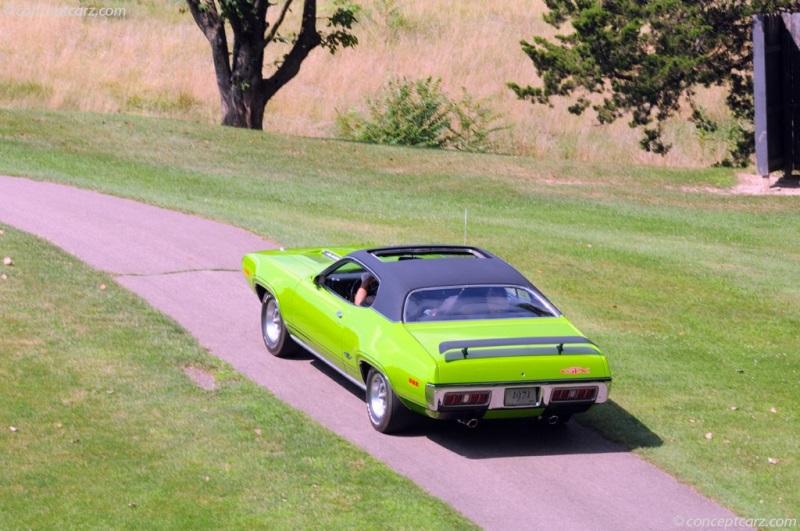
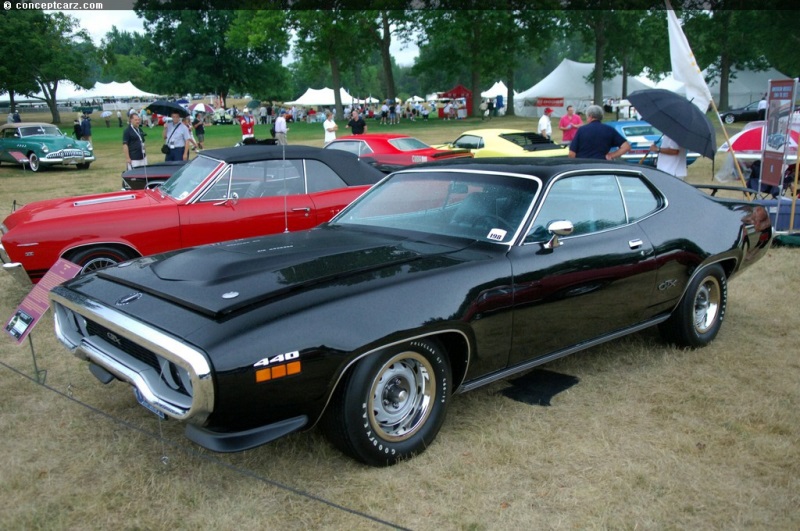
1971 was the only year the Hemi and Six Pack were offered as options in the GTX. The GTX was introduced as the Belvedere GTX in 1967 and positioned as a mid-sized upscale-trimmed performance muscle car. Styling differences included special rear fascia, a blacked-out grille, and fiberglass simulated hood scoops. Optional performance enhancements included racing stripes, a tachometer mounted on the center console, and a chrome 'pop-open' fuel filler cap. The standard 440 cubic-inch V8 engine, called the 'Super Commando 440' developed 375 horsepower. The 426 cubic-inch 'Street Hemi' was optional.
Hardtop Coupe
View info and historyPlymouth B-bodies received hourglass styling for 1968 that would continue through 1970, replacing the previous rectilinear design. The standard engine in the GTX was the high-performance 440 backed by a TorqueFlite automatic transmission. Body styles included a two-door convertible and a two-door hardtop without a B-pillar. The GTX was similar to the Road Rummer but with more luxury and performance, and fitted with the Sport Satellite trim. Plymouth redesigned the B-Body for 1971 with rounded 'fuselage' styling with a hidden cowl, a loop-type front bumper, deeply inset grille and headlights, and a raked windshield. Body styles on the GTX were now solely a two-door hardtop coupe priced at $3,730, making it the most expensive within the Satellite group. The base satellite coupe was priced at $2,660 (the sedan at $2,730 and the station wagon at $3,060), the Satellite Sebring hardtop coupe at $2,930, and the Satellite Custom sedan at $2,900 (6-passenger wagon at $3,240 and 9-passenger version at $3,315). The Road Runner hardtop coupe listed for $3,150, the Satellite Sebring-Plus hardtop coupe at $3,180, and the Satellite Brougham sedan at $3,190. The GTX and Fury GT came standard with a 440 cubic-inch V8 with overhead valves, a four-barrel carburetor, hydraulic valve lifters, five main bearings, and 375 horsepower at 4,300 RPM. Options included the 440 with three two-barrels (Six Pack) and the 426 Hemi. Due to lower compression ratios and faster-acting choke operation, output on the base 440 CID V8 had decreased by five horsepower. The Six Barrel version was down to 385 horsepower, but the Hemi continued to produce 425 horsepower.
Hardtop Coupe
Chassis #: RS23U1R108925
View info and history1971 was the final year for the GTX and like many other muscle cars throughout the industry, sales were dismal. A mere 2,942 examples were sold compared to 7,748 units the previous year and over 15,600 units in 1969. From 1972 through 1974, the 'GTX' name was part of the Road Runner and added when ordered with the optional 440, wearing badging from both nameplates.
by Daniel Vaughan | Jul 2021
Hardtop Coupe
View info and history
Hardtop Coupe
Chassis #: RS23U1R108925
View info and history
by Daniel Vaughan | Jul 2021
Related Reading : Plymouth GTX History
In 1967 Plymouth introduced the GTX as an optional package on the Belvedere model line. The GTX was a two-door vehicle that could be purchased in either convertible or hardtop configuration. It had all the performance options pre-installed and packaged in a stylish vehicle design. The excellent handling was courteous of the leaf springs, modified shocks, ball joints, and torsion bars. Under the hood....
Continue Reading >>
Continue Reading >>
- 1971 Plymouth GTX Menu
- Article
- Image gallery
- Valuation
- Specifications
- Profiles
- Production figures
Plymouth
Similarly Sized Vehicles
from 1971
- Buick Gran Sport
Buick Skylark
Chevrolet Chevelle
Chevrolet Monte Carlo
Ford Ranchero
Lola T260
Mercedes-Benz 600
Oldsmobile 442
Oldsmobile Cutlass
Oldsmobile Cutlass Supreme
Similarly Priced Vehicles
- Oldsmobile 442 ($3,550-$3,740)
- Plymouth Fury ($3,110-$4,145)
Average Auction Sale: $53,271


1971 Plymouth GTX Vehicle Profiles

Recent Vehicle Additions


Performance and Specification Comparison
Price Comparison
$2,310 - $2,700
$2,660 - $3,410
$2,660 - $3,640
$3,110 - $4,145
GTX Specification Comparison by Year
Year
Production
Wheelbase
Engine
Prices
18,940
116.00 in.
8 cyl., 318.00 CID., 230.00hp
8 cyl., 383.00 CID., 290.00hp
8 cyl., 383.00 CID., 330.00hp
8 cyl., 426.00 CID., 425.00hp
8 cyl., 383.00 CID., 290.00hp
8 cyl., 383.00 CID., 330.00hp
8 cyl., 426.00 CID., 425.00hp
$3,330 - $3,591
2,942
115.00 in.
8 cyl., 440.00 CID., 375.00hp
8 cyl., 440.00 CID., 385.00hp
8 cyl., 426.00 CID., 425.00hp
8 cyl., 440.00 CID., 385.00hp
8 cyl., 426.00 CID., 425.00hp
$3,730 - $3,730
Related Automotive News

1970 PLYMOUTH HEMI CUDA CONVERTIBLE WILL STAR AT MECUM MONTEREY 2015
The Executive Demonstrator of John Herlitz is a Rare Treasure
WALWORTH, Wis. – Aug. 4, 2015 – While the famous Monterey Car Week is typically associated with multimillion-dollar purebred European sports cars and antique luxury auto...

MECUM IN HOUSTON APRIL 9-11 WITH 1,000 COLLECTOR CARS AT AUCTION
Three Featured Collections Including 45 Cars from Houstons Charlie Thomas
WALWORTH, Wis. – March 12, 2015 – Following the historic sale of the 1964 Ford GT40 Prototype for %247 million in 2014, Mecum Auctions returns to Houstons NRG...

Russo and Steele Collector Automobile Auctions Kicks Off 15th Anniversary with Eight Initial Offerings to Watch
Scottsdale, Arizona (December 1st, 2014) – For Enthusiasts – By Enthusiasts. ™ This is far more than a tagline at Russo and Steele Collector Automobile Auctions. Its a lifestyle, and we are gearing up to deliver that singular passion to the High...

Raw Power Has a Stamp of Its Own Muscle Cars Roar at Spring Classic Auction
What do you get when you bring the U.S. Postal Service and Dana Mecums Original Spring Classic Auction together at the State Fairgrounds — a Muscle Car Extravaganza!
Since it began 26 years ago, Mecums Spring Classic auction in Indianapolis...

RICHARD PETTY DEDICATES MUSCLE CARS FOREVER STAMPS
Raw power gets a stamp of its own today as seven-time NASCAR National Champion Richard Petty helps dedicate the America on the Move Muscle Cars Forever stamps.
Petty, his son Kyle and Postmaster General Patrick Donahoe will dedicate the limited-edition...