John Marston registered the Sunbeam marque in 1888 with the intent on making bicycles. Between the years 1889 - 1901, the company dabbled in automobile making though none of their experiments were ever marketed. Their fist production attempt was in 1901 with the Sunbeam Mabley. It was powered by a single-cylinder engine with at most, three horsepower, and belt-driven rear wheels. Top speed was in the neighborhood of about 18 mph. At a price tag of 130 pounds, the company was able to find 420 buyers. 
Open Wheel Race Car
View info and historyBy 1905, the Sunbeam Motor Car Company officially separated from the motorcycle and bicycle section of its business and focused its attention and skill on automobile production. In 1909, the company hired Louis Coatalen as their chief design engineer. during this year the company was reorganized and all of their parts were not built in-house instead of relying on outside vendors. Louis Coatalen was of the belief that 'racing improves the breed.' Driven by this theory, four Sunbeam cars were entered in the 1912 French Grand Prix where they emerged in 3rd-5th position. A short time later, they captured the top three spots at the French Coupe De L'Auto. Automobile production was halted during World War I, though the company did produce items in support of the war effort. Production resumed in 1919 at which point the company merged with Darraq of France, which had recently acquired Clement-Talbot. The result was the STD Motors. The production and racing cars produced were still badged as Sunbeams, Talbots and Darraqu's.
Open Wheel Race Car
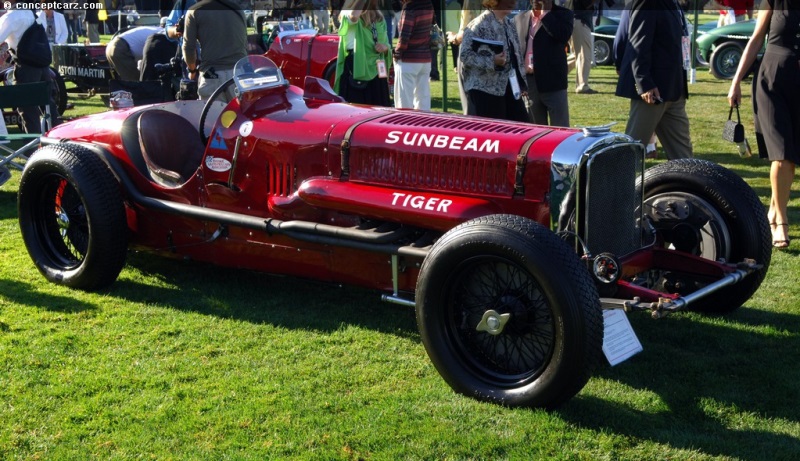
View info and historySunbeams were used in various sporting competitions, and for land speed record attempts. The first land speed record in a Sunbeam was in 1922 at Brooklands. Kenelm Lee Guiness drove a Sunbeam powered by a V12 engine and produced 350 horsepower to an average speed of 133.75 MPH. The car was later renamed 'Bluebird' by Malcolm Campbell and another attempt was made, hoping to bring the average to 150 MPH. In 1924 Malcolm drove Bluebird at Pendine Sands to a record of 146.16 mph. Another attempt by Malcolm was made in 1925 where he finally reached his goal of 150 mph (150.87 mph). Major Harry Segrave had much success with Sunbeam's in Grand Prix racing, winning the French Grand Prix in 1923 and the Spanish Grand Prix in 1924. In the mid-1920s he set out to break Campbell's land speed record. His car, originally dubbed 'Ladybird' and then 'Tiger', rose the record to 152.33 MPH at Southport in 1926. In 1927 Sunbeam made their final attempt on the record with a car powered by two V12 engines and having an available 1000 horsepower. The car was driven by Major Henry Seagrave to a record speed of 203.79 mph.
by Daniel Vaughan | Oct 2007

Open Wheel Race Car
View info and history

Open Wheel Race Car
View info and history
by Daniel Vaughan | Oct 2007


1925 Sunbeam Tiger Vehicle Profiles
Recent Vehicle Additions


Related Automotive News

Brooklands Museum to celebrate 95th Anniversary of first ever British Grand Prix
Brooklands hosted the first ever British Grand Prix in 1926
Examples of Grand Prix cars from each decade from 1920s to 2010s, will be at Brooklands Relived on 7th August
Display will show development of motorsport engineering over the past 95 year...

Dario Resta: A Man of Many Nations
Dario Resta would be born in August of 1882 in the Italian town of Faenza, not far from Imola. But though he would be Italian by birth, Resta would race under the Union Jack and the Stars and Stripes. It would not matter for what nation he drove, for...

120 years of motor sport at Mercedes-Benz take centre stage at the Goodwood Festival of Speed 2014
Addicted to Winning at this years Goodwood Festival of Speed, Mercedes-Benz looks back on some fascinating racing victories of the last 120 years
The unique motor sport heritage of the Mercedes-Benz brand is being celebrated with an exclusive i...

Techno Classica 2014: more than 30 racing cars to celebrate 120 years of Mercedes-Benz motor racing history
Cars that were the heroes of magical moments put their stamp on this high-powered, most comprehensive show presentation
With more than 30 vehicles, Mercedes-Benz Classic presents motor racing history in all its unique breadth and depth
120 years o...

1993 Hungarian Grand Prix: It All Started with Hungary
In 1975, Formula One would loose one of its great ambassadors and larger-than-life characters. The name Hill would be lost in Formula One a terrible lost for the sport. However in 1993, Formula One would witness the return of Hill to the top step...