1912 Peerless Model 36
1912 Peerless Model 36 Navigation
Peerless roots date back to 1874 in Cincinnati, Ohio as a manufacturer of clothes wringers, clothespins, and washboards. From the beginning, the Peerless Company was successful and within a short fifteen years, had outgrown its facilities and was searching for new space. The company formed with the Mercantile Manufacturing Company in Cleveland and the new organization became the Peerless Manufacturing Company. The Cleveland location offered several advantages over Cincinnati, mainly better access to shipping.
Touring
Chassis #: 122450
Engine #: 122001
View info and history
Auction entries : 2The Peerless Manufacturing Company of Cleveland, Ohio became the world leader in laundry equipment and continued to find new business in licensing its designs and name to manufacturers outside North America. Two years after moving to Cleveland, the company embarked on new business ventures; bicycle building had become popular and Peerless followed the boom, entering the business around 1891. Success again followed, but the business of bicycle making was short-lived, as auto production soon surpassed bicycles. Peerless decided to follow the trend and entered the new and uncharted world of automobile production. Louis P. Mooers had some experience in building automobiles, and he was tasked with leading the Peerless Company in this new direction. Peerless licensed deDion Bouton designs, building both four-wheeled motorettes and three-wheeled tricycles from the single-cylinder DeDion engines. Mooers first design for Peerless used a two-cylinder engine with a single-throw crankshaft in which both pistons moved in the same direction. The engine layout followed the Panhard System design which had the engine in the front and drive taken through to transmission and onto the rear axle by a driveshaft. This two-cylinder vehicle was elegant, built of high quality, and suitable to traverse the continually evolving roadways.
Touring
Chassis #: 122450
Engine #: 122001
View info and history
Auction entries : 2A sixty-horsepower four-cylinder Peerless was created by Mooers by 1904. It was used by the company's new driver, Eli 'Barney' Oldfield for use in competition. The car was given the nickname, the 'Peerless Green Dragon', and would become a pillar in defining Peerless's reputation for high performance coupled with quality and durability.Oldfield and Mooers both left Peerless in 1905 to join a St. Louis business called Moon. Charles Schmidt was given Mooers position; Schmidt was the former chief engineer for Packard and an experienced high-speed driver.Peerless continued to promote its product through endurance challenges and racing. They faired rather well in the early Glidden Tours, with perfect scores achieved in 1906-1908. They set a 1,000-mile endurance record and the fastest time ever in the Mt. Washington hillclimb in New Hampshire.
Touring
Chassis #: 122450
Engine #: 122001
View info and history
Auction entries : 2Peerless was the first company to successfully use a flyball governor to maintain speeds. They were the first to use a hinged steering wheel which allowed easier access into the cockpits for the driver. Another first was the use of aluminum in their side-entrance tonneau along with being the first closed formal body in American production.Peerless was one of the first companies to use electric lighting. They used a Gray & Davis system as early as 1910 and then upgraded in 1913 to a single-voltage Gray & Davis system which now included an electric starter.By the early 1910s, the company was producing nearly every important component in their Cleveland factory for their automobiles. In 1912 a new line of T-head six-cylinder models was introduced, each featuring seven main bearings and dual ignition. Also in their engine lineup was the tried-and-true four-cylinder T-head unit which was rated at about 25 horsepower. The company's products were durable, effective, and built to last. Their methods employed advanced manufacturing processes and the use of the finest materials available.
Touring
Chassis #: 122450
Engine #: 122001
View info and history
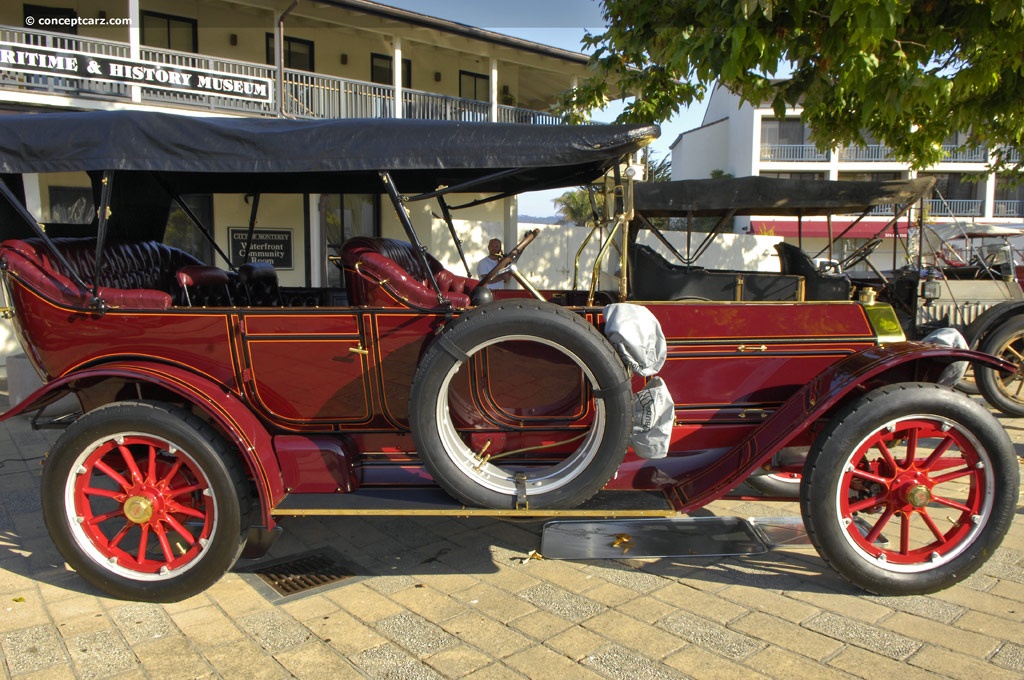
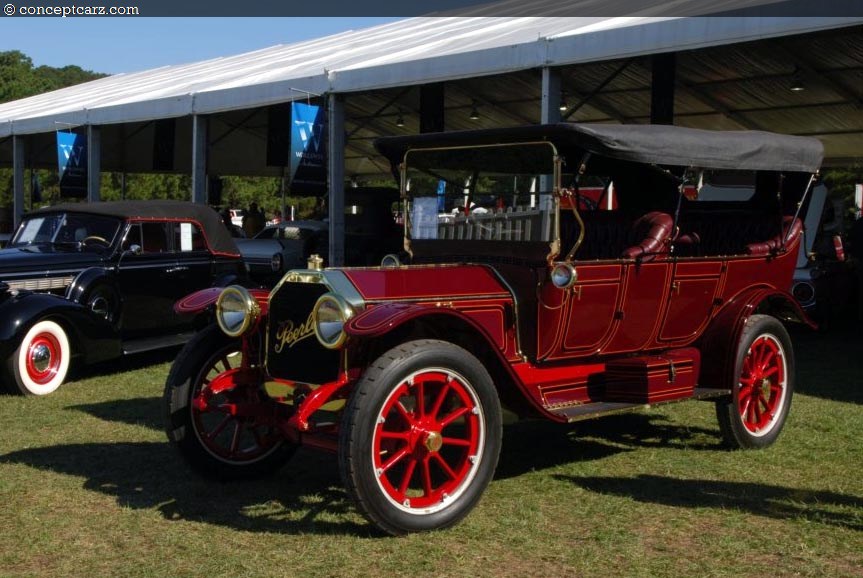
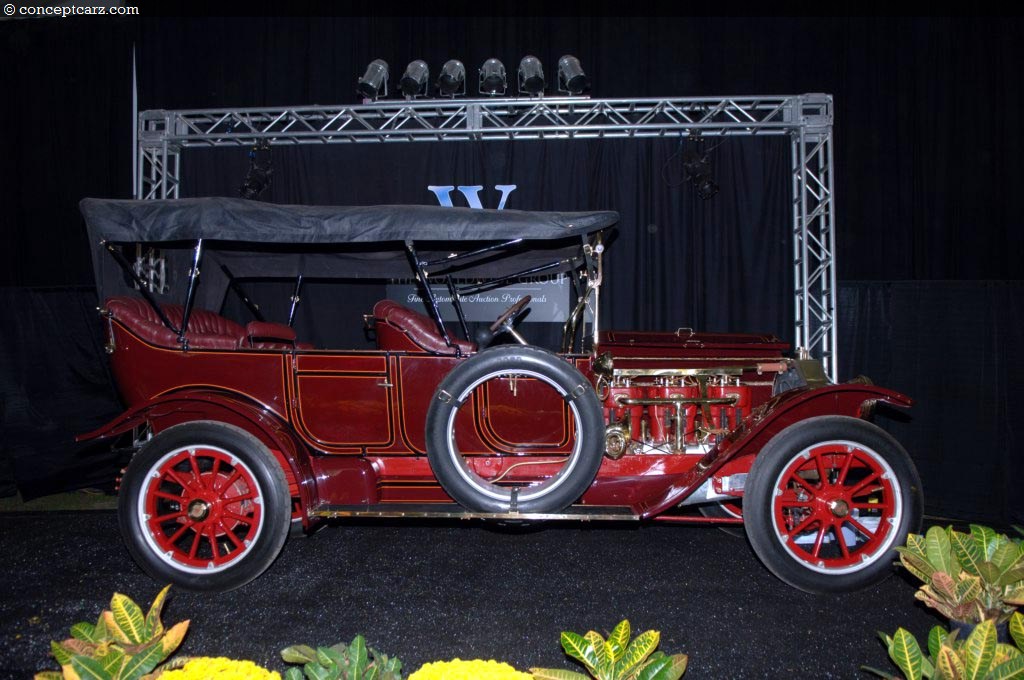
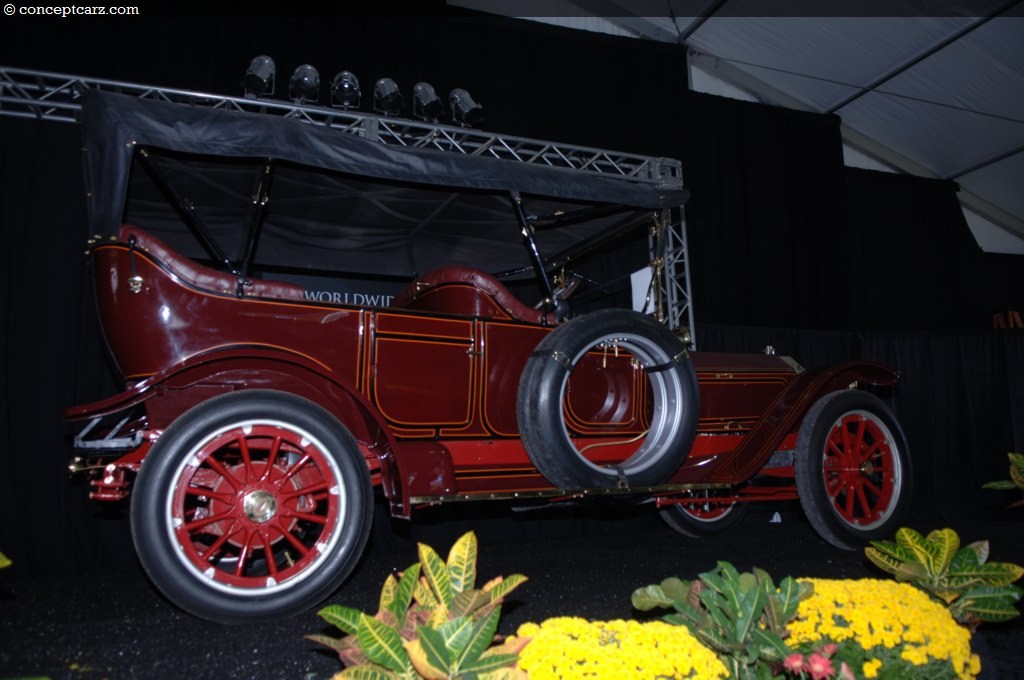
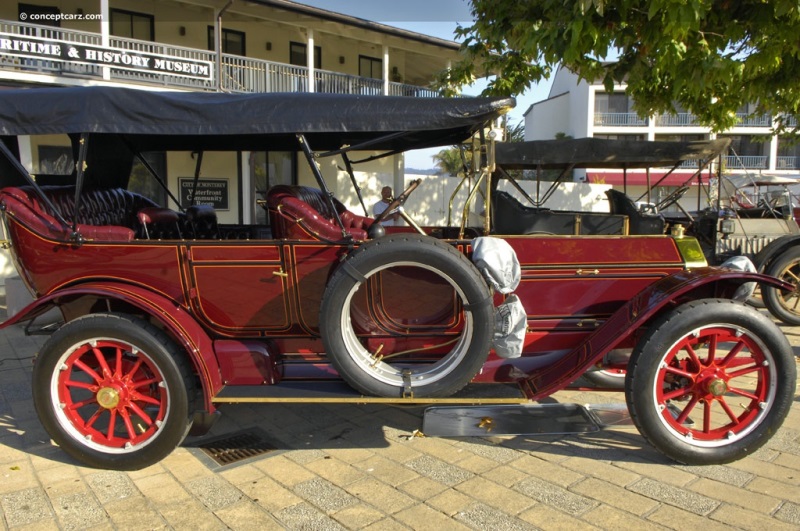
Auction entries : 2With this level of quality, their products appealed to the elite in society, the aristocratic and the most demanding. Their list of clients included Cornelius Vanderbilt and John D. Rockefeller. In the 1912 Peerless catalog were the 415 cubic-inch engine rated at 38 horsepower, a 578 cubic-inch unit with nearly 50 horsepower available, and a massive 825 cubic-inch engine that produced an astonishing 60 horsepower. These horsepower figures were really about half of what the engine truly produced. Peerless did not bother giving horsepower figures; their patrons did not care for these details. The 825 CID engine still holds the Guinness record as the largest engine ever cataloged and built for consumer use. The Peerless Model 36-Six, also known as the Model K, was outfitted with the 578 CID engine and powered the elegant body which rested on a wheelbase that measured 137 inches. The engine was inline with three pairs of cast-iron cylinders bolted to a large aluminum crankcase. It had a seven-main bearing crankshaft made of imported steel and drove through a unique internally-expanding clutch to the four-speed transmission. The transmission was separately mounted to the frame. Peerless used an open driveshaft and a separate arm between the transmission and the rear axle to help absorb the torque from the rear axle. The suspension was comprised of a live axle setup in both front and rear, with semi-elliptical leaf springs in the front and platform suspension in the rear.
Touring
Chassis #: 122450
Engine #: 122001
View info and history
Auction entries : 2A very unusual and technically advanced aspect of the design was the cambered rear axle which was positioned at a three-degree positive angle in each rear wheel and required a complete rear axle to cope. According to the Peerless Company, the benefit of this design was higher ground clearance for the differential and strong wood-spoke wheels. In modern terms, it would be similar in design to the 'positive offset rims.' Braking was on the rear wheels through a contracting brake band located on the outside of the brake drums. The hand brake actuated expanding brake shoes with the same drum. In comparison to many other systems of the day, this was a very advanced design. Most other braking systems employed a driveshaft brake that stopped only one rear wheel through the differential. A Peerless automobile was followed by serious financial obligations. They were not cheap. Prices of the 38-Six started at around $3,500 for the chassis and $4,000 for the Touring model with seating for five. Their pricing scale was rather simple; an extra thousand dollars was applied for each move up the model ladder, plateauing at $6,000 for the Model 60-Six. The addition of accessories only escalated the price. Popular accessories at the time were windshields and lighting, body features and painting, leathers and fabrics, and much more.
Touring
Chassis #: 122450
Engine #: 122001
View info and history
Auction entries : 2During the first World War, the company supplied trucks and military automobile chassis in support of the war effort. The company survived for many years, struggling through the Great Depression era, and after completing one V-16 prototype the company shut down in mid-1932. When the Volstead Act was repealed, ending Prohibition, the Peerless applied for a license to brew Carling's Black Label beer and Red Cap Ale. The Company prospered and by the 1960s had twenty-three breweries in the US., Canada, and overseas.
by Daniel Vaughan | Nov 2007
Touring
Chassis #: 122450
Engine #: 122001
View info and history
Auction entries : 2
Touring
Chassis #: 122450
Engine #: 122001
View info and history
Auction entries : 2
Touring
Chassis #: 122450
Engine #: 122001
View info and history
Auction entries : 2
Touring
Chassis #: 122450
Engine #: 122001
View info and history
Auction entries : 2
Touring
Chassis #: 122450
Engine #: 122001
View info and history
Auction entries : 2
Touring
Chassis #: 122450
Engine #: 122001
View info and history
Auction entries : 2
by Daniel Vaughan | Nov 2007
- 1912 Peerless Model 36 Menu
- Article
- Image gallery
- Valuation
- Specifications


1912 Peerless Model 36 Vehicle Profiles
Recent Vehicle Additions


Performance and Specification Comparison
Related Automotive News

Gooding & Company Presents the Best of American Motoring, from Brass Era Legends to Postwar Sports Cars, at Its Pebble Beach Auctions
An incredible 1912 Simplex 50 HP Toy Tonneau, offered for sale from 111 years of single family ownership, will come to market for the first time, alongside motoring icons from the greatest eras of American automotive history.
The official auction...

Gooding & Company Presents the Estate of Mark Smith Auction, Entirely Offered Without Reserve, this April
The Estate of Mark Smith Auction will feature offerings, all without reserve, from the personal collection of the late Mark J. Smith, including largely original and unrestored Classic Era automobiles from Mercedes-Benz, Chrysler, Bentley, White, and...

Rare Barnfind Mercedes-Benz and Concours-Restorations Parade at Bonhams Scottsdale Auction
A rare and special barnfind Mercedes-Benz – surely one of the last unrestored 300S Roadsters – will line up with a parade of concours-standard restorations at The Scottsdale Auction, Bonhams motor cars season-opener staged at the Westin Kierland Resort,...

Mercedes-Benz at Pebble Beach Automotive Week: An Expression of Fascinating Design and Innovation
Historical Tribute to SL W194 Chassis No. 2, 7 and 11 among 300SL vehicles on display
The Concept Style Coupé opens a new chapter and generation of Mercedes-Benz vehicles
AMG 45 year anniversary highlights the pinnacle of performance and style
...
Worldwide Auctioneers to present one of the finest and largest offerings of pre-war classics available anywhere in North America at The Auburn Auction.
Worldwide Auctioneers line up of consignments for its second annual The Auburn Auction will embrace a wonderful selection of over forty venerable pre-war classics, appropriately set to go under the hammer in the town which is celebrated as The Classic...