Concept Cars Home
Image Left 1969 B16
 

1970 Chevron B16 news, pictures, and information

Coupe
 
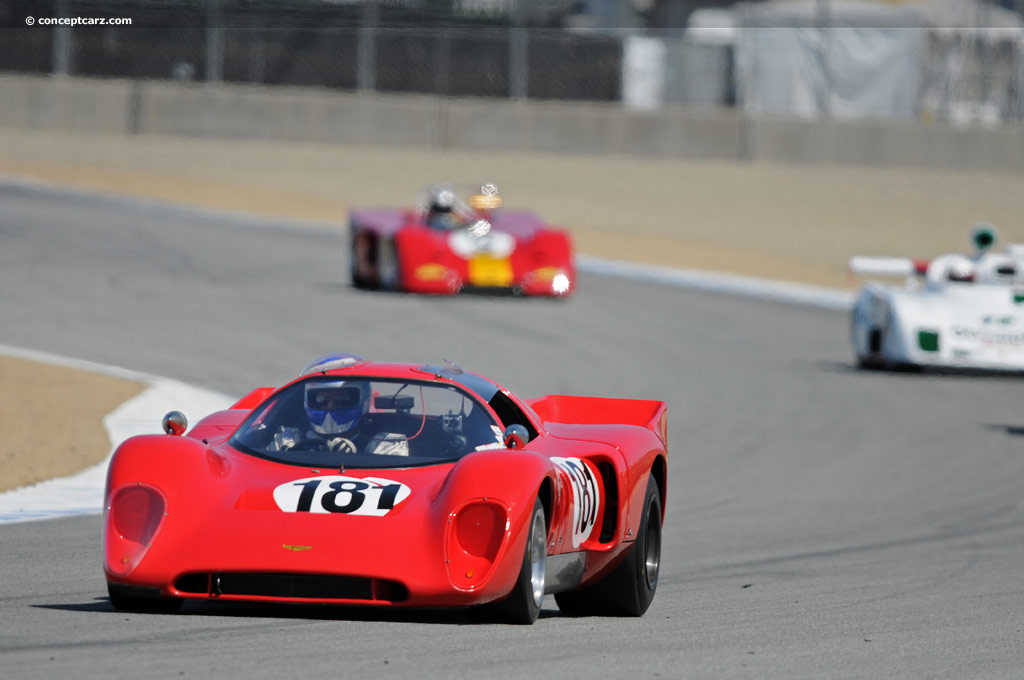
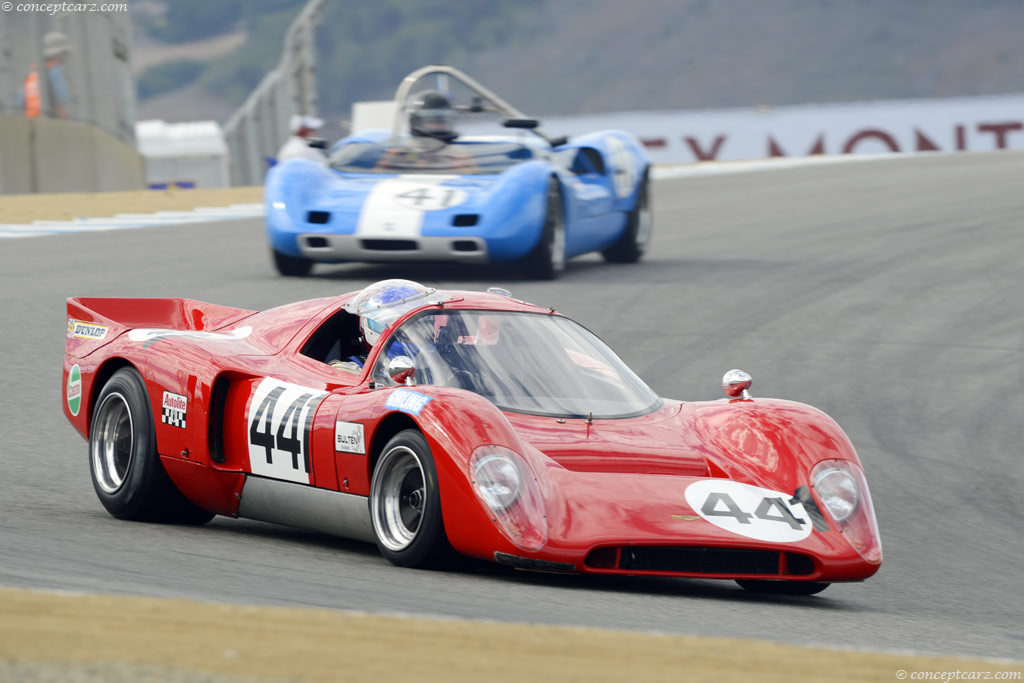
This 1970 Chevron B16 number 44 is one of 23 constructed with only 17 remaining in modern times. It is powered by a Ford Cosworth four-cylinder engine that displaces 2.1-liters and produces 315 horsepower. The engine is mated to a five-speed TF200 Hewland gearbox and powers the rear wheels.

The B16 Chevron raced in the 1970-1972 World Endurance Series. The B16 was also at the 1970-1972 24 Hours of LeMans. This car has been raced at Daytona and Sebring and was driven in the Steve McQueen movie 'LeMans.'

By Daniel Vaughan | Feb 2008
Spyder
Chassis Num: B16 DBE/SP1
Engine Num: 0590
 
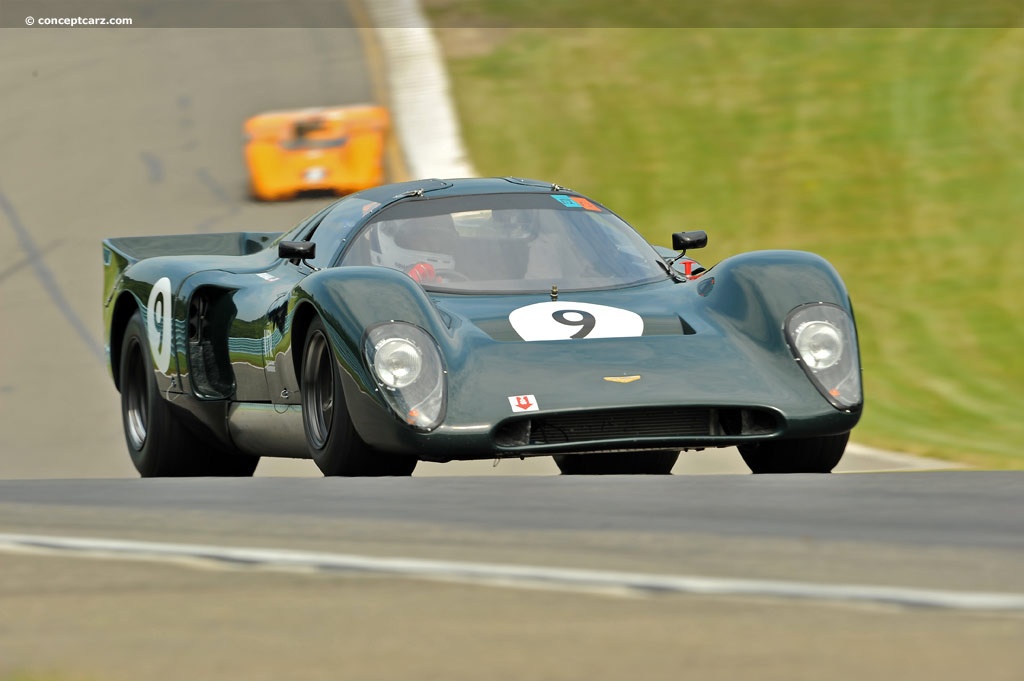
There were 23 Chevron B16 models built in 1969 and 1970 plus a B16 Spyder constructed in 1970. The B16 was based on, and an evolution of, the B8. It had a spaceframe chassis and reinforced with steel to form a full monocoque. The front suspension was carried by tubular frames. The suspension was double wishbones at the front and upper link and triangular wishbones at the rear. The basic fiberglass body design was created with the help of stylist Jim Clark.

Mounted mid-ship was a Cosworth FVA Formula 2 engine. This was the same found in the B8. Cosworth's main engineer, Keith Duckworth, enlarged the capacity closer to two liters. It was given a different crank and a longer stroke, increasing the displacement from 1598cc to 1790cc. The result was a boost in horsepower to 245bhp and a new designation, the FVC.

In July of 1969, the Chevron B16 was tested at Aintree where it proved to be extremely quick 'right out of the box.' It was close to the lap record. On September 7th of 1969, after continued development and testing, the B16 made its racing debut at the Nurburgring 500 km race. Brian Redman qualified the car on pole and had a full 5.6 seconds ahead of its nearest competitor. The race would be just as successful for the B16, with Redman leading the entire event. It was quick, but had a tremendous amount of understeer. This was due to a lack of down-force at the rear. To resolve future B16 models, two orange box rear spoilers were fitted.

The following season, Redman was still Chevron's factory driver. Lola introduced their new T210 which provided considerable amounts of competition for the B16. Redman would lose to the Lola on several occasions (and win on several occasions). He begged Chevron for an advantage - an open car. Only one was ever created.

A few of the customer B16 cars were sent back to the factory in 1972 and converted into B21 cars. These were basically B19 cars with a different cockpit section.

This car was originally a coupe that was converted into a spyder. It is painted in the same red and brown color as the coupe that raced at Nurburgring 500 km in 1969. It has a Hewland FT200 gearbox, coil over wishbone suspension and a four-cylinder engine rated at 278 horsepower. The engine is number 0590.

By Daniel Vaughan | Sep 2008
Derek Bennett was the individual responsible with the formation of Chevron Cars Ltd. He was a brilliant engineer, mostly self-taught, and had a talent for modifying, repairing, and sculpting automobiles. Near the close of the 1950's he began working in a shop in North England where he quickly developed a name for himself. When he was not working at the track, he could often be seen at nearby tracks where he raced mostly custom-built racing cars.

Changes in racing regulations had many producers of racers scrambling to create a formidable contender that conformed to the new rules. Bennett had been contemplating purchasing a new racer but with the new changes, he felt he could produce a better machine than other marques were fielding. With no drawings and all the details in Bennett's head, he began construction beginning with a tubular space-frame chassis. Power was from a modified Ford Kent engine that had been taken from an Anglia. When the vehicle was complete, it carried the marque name 'Chevron'; the name had been inspired from a Highway Code symbol. Up to this point, his vehicles he had constructed were dubbed Bennett Specials.

The newly created racer, dubbed the B1, made its inaugural appearance in 1965 at Kirkistown, Ireland. Little testing had been done but the car still managed to set an impressive pace and finished in first pace. For the next few years Bennett created racers and gave them various designations. The B1 was introduced in 1965 and followed a year later by the B2. Both were Clubmans which was a British national formula series for open-top sports cars with Ford engines placed in the front of the cars.

The B3 was Bennett's first attempt at Gran Turismo competition. The 1.6-liter twin-cam Ford engine was mounted behind the driver and in front of the rear axle. The car was constructed for Alan Minshaw who had seen a small-scale model on Bennett's desk and had immediately produced funds to finance its construction. The initial estimates to create the car fell short of the actual figure and Digby Martland stepped in to provide the additional funds needed to complete the project. Once the project was complete, Bennett created a second racer, dubbed the B4, and fitted it with a BMW 2-liter engine.

During some initial trial runs of the Martland B3 racer, it attracted the attention of Peter Gethin who immediately ordered one for himself. The B3 made its racing debut a short time later where it emerged victorious. The Ford powered car was very impressive whereas the BMW powered B4 suffered from lubrication problems. The reason for this was the way the BMW engine was installed which sat vertically which prevented the oil to properly drain. A custom dry-sump lubrication system was later installed and resolved these issues.

After securing a deal with BMW Motorsports to supply engines through a dealership at discounted price, Bennett began creating more examples of the B4 GT car.

The B5 was powered by a BRM 2-liter V8 engine. Brian Redman drove a B5 in international competition in a Group 6 at Brands Hatch where he emerged victorious. This was Chevron's first international race win. Redman would go on to become a works driver for Chevron.

The B6 was very similar to the B4 but with a fiberglass body. It competed in Group 6 prototype competition against tough competition from Ferraris and other big-named marque's. After enough examples were created to homologate the cars, they were then able to compete in Group 4 GT competition. 50 examples had been required in order to compete; not all 50 were created - when the FIA stopped by Bennett's shop to perform the count, Bennett proved he had enough materials to create the racers. Only 44 examples were ever created.

The B7 was a single seat racer which competed in Formula 3 competition. The B8 was the 1968 version of the GT racer. The B9 was a Formula 3 car. The B10 was a Formula 2 racer.

The replacement for these two-liter cars came with the B16 and was quickly replaced with the B16 Spyder which had bodywork inspired by the Porsche 908 Spyder. The Chevron was a continuation of the B8 with styling help from Jim Clark. It had a spaceframe chassis, monocoque design, tubular frames, and a fiberglass body. The engine and gearbox was both placed midship. To make the vehicle easy to maintain, it had a removable front subframe. A 1790cc FVA Cosworth engine was used which provided an impressive 245 horsepower.

The B16 made its inaugural debut at the 1969 Nurburgring 500km race where it was driven by Brian Redman and qualified for pole position. From the start of the race, Redman led the pack and continued this for three-and-a-half hours before crossing the finish line victorious. The car was surprisingly fast though it did suffer from under-steer due to not enough down-force. The problem was later solved by adding two orange box rear spoilers

During the 1970 season, Lola introduced the T210 which had Redman struggling to maintain the lead. It was not long before the T210 was consistently beating Redman and the B16. Redman approached Bennett requesting an open car that was lighter and more nimble. The result was the B16 Spyder of which only one was ever created. This would set the foundation for the rest of the cars for years to come.

The B19 was introduced in 1971 and the B21 in 1972. These were used in Group 6 competition. The B23 was introduced in 1973; the B26 was also a 1973 car; the B31 was the final iteration of Group 6 cars introduced in 1975.

In 1972 the B24 was introduced and intended for F5000 competition. Continuing the tradition of Chevron cars, it won its inaugural race. Driven a year later by works driver, Peter Gethin, it became the first F5000 car to beat the F1 cars. The B24 were impressive racers but the Lola T330 cars were faster. Chevron would finish the season with 32 Top 3 finishes from 35 races while Lola managed 39 Top 3 finishes.

It is believed that eight examples (possibly 10) of the B24 were constructed. One was later rebuilt to B28 specification.

Other interests of the Chevron company during this time were Formula competition such as Formula Atlantic and Formula Two. Examples include the B25, B27, B29, B35 Formula Atlantic/Formula Two cars.

Derek Bennett's passed away after a hang-gliding accident. The company continued for a number of years. Ownership passed through the hands of a few owners.

By Daniel Vaughan | Jan 2007
Corvette Shines in the Big Apple
All-new Corvette Stingray comes to New York City 60 years to the day after Motorama debut 2013-01-16 Sixty years ago tomorrow, spectators lined New York City's posh Park Avenue, waiting to get a glimpse of the ground-breaking Chevrolet Corvette on display at the General Motors' Motorama show. On Thursday, the Corvette will be back in The Big Apple, marking the historic milestone with the all-new 2014 Chevrolet Corvette Stingray. The all-new Corvette Stingray debuted earlier...[Read more...]
Limited-Edition Ford Racing History Artwork Unveiled at SEMA; Limited-Edition Print Sales to Benefit JDRF
•Special limited-edition Ford Racing history artwork is unveiled at the annual SEMA show as part of the Ford press conference •Famed automotive artist Sam Bass created the artwork at the request of Edsel B. Ford II, with proceeds from sales of limited-edition autographed prints benefiting JDRF •Drivers and Ford race vehicles featured on the special artwork include Henry Ford (Sweepstakes), Trevor Bayne (No. 21 Fusion), Dan Gurney/A.J. Foyt (Ford Mark IV), Bob Glidden (NHRA Thunderbird), Jack...[Read more...]
1967 Can-Am Road America: The Beginning of the 'Bruce and Denny Show'
While Formula One will be forever considered the pinnacle of motorsport, from a period between 1966 and 1986 there existed a series that would likely be the closest to 'anything goes' as any motor racing series could truly get. Based upon the FIA Group 7 cars but allowed to showcase unlimited engine sizes and unfettered aerodynamics, the Can-Am cars would have to be considered the pinnacle of motorsport technology and power of their era. And for more than a couple of years there would be one tea...[Read more...]
1999 European Grand Prix: The First and Last
When Johnny Herbert signed with the brand new Stewart-Ford Racing team many believed Herbert to have missed out on his opportunity at success in Formula One. In fact, many would see a great divide between him and the obvious number one driver Rubens Barrichello. However, on the 26th of September Herbert would show he still had some fight within and would actually be the one to earn a very important first for the team. Herbert's Formula One career would go through something of a renaissance af...[Read more...]
Carroll Shelby, Ford Family for More Than Half a Century
Carroll Shelby was a member of the Ford family for the better part of 60 years, producing stunning performance vehicles from concepts to production models. He once said his energy and passion for performance products were always strongest when he was working with Ford. Shelby most recently collaborated with the company on the 2013 Ford Shelby GT500 Mustang, the most powerful production V8 in the world. Working with SVT engineers at Sebring and the Arizona Proving Grounds, at times he drov...[Read more...]
B16
B19
B21
B23
B26
B27
B31
B36
B62
B8

Image Left 1969 B16
© 1998-2012. All rights reserved. The material may not be published, broadcast, rewritten, or redistributed.