1913 Model 35 |
1914 Mercer 450 news, pictures, and information | ||
| Tweet | ||
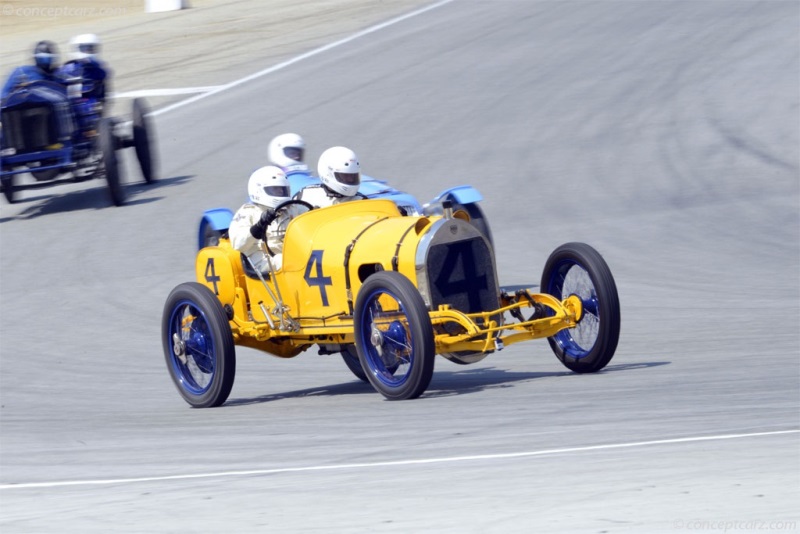
![]() | ![]() | ![]() | Raceabout Chassis Num: 4 |
The chassis was a standard type 35 raceabout unit of 112 inches along with the raceabout 4-speed transmission. Two type '450' Mercers have survived and one is powered by the famous Eddie Pullen record breaking engine. Model 45s were among the front-runners at many races, including the Indianapolis 500 and the Vanderbilt Cup. Pullen was leading the Vanderbilt Cup ahead of Barney Oldfield's Type 45 before tire failure put him and the car out of race. Pullen managed to repair it for the start of the Grand Prix 48 hours later, going on to clock an average speed of nearly 80 mph for the 403 mile race.
This was the first American Car to win the American Grand Prix: At Santa Monica California on 2/23/14 averaging 77.2mph for 403.248 miles.
A Type 45 Mercer broke the world racing speed record: Eddie Pullen averaged 87.8 mph for 300 miles at Carona California on Nov 26, 1914.
Eddie Pullen, Ralph DePalma, Barney Oldfield, Spencer Wishart along with Joe Thomas and Grover Ruckstell all drove type 45 Mercers with great success from 1913 through 1916.
![]() | ![]() | ![]() | Raceabout |
The Mercer Raceabout Model 35J T-head was constructed from 1913 through 1914. Under the hood was a 300 cubic-inch four-cylinder engine and mated to a Brown & Lipe gearbox. In 1911 and 1912 there were three speeds. Beginning in 1913, a four-speed unit was offered with a multiple-disc clutch. To improve the vehicles handling characteristics, the drive was placed low in the frame. Mounted on the rear were dual spare tires.
Many of the T-Head Mercer's were taken from the showroom floor and driven straight to the track. All that was needed to have these cars ready for the track was the removal of the fenders, running boards, and lighting equipment. After the race, the cars were driven home which made these one of the first mass produced dual-purpose vehicles.
These were designed mostly for racing. They had a ladder-frame with very little bodywork (only a hood and vestigial fenders). They had a 25-gallon gas tank mounted directly behind the two-seats. There was little needed to prepare them for racing; some owners added a monocle windshield to provide mild protection from the elements and harsh roadways of the era.
It is hard to imagine that these were very advanced vehicles of their day, but they were. Their T-head engine offered 60 horsepower and their finely-tuned gear ratios and four-speed transmission gave them a competitive edge over their rivals. Though the body and frame seemed minimalist and crude, it was lightweight and rugged. With no body, no starter, and a lack of amenities, these Speedsters weighed a mere 2300 pounds.
By Daniel Vaughan | Jul 2008
For more information and related vehicles, click hereMany of the T-Head Mercer's were taken from the showroom floor and driven straight to the track. All that was needed to have these cars ready for the track was the removal of the fenders, running boards, and lighting equipment. After the race, the cars were driven home which made these one of the first mass produced dual-purpose vehicles.
These were designed mostly for racing. They had a ladder-frame with very little bodywork (only a hood and vestigial fenders). They had a 25-gallon gas tank mounted directly behind the two-seats. There was little needed to prepare them for racing; some owners added a monocle windshield to provide mild protection from the elements and harsh roadways of the era.
It is hard to imagine that these were very advanced vehicles of their day, but they were. Their T-head engine offered 60 horsepower and their finely-tuned gear ratios and four-speed transmission gave them a competitive edge over their rivals. Though the body and frame seemed minimalist and crude, it was lightweight and rugged. With no body, no starter, and a lack of amenities, these Speedsters weighed a mere 2300 pounds.
By Daniel Vaughan | Jul 2008
| Prince Heinrich Benz Racers Reunited at 'The Amelia' | |
![]() | In the early 1900's, at the dawn of the automotive motorsport age, one of the most significant race venues was the Prinz Heinrich Tour, named after Prince Albert Wilhelm Heinrich of Prussia, automotive enthusiast and brother of German Emperor Wilhelm II. In 1907, the German Imperial Automobile Club organized the first annual Prinz Heinrich Tour which is often seen as a precursor to the German Grand Prix. Among the races' most notable winners were Fritz Erle who won the 1908 race in a 50 h...[Read more...] |
1914
Mercer
models |
| Mercer Model J-35 |
| Mercer Model O |
| Similar Automakers | |
| American | Chalmers |
| Chandler | EMF |
| Locomobile | Lozier |
| Marr | National |
| Paige | Penn |
| Pierce Arrow | Simplex |
| Stellite | Stevens Duryea |
| Stoddard-Dayton | Stutz |
| Mercer: 1911-1920 |
| Similar Automakers |
| Mercer History |
| Other models by Mercer |
| Related Articles and Event Coverage |
| Pebble Beach Concours d'Elegance |
| Rolex Monterey Motorsports Reunion |
| Pebble Beach Concours d'Elegance |
| Monterey Historic Automobile Races at Laguna Seca |
| Model 30 Model 35 Series 5 |
1913 Model 35 |


1913 Model 35


1914