1965 Lola T70 MKI
1965 Lola T70 MKI Navigation
History
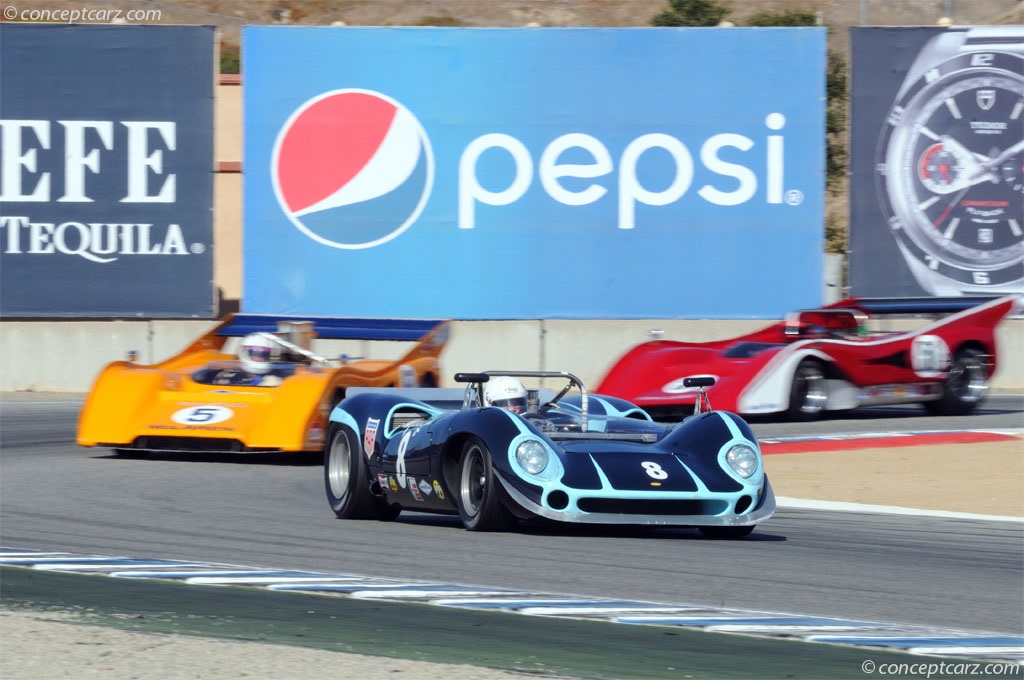
The Lola Racing Cars Group introduced the T70 in 1965 and during its lifetime, from 1965 through 1969, over 100 examples were produced in three versions. They were designed for endurance racing, incorporating excellent aerodynamics and flowing lines. The chassis was an aluminum monocoque structure that was both lightweight and rigid. The project was undertaken by Eric Broadley of Lola Cars with assistance from F1 world champion John Surtees. Originally, Broadley had been considered by Ford to build a racer that could defeat Ferrari at LeMans. Colin Chapman of Lotus and Cooper were also considered. After some consideration, the project was given to Broadley of Lola. Ford had been impressed with the Lola Mark VI mid-engined racer which was powered by a Ford 4.2-liter engine and produced around 350 horsepower. The sleek body had been created by John Frayling and utilized some of the most exotic materials available. By 1965 Ford had their Ferrari slayer and Broadley was ready to again work under his own supervision. He was not fond of how the GT40 had progressed and felt that it had gone in too many directions with each decision being analyzed by a committee. Work began on the T70 which would share many similarities to the GT40. In a sense, the Lola T70 was a result of Enzo Ferrari, since the GT40 had been created to defeat Ferrari at Le Mans. The first version was the MKII open-roofed version. The second version was the MKIII Coupe-version followed by the MK IIIB.
The straight back end soon gave it the nickname of 'breadvan' as it resembled delivery trucks of that era. The rear body shape was the result of lessons learned from the GT40 project and its handling on the Mulsanne straight at Le Mans. It was designed to eliminate some of the lift created at high speeds. The GT40 created 300 kg of lift at speed while the Lola T70 only created 200 kg of downforce though it did increase drag.
Though designed for endurance racing, the T70 proved most potent on the short sprint races where its lightweight body and superior handling made it very competitive. Reliability issues plagued the car on races of more than three hours. The Chevrolet small-block power-plant was unsuitable for utilizing the high-octane fuels that powered other racers. The engine was unable to fully utilize European fuels and as such, did not perform as well as intended in international competition.
The T70 MKII was entered in the competitive and newly formed CanAm series, where it dominated at nearly every race it entered, winning five of the six rounds. John Surtees won the title after winning three of those races in a factory car. The cars were also successful in Group 7 racing until the series came to a halt in 1966. 1966 was the final year for a successful season for the Lola T70s in CanAm racing as McLaren would dominate the following year. The T70 would win only one CanAm race in 1967. The powerful McLaren M6 racers easily overpowered the T70. In retaliation, the T70 IIIB was introduced which improved power and performance. The front was improved to separate the airflow between the bottom and top of the car, thus, minimizing pressure underneath the vehicle. Power came from a 327 small-block Chevrolet engine which was later upgraded to a 350 cubic-inch unit. It would go on to win many international endurance races. One of the most famous of its victories was the 1969 Daytona 24 Hours driven by Mark Donohue and Chuck Parsons. The demise of the racer occurred when rule changes that limited the size of the engine made it obsolete. This benefited the Ferrari 312 and Porsche 917 as their F1 engines were appropriate and highly tuned.
By 1968, a new car was needed; Lola introduced the T160 which was lighter and more powerful than its predecessor.
The Lola T70 was important for sports racing for many reasons with the most recognizable being the importance of downforce at a cost of extra drag. The cars won many important victories during the close of the 1960's and have continued in competition to this day, with many racing in historic racing events.
By Daniel Vaughan | Feb 2008
The straight back end soon gave it the nickname of 'breadvan' as it resembled delivery trucks of that era. The rear body shape was the result of lessons learned from the GT40 project and its handling on the Mulsanne straight at Le Mans. It was designed to eliminate some of the lift created at high speeds. The GT40 created 300 kg of lift at speed while the Lola T70 only created 200 kg of downforce though it did increase drag.
Though designed for endurance racing, the T70 proved most potent on the short sprint races where its lightweight body and superior handling made it very competitive. Reliability issues plagued the car on races of more than three hours. The Chevrolet small-block power-plant was unsuitable for utilizing the high-octane fuels that powered other racers. The engine was unable to fully utilize European fuels and as such, did not perform as well as intended in international competition.
The T70 MKII was entered in the competitive and newly formed CanAm series, where it dominated at nearly every race it entered, winning five of the six rounds. John Surtees won the title after winning three of those races in a factory car. The cars were also successful in Group 7 racing until the series came to a halt in 1966. 1966 was the final year for a successful season for the Lola T70s in CanAm racing as McLaren would dominate the following year. The T70 would win only one CanAm race in 1967. The powerful McLaren M6 racers easily overpowered the T70. In retaliation, the T70 IIIB was introduced which improved power and performance. The front was improved to separate the airflow between the bottom and top of the car, thus, minimizing pressure underneath the vehicle. Power came from a 327 small-block Chevrolet engine which was later upgraded to a 350 cubic-inch unit. It would go on to win many international endurance races. One of the most famous of its victories was the 1969 Daytona 24 Hours driven by Mark Donohue and Chuck Parsons. The demise of the racer occurred when rule changes that limited the size of the engine made it obsolete. This benefited the Ferrari 312 and Porsche 917 as their F1 engines were appropriate and highly tuned.
By 1968, a new car was needed; Lola introduced the T160 which was lighter and more powerful than its predecessor.
The Lola T70 was important for sports racing for many reasons with the most recognizable being the importance of downforce at a cost of extra drag. The cars won many important victories during the close of the 1960's and have continued in competition to this day, with many racing in historic racing events.
By Daniel Vaughan | Feb 2008
- 1965 Lola T70 MKI Menu
- Article
- Image gallery
- Valuation
- Specifications
- Profiles


1965 Lola T70 MKI Vehicle Profiles


Recent Vehicle Additions


Related Automotive News

From Lucybelle to DHL: Historic Porsche Competition Cars Race to Gooding & Company's Pebble Beach Auctions
The very best of Porsche excellence will come to Pebble Beach with a 1959 Porsche 718 RSK, a 1969 Porsche 90802, a 2007 Porsche RS Spyder Evo, and more.
Gooding %26 Company, the official auction house of the Pebble Beach Concours dElegance®,...

Nissan Racing History to be Celebrated as Featured Marque at Rolex Monterey Motorsports Reunion
First Time Nissan is Named Featured Marque at Renowned Event
MONTEREY, Calif., February 26, 2018 — On the occasion of the 50th anniversary of corporate involvement in motorsports that continues today, Nissan has been named the featured...

Popular Trans-Am Categories Geared Up For Spring Classic May 19-21
MONTEREY, Calif., March 1, 2017 — The Spring Classic vintage car race and historic motorcycle exhibition to be held on May 19-21 features 10 run groups with racers from around the country excited to take part in the inaugural event during Mazda...

Scott Pruett to be Honored Guest at Picnic in the Park
Scott Pruett is Special Guest to Highlight Picnic in the Park at Rolex Monterey Motorsports Reunion
MONTEREY, Calif., July 9, 2015 — Sports car racing legend and award-winning winemaker Scott Pruett will be the honored guest at the annual...

THE VIPER GTS-R IS BACK IN 2012
Two identical SRT Viper GTS-R race cars will compete in this weekends American Le Mans Series event at the 2.54-mile Road Atlanta circuit.
The driver lineup for Petit Le Mans Tommy Kendall and Marc Goossens will be joined by Jonathan Bomarito in...