1931 Duesenberg Cummins Diesel Indy Racer
1931 Duesenberg Cummins Diesel Indy Racer Navigation


Boattail Racer
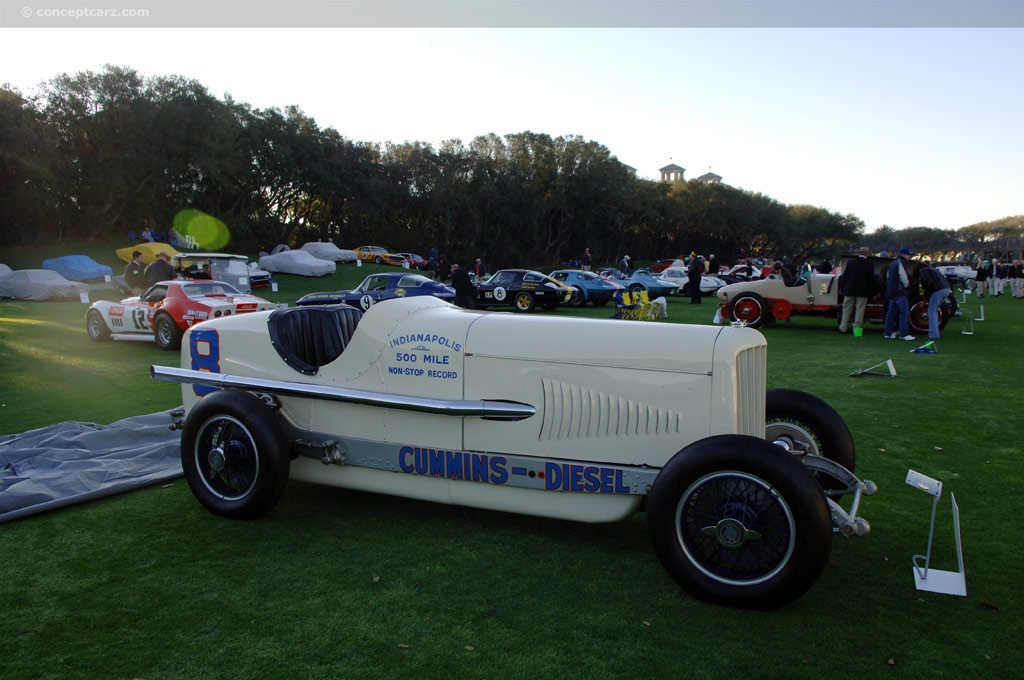
Driver Dave Evans (a veteran of three Indy 500s) and riding mechanic Thane Houser completed the marathon in five hours and 48 minutes at an average speed of 86.170 mph. It was the first car to run the entire Indianapolis 500 race nonstop; it started 17th on the grid and finished in 13th position with an average speed of 86.107 mph, consuming just over 30 gallons of diesel fuel. The man responsible for the project was Clessie Cummins, the founder of Cummins Diesel Engines of Columbus, Indiana; he commissioned August Duesenberg to modify the Model A passenger car chassis to accommodate the 85 horsepower, 4-cylinder Cummins Model U marine engine. The finished car weighed over 3,380 pounds and was the second heaviest on the grid, but it still managed a top speed of 96.871 mph.
In 1931, Chessie Cummins drove this car on Daytona Beach setting the record for a diesel-powered car of just over 100 mph.
The Indianapolis 500 race grew in popularity straight from the beginning. It was a phenomenal race that tested a machine's abilities and drew a large crowd. The competition was fierce, as the rewards were great; not only was there prize money to be won, but also an increase in sales if one finished strongly. But as the Great Depression began showing its ugly head, the prize money began to decrease, companies had fewer resources to dedicate to racing, and the popularity was beginning to fade. In 1930, the purse for the winner dropped from $50,000 and a total of $98,250 to $18,000 and $54,450 respectively.
In an effort to increase the number of competitors, the racing organization created the 'junkyard formula' which relaxed the rules for many home-grown mechanics and allowed stock-block engines up to 366 cubic inches. This served as an affordable alternative to the high-priced and exotic superchargers of the day. These changes worked, and by 1933 a record of 42 cars were on the track.
Seeing an opportunity, Cummins decided to get in on the action using a modified marine engine. The car was allowed to compete as a 'special engineering' entry which meant it could win no prize money, and as long as it maintained at least a 70 mph average.
A Duesenberg passenger-car chassis was used. It was modified to house the 361 cubic-inch four-cylinder marine diesel engine that had an available 85 horsepower. During qualifying, it placed in the last position at 96.871 mph. During the race, it averaged 86.1 mph and finished 13th out of the 40 starting cars.
Diesels had some advantages over its rivals, which were mostly with their fuel economy. The diesel engine could go much farther on a single tank of gas. Another advantage is that since less fuel was needed, it meant a reduction in overall weight.
Three years later, Cummins returned to the Indy 500 with two Duesenbergs. One was fitted with a two-cycle engine and the other a four-cycle diesel engine. Each of the engines displaces 364 cubic inches and is given a boost in power thanks to a Roots-Type supercharger. Both cars qualified for the race but failed to finish the race. The two-cycle car made it 200 laps before its engine seized. The four-cycle car had transmission problems after just 81 laps and ended its day prematurely as well.
Cummins returned in 1950 with the help of the legendary builder, Frank Kurtis. Kurtis created a tubular chassis that was specially designed to house the 401 cubic-inch magnesium-block diesel truck engine. A Roots-Type supercharger was added resulting in 340 horsepower at 4000 RPM.
The car qualified near the back of the pack and its inaugural racing career would not be that much different. After just two laps, the car was forced to retire due to an engine vibration that shattered a damper.
Two years later, in 1952, Cummins was back at Indianapolis, this time with a Kurtis-built roadster and a 401 cubic-inch turbocharged diesel engine that produced 380 horsepower. This was a historical accomplishment, as it was the first turbocharger ever to be used in the Indy 500. The car was very modern, having a very low center of gravity thanks, in part, to having its engine on its side allowing it to sit low in the chassis. The body was aerodynamic and streamlined. Piloting this machine was Freddie Agabashian who drove it to a very impressive pole position. It had captured the single-lap qualifying speed record at 139.104 mph.
After many years of trying, Cummins now had a chance at winning the Indy 500. Sadly, the car would retire after just 70 laps when rubber particles made their way into the engine and choked the engine. Disappointed, Cummins withdrew from Indy competition and has not fielded a car since that time.
By Daniel Vaughan | Mar 2008
In an effort to increase the number of competitors, the racing organization created the 'junkyard formula' which relaxed the rules for many home-grown mechanics and allowed stock-block engines up to 366 cubic inches. This served as an affordable alternative to the high-priced and exotic superchargers of the day. These changes worked, and by 1933 a record of 42 cars were on the track.
Seeing an opportunity, Cummins decided to get in on the action using a modified marine engine. The car was allowed to compete as a 'special engineering' entry which meant it could win no prize money, and as long as it maintained at least a 70 mph average.
A Duesenberg passenger-car chassis was used. It was modified to house the 361 cubic-inch four-cylinder marine diesel engine that had an available 85 horsepower. During qualifying, it placed in the last position at 96.871 mph. During the race, it averaged 86.1 mph and finished 13th out of the 40 starting cars.
Diesels had some advantages over its rivals, which were mostly with their fuel economy. The diesel engine could go much farther on a single tank of gas. Another advantage is that since less fuel was needed, it meant a reduction in overall weight.
Three years later, Cummins returned to the Indy 500 with two Duesenbergs. One was fitted with a two-cycle engine and the other a four-cycle diesel engine. Each of the engines displaces 364 cubic inches and is given a boost in power thanks to a Roots-Type supercharger. Both cars qualified for the race but failed to finish the race. The two-cycle car made it 200 laps before its engine seized. The four-cycle car had transmission problems after just 81 laps and ended its day prematurely as well.
Cummins returned in 1950 with the help of the legendary builder, Frank Kurtis. Kurtis created a tubular chassis that was specially designed to house the 401 cubic-inch magnesium-block diesel truck engine. A Roots-Type supercharger was added resulting in 340 horsepower at 4000 RPM.
The car qualified near the back of the pack and its inaugural racing career would not be that much different. After just two laps, the car was forced to retire due to an engine vibration that shattered a damper.
Two years later, in 1952, Cummins was back at Indianapolis, this time with a Kurtis-built roadster and a 401 cubic-inch turbocharged diesel engine that produced 380 horsepower. This was a historical accomplishment, as it was the first turbocharger ever to be used in the Indy 500. The car was very modern, having a very low center of gravity thanks, in part, to having its engine on its side allowing it to sit low in the chassis. The body was aerodynamic and streamlined. Piloting this machine was Freddie Agabashian who drove it to a very impressive pole position. It had captured the single-lap qualifying speed record at 139.104 mph.
After many years of trying, Cummins now had a chance at winning the Indy 500. Sadly, the car would retire after just 70 laps when rubber particles made their way into the engine and choked the engine. Disappointed, Cummins withdrew from Indy competition and has not fielded a car since that time.
By Daniel Vaughan | Mar 2008
- 1931 Duesenberg Cummins Diesel Indy Racer Menu
- Article
- Image gallery
- Specifications


1931 Duesenberg Cummins Diesel Indy Racer Vehicle Profiles

Recent Vehicle Additions


Related Automotive News

The Brumos Collection
The Brumos Collection, located at 5159 San Pablo Road South, recently opened its doors to the public, with viewings on Thursdays and Fridays from 10 a.m. to 3p.m (and one Saturday a month). Although they rarely use the word museum, the mission...

Two Significant Private Collections Lead Early Entries For RM Auctions Auburn Spring Sale
THE BILL AKIN COLLECTION FEATURING HISTORIC INDY RACERS AND HOT RODS
31 BUICKS FROM THE ROADMASTER COLLECTION SPANNING NEARLY EIGHT DECADES
ALL OFFERED ENTIRELY WITHOUT RESERVE
RM Auctions announces two important, single-own...

Mazda6 Becomes First Diesel To Win At Indianapolis Motor Speedway
July 26, 2013 (INDIANAPOLIS, Ind.) Over the past four decades, Mazda has scored hundreds of race wins at tracks across the county, and around the world. But until today, Mazda did not have a win at what is perhaps the most famous racetrack in...

BORGWARNER INTRODUCES NEXT-GENERATION EFR TURBOCHARGING TECHNOLOGY AT 2012 SEMA SHOW
BorgWarner Hosts 2012 Indianapolis 500 Winner Dario Franchitti on October 30
Borg-Warner Trophy™ on Display October 30 - November 1
BorgWarner (NYSE BWA) will introduce its next-generation EFR-7163 (Engineered for Racing) turbocharger a...

BORGWARNER EFR TURBOCHARGERS EARN REPUTATION FOR PERFORMANCE, DURABILITY AND DEPENDABILITY AT INDYCAR AND LE MANS
BorgWarners Race-Proven Turbocharging Technology Delivers Powerful Performance and Durability without Incident
BorgWarners first year as the exclusive turbocharger supplier for the IZOD IndyCar® Series established a reputation of powerful performance,...