British Racing Motors, commonly known as BRM, was a British Formula 1 racing team that was formed in 1945 and competed in competition from 1950 through 1977. In total, they competed in 197 Grand Prix races, of which they won 17. 
Chassis #: 09
View info and history
Auction entries : 1The company was founded by Raymond Mays. Mays was a notable driver who won the British Hill Climb Championship in 1947 and 1948. Prior to World War II, Mays had built several road racing cars and hillclimb vehicles under the ERA brand.After World War II, Mays used his pre-War experience in racing, and his many contacts and designs documents gathered while in the sport to form an all-British Grand Prix car of which, he would drive. The team set up shop in Spalding Road, Bourne, Lincolnshire, directly behind Mays' family home. Some individuals involved with ERA prior to War, returned in the post-War era to work for BRM. Those included in this category were Harry Mundy and Eric Richter. The rules in the post-War era allowed for engine sizes of 1.5 liters in supercharged form, or 4.5 liters in naturally aspirated condition. The BRM's cars were generally unconventional compared to other teams. Their first entries in the sport were powered by V16 engines enhanced with the help of supercharges. Instead of using the traditional Roots-Type supercharger, Rolls-Royce was tasked with creating the centrifugal supercharger. The engine proved to be very powerful, as expected. Its Achilles heal was its complexity and high horsepower output produced over a very limited range of engine speed. As the years progressed, the team's racers became more traditional, though still fitted with many unique features.
Chassis #: 09
View info and history
Auction entries : 1By the time the V16 BRM engine's shortcomings were resolved, the engine was no longer eligible for Grand Prix competition. Instead, it was used in Formula Libre events scoring several victories over its racing career, though all victories were in minor events. After the V16 project, five years later, BRM began work on a new F1 car. They continued to be true to their founding principles, with every major component being designed in-house. Instead of creating a dramatic, bold, and unconventionally vehicle, they chose to go the traditional route. The result was the BRM P25 which was dramatically different from its V16 sibling. It was powered by a 2.5-liter four-cylinder engine in a naturally aspirated guise and designed by Stuart Tresilian. The development of the car took longer than anticipated and, upon its racing debut, proved to be unsuccessful. A victory would not be scored by the Type 25 for a long time; the first victory came at the Dutch Grand Prix in 1959. The shortcomings of the BRM P25 were many; but mostly due to the large engine valves and rear brakes. In 1956 Mike Hawthorn and Tony Brooks were hired as team drivers. The team failed to score any major victory. At the conclusion of the season, Brooks left. For the following season, a few improvements were made, but they failed to kindle the desired results.
Chassis #: 09
View info and history
Auction entries : 1In 1958, the next iteration of the BRM was introduced and brought with it an updated suspension. Colin Chapman of Lotus fame had suggested replacing the single-leaf spring with a coil spring setup. The change did improve the vehicle's handling, but by this point, the car's reputation was horribly dismal. Drivers struggling to get into Formula 1 were unwilling to get in its cockpit. Another problem with the car surfaced when alcohol-based fuels were replaced with pumped gas. This caused the engine to overheat, which was corrected in 1959. After years of development and testing, the car was finally becoming a formidable contender. Just as the car was coming into its glory, other marques, mainly Cooper, had become dominant. Cooper's mid-engined cars were revolutionary and allowed better weight distribution throughout the vehicle. In response to this, BRM introduced a mid-engined version of the P25, which they dubbed the P48. In almost every respect, the P25 and P48 were identical, except for the layout. The P48 made its racing debut near the close of 1959. Just like prior cars in BRM history, this car failed to live up to expectations. In 1960, the team scored just four finishes and BRM finished in fourth place in the Constructors' Championship. In 1961, in response to rule changes, the car's engine was updated. Again, in BRM fashion, the engine was not ready in time; instead, the car was powered by a Coventry-Climax four-cylinder unit. By the early 1960s, Tony Rudd was in charge of the design teams. Under his care, the cars were fitted with V8 engines which were both traditional and the correct choice. In the hands of Graham Hill, the P57 finally served the BRM team well, securing BRM five Grand Prix wins. Hill secured the Driver's World Championship and BRM was crowed the Constructor Champion.
Chassis #: 09
View info and history
Auction entries : 1In 1963, the P57 was modified and improved to keep it competitive. The cars ran well for the next few years until regulations in 1966 engine the car's career. With the new engine regulations announcement, BRM decided to return to the sixteen-cylinder engine. The engine was complex, just as their prior attempt with an engine of this size had been. The designers tried to keep the engine compact and lightweight; part of their solution to achieving this goal was by laying two eight-cylinder layouts on top of each other, creating an H-16 layout. Just as the sixteen-cylinder engine of prior years had been, this H16 version was complex, heavy, and unreliable. Only one victory was scored with the engine, and it was in a Lotus. For 1967, the team began work on a twelve-cylinder unit that would be powerful and rectify the shortcomings of the sixteen-cylinder unit. The engine made its racing debut in a McLaren late in 1967. The results were positive, resulting in BRM abandoning its sixteen-cylinder technology in favor of positive prospects with its twelve. The engine was much less complex and more reliable, though lacking in power in comparison. The first BRM car to be powered by the Len Terry-designed twelve-cylinder unit was the P126. In total, there were three chassis constructed by Terry, all were given the V12 engine and a Hewland five-speed gearbox. During the 1968 season, the P126s served the team well, scoring some impressive second-place finishes. Mid-way through the season, the team introduced the P133. There were two examples constructed, both were very similar to the P126. One of the chassis was in existence for only a short time before being destroyed; the second was raced with mild success.
Chassis #: 09
View info and history
Auction entries : 1At the end of the 1968 season, BRM found themselves fifth in the Constructor's Championship. This was a major improvement from the past two seasons. For the 1969 season, the P128 and P133 were further developed, resulting in the P138 and the P139. The engine improvements were ongoing. By the early 1970s, it had been fitted with four-valves per cylinder heads resulting in an increase in power. BRM was one of the few teams at this time using twelve-cylinder units; other teams were having success with engines such as the Cosworth DFV units.Tony Southgate became chief designer for BRM at the end of the 1969 season. The P153 was introduced in 1970 and achieved a victory at the Spa Grand Prix. This victory ended the team's four-year dry spell.
Chassis #: 09
View info and history
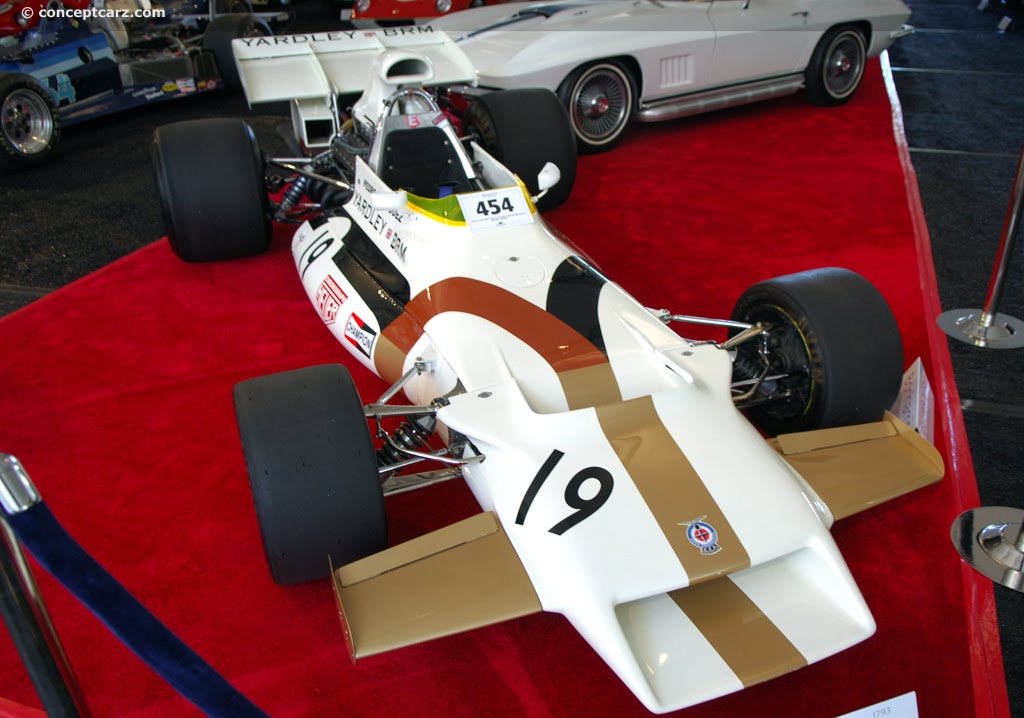
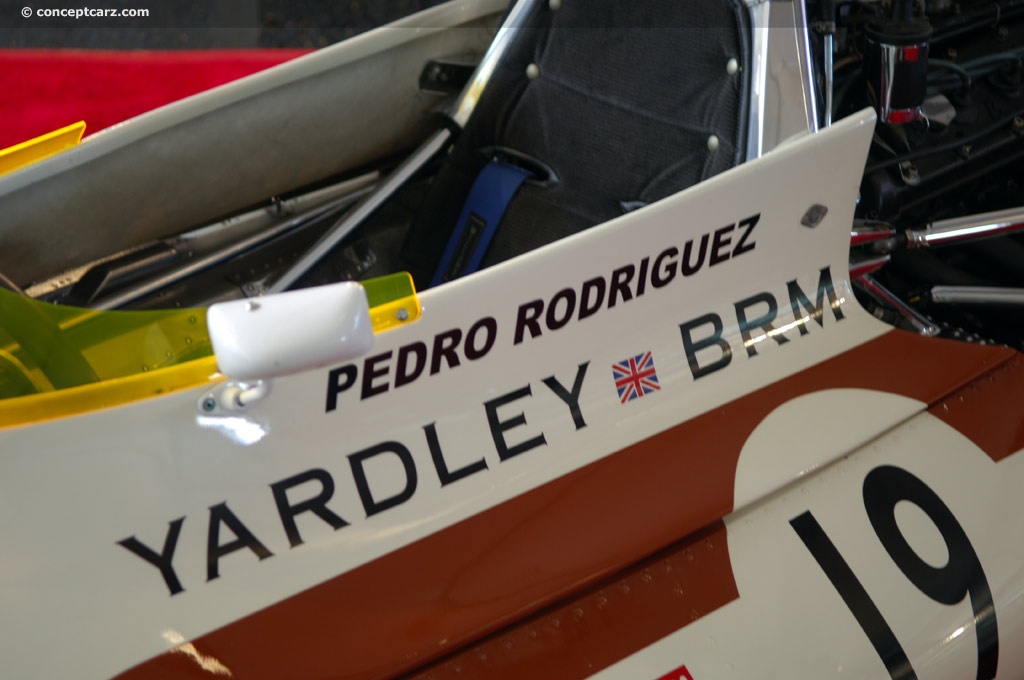
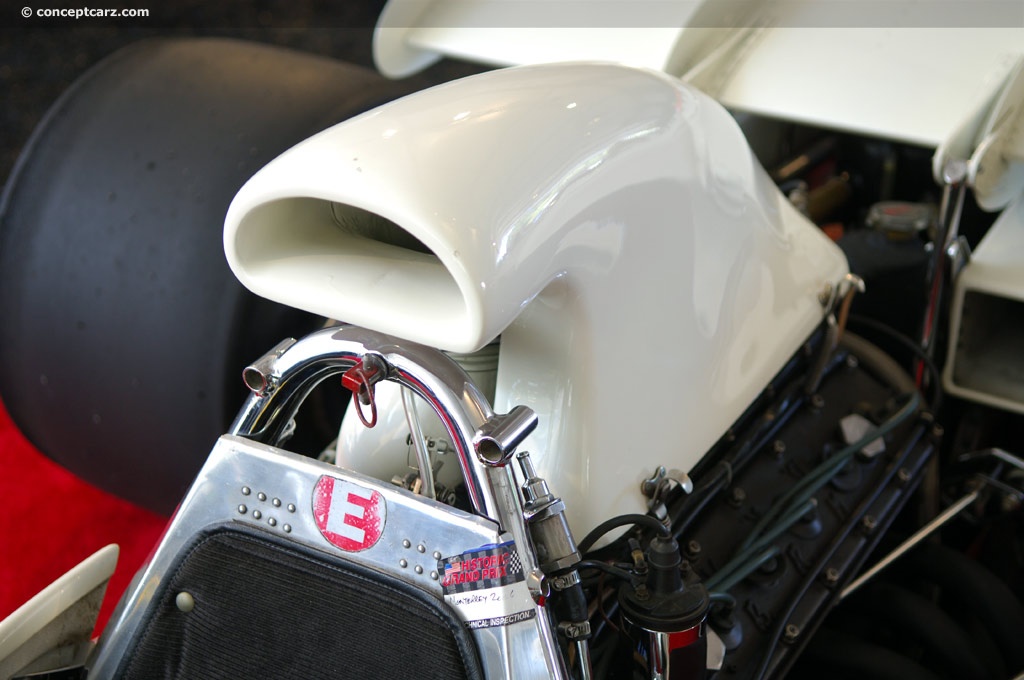
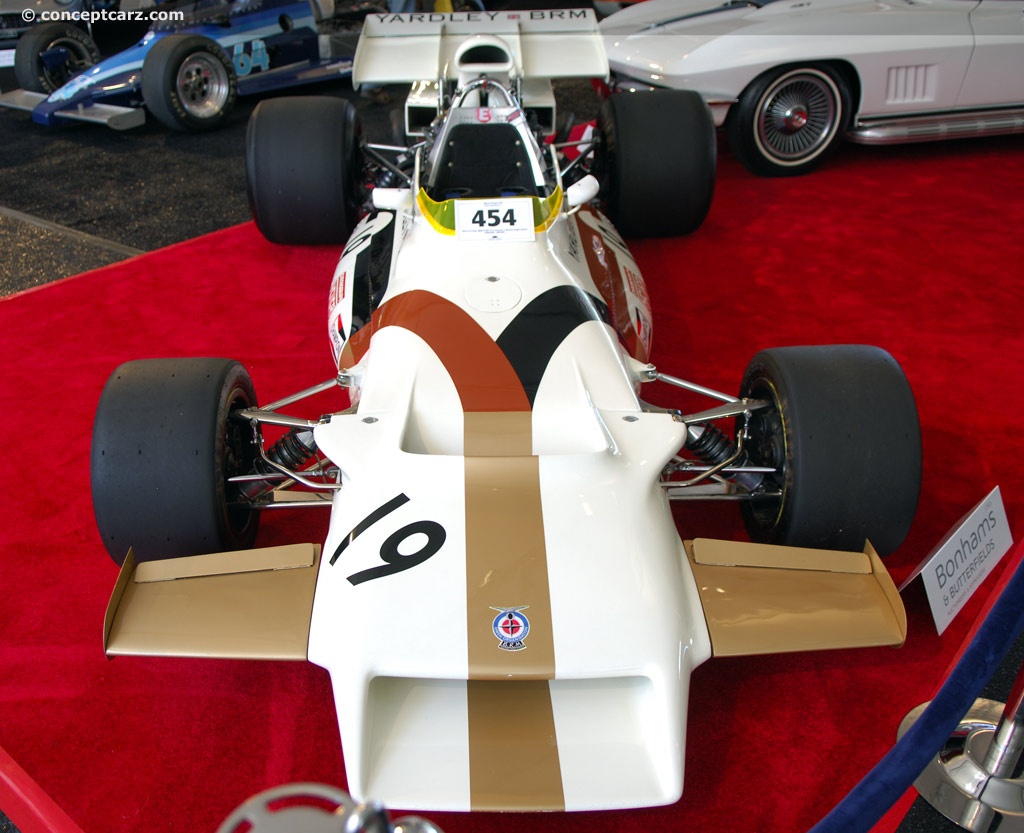
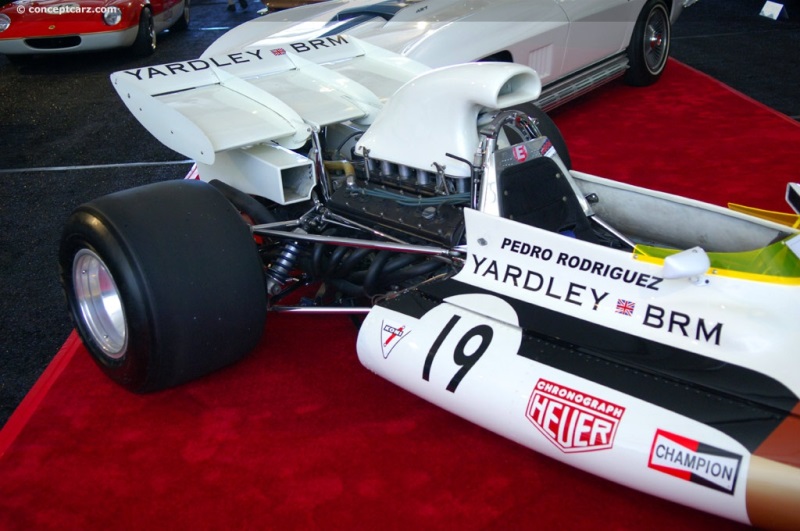
Auction entries : 1In 1971, the P160 was introduced. It used a fully-stressed version of the twelve-cylinder engine. The cars were fast and carried Peter Gethin to a victory at the Monza Grand Prix after averaging over 242 mph. Jo Siffert captured a Grand Prix victory in the P160 during the 1971 season. At the conclusion of the year, BRM was in second place in the Constructors' Championship, right behind Tyrrell. The P160, in various versions, was used for another three seasons, with a total of seven examples being constructed. In 1972, the P180 was introduced. It was a development of the P160 with only a few minor changes. Radiators were placed on either side of the gearbox, instead of the vehicle's nose. This change proved detrimental, as the vehicle's handling was compromised. At the end of the season, the project was abandoned after only two cars had been created.
Chassis #: 09
View info and history
Auction entries : 1In 1974, the Mike Pilbeam-designed P201 made its racing debut. Power was from the V12 engine, now producing around 450 horsepower. The engines were mated to a BRM five-speed manual gearbox. Drivers Jean Pierre Beltoise and Henri Pescarolo had very little success with the cars. The highlight of the P201's career was a second-place finish at Kyalami in the hands of Beltoise. The 1974 season was another low point in the BRM racing career. That low point would decline further when long-time financial backer, Alfred Owen, passed away. This signaled the demise of the company. The BRM P 207 was the last F1 car manufactured by British Racing Motors. Two cars were produced for the 1976 F1 season by Stanley - BRM with sponsorship by Rotary Swiss watches. This is the 02 car. The 01 car is currently being completed in the UK. BRM, along with Ferrari, were the only two teams to manufacture all parts of the car.
Chassis #: 09
View info and history
Auction entries : 1The car was driven by Larry Perkins, Conny Andersson, and Teddy Pilette.Because of a severe lack of financing, the cars were never developed to their full potential. The P207 marked the end of an era for BRM.The team was run for a short time with support from Louis Stanley and some Bourne personnel until 1977. When the team folded, the assets were acquired by John Jordan, who backed the building of a pair of P230 cars.
by Daniel Vaughan | Apr 2008
Chassis #: 09
View info and history
Auction entries : 1

Chassis #: 09
View info and history
Auction entries : 1
Chassis #: 09
View info and history
Auction entries : 1

Chassis #: 09
View info and history
Auction entries : 1
Chassis #: 09
View info and history
Auction entries : 1

Chassis #: 09
View info and history
Auction entries : 1

Chassis #: 09
View info and history
Auction entries : 1
Chassis #: 09
View info and history
Auction entries : 1
by Daniel Vaughan | Apr 2008
Similar Automakers
Similarly Sized Vehicles
from 1973
Related Drivers
Related Teams


1973 BRM P160 Vehicle Profiles
Chassis #: 09
Recent Vehicle Additions


Related Automotive News

WORLD-FIRST DISPLAY OF ALL SEVEN REMAINING LOTUS 49S LINING-UP AT AUTOSPORT INTERNATIONAL
Autosport International to host display featuring all seven remaining Lotus type 49 cars thanks to their owners from around the world
Celebrations at Autosport International to mark 50 years since this pioneering F1 car first raced
To this day, th...

John Barnard's Finest: Some of the Greatest of Barnard's Design
The latter-part of Barnards Formula One career would be filled with disappointments and disputes. However, there was no disputing the genius of the man from London. In fact, a couple of innovations that are mainstays in Formula One design were first...

High Efficiency Motors: 1958 Formula One Season
C.T. Tommy Atkins would start out his career as a motorcycle racer riding Douglas motorcycles in the early 1930s. By the time the mid-to-late 50s rolled around, Atkins had moved on from racing, but not very far. Perhaps feeling a need to support up-and-coming...

1972 Italian Grand Prix: Youth Beats Experience
From the moment Fittpaldi responded by earning victory following the tragic loss of Jochen Rindt back in 1970, it was clear the Brazilian was a World Champion in the making. The question would be How long would it take In just two short years, and...

1968 Belgian Grand Prix: A First for McLaren
McLaren and Formula One are truly synonymous. Over the course of its history, McLaren has completed 714 races and have garnered no less than 178 victories. But while McLaren and victory in Formula One are an almost certainty, the very first would be...


