Concept Cars Home
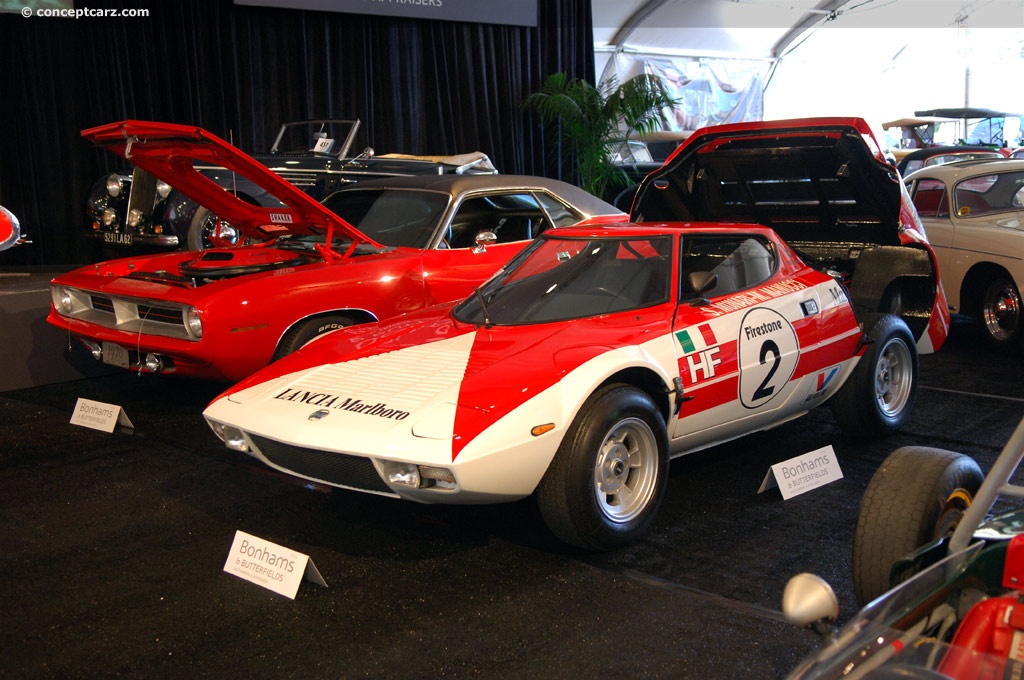
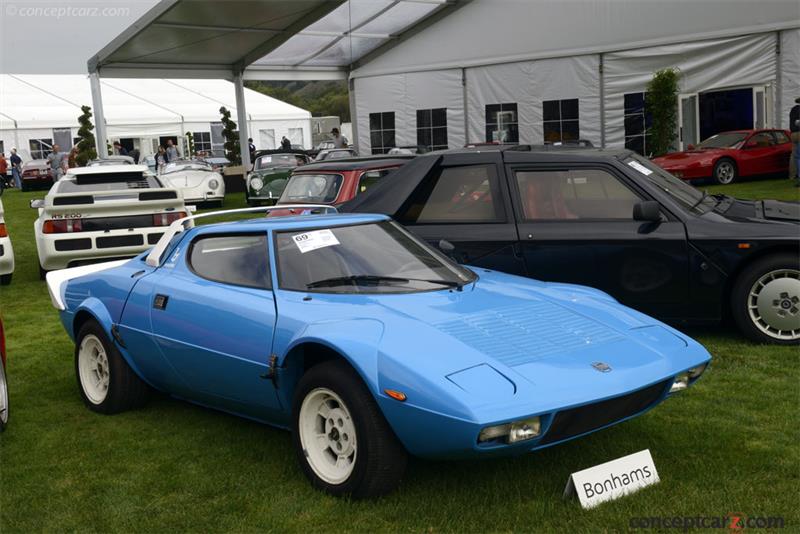
Image Left 1974 Stratos Group 4
 

1975 Lancia Stratos HF news, pictures, and information

Coupe
Designer: Bertone
Chassis Num: 829 ARO 0011948
Engine Num: 142536
 
Sold for $113,000 at 2007 Bonhams.
During the mid-1970s, the Lancia Stratos were raced by both factory and privately owned teams with much success in rally competition racing from European and World Championship level to National-standard series in many countries. The mid-engine cars were very effective on tarmac-surfaced states and rough terrain. The Ferrari-derived quad-cam V6 engine was mounted transversely behind the drear bulkhead and provided enough power to carry to lightweight and well-balanced cars at Rally-winning speeds.

The idea began with the Stratos Concept Car first show by Carrozzeria Bertone at the 1980 Salone del'Automobile in Turin. It was labeled as an impractical design - a label which would soon be proven very wrong. The Lancia Division made modifications to the design and prepared it for competition.

The original design incorporated a Fulvia 1600cc engine. That was later replaced by a 2418cc Ferrari Dino V6 engine which offered 190 bhp in normal guise. To satisfy FIA's Group 4 Special GT homologation requirements, the Lancia group began creating the new Coupe in significant quantities. At least 500 were required within one calendar year. This point in history was difficult, as the oil crisis of the early 1970s hindered production. Compounding this problem was the Italian national tax upon cars with engines exceeding 2-liters in capacity. Consequently, around 270 examples were created.

Nevertheless, the Lancia Stratos Coupes were used very successfully in International Rally events. The V6 4-cam engines were first tuned to 230 bhp and then to 240 in 24-valve trim.

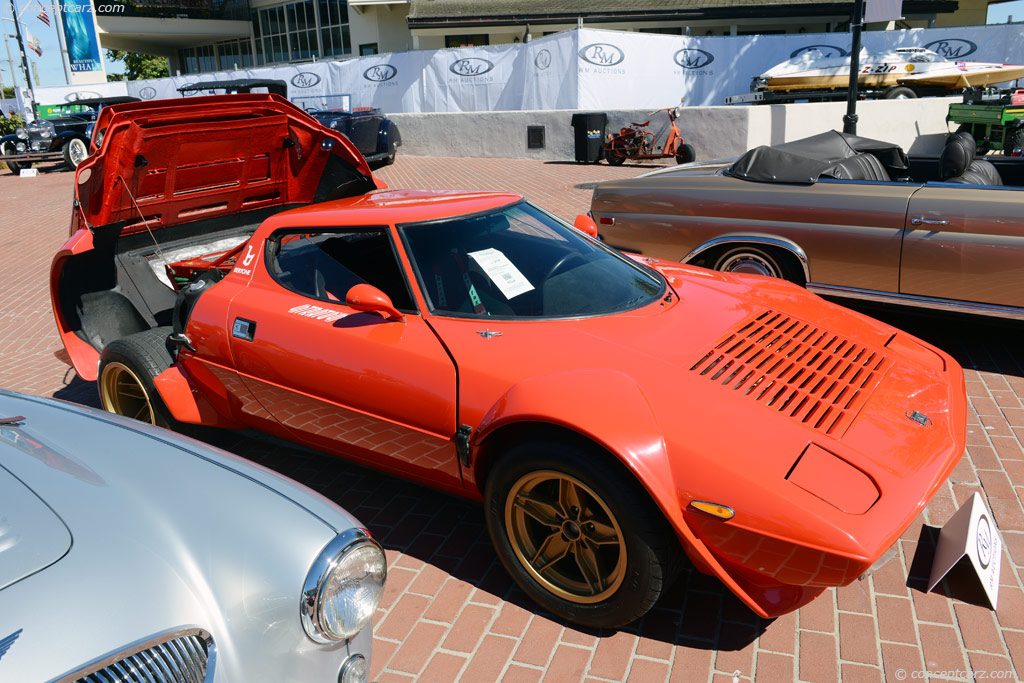
This example is a 1975 Lancia Stratos HF Competition-Liveried Two-Seater Coupe with coachwork by Carrozeria Bertone. It has been a static display for many years in a private European collection. It is a near-identical version of the rally team car with an interior that is more civilized.

In 2007, this coupe was brought to the Quail Lodge Resort & Golf Club in Carmel, California where it was auctioned at the Bonhams auction, An Important Sale of Collectors' Motorcars and Automobilia. Bidding reached a high of $113,000 (plus premium and taxes) which was enough to satisfy the reserve and the lot was sold.

By Daniel Vaughan | Apr 2008
Coupe
Designer: Bertone
Chassis Num: 829AR0 001672
 
Lancia presented the Bertone designed Lancia Stratos HF prototype at the 1971 Turin Motor Show, a year after the announcement of the Stratos Zero concept car. The prototype Stratos HF (chassis 1240) was florescent red in color and featured a distinctive crescent-shaped-wrap-around windshield providing maximum forward visibility with almost no rear visibility. The prototype had three different engines in its early development life: the Lancia Fulvia engine, the Lancia Beta engine and finally for the 1971 public announcement, the mid-mounted Dino Ferrari V6 producing 192 horsepower.

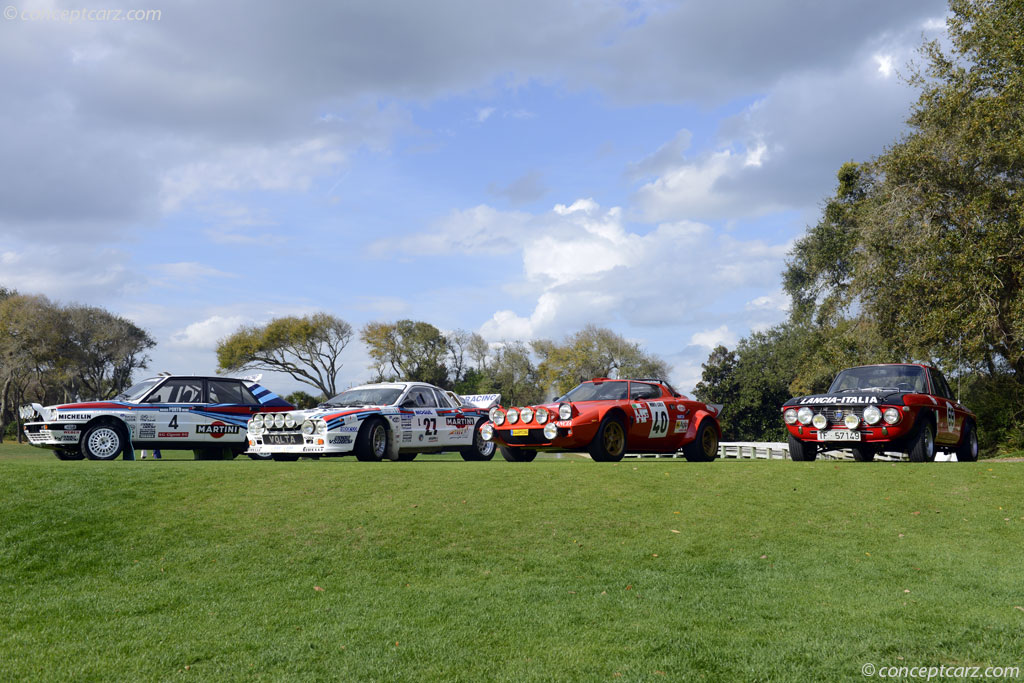
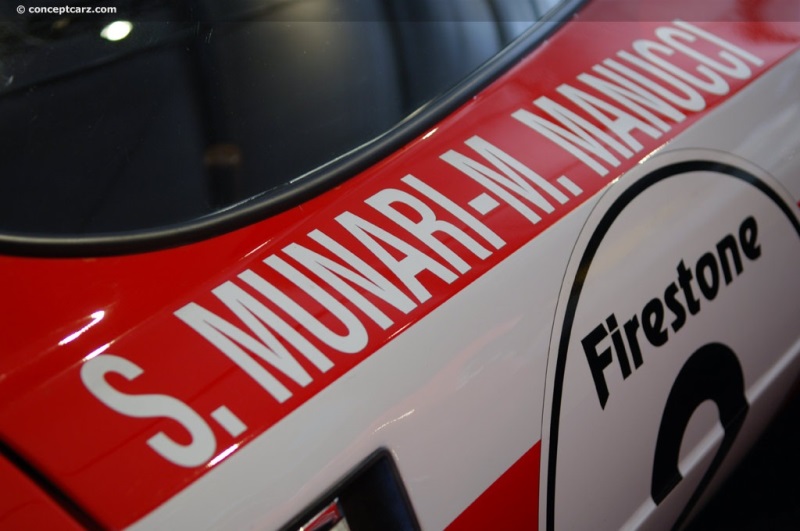
The Stratos was a very successful rally car during the 1970s and early 1980s. It started a new era in rallying as it was the first car designed from scratch for this kind of competition. The three leading men behind the entire rallying project were Lancia team manager Cesare Fiorio, British racer/engineer Mike Parks and factory rally driver Sandro Munari.

Without support from Fiat, and despite new regulations that restricted engine power, the car would remain a serious competitor. The final Stratos racing chapter at the international level took place in 1981.
The Betone designed Stratos was built for one purpose, to win the World Rally Championship. Two prototype versions of the Stratos were shown, one during the 1970 Turin Motor Show and another a year later. The road going versions of this car was built only to satisfy the homologation rules. As a result, the road version had noisy cockpits, was uncomfortable, and did not have good cabin air circulation. The front part of the car housed cooling fans and a spare tire. So it was not very practical when it came to luggage.

In 1973, the Stratos won its first rally it participated in. In 1974 through 1976 it dominated the rally scene by capturing the World Championship.

Since Lancia was owned by Fiat, who also owned Ferrari, there was a wealth of resources to draw from. And such, a Ferrari Dino V6 quad cam engine was used and placed in the rear of the car. The engine was capable of producing almost 200 horsepower which could propel the car from zero to sixty mph in just 7 seconds. A five speed manual gear box and 9.9 inch vented disc brakes were also used.

The body was built by Bertone and light-weight fiberglass was used whenever possible.

The rear spoiler provided down force and channeled air into the engine ducts. If the vehicle rolled-over the spoiler was actually strong enough to take the impact of the tumble.

By Daniel Vaughan | Apr 2008
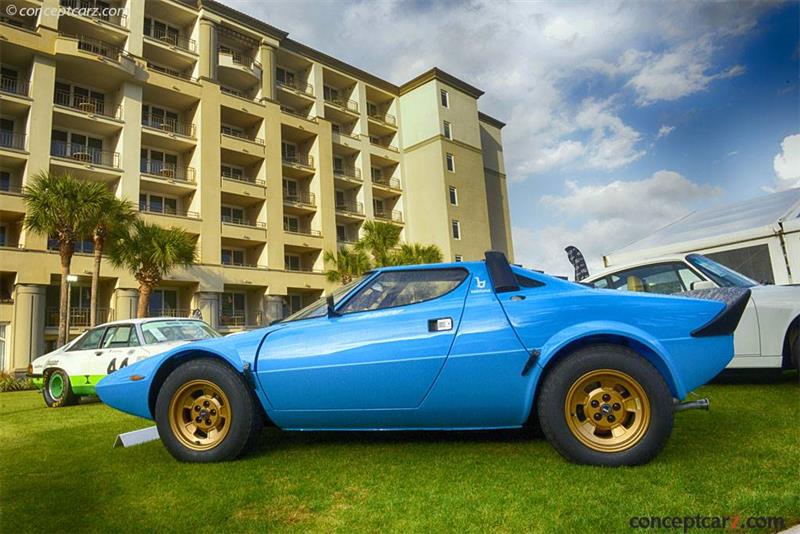
A big success by any standard both in and out of competition, the Lancia Stratos was developed as a homologation Special for European rallying. After production ceased it became a cult car and is now highly priced as the ‘modern classis' it is. Conceived strictly for rallying, the Lancia Stratos however makes an exciting road car, though it is very far from GT standards in both luxury and refinement.

The concept vehicle responsible for providing the inspiration for the Lancia Stratos Rally car is the Lancia (Bertone) Stratos. The Stratos featured a 1584 cc V4 DOHC with 115 bhp horsepower at 200 rpm. Designed by Marcello Gandini, the same designer responsible for the Lamborghini Countach and Lamborghini Miura, the Stratos concept was a development of the Bertone designed Alfa Romeo Carabo concept from 1968. The Carabo concept was also a Gandini creation.

First revealed at the Turin Motor Show in October of 1970, the Lancia Stratos HF prototype was a styling exercise for Bertone. A futuristic design, the Stratos featured a wedge shaped profile that stood just 33 inches from the ground. Since the vehicle was so low, conventional doors could not be used and instead one accessed the interior of the Stratos by a hinged windscreen. Drivers had to flip up the windscreen and walk into the vehicle. Once inside, visibility was quite restricted since the front windscreen was narrow. The cockpit of the Lancia Stratos was designed specifically for fast forest flying.

The body design was predictably minimal to hold down weight and bulk with its most distinctive features being semi-concealed A-pillars and a door beltline that sharply upswept to the top of the daylight opening. The shape of the resulting unbroken expanse of glass gave the tunnelback roof the appearance of a futuristic crash helmet.

The main body structure was steel, like the chassis, and weight-saving fiberglass was used for tilt-up nose and tail sections. A small box above and behind the powertrain was where cargo space was held. Bins were also molded into the interior door panels for storing helmets.

The same engine utilized on the Lancia 1600 HF Fulvia was used on the Bertone designed Lancia Stratos Zero prototype. A triangular shaped panel hinged upwards to allow access to the mid-mounted engine. Developed for rallying purposes, the legendary Lancia Stratos was unveiled in 1974. The production vehicle Stratos was powered by a 2.4 liter mid-mounted V6 from the Ferrari Dino.

Like no other Lancia before or after, the Lancia Stratos was a shock that left enthusiasts and rally fans breathless. For almost a decade the Stratos streaked across the rally landscape much like a brilliant comet, while discarding past principles, it also fearlessly represented something undeniably new. A phenomenal rally car, the Lancia Stratos set an example to every other car manufacturer in the world. The first viable purpose-built rally car ever built, the Stratos was probably the last purpose-built rally car.

Created by the Bertone coachbuilding company, the Stratos was both radical, yet fully functional. Fiorio realized that for Lancia to continue to compete in the World Rally Championship, the Fulvia HF would need a much more powerful replacement. A the time, four-wheel drive was not an option, so a mid-engined configuration seemed ideal. To reinforce Fiori's convictions, the Bertone show car was featured soon after with a mid-engine Fulvia V4.

The introduction of the Ford mid-engine purpose-built GT70 rally car at the 1971Brussels Motor Show was what truly inspired the impetus behind the Stratos proect. It was after this appearance that Lancia's general manager, Pierugo Gobbato contacted Nuccio Bertone. Though the GT70 was actually never put in production by Ford, it was this that sparked the inspiration of the Lancia Stratos.
As always, there was a minimum production requirement, 500 units for the Lancia Stratos. This was an awkward figure that would necessitate funds for at least semi-permanent tooling as well as design and development. This was a job well suited to the Italian industry. Fiorio masterminded the project, and he envisioned a short, wide coupe with transverse midships drivetrain. Bertone was immediately contracted to style the vehicle and built its unit body/chassis structure.

43 months passed in between the time of conception to the actual birth of the Lancia Stratos. The vehicle was developed to take over and make Lancia the outright world rally champ. The Stratos was both short and wide, with a wheelbase of only 7 feet 1.8 inches, the width of the vehicle was only 5 feet 8.9 inches. Weighing only 1958 lbs, the Stratos was only 3 feet 7.9 inches high. Able to easily exceed 140 mph, the Stratos featured 190 horsepower in roadgoing trim.

Having studied every possible powerteam in the Fiat/Lancia group, Fiorio secured 2.4 liter V-6s and 5-speed transaxles from Ferrari, which was an ideal chouse as they'd be installed exactly as the Dino 246. All-independent suspension, rack-and-pinion steering and four-wheel disc brakes were all specifically designed for the Lancia Stratos.

After 1978 the Stratos was officially retired and no longer was officially entered by the Lancia factory, the vehicle was still going strong. The Lancia team was headed by by Sandro Munari who won its first event as a homologated entry in October of 1974. Mun ari entered alone 40 events with the Lancia Stratos and won 14. The Stratos also won the World Rally Championship in 1974, 1975, and 1976 and remained competitive for another four years. The final major win came in 1979 when a Lancia Stratos entered by the Monaco importer won the famed Monte Carlo Rally. Finally the factory retired the Stratos.

By Jessica Donaldson
For more information and related vehicles, click here

Hagan Drives ‘Magneti Marelli Offered By Mopar' To 4-Wide Nhra National Win
• Don Schumacher Racing's Hagan takes 'Magneti Marelli Offered by Mopar' to winner's circle at Four-Wide Nationals
• Win by Hagan extends Mopar's win streak to six titles in five NHRA events in 2013
• Hagan back on track with first win since his 2011 NHRA Funny Car Championship season
• Hagan takes the Funny Car Championship points lead by 50 points
• Mopar Express Lane driver Johnson drops to second place in Pro Stock points standings after red light in round t...[Read more...]
TAG HEUER & McLAREN: A BIGGER & STRONGER PARTNERSHIP
During the Geneva Motor Show, Jean-Christophe Babin, TAG Heuer's President & CEO, and Ron Dennis, Executive Chairman of the McLaren Group, announced a new exclusive partnership agreement. TAG Heuer will continue to supply the official timepiece for the Vodafone McLaren Mercedes Formula 1 team and the partnership will be extended to include McLaren Automotive, the manufacturer of world leading high performance sports cars including the 12C and McLaren P1™. TAG Heuer and McLaren engineers ...[Read more...]
RALLY AMERICA HONORS 2012 NATIONAL CHAMPIONSHIP AWARD RECIPIENTS
Officials with Rally America, the premier sanctioning body for performance rally in North America, celebrated the closing of the 2012 Rally America National Championship with a festive awards ceremony held at the Red Lion Inn following the conclusion of the Olympus Rally on September 23rd. National teams were in attendance to honor the recipients of Rally America's annual national awards after a hard fought season that produced fantastic stories and many surprises. Paul Giblin, Rally America...[Read more...]
The 2012 Rally America Championship Ends In A Cloud of Dust At Olympus Rally
With the 2012 Rally America Driver's Championship mathematically in his favor for a second year in a row, Subaru Rally Team USA (SRT USA) driver David Higgins entered the Olympus Rally season finale with an aim to put on a show for the fans and go for the win. Unfortunately, neither goal would materialize due to extreme drought conditions in the area, placing the rally's forest stages off-limits to fans due to fire danger and creating blinding dust for Higgins and the bulk of the field. Higgin...[Read more...]
The Champion in Touring Car Racing : The BMW M3
In August 1985, a rumour surfaced in motor magazine Auto-Deutschland which emanated from a new sports car. An A Group Car from BMW that was a thoroughbred racing car according to the rules but was also to be produced in a version licensed to drive on open roads for everyday use. Speculation about this dream car that could take to normal roads and was intended for the 'Most dynamic among BMW 3 Series drivers' was right on target. But the pundits missed the mark about the motor-sport car by a mile...[Read more...]
Appia
Aprilia
Artena
Astura
Augusta
Aurelia
Beta
D50
Dedra
Dilambda
Flaminia
Flavia
Fulvia
Hyena
Lambda
Scorpion
Stratos
Thema
Theta

Image Left 1974 Stratos Group 4
© 1998-2012. All rights reserved. The material may not be published, broadcast, rewritten, or redistributed.