As the automobile grew in interest, companies and those eager to capitalize on this new market scrambled to meet the demand. Prior to World War I, hundreds of individuals and companies sprung up in every major city and throughout the United States, trying to create their version of the horseless carriage. Many would be out of business within a few years. 
Torpedo Roadster
Chassis #: 18910
View info and history
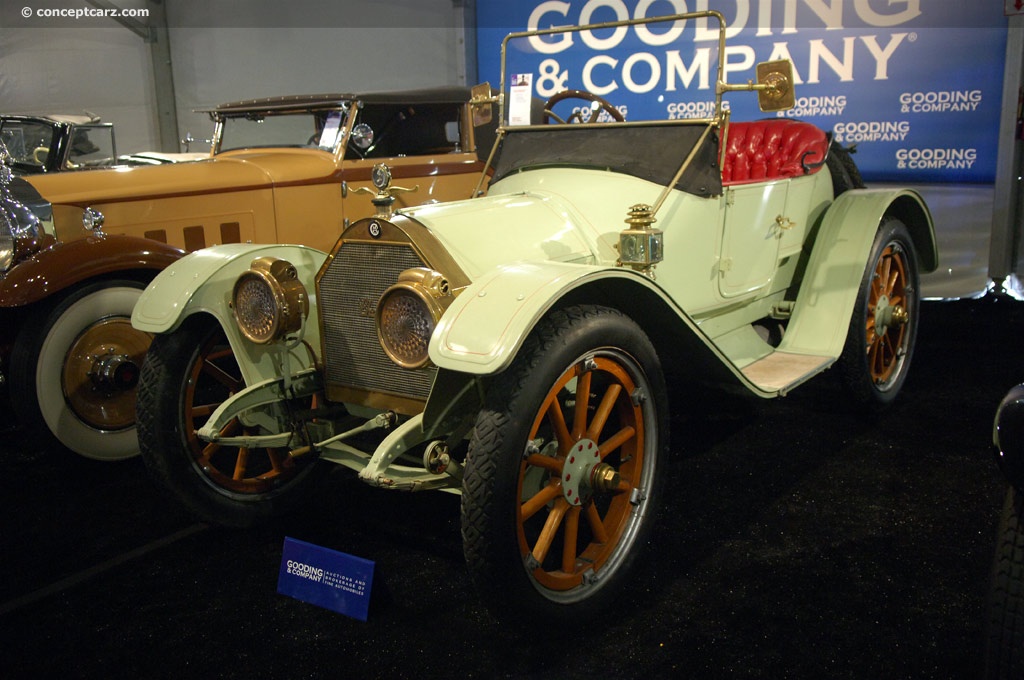
Auction entries : 2In 1903 Jonathan Maxwell, with assistance from Benjamin Briscoe, designed and built their first motor car, and soon the Maxwell-Briscoe Company was formed. Production began in 1904 in facilities located in Tarrytown, New York. Within the first year, they were able to create 532 cars, an astonishing accomplishment considering the evolutionary stage of the motor car in that era. As time progressed, their vehicles improved, as did their mechanical capabilities and durability. A shaft drive replaced the chain drive in 1905. In 1908 William C. Durant and his Buick marque tried to convince the Briscoe brothers, Frank and Benjamin, to become a part of a single corporation called 'General Motors Corporation.' Talks fail though each would go on to form their own 'large entity' corporation. Durrant formed 'General Motors,' and the Briscoe brothers formed the United States Motor Company, consisting of their Maxwell-Briscoe Company and Brush Motor Car Company. Brush Motor Car Company was formed in 1907 by Alanson P. Brush and located in Detroit, Michigan. It was known for its simplistic vehicles consisting of a single-cylinder engine using chain drive to propel the wood frame vehicle. Many other small, independent companies soon joined the United States Motor Car Company, including Columbia, Brush, Maxwell, Stoddard-Dayton, Courier, Sampson Trucks, Chalmers, and more.
Torpedo Roadster
Chassis #: 18910
View info and history
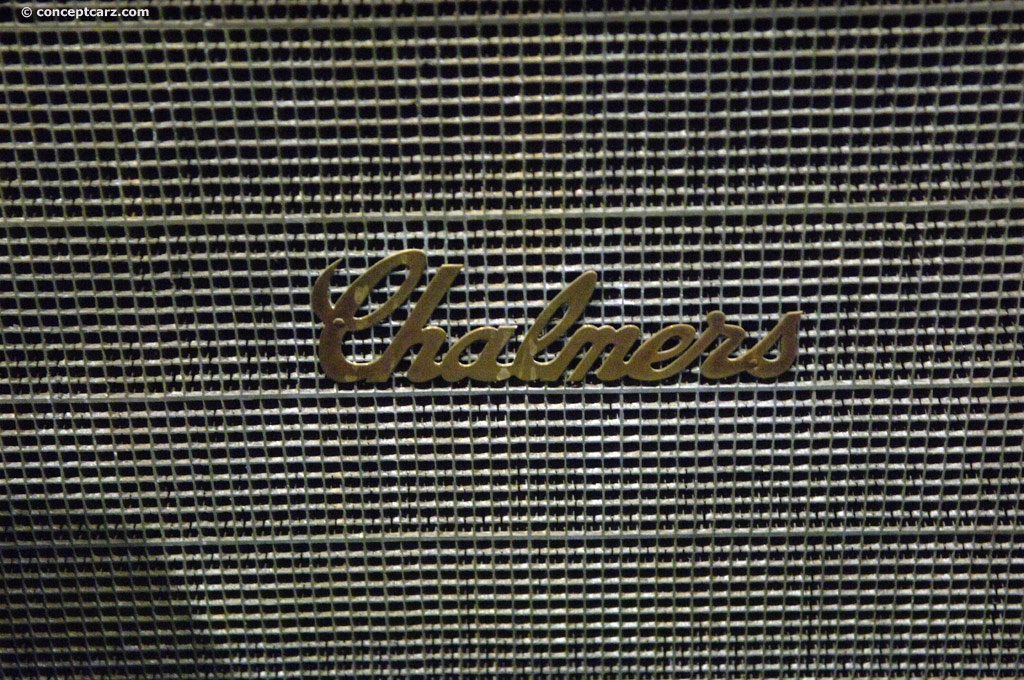
Auction entries : 2In 1910 Maxwell ranked third in U.S. sales behind Ford and Buick. Chalmers cars were named after Hugh Chalmers of the National Cash Register Company, who bought into the Thomas-Detroit car company in 1907 and changed the name to Chalmers-Detroit. Within a few years, the 'Detroit' part was dropped and it was simply known as 'Chalmers'. Just before World War I, the United States Motor Company dissolved due to conflicts between two of its primary financial supporters. These individuals also had financial interests in the General Motors Corporation. Walter Flanders purchased the ailing Maxwell Company and continued to produce cars using its nameplate. The company survived until 1924 when Walter P. Chrysler merged it with his new Chrysler Corporation.
Torpedo Roadster
Chassis #: 18910
View info and history
Auction entries : 2In 1917 Maxwell's business was successful while the Chalmers Company's sales were stagnating. Maxwell had secured many government orders for the war efforts and was finding it difficult to keep pace with demand. Maxwell formed an agreement with Chalmers for the lease of their production plant on Jefferson Avenue to aid in the production of their Highland Park facility. The agreement stated that Chalmers cars would be sold through Maxwell's dealerships. When wartime ceased, Maxwell and Chalmers met the harsh reality of a post-war recession, slow sales, material shortages, tough competition, rapidly evolving technology, and increased prices. In 1920 the Maxwell Company produced 34,169 cars but could only find buyers for about 8,200 of them. Walter P. Chrysler headed a reorganization committee that formed the Maxwell Motor Corporation with Chalmers in May of 1921. Walter Chrysler was named Chairman of the Board. Production of the Maxwell and Chalmers cars continued in the early 1920s. The companies tried much to survive in the Post War era but were met with slow sales and build problems. Production of the Maxwell Cars limped along until 1924 and on June 6, 1925, the Chrysler Corporation was formed, replacing the Maxwell Motor Corporation.
by Daniel Vaughan | Apr 2008
Torpedo Roadster
Chassis #: 18910
View info and history
Auction entries : 2

Torpedo Roadster
Chassis #: 18910
View info and history
Auction entries : 2
Torpedo Roadster
Chassis #: 18910
View info and history
Auction entries : 2
by Daniel Vaughan | Apr 2008
Similar Automakers
Similarly Priced Vehicles
Mitchell Model 5-6 ($1,750-$1,750)
Standard Electric Model Electrique ($1,850-$1,885)
Cadillac Model 30 ($1,805-$3,255)
Abbot-Detroit Model 44 ($2,000-$2,000)
Franklin Model G ($2,000-$2,000)
Hudson Model 33 ($1,620-$2,755)
Buick Model 43 ($1,725-$1,725)
Havers Six-44 ($1,850-$1,850)
Overland Model 61 ($1,500-$2,000)
Stutz Series A ($2,000-$2,500)
Moon Model 30 ($1,600-$2,750)
Average Auction Sale: $50,119
Standard Electric Model Electrique ($1,850-$1,885)
Cadillac Model 30 ($1,805-$3,255)
Abbot-Detroit Model 44 ($2,000-$2,000)
Franklin Model G ($2,000-$2,000)
Hudson Model 33 ($1,620-$2,755)
Buick Model 43 ($1,725-$1,725)
Havers Six-44 ($1,850-$1,850)
Overland Model 61 ($1,500-$2,000)
Stutz Series A ($2,000-$2,500)
Moon Model 30 ($1,600-$2,750)
Average Auction Sale: $50,119


1912 Chalmers Model 9 Vehicle Profiles
Recent Vehicle Additions


Performance and Specification Comparison
Price Comparison
Related Automotive News

Gooding & Company Presents the Best of American Motoring, from Brass Era Legends to Postwar Sports Cars, at Its Pebble Beach Auctions
An incredible 1912 Simplex 50 HP Toy Tonneau, offered for sale from 111 years of single family ownership, will come to market for the first time, alongside motoring icons from the greatest eras of American automotive history.
The official auction...

Gooding & Company Presents the Estate of Mark Smith Auction, Entirely Offered Without Reserve, this April
The Estate of Mark Smith Auction will feature offerings, all without reserve, from the personal collection of the late Mark J. Smith, including largely original and unrestored Classic Era automobiles from Mercedes-Benz, Chrysler, Bentley, White, and...

Gooding & Company Unveils Online Catalogue for Pebble Beach Auctions, Announces Additional Star Consignments
The catalogue features major new additions from the auction house, including a 1959 Ferrari 250 GT LWB California Spider Competizione, a 1998 Mercedes-Benz AMG CLK GTR Strassenversion, a 1957 Maserati 200 SI, and a 1961 Aston Martin DB4 GT.
The...

Maserati Debuts Nerissimo Package For Levante, Ghibli And Quattroporte At Los Angeles Auto Show
New Nerissimo black package now available for Levante, Ghibli and Quattroporte models
2018 Ghibli and Levante now available in new GranLusso and GranSport trims
GranTurismo and GranTurismo Convertible MY18 receive exterior restyling and interior...

Breaking news from Coys
1966 AC Shelby Cobra - Now selling at No Reserve!
Coys are pleased to announce that a 1966 AC Shelby Cobra will now be selling at No Reserve later today at the Autosport International show at the NEC in Birmingham.
Featured on the front cover...