1926 Type 38 |
1927 Bugatti Type 38 news, pictures, and information | ||
| Tweet | ||
![]() | ![]() | ![]() | Touring Car Coachwork: Lavocat and Marsaud Chassis Num: 38240 Engine Num: 151 |
| Sold for $220,000 at 2007 Gooding & Company. | |||
In 2003 the car was sold at auction at which time it came into the care of the present owner. During that time it has seen very little use but properly maintained.
Since leaving the Molsheim factory it has been given several replacement electrical components, including the starter, generator and fuel pump. The original starter/generator is still with the car, in the current owners care.
It is chassis number 38240 and was brought to the 2007 Gooding & Company auction held in Pebble Beach, CA where it was estimated to sell for $130,000 - $170,000 and offered without reserve. Those estimates were shattered as bidding settled at $220,000 including buyer's premium. Needless to say, the lot was sold.
By Daniel Vaughan | Apr 2008
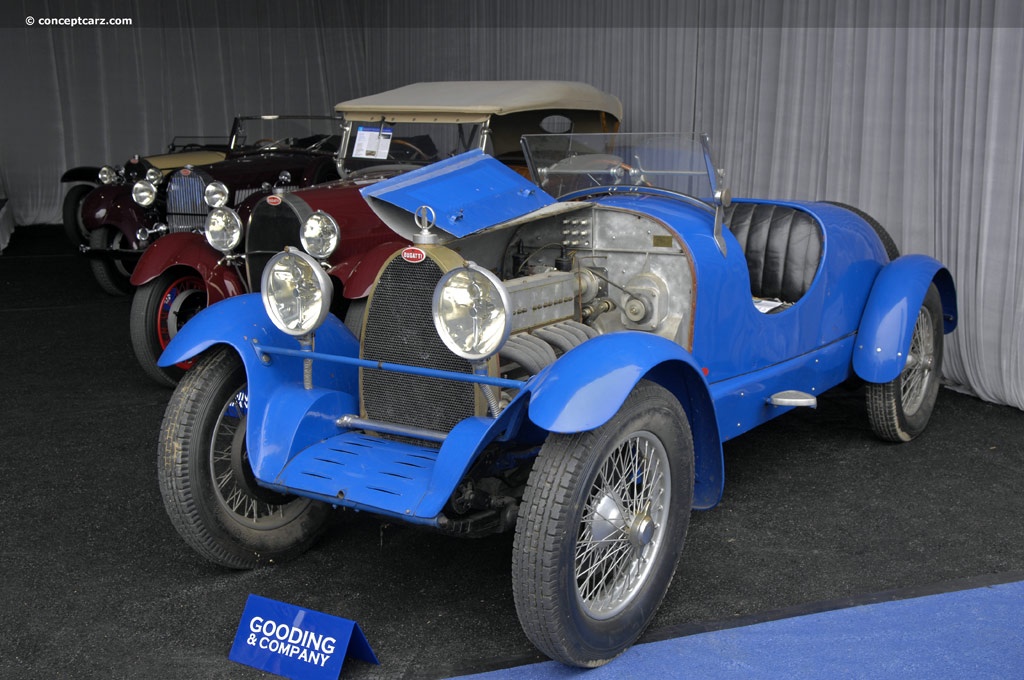
![]() | ![]() | ![]() | Roadster Chassis Num: 38385 Engine Num: 4001 |
| Sold for $198,000 at 2008 Gooding & Company. | |||
This 1927 Bugatti Type 38 Roadster is believed to have been purchased new by Elizabeth and Vincent Junek, the Czech racing couple who exchanged it for their Type 29/30 Strasbourg Grand Prix car. Elizabeth, who had been racing seriously since 1923, was one of the best female drivers in Europe. Her list of accomplishments in the sport included several hill climb victories, a second in the Klaussen climb in 1926, and winning the two-liter class at the Nurburgring.
It is believed that this Type 38 Roadster was used as a reconnaissance car by Elizabeth in the 1928 Targa Florio. It was used to inspect the course and to learn the route. Being fully prepared, she drove her Bugatti Type 35B fifth overall. Her racing career would come to an end a short time later after her husband was killed in a racing accident. After this tragedy, she withdrew from the sport.
It is believed that the car was imported from Prague by Ed Jurist's Vintage Car Store and was acquired by Fred Beddiges and later by Dr. Peter and Susan Williamson.
This car is currently unrestored and finished in blue with black leather interior. It has a pair of SU carburetors, Type 30 radiator, an electric fuel pump, silver-painted wire wheels, Marchal headlights, rear-mounted spare wheel and tire, and a pair of Scintilla tail-lights.
In 2008, this Series E Bearcat was brought to the Gooding & Company auction held in Pebble Beach, CA. It was estimated to sell for $80,000 - $120,000 and offered without reserve. Those estimates were smashed as the lot was sold for $198,000, including buyer's premium.
By Daniel Vaughan | Mar 2009
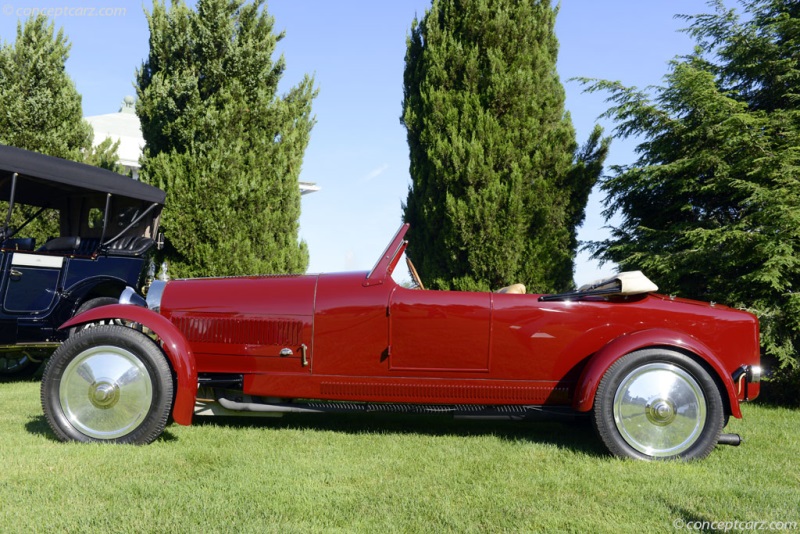
![]() | ![]() | ![]() | Tourer Coachwork: Figoni Chassis Num: 38444 Engine Num: 12 (ex. 38142) |
| Sold for $495,000 at 2012 Gooding & Company. | |||
This 1927 Bugatti Tourer is one of eight Type 38A models that was originally ordered by Bugatti's Paris agency on July 23rd of 1927. It is a unique automobile that features Tourer coachwork fashioned by Joseph Figoni. It is believed that this is one of Figoni's first efforts on a Bugatti chassis and pre-dates his involvement with Ovidio Falaschi years later.
The design features graceful proportions and several distinguishing characteristics such as the polished aluminum body cappings and flowing wings. There is a folding two-pane windscreen and twin rear-mounted spare wheels.
After the work was completed, the car arrived in Paris on September 9th of 1928. The cost to its original owner was approximately 45,000 French francs.
By the 1950s, the car was in the care of Lieut. M. Pornett of Tiresford. At that time, it was registered in Berlin with a British Zone number and described as a Type 38, indicating that the supercharger had been removed.
In 1962, after passing through the care of P.T. McGee and a Mr. Hatfield, the Bugatti entered the possession of Robert Ian Payne of Edinburgh. At some point in the car's history, prior to the acquisition by Mr. Payne, the original engine was substituted with a Type 30 unit, number 360.
In the late 1960s, the car was purchased by Hamish Mofatt who replaced the incorrect engine with an appropriate Type 38 engine, original fitted to chassis number 38142.
In the 1970s, the car was exported to the United States and sold to San Francisco resident Sid Colberg. During his three decades of ownership, it was rarely seen or exhibited at events.
In 2005, the car was sold to a Bugatti and Figoni enthusiast. While in their care, the car was sent to Carrosserie Tessier in France for a sympathetic cosmetic restoration. Tessier had completed much of the work when the owner passed away. During that period in France, Claude Figoni, the son of Joseph Figoni, had the opportunity to examine and admire the unique Bugatti.
The current owner has since completed the restoration. The car is finished in deep aubergine and the interior upholstered in pleated brown leather and matching carpets. There are polished wheel discs, Marchal lamps and body edges capped in aluminum.
The car has its original frame (stamped 37), is equipped with engine number 12, and the engine's assembly number (15) was found on the upper and lower crankcase, confirming them as an original matched pair. It has the correct, larger-diameter brake drums, and its original radiator (produced by G. Moreux & Cie of Paris). The steering box is in the correct location for a late-production Type 38A. The complete original rear axle assembly is suspended on the usual reversed quarter-elliptical springs and the rear spring hangers still retain their original brass Bugatti logos. The body has most of its timber structure and aluminum panels intact.
In 2012, this car was offered for sale at the Gooding & Company auction held in Scottsdale, Arizona. It had a pre-auction estimated value of $500,000 - $650,000. As bidding came to a close, the car had been sold for the sum of $495,000 inclusive of buyer's premium.
By Daniel Vaughan | Jan 2012
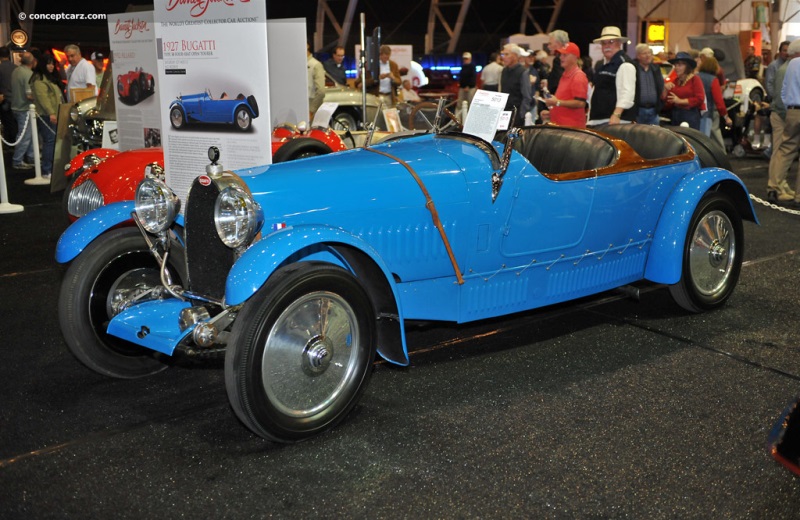
![]() | Touring Car Coachwork: Lavocat and Marsaud Chassis Num: 38243 |
Though the Type 38 was not a competitive Grand Prix racing car, it did share the same 8-cylinder powerplant with wider mountings, gearbox and brakes, as with the Type 35A Grand Prix car.
By Daniel Vaughan | Jan 2013
The Bugatti Type 38 was produced from 1926 through 1927. The Bugatti Type 38 had a straight-eight that displaced two-liters. Performance was further increased with the adoption of a supercharger, making the Type 38A. During its short production lifespan, 385 examples were produced with less than 40 being equipped with superchargers. They were replaced by the Type 43.
In comparison to the vehicles they replaced, the Type 30, the Type 38 sat atop a longer wheelbase with a wider track. The Type 30 was introduced in 1922 and was Bugatti's first eight-cylinder passenger car. The engine was very impressive; it was the first production engine to use the rectangular slab construction that would eventually become a Bugatti trademark. It featured an overhead camshaft, three valves per cylinder and a Brescia transmission.
The eight-cylinder engine was placed into a Type 23 chassis, dubbed the Type 30, would continue until 1926 with total production reaching around 600 units.
The Type 38 were similar to the Type 30 in many ways, however, they rested on a longer wheelbase and had a track that was two inches wider. Large, cable-operated drum brakes showed through the center-lock wire wheels. The suspension comprised of a standard rear Bugatti setup with a solid tubular front axle with slots through which the leaf springs passed.
Under the bonnet lurked a 2-liter, three-valve engine based on the Type 35, though the crankshaft - which was riding on ball bearings - was from the Type 30. The engine breathed through two Solex carburetors. There was coil ignition and a new four-speed manual gearbox which helped send the power to the rear wheels.
In keeping with Bugatti tradition, the cars were built at the Molsheim factory and delivered to coachbuilders as rolling chassis. From their, the artisans would create the elegant bodies for these magnificent vehicles.
By Daniel Vaughan | Apr 2008
For more information and related vehicles, click hereIn comparison to the vehicles they replaced, the Type 30, the Type 38 sat atop a longer wheelbase with a wider track. The Type 30 was introduced in 1922 and was Bugatti's first eight-cylinder passenger car. The engine was very impressive; it was the first production engine to use the rectangular slab construction that would eventually become a Bugatti trademark. It featured an overhead camshaft, three valves per cylinder and a Brescia transmission.
The eight-cylinder engine was placed into a Type 23 chassis, dubbed the Type 30, would continue until 1926 with total production reaching around 600 units.
The Type 38 were similar to the Type 30 in many ways, however, they rested on a longer wheelbase and had a track that was two inches wider. Large, cable-operated drum brakes showed through the center-lock wire wheels. The suspension comprised of a standard rear Bugatti setup with a solid tubular front axle with slots through which the leaf springs passed.
Under the bonnet lurked a 2-liter, three-valve engine based on the Type 35, though the crankshaft - which was riding on ball bearings - was from the Type 30. The engine breathed through two Solex carburetors. There was coil ignition and a new four-speed manual gearbox which helped send the power to the rear wheels.
In keeping with Bugatti tradition, the cars were built at the Molsheim factory and delivered to coachbuilders as rolling chassis. From their, the artisans would create the elegant bodies for these magnificent vehicles.
By Daniel Vaughan | Apr 2008
| Firestone Returns As Presenting Sponsor of RRDC Evening With Brian Redman in Long Beach | |
![]() | The Firestone brand will return as presenting sponsor of the Road Racing Drivers Club's fifth annual West Coast banquet honoring auto racing's most influential leaders. This year, on Thursday, April 18, prior to the running of the Toyota Grand Prix of Long Beach, the 'RRDC Evening with Brian Redman presented by Firestone' will highlight the career of one of the sport's most popular, talented and successful race-car drivers. This is the Firestone brand's fourth straight year as a supporter of the...[Read more...] |
| Sir Stirling Moss Returns To The Amelia Concours | |
![]() | Sir Stirling Moss defined the image of a professional racing driver. By the time premature retirement was forced upon him by a racing accident at Goodwood in 1962, his name meant 'racing driver'. He was every English schoolboy's hero and the inheritor of grand master and Mercedes-Benz teammate Juan Fangio's orb, scepter and crown. In 1996 Sir Stirling was the Amelia Island Concours d'Elegance first Honorary Chairman. The cover of 'The Amelia's' 1996 collector-grade program depict...[Read more...] |
| Magnificent Series of Coachbuilt Classics To Grace RM's Amelia Island Concours D'Elegance Sale | |
![]() | • RM Auctions returns as the official auction house of the Amelia Island Concours d'Elegance, March 9, 2013 • Single-day sale features breathtaking roster of more than 80 investment-quality collector cars • Notable highlights include an outstanding series of coachbuilt classics headlined by a multi-million-dollar 1935 Duesenberg Model SJ Walker-LaGrande Convertible Coupe and a trio of Cords from the personal collection of Jim Fasnacht • Frequently updated list of entries available online at r...[Read more...] |
| 1957 Italian Grand Prix: A True Nobleman Stands Amongst Two of F1's Most Noble | |
![]() | The sea of spectators overwhelming the circuit would be a truly awe-inspiring sight to behold. The vast majority of this horde was there to celebrate the car adorned in red finishing in the top three. The car's driver, a true royal, would stand amongst the crowd as if standing amongst adoring and loving subjects. For the first time in his career, Wolfgang von Trips would be able to count himself amongst the elite of Formula One. Wolfgang von Trips had been born into a noble German family in ...[Read more...] |
| 1958 Moroccan Grand Prix: British All the Way | |
![]() | After years of frustration, and well past his life-expectancy, Mike Hawthorn would be on the verge of his first World Championship. This was more than likely Hawthorn's last and best hope at a World Championship title. Just one last race, and a fellow Brit, would separate Hawthorn from his World Championship. Emotionally, Hawthorn was done. The last few seasons had seen Hawthorn fail to experience anywhere near the level of success he had even in his rookie year of 1952. In 1952, with an unde...[Read more...] |
1927
Bugatti
models |
| Bugatti Type 35B |
| Bugatti Type 35C |
| Bugatti Type 37 |
| Bugatti Type 37A |
| Bugatti Type 39/35B |
| Bugatti Type 40 |
| Bugatti Type 43 |
| Bugatti Type 44 |
| Similar Automakers | |
| Aston Martin | Bentley |
| Devon | Ferrari |
| GTA | Koenigsegg |
| Lamborghini | Lotus |
| Maserati | Maybach |
| McLaren | Porsche |
| Rolls-Royce | Spyker |
| Tesla | |
| Bugatti: 1921-1930 |
| Similar Automakers |
| Bugatti History |
| Other models by Bugatti |
| Manufacturer Website |
| Related Articles and Event Coverage |
| Barrett-Jackson Scottsdale |
| Gooding and Company - The Scottsdale Auction |
| Gooding & Company |
| Gooding & Company |
| 2005 Concours d'Elegance of the Eastern United States |
| 8-Liter EB110 Royale | Type 101 Type 13 Type 23 | Type 35 Type 37 Type 38 | Type 39 and Type 39A Type 40 Type 46 | Type 50 Type 51 Type 55 | Type 57 Type 59 Veyron |
1926 Type 38 |


1926 Type 38


1927