1979 V8 | 1981 V8 ![]() |
1980 Aston Martin V8 Volante news, pictures, and information | ||
| Tweet | ||
![]() | ![]() | ![]() | Convertible Coupe |
By Daniel Vaughan | May 2008
The Aston Martin V8 was produced from 1969 through 1990 and was, of course, powered by an eight-cylinder engine. For many years eager customers had been pleading with Aston Martin to produce an eight-cylinder car. Expected to be completed by 1967, the engine took a few more years of development before being ready. In the mean-time, Aston Martin introduced the DBS which borrowed its Vantage six-cylinder engine from the DB6.
In the 1987 film 'The Living Daylights', famous British Secret Agent James Bond could be seen on the big screen driving around in his V8 Vantage Volante. A few years earlier Roger Moore had driven a DBS V8 in the movie 'The Persuaders.' His car was built to resemble the V8 version but actually powered by a six-cylinder engine.
In 1969 the eight-cylinder engine was ready and successfully adapted to the DBS. The engine had been designed by Aston Martin's head engineer, Tadek Marek. The engine had made an appearance in the Lola T70 LeMans racer but was more of learning and testing experience than a true success. The DBS was now available with either the six- or eight-cylinder engine, with the eight-cylinder version being the more popular. Over the years the 5.3 liter V8 used fitted with either Bosch fuel injection or carburetors, double overhead camshafts and was capable of producing around 300-315 horsepower. Zero-to-sixty took a mere 5.9 seconds with top speed being achieved at 160 mph.
The square-grille, four headlights, and large front air dam was the traditional Aston Martin persona. Gone were the wire wheels.
By 1972 the DBS V8 became the Aston Martin V8; since the six-cylinder DBS was no longer offered. This left the V8 and the Vantage as Aston Martins entire model line.
In 1972 Aston Martin offered the Series II which incorporated minor visual and mechanical changes. The front featured a mesh grille with twin quart headlights while under the hood the engine was given a little extra tuning. Production of the Series II continued until 1973 with just over 285 examples being produced. After the Series II came the Series III which incorporated four twin-choke Weber carburetors and a larger hood scoop. The 310 horsepower engine took the car from zero-to-sixty in 5.7 seconds, when equipped with the manual transmission. Soon strict emission and government regulations sent the performance tumbling. A new exhaust and camshaft helped boost power a little but was still down by about 10 horsepower.
The Series III continued production from 1973 through 1978 except for 1975 when production was temporarily halted. In total over 965 examples were produced. Production had ceased in 1975 due to financial difficulties. A take-over from a consortium in 1975 meant the company could continue producing vehicles. It was decided that instead of creating new models which often consumes large amounts of capital, the company would focus their attention and abilities on fine-tuning the products already in production.
At the Birmingham International Motor Show in 1978, Aston Martin introduced the Series IV, also known as the 'Oscar India.' The hood scoop was replaced with a bulge, and a spoiler could now be found on the rear. On the interior could be found wood trim, not seen on an Aston Martin since the DB2/4 of the 1950's. Most were equipped with Chrysler's Torqueflite 3-speed automatic gearbox. Production continued from 1978 through 1985 with a total of 291 examples being produced.
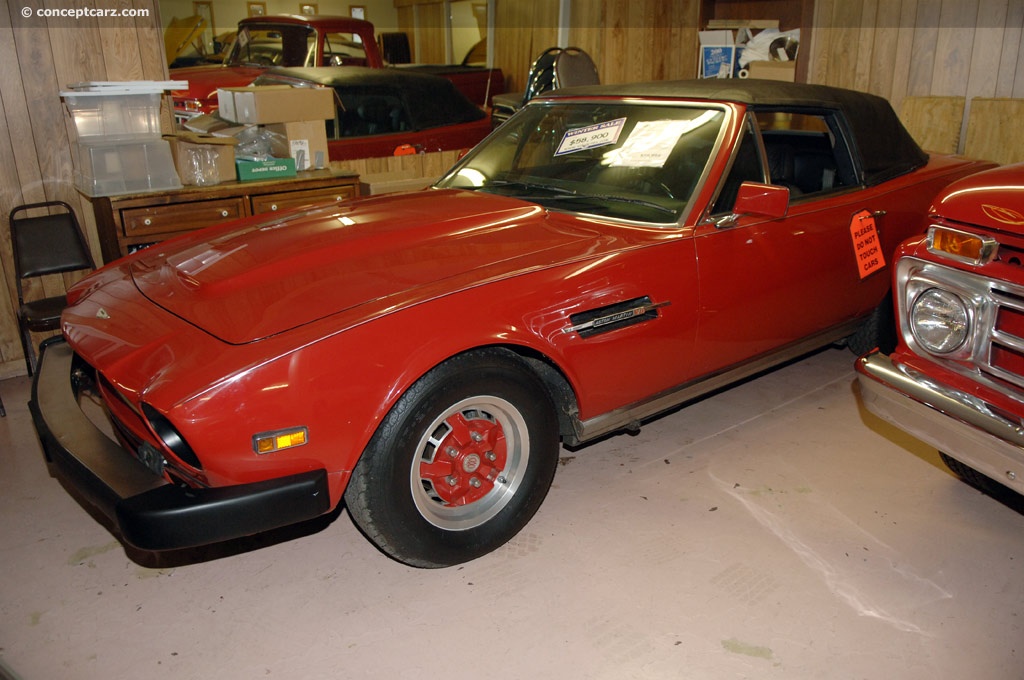
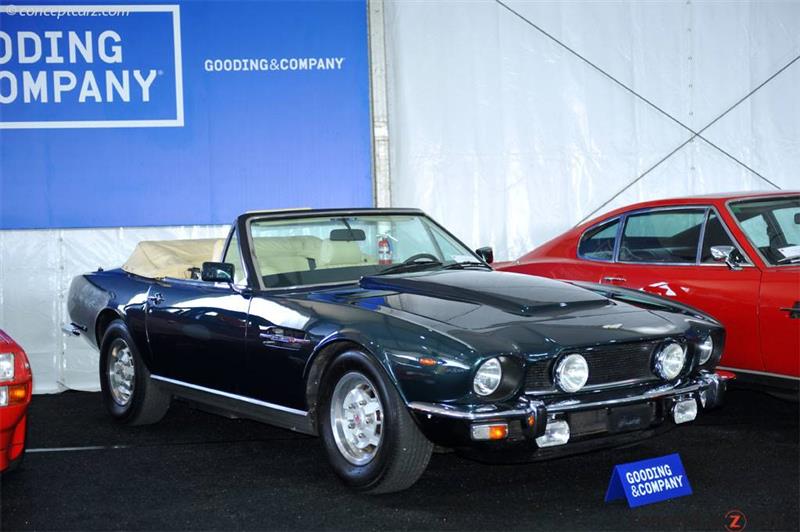
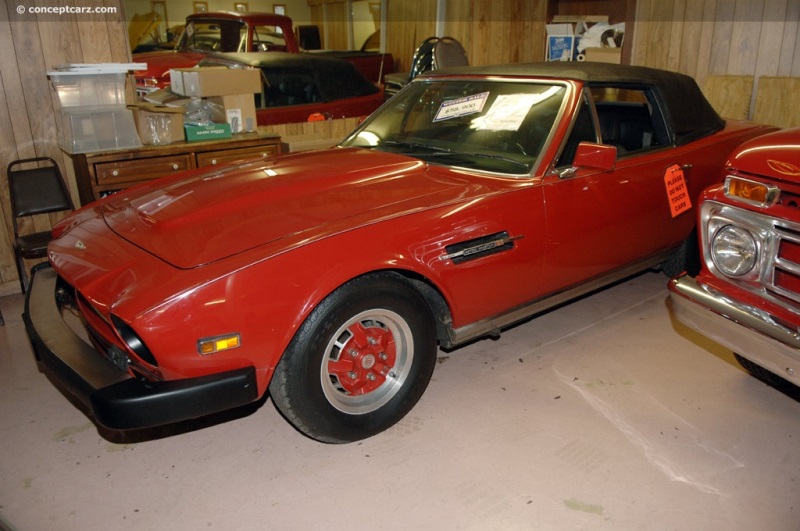
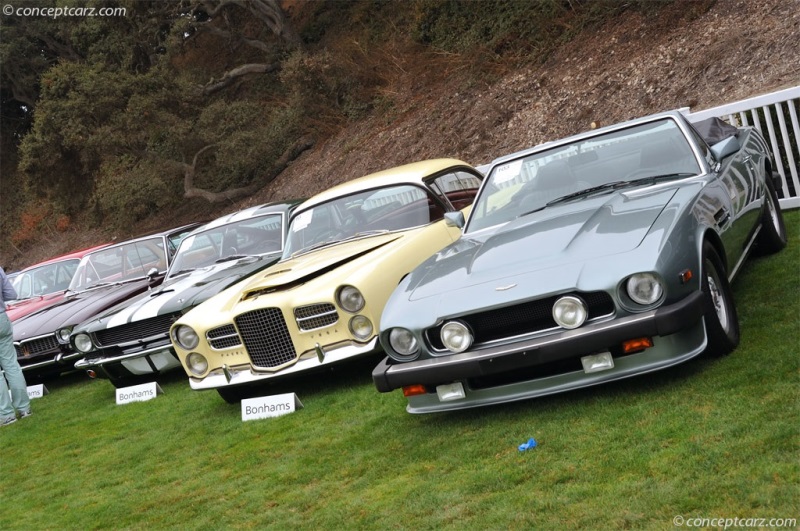
1978 also saw the introduction of the V8 Volante which was a convertible. Though the United States had strict rules concerning safety and convertibles, many of the 650 Volantes produced during the 12 year period made their way State-side.
In 1985 a partnership was formed with the famous Italian coachbuilder Zagato to build a limited edition Zagato bodied version of the V8 Vantage. Sketches were shown to the public at the 1985 Geneva Motorshow with the production version making an appearance a year later. These cars were lighter and smaller with an estimated top speed of around 300 km/h. Though production was limited to only 50 examples, demand was much higher. Even before the cars were produced, the money had already been collected from buyers and the original sticker price had even seen escalation due to the popularity.
Planning always takes a back seat to reality. The car was estimated to have a top speed of 300 km/h but when testing began, the engine proved inadequate to meet the goal. The fuel injection system was replaced with Weber carburetors but this caused a new problem. The hood needed to be enlarged to house the cabs resulting in a design that was not aesthetically pleasing to many customers.
The 'double bubble' roof was Zagato's signature trademark. The aerodynamic body was shorter than its counterpart and weighed 10% less. Handling was considerable better as was the overall performance.
Since the Aston Martin V8 Vantage Zagato was produced in limited numbers many investors purchased the vehicles in hopes of turning a profit. Though the designs are very elegant, the true strength of the car was in its performance; sadly many have not been given the opportunity to prove their potential to their owners.
At the 1986 New York Auto Show, Aston Martin introduced their fuel-injected Series V. Since there were no bulky carburetors, there was no need for the bulge. Production continued until 1989 with around 61 examples being produced.
In 1998 a limited edition version of the Vantage was introduced and dubbed the V600. Outfitted with the 5.3 liter V8 and fitted with dual superchargers, the car was capable of producing an astonishing 600 horsepower. Some of the design cues were taken from the DBR1 LeMans racer that won the 1959 LeMans race. Production was low due to problems with emission regulations. Instead, Aston Martin introduced the V12 Vanquish in 2001.
During the production of the Aston Martin V8, it was hailed by many as Britain's 'super car'. It's eight-cylinder engine was a bold move for the small, low production quantity Aston Martin firm. In the end, it was the right decision and one that carried the company for many years. Its performance was legendary and the design was elegant.
By Daniel Vaughan | Jul 2006
For more information and related vehicles, click hereIn the 1987 film 'The Living Daylights', famous British Secret Agent James Bond could be seen on the big screen driving around in his V8 Vantage Volante. A few years earlier Roger Moore had driven a DBS V8 in the movie 'The Persuaders.' His car was built to resemble the V8 version but actually powered by a six-cylinder engine.
In 1969 the eight-cylinder engine was ready and successfully adapted to the DBS. The engine had been designed by Aston Martin's head engineer, Tadek Marek. The engine had made an appearance in the Lola T70 LeMans racer but was more of learning and testing experience than a true success. The DBS was now available with either the six- or eight-cylinder engine, with the eight-cylinder version being the more popular. Over the years the 5.3 liter V8 used fitted with either Bosch fuel injection or carburetors, double overhead camshafts and was capable of producing around 300-315 horsepower. Zero-to-sixty took a mere 5.9 seconds with top speed being achieved at 160 mph.
The square-grille, four headlights, and large front air dam was the traditional Aston Martin persona. Gone were the wire wheels.
By 1972 the DBS V8 became the Aston Martin V8; since the six-cylinder DBS was no longer offered. This left the V8 and the Vantage as Aston Martins entire model line.
In 1972 Aston Martin offered the Series II which incorporated minor visual and mechanical changes. The front featured a mesh grille with twin quart headlights while under the hood the engine was given a little extra tuning. Production of the Series II continued until 1973 with just over 285 examples being produced. After the Series II came the Series III which incorporated four twin-choke Weber carburetors and a larger hood scoop. The 310 horsepower engine took the car from zero-to-sixty in 5.7 seconds, when equipped with the manual transmission. Soon strict emission and government regulations sent the performance tumbling. A new exhaust and camshaft helped boost power a little but was still down by about 10 horsepower.
The Series III continued production from 1973 through 1978 except for 1975 when production was temporarily halted. In total over 965 examples were produced. Production had ceased in 1975 due to financial difficulties. A take-over from a consortium in 1975 meant the company could continue producing vehicles. It was decided that instead of creating new models which often consumes large amounts of capital, the company would focus their attention and abilities on fine-tuning the products already in production.
At the Birmingham International Motor Show in 1978, Aston Martin introduced the Series IV, also known as the 'Oscar India.' The hood scoop was replaced with a bulge, and a spoiler could now be found on the rear. On the interior could be found wood trim, not seen on an Aston Martin since the DB2/4 of the 1950's. Most were equipped with Chrysler's Torqueflite 3-speed automatic gearbox. Production continued from 1978 through 1985 with a total of 291 examples being produced.
1978 also saw the introduction of the V8 Volante which was a convertible. Though the United States had strict rules concerning safety and convertibles, many of the 650 Volantes produced during the 12 year period made their way State-side.
In 1985 a partnership was formed with the famous Italian coachbuilder Zagato to build a limited edition Zagato bodied version of the V8 Vantage. Sketches were shown to the public at the 1985 Geneva Motorshow with the production version making an appearance a year later. These cars were lighter and smaller with an estimated top speed of around 300 km/h. Though production was limited to only 50 examples, demand was much higher. Even before the cars were produced, the money had already been collected from buyers and the original sticker price had even seen escalation due to the popularity.
Planning always takes a back seat to reality. The car was estimated to have a top speed of 300 km/h but when testing began, the engine proved inadequate to meet the goal. The fuel injection system was replaced with Weber carburetors but this caused a new problem. The hood needed to be enlarged to house the cabs resulting in a design that was not aesthetically pleasing to many customers.
The 'double bubble' roof was Zagato's signature trademark. The aerodynamic body was shorter than its counterpart and weighed 10% less. Handling was considerable better as was the overall performance.
Since the Aston Martin V8 Vantage Zagato was produced in limited numbers many investors purchased the vehicles in hopes of turning a profit. Though the designs are very elegant, the true strength of the car was in its performance; sadly many have not been given the opportunity to prove their potential to their owners.
At the 1986 New York Auto Show, Aston Martin introduced their fuel-injected Series V. Since there were no bulky carburetors, there was no need for the bulge. Production continued until 1989 with around 61 examples being produced.
In 1998 a limited edition version of the Vantage was introduced and dubbed the V600. Outfitted with the 5.3 liter V8 and fitted with dual superchargers, the car was capable of producing an astonishing 600 horsepower. Some of the design cues were taken from the DBR1 LeMans racer that won the 1959 LeMans race. Production was low due to problems with emission regulations. Instead, Aston Martin introduced the V12 Vanquish in 2001.
During the production of the Aston Martin V8, it was hailed by many as Britain's 'super car'. It's eight-cylinder engine was a bold move for the small, low production quantity Aston Martin firm. In the end, it was the right decision and one that carried the company for many years. Its performance was legendary and the design was elegant.
By Daniel Vaughan | Jul 2006
| Steve McQueen Chevrolet Styleline Leads Exciting List of Celebrity Rides At Auctions America's Ford Lauderdale Sale | |
![]() | • Auctions America kicks off its 2013 calendar, March 22 – 24, 2013 in Fort Lauderdale, Florida • Regarded as South Florida's premier collector car auction, multi-day sale expected to feature more than 550 quality collector cars • Star attraction: 1951 Chevrolet Styleline DeLuxe Convertible formerly owned by Steve McQueen to be offered at no reserve • Additional highlights include a diverse assortment of 1950s convertibles from 'The Gauthier Collection', 1967 Dodge Coronet WO23 Hemi Super Sto...[Read more...] |
| Sold! Barrett-Jackson's 5000 Series Generates More Than $29.2 Million In Scottsdale | |
![]() | Original 1966 TV Batmobile Sells for $4.62 Million at The World's Greatest Collector Car Auctions™ and New World Records are Set January 19, 2013 •LOT #5037 The Original Batmobile is the highest selling car at the company's annual Scottsdale Auction •LOT #5019 1947 Talbot-Lago T-26 Grand Sport sets a new world record for the model •LOT #5034 1956 Chrysler Diablo Concept Convertible sets a new world record for Chrysler concept cars Scottsdale, Ariz. (Jan. 20, 2013) – Barr...[Read more...] |
| Barrett-Jackson Breaks Sales And Attendance Records At Its Spectacular 5th Annual Las Vegas Auction | |
![]() | The World's Greatest Collector Car Auctions™ Brings Together Auto Enthusiasts from Near and Far Barrett-Jackson, The World's Greatest Collector Car Auctions™, announced today that it generated more than $23 million in sales of rare, high-end collectible vehicles, exotics, customs, classics and Shelbys during its 5th annual Las Vegas auction. The auction company increased its overall hammer average from 2011, proving that the car market is stronger than ever. Automobilia sales reached m...[Read more...] |
| Historic Aston Martin DB3S Sports Racing Car Joins RM's Monterey Sale | |
![]() | A rare and spectacular 1955 Aston Martin DB3S Sports Racing Car, chassis DB3S/118, is the latest multi-million-dollar entry to join RM's highly anticipated Monterey sale, August 17–18 in California. Noteworthy for its outstanding provenance, rarity, and trendsetting Aston Martin design, the DB3S is widely considered one of the most attractive and elegantly designed sports racing cars of the post war period—a masterpiece of David Brown's vision, executed stunningly in aluminum from the charact...[Read more...] |
| America's Favorite Sports Cars to Pace Belle Isle Grand Prix | |
![]() | •Camaro and Corvette setting sales pace for their segments •Forza Motorsport 4 fans compile 63 million miles in Corvettes and Camaros America's favorite sports cars will lead the return of motorsports to Detroit this weekend, when the Camaro ZL1 paces the Chevrolet Grand-Am 200 at Belle Isle on Saturday, and the Corvette 427 Convertible paces the Chevrolet Indy Grand Prix on Sunday. Both are essentially unchanged production models. 'With Corvette and Camaro, Chevrolet has two of the mos...[Read more...] |
| 1980 Aston Martin Concepts |
| Aston Martin Bulldog Concept |
| Similar Automakers | |
| Bentley | Bugatti |
| Devon | Ferrari |
| GTA | Koenigsegg |
| Lamborghini | Lotus |
| Maserati | Maybach |
| McLaren | Porsche |
| Rolls-Royce | Spyker |
| Tesla | |
| Aston Martin: 1970-1980 |
| Similar Automakers |
| Other models by Aston Martin |
| Related Articles and Event Coverage |
| Greenwich Concours - European Cars |
| Volo Auto Museum |
| 15/98 2 litre C-Type 2-Liter Type A Speed Model Aston V8 | Cygnet DB2 DB3 DB4 | DB5 DB6 DB7 DB9 | DBR1 DBR9 DBS Lagonda | Le Mans Mk II One-77 T-Type | Ulster V12 Vantage Roadster V12 Zagato V8 Vantage | Vanquish Virage |
1979 V8 | 1981 V8 ![]() |


1979 V8