History
Road Racing categories have always been exciting and competitive which often bred many unique and creative racing machines. The 1950s were particularly exciting as road racing specials, kit cars, and modifieds seemed to roam the tracks one circle at a time, turning heads and winning trophies. The European cars were dominant for a while, then lightweight specials powered by American muscle began to turn the tides. Mainstream manufacturers such as Ford and Chevrolet found their nitch with the Cobra's and the Corvettes. The modified Corvette's had been highly competitive in the SCCA production until the big three American Companies agreed not to race during the close of the 1950s which meant there were not Works teams. Loopholes in the agreement were exploited, and Ford was able to make sure appropriate funding made it to the Shelby Cobra project, unofficially of course.
Bill Thomas approached General Motors with a similar proposal, requesting funding to build a series of modified vehicles based on Corvette components that could be worthy contenders of the might Cobra. The proposal was accepted and the 'Cheetah' was born.
SCCA Competition had homologation requirements for various classes and categories of racing; the category where the Cobra ran required at least 100 examples to be created before it could qualify for racing. As the beginning of the 1964 season came into sight, Thomas had nowhere near that many and had to race in the specials class which pitted his front-engined machine against some very highly-developed mid-engined race cars.
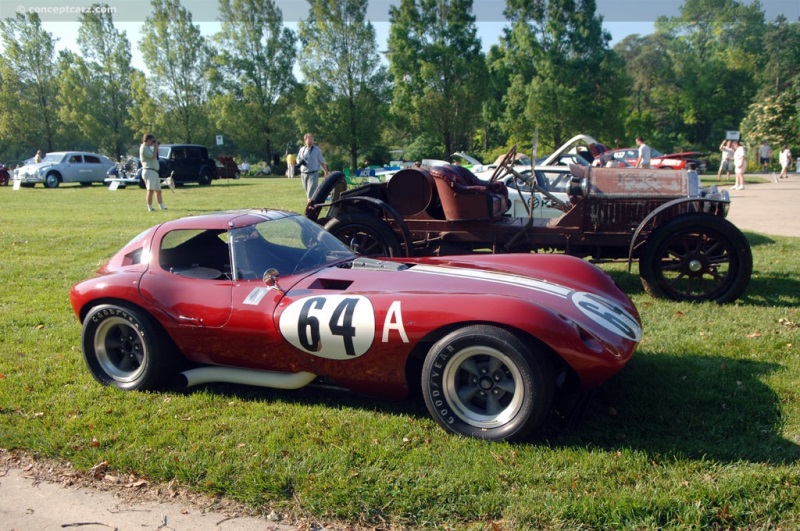
The Cheetah had a tubular spaceframe chassis and was powered by a Corvette V8 small-block engine bored out to over 6 liters. Thomas was restricted to only Corvette parts, so all components were stock or modified Corvette materials. The Cheetah had a tuned-version of the Rochester fuel-injection system which helped produce over 475 horsepower. The positioning of the engine was done to improve performance; it sat very far back in the engine bay resulting in the driver compartment moving rearward. The engine was mated to a Borg-Warner T-10 four-speed gearbox and sent the power to the rear wheels. The rear wheels were mere inches behind the driver. Corvette drum brakes were placed on all four corners, which would prove unable to handle the massive amounts of power produced by the engine. The entire package was clothed in a lightweight aluminum hand-formed Coupe body featuring exotic gullwing doors.
Theory never guarantees success. After much planning, building, tuning, and modifying, the Cheetah was brought to the track. Its performance was less than adequate and disappointing. Teething problems are to be expected from any new race car, but some are just too difficult to overcome. The doors blew off the vehicle while at speed, its brakes were inadequate, and the cockpit had poor ventilation making it unbearably hot for the driver. The heat problem was solved for at least one car whose top was cut off. The first year proved to be a valuable learning experience.
SCCA regulations were changed for the 1965 season, now requiring a minimum of 1000 cars to race in the GT category. This would be very difficult, if not impossible, target to achieve, especially considering Thomas' factory had been damaged in a fire. Thomas had no recourse except to terminate the project.
Around ten examples of the Cheetah were ever produced, with only eight making it to modern times. Many of the remaining cars are still used in historic competition.
By Daniel Vaughan | Jun 2008
Bill Thomas approached General Motors with a similar proposal, requesting funding to build a series of modified vehicles based on Corvette components that could be worthy contenders of the might Cobra. The proposal was accepted and the 'Cheetah' was born.
SCCA Competition had homologation requirements for various classes and categories of racing; the category where the Cobra ran required at least 100 examples to be created before it could qualify for racing. As the beginning of the 1964 season came into sight, Thomas had nowhere near that many and had to race in the specials class which pitted his front-engined machine against some very highly-developed mid-engined race cars.
The Cheetah had a tubular spaceframe chassis and was powered by a Corvette V8 small-block engine bored out to over 6 liters. Thomas was restricted to only Corvette parts, so all components were stock or modified Corvette materials. The Cheetah had a tuned-version of the Rochester fuel-injection system which helped produce over 475 horsepower. The positioning of the engine was done to improve performance; it sat very far back in the engine bay resulting in the driver compartment moving rearward. The engine was mated to a Borg-Warner T-10 four-speed gearbox and sent the power to the rear wheels. The rear wheels were mere inches behind the driver. Corvette drum brakes were placed on all four corners, which would prove unable to handle the massive amounts of power produced by the engine. The entire package was clothed in a lightweight aluminum hand-formed Coupe body featuring exotic gullwing doors.
Theory never guarantees success. After much planning, building, tuning, and modifying, the Cheetah was brought to the track. Its performance was less than adequate and disappointing. Teething problems are to be expected from any new race car, but some are just too difficult to overcome. The doors blew off the vehicle while at speed, its brakes were inadequate, and the cockpit had poor ventilation making it unbearably hot for the driver. The heat problem was solved for at least one car whose top was cut off. The first year proved to be a valuable learning experience.
SCCA regulations were changed for the 1965 season, now requiring a minimum of 1000 cars to race in the GT category. This would be very difficult, if not impossible, target to achieve, especially considering Thomas' factory had been damaged in a fire. Thomas had no recourse except to terminate the project.
Around ten examples of the Cheetah were ever produced, with only eight making it to modern times. Many of the remaining cars are still used in historic competition.
By Daniel Vaughan | Jun 2008


1963 Cheetah Coupe Vehicle Profiles
Recent Vehicle Additions


Related Automotive News

SCCA JUNE SPRINTS RETURN TO ROAD AMERICA
LOCAL RACERS ARE NOT IN IT FOR THE MONEY AS THE WEATHERTECH® CHICAGO REGION SCCA JUNE SPRINTS® RETURN TO ROAD AMERICA
ELKHART LAKE, Wis., June 10, 2013 - The tradition for many local SCCA racers around this time of year is something li...

Chase Elliot, Ryan Blaney File Entries For Arca's Debut At Road America
ELKHART LAKE, Wis., June 6, 2013 - The first annual SCOTT® 160 at Road America is already attracting an interesting mix of rookies and veterans vying for supremacy on the renowned 14-turn, 4-mile road course in Elkhart Lake, Wisconsin.
The event...
Mazda Racers Salute Their Number One Supporter: Mom
May 9, 2013 (IRVINE, Calif.) When racers talk about the need to have the complete package to win – balanced chassis, powerful and reliable powertrain, great tires, a brilliant engineer, perfect pitstops by a tireless crew, and a mega-budget,...
Oshkosh Office Systems Named Official Office Equipment Provider For Road America
ELKHART LAKE, Wis., May 8, 2013 - Road America announced today that Oshkosh Office Systems is now the facilitys Official Office Equipment Provider. Oshkosh Office Systems is one of the oldest authorized five-star Ricoh dealers in Wisconsin providing...

Road America Welcomes Racers And Fans For The SVRA Spring Vintage Weekend
ELKHART LAKE, Wis., (May 7, 2013) - You know that spring has arrived when the Sportscar Vintage Racing Association (SVRA) starts their engines for the annual Spring Vintage Weekend at Road America, May 17-19. With radical elevation changes, tree-lined...