1927 Bugatti Type 39/35B
1927 Bugatti Type 39/35B Navigation
History
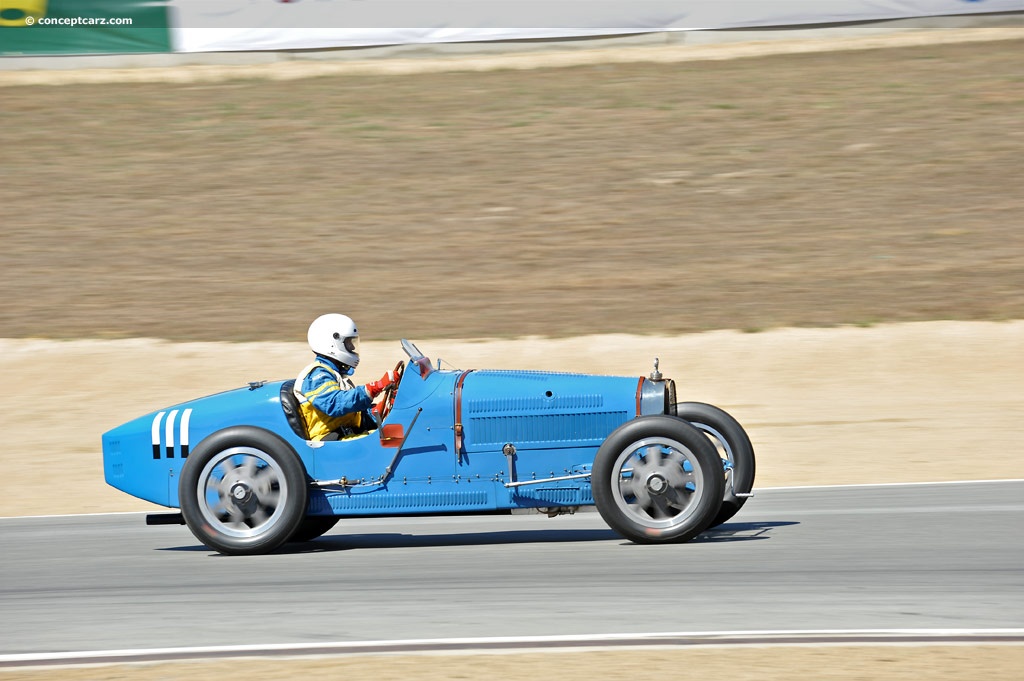
Although it is personal preference, the Bugatti Type 35 is regarded by many as one of the most beautiful pre-war racer from the legendary Bugatti Company. Its beauty is matched by its accomplishments, being one of the most successful pre-war racer winning over 1000 races and capturing the 1926 Grand Prix World Championship with 351 races. During that two-year period, it also claimed 47 records. From 1925 through 1929, the Bugatti Type 35 dominated the Targa Florio.
The first Bugatti Type 35 was introduced on August 3rd, 1924. It was powered by a modified engine used in the Type 29. The 3-valve 2-liter overhead cam straight-eight engine had five main bearings and produced around 90 horsepower. The suspension was comprised of leaf springs attached to solid axles. Stopping power was provided by drum brakes in the rear operated by cables which could be seen on the exterior of the vehicle. In total, there were 96 examples produced.
There were multiple versions of the Type 35 which were specifically designed to accommodate many types of racers. The Type 35A, nicknamed 'Tecla' was an inexpensive version of the Type 35 and made its first appearance in May of 1925. Its nickname was given by the public after a maker of imitation jewelry. The engine was a reliable unit borrowed from the Type 30. It used three bearings, had smaller valves, coil ignition, and produced less horsepower than its Type 35 sibling. In total, 139 examples of the Type 35A were created.
Though Ettore Bugatti favored naturally aspirated engines, the Type 35C was given a Roots-Type supercharger which boosted power to an impressive 128 horsepower. Only fifty examples were created, with many providing historic victories for the company. The Type 35C won the 1928 and 1930 French Grand Prix, undoubtedly their greatest accomplishments.
The Bugatti Type 35T, commonly known as the Targa Florio, was specially prepared for the Targa Florio race. There were only thirteen examples produced. It was powered by a 2.3-liter engine. When Grand Prix rules changed, stating that engine displacement sizes of up to 2 liters were required, the Type 35T became obsolete and production ceased.
The Bugatti Type 35B was introduced in 1927 and was the final iteration of the Type 35 series. The name Type 35TC was pondered since it shared the same 2.3-liter engine as the Type 35T and a supercharger like the Type 35C. The engine produced an astonishing 138 horsepower, by far the most of the Type 35 series. In total, there were only 45 examples produced, with one of their greatest accomplishments being the victory at the 1929 French Grand Prix.
The Bugatti Type 39 was produced alongside the Type 35B but adhered to current Grand Prix regulations which limited engine capacities to 1.5 liters. Only ten examples of the Type 39 were produced.
By Daniel Vaughan | May 2011
The first Bugatti Type 35 was introduced on August 3rd, 1924. It was powered by a modified engine used in the Type 29. The 3-valve 2-liter overhead cam straight-eight engine had five main bearings and produced around 90 horsepower. The suspension was comprised of leaf springs attached to solid axles. Stopping power was provided by drum brakes in the rear operated by cables which could be seen on the exterior of the vehicle. In total, there were 96 examples produced.
There were multiple versions of the Type 35 which were specifically designed to accommodate many types of racers. The Type 35A, nicknamed 'Tecla' was an inexpensive version of the Type 35 and made its first appearance in May of 1925. Its nickname was given by the public after a maker of imitation jewelry. The engine was a reliable unit borrowed from the Type 30. It used three bearings, had smaller valves, coil ignition, and produced less horsepower than its Type 35 sibling. In total, 139 examples of the Type 35A were created.
Though Ettore Bugatti favored naturally aspirated engines, the Type 35C was given a Roots-Type supercharger which boosted power to an impressive 128 horsepower. Only fifty examples were created, with many providing historic victories for the company. The Type 35C won the 1928 and 1930 French Grand Prix, undoubtedly their greatest accomplishments.
The Bugatti Type 35T, commonly known as the Targa Florio, was specially prepared for the Targa Florio race. There were only thirteen examples produced. It was powered by a 2.3-liter engine. When Grand Prix rules changed, stating that engine displacement sizes of up to 2 liters were required, the Type 35T became obsolete and production ceased.
The Bugatti Type 35B was introduced in 1927 and was the final iteration of the Type 35 series. The name Type 35TC was pondered since it shared the same 2.3-liter engine as the Type 35T and a supercharger like the Type 35C. The engine produced an astonishing 138 horsepower, by far the most of the Type 35 series. In total, there were only 45 examples produced, with one of their greatest accomplishments being the victory at the 1929 French Grand Prix.
The Bugatti Type 39 was produced alongside the Type 35B but adhered to current Grand Prix regulations which limited engine capacities to 1.5 liters. Only ten examples of the Type 39 were produced.
By Daniel Vaughan | May 2011
- 1927 Bugatti Type 39/35B Menu
- Article
- Image gallery
- Specifications
- Profiles
Bugatti
Similar Automakers
Similarly Sized Vehicles
from 1927


1927 Bugatti Type 39/35B Vehicle Profiles

Recent Vehicle Additions


Related Automotive News

1982 Austrian Grand Prix: de Angelis Flying Through the Thin Air
It is almost impossible to predict events and just how momentous they just might be. This would certainly be the case with the 1982 Austrian Grand Prix, a truly special and memorable moment in Formula One history.
Heading into the Austrian Grand Prix...

NISMO Heritage: A History of Maverick Engineering in Motorsports and Attainable Performance
CHICAGO - NISMO. Five letters taken from the words NISsan MOtorsports. Known around the world racing fraternity for nearly 50 years. Passionately embraced by grassroots Datsun and Nissan club racers and electronic race gamers alike. With the addition...

1962 Monaco Grand Prix: McLaren Carries the Cooper Flag back to the Top
By the beginning of the 1962 Formula One season Jack Brabham had left Cooper to form his own racing team. It seemed the glories days of the double World Championship were well and truly behind them. However, left in Brabhams stead would be a man very...

TMC Launches Redesigned Corolla Series in Japan
Toyota Motor Corporation (TMC) announces the launch in Japan today of the redesigned Corolla Axio sedan and Corolla Fielder*1 station wagon. The vehicles will be sold across Japan through Toyota Corolla dealers.
Since its debut in 1966, the...

1956 24 Hours of Le Mans: The Rise of Two Counts
The 1955 24 Hours of Le Mans would end up being the darkest day in all of motorsport when Pierre Levegh launched off the back of Lance Macklins Austin-Healey and crashed into a barrier sending large portions of the car flying through the air acting...