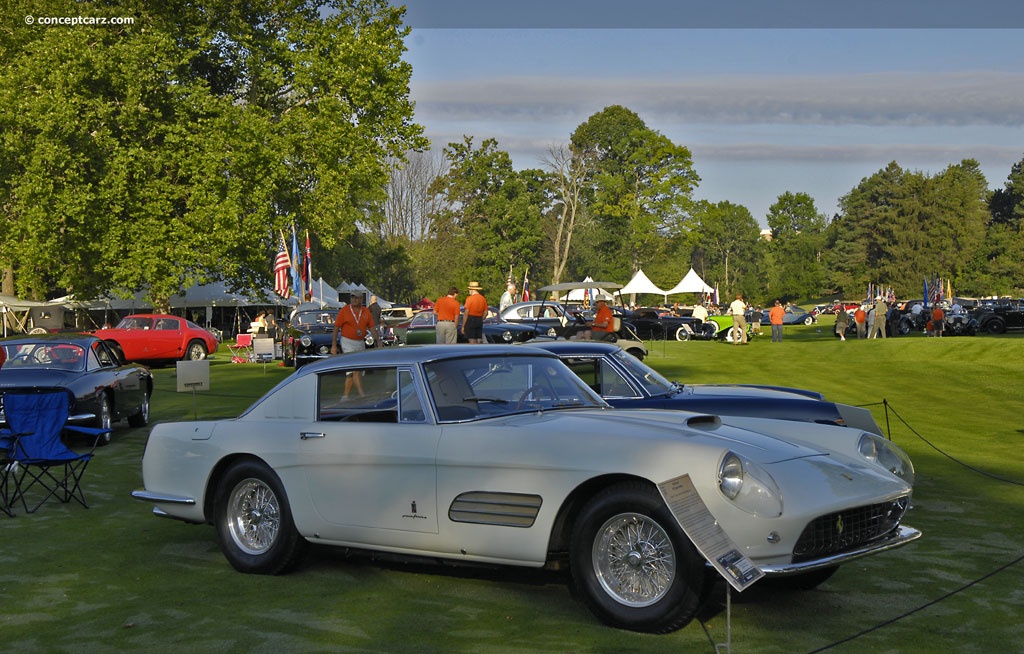
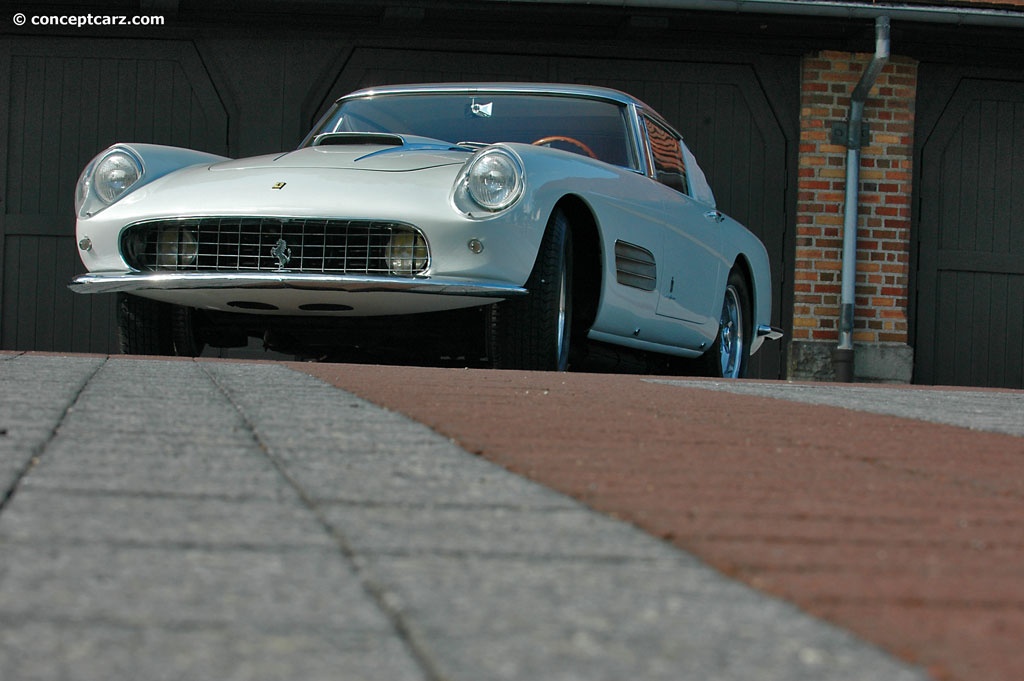
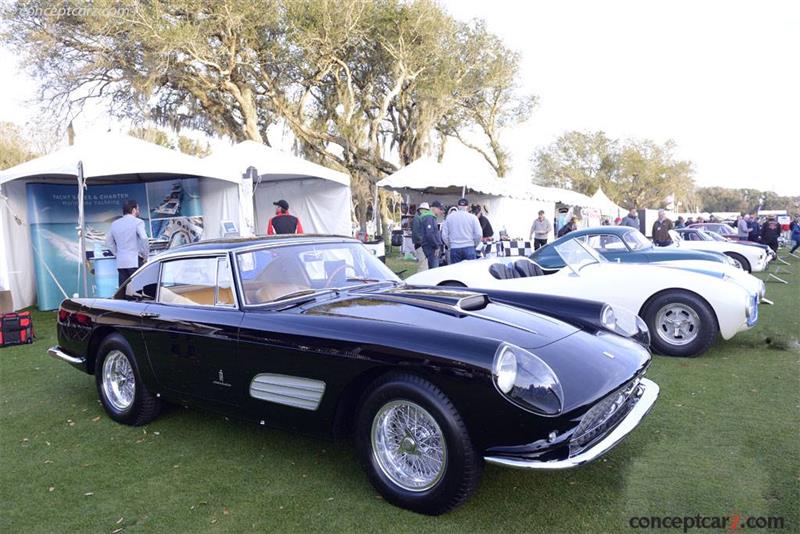
1958 410 Superamerica |
1959 Ferrari 410 Superamerica news, pictures, and information | ||
| Tweet | ||
![]() | ![]() | ![]() | Coupe Coachwork: Pininfarina |
As if the custom, low-volume America was not fast enough, Ferrari produced another line of America cars, beginning with the 1955 410 Super America. The engine was now up to 5.0-liters with 340 horsepower (254 kW) available. A 1957 Super America III had triple Weber carburetors for even more power.
Each 410 Super America had custom bodywork, with a few by Ghia but most by Ferrari stalwart, Pinin Farina. The price was extremely high : US $16,800. The 410 Super America offered at the New York Auto Show by importer Luigi Chinetti was more than twice as expensive as the Mercedes-Benz 300SL 'Gullwing' exhibited by Max Hoffman. Just a few (14 to 35) were built when the series ended in 1959.
Most of the Pinin Farina cars shared similar lines, however a small group were extremely unique and celebrated their own style. The most notorious of these was the individually-titled 410 Superfast which sported prominent tail fins like the American cars of the era.
During the mid-1950s, Ferrari's 250GT production became standardized with the Boano, Ellena and Pinin Farmin coupes. Ferrari, about a decade old at this point in history, had accomplished and achieved racing success and fostered an exclusive list of clientele. They had experimented with a wide range of engines including fours, sixes, and even the two-cylinder Grand Prix engine. During this experimentation which included the first Ferrari V6 and V8 engines, Ferrari gained the knowledge and solidified designs that would carry them through the next decade of racing. Those designs would even find their way to their road-going vehicles.
While Ferrari's racing program and 250 GT production were becoming well established, they wanted to continue their legacy of exclusive, limited production, and handcrafted line of vehicles. In 1954, this would become manifested in the 410 Superamerica.
The Ferrari 410 Superamerica was a continuation of the Lampredi-powered 375 America. The engine was enlarged to 4963cc resulting in 340 horsepower. The 375 America displaced 4,522cc and produced 300 horsepower. Modifications continued throughout the vehicle, including an increase in track width by 130 mm at both the front ad rear. The transverse leaf springs in the front were replaced with coil springs. These changes gave it a wider stance with a more modern appearance and better stability at speed.
Most of the 410 Superameria chassis's were clothed by Pini Farina. Only four examples were bodied by other artesian, with Sergio Scaglietti performing his craft on one, chassis number 0671 SA. The Scaglietti body was created for Dottore Enrico Wax, the principal in the Genoese firm of Wax & Vitale whose business was in importing.
Scaglietti's relationship with Ferrari began with the 500 Mondial and would continue throughout the years, with one of their more-memorable designs being the 500 TRC. Currently, Scaglietti is owned by Ferrari SEFAC and is the bodywork production facility for all Ferrari road cars.
By Daniel Vaughan | Aug 2008
While Ferrari's racing program and 250 GT production were becoming well established, they wanted to continue their legacy of exclusive, limited production, and handcrafted line of vehicles. In 1954, this would become manifested in the 410 Superamerica.
The Ferrari 410 Superamerica was a continuation of the Lampredi-powered 375 America. The engine was enlarged to 4963cc resulting in 340 horsepower. The 375 America displaced 4,522cc and produced 300 horsepower. Modifications continued throughout the vehicle, including an increase in track width by 130 mm at both the front ad rear. The transverse leaf springs in the front were replaced with coil springs. These changes gave it a wider stance with a more modern appearance and better stability at speed.
Most of the 410 Superameria chassis's were clothed by Pini Farina. Only four examples were bodied by other artesian, with Sergio Scaglietti performing his craft on one, chassis number 0671 SA. The Scaglietti body was created for Dottore Enrico Wax, the principal in the Genoese firm of Wax & Vitale whose business was in importing.
Scaglietti's relationship with Ferrari began with the 500 Mondial and would continue throughout the years, with one of their more-memorable designs being the 500 TRC. Currently, Scaglietti is owned by Ferrari SEFAC and is the bodywork production facility for all Ferrari road cars.
By Daniel Vaughan | Aug 2008
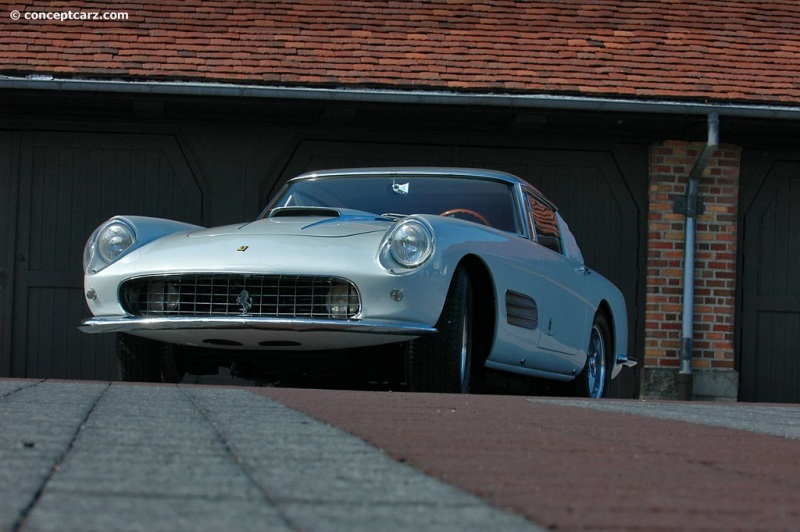
![]() | ![]() | ![]() | Coupe Coachwork: Pininfarina Chassis Num: 1323SA |
| Sold for $1,760,000 at 2010 RM Auctions. | |||
The car was completed on July 8th of 1959. The car was sold through Chinetti Motors to its first owner Gill Brothers, a resident of Rhinelander, New York. The second owner, Henry Desormea of Latham, New York, took possession of the car in 1963. He would retina the car until 1975 when it was sold to Jim Haynes of Lime Rock, Connecticut. In 1979, it passed through Bill Kontes and eventually to Hilary A. Raab, Jr. of Crown Point, Indiana. Raab would keep the car until 1998, when it was sold to Luigi Chinetti Jr. of Connecticut.
In 2004, the car was sold to William Grimsley of Sausalito, California. On October 23rd, 2007, Grimsley sold 1323 SA to Robert Harris of Logan, Utah. The current owner acquired the car in 2008.
In 2010, this car was offered for sale at the Sports & Classics of Monterey offered by RM Auctions. It was estimated to sell for $1,600,000 - $2,200,000. As bidding came to a close, the car had been sold for the sum of $1,760,000, inclusive of buyer's premium.
By Daniel Vaughan | Dec 2010
![]() | ![]() | ![]() | Coupe Coachwork: Pininfarina Chassis Num: 1449SA |
An ultra-rare, extremely expensive, very fast vehicle, the Superamerica featured a low grille opening and covered headlights. With a long sloping rear deck combine with the double curvature of the windshield and rear window, the car had a taut, muscular look in keeping with its performance capability. Built as if for a king, the inside of the Ferrari 400 Superamerica features a lavish interior with thickly bolstered seats and sumptuous Italian hides.
Introduced in 1959, the Ferrari 400 Superamerica featured a Colombo V12 that displaced 3,967 cc. A first for Ferrari road vehicles, the Superamerica also boasted disc brakes. Only 47 units in two series, short and long wheelbase were ever constructed during the Superamerica's five-year production run.
Built to order, the vehicles featured a very demanding clientele that had the option of a wide choice of finishing details on their cars. The Superamerica was built only according to the specifications of the individual. An entirely European concept, the vehicle was a kind of luxury item that only few could afford. In accordance, no two Ferrari 400 Superamerica vehicles are ever exactly alike. These vehicles have been produced for elite owners such as Aga Khan, Gianni Agnelli, Enzo Ferrari and Nelson Rochefeller.
One of the rarest examples of the Ferrari 400 Superamerica is the 5029 SA, the Series II long-wheelbase, which was delivered new in Italy. Finished in elegant silver gray; Grigio Argento, with an exquisite red leather interior. Sold in 1998 in Switzerland, the 5029 SA was restored fully by some of the most respected European specialists.
Still recovering from World War II during the late 1940s and early 1950's, while Europe struggled with the scarcity of fuel, cash, and raw materials, Enzo Ferrari sensed that there was a market for a high-powered GT. The 340 America was introduced in 1950 as the first attempt to put a powerful Lampredi V12 engine in a Ferrari GT. Trying to associate the name with America's ‘bigger is better' culture, Ferrari also sought to make the Americans aware of this new Italian marque.
Popular hits, the 340, 342 and 375 America's were featured in an assortment of beautiful bodies from Italy's most talented carrozezrias, and powered by Ferrari's legendary Lampredi engines. The Ferrari's 250 series had changed the company from a manufacturer of short runs of rapidly evolving models to a series-production-based manufacturer by the mid 1950's. Feeling that it was time to move up-market, Enzo Ferrari moved on to produce a GT model that would satisfy his most demanding and affluent customers. This new model would share a common drivetrain and chassis, but would allow the customers the discretion in the choice of features, tune and coachwork. A step above the previous ‘America', this new model was aptly called the Superamerica.
The 410 Superamerica debuted in 1956 following the ‘more power is better' theme of the earlier ‘America's, while featuring a near-5-liter Lampredi V12 and offered in tuning levels up to 400 horsepower. Reportedly able to spin the rear wheels in third gear, a total of around 35 examples were produced in vastly different configurations as both cabriolets and coupes.
Following the 410, the 400 Superamerica was an impressive automobile, but unfortunately fell short of the 410. The refined Colombo-designed V12 was a more reliable and less expensive alternative to the Lampredi, and a 4-liter version of the Colombo engine was developed for the 400 Superamerica. Rated at 340 horsepower, the new V12 was sadly 60 less than the very powerful 410 engine.
On the other hand, the coachwork options were more impressive. An impressive array of coupe and cabriolet models in both LWB and SWB variations were commissioned, and four show cars called Superfast I, II, III and IV were produced during the 410/400 Superamerica's production run. Featuring Superamerica mechanicals and are apart of the Superamerica family, they are classified by their Superfast chassis number.
The 500 Superfast was introduced in 1964 as the newest car to the ‘America' series and followed the ultra-premium ‘America' theme, though only offered with one engine and body configuration. A total of 36 500 Superfast models were produced.By Jessica Donaldson
Introduced in 1959, the Ferrari 400 Superamerica featured a Colombo V12 that displaced 3,967 cc. A first for Ferrari road vehicles, the Superamerica also boasted disc brakes. Only 47 units in two series, short and long wheelbase were ever constructed during the Superamerica's five-year production run.
Built to order, the vehicles featured a very demanding clientele that had the option of a wide choice of finishing details on their cars. The Superamerica was built only according to the specifications of the individual. An entirely European concept, the vehicle was a kind of luxury item that only few could afford. In accordance, no two Ferrari 400 Superamerica vehicles are ever exactly alike. These vehicles have been produced for elite owners such as Aga Khan, Gianni Agnelli, Enzo Ferrari and Nelson Rochefeller.
One of the rarest examples of the Ferrari 400 Superamerica is the 5029 SA, the Series II long-wheelbase, which was delivered new in Italy. Finished in elegant silver gray; Grigio Argento, with an exquisite red leather interior. Sold in 1998 in Switzerland, the 5029 SA was restored fully by some of the most respected European specialists.
Still recovering from World War II during the late 1940s and early 1950's, while Europe struggled with the scarcity of fuel, cash, and raw materials, Enzo Ferrari sensed that there was a market for a high-powered GT. The 340 America was introduced in 1950 as the first attempt to put a powerful Lampredi V12 engine in a Ferrari GT. Trying to associate the name with America's ‘bigger is better' culture, Ferrari also sought to make the Americans aware of this new Italian marque.
Popular hits, the 340, 342 and 375 America's were featured in an assortment of beautiful bodies from Italy's most talented carrozezrias, and powered by Ferrari's legendary Lampredi engines. The Ferrari's 250 series had changed the company from a manufacturer of short runs of rapidly evolving models to a series-production-based manufacturer by the mid 1950's. Feeling that it was time to move up-market, Enzo Ferrari moved on to produce a GT model that would satisfy his most demanding and affluent customers. This new model would share a common drivetrain and chassis, but would allow the customers the discretion in the choice of features, tune and coachwork. A step above the previous ‘America', this new model was aptly called the Superamerica.
The 410 Superamerica debuted in 1956 following the ‘more power is better' theme of the earlier ‘America's, while featuring a near-5-liter Lampredi V12 and offered in tuning levels up to 400 horsepower. Reportedly able to spin the rear wheels in third gear, a total of around 35 examples were produced in vastly different configurations as both cabriolets and coupes.
Following the 410, the 400 Superamerica was an impressive automobile, but unfortunately fell short of the 410. The refined Colombo-designed V12 was a more reliable and less expensive alternative to the Lampredi, and a 4-liter version of the Colombo engine was developed for the 400 Superamerica. Rated at 340 horsepower, the new V12 was sadly 60 less than the very powerful 410 engine.
On the other hand, the coachwork options were more impressive. An impressive array of coupe and cabriolet models in both LWB and SWB variations were commissioned, and four show cars called Superfast I, II, III and IV were produced during the 410/400 Superamerica's production run. Featuring Superamerica mechanicals and are apart of the Superamerica family, they are classified by their Superfast chassis number.
The 500 Superfast was introduced in 1964 as the newest car to the ‘America' series and followed the ultra-premium ‘America' theme, though only offered with one engine and body configuration. A total of 36 500 Superfast models were produced.By Jessica Donaldson
In 1955, Enzo Ferrari displayed a polished chassis #0423 SA at the Paris Salon. The completed version of the 410, crafted by the Italian coachbuilder Pinin Farina, was displayed at the Brussels Salon in January of 1956. As was the style of Ferrari, many variations of this vehicle were built. This is due to the fact that Ferrari used different coachbuilders during the vehicles assembly. Coachbuilders such as Boano, Ghia, and Scaglietti produced versions such as the Testa Rossa, Series I, II and III, and Superfast. This included Coupes and cabriolet versions. Mario Boano produced two, one by Ghia, one by Scaglietti, and the remaining thirty were by Pinin Farina.
The 410 came as a replacement for the 375 America. There were three series for this model but only a total of 38 were produced from 1956-1959.
Although similar to some of the earlier models produced by Ferrari, this one had a few styling changes. The 410 featured side vents located behind the front wheels. These have become a signature of the Superamerica series.
The 410 was given a larger engine and bigger brakes. Coil spring suspensions were used in the front. As with most of the Ferrari's from this era, Pinin Farina produced most of the bodies. From 1956-1958, a 110.2 inch wheelbase was used. In 1958 the size of the wheelbase was decreased to 102.3.
A Colombo engine provided the muscle for the GT version. It featured a 60-degree, single-overhead-cam, 'vee' type 12-cylinder, with aluminum alloy block and heads and cast-iron cylinder liners. The power produced by this engine was in the 220-260 hp range. The 410 SuperAmeria had a 60-degree, single-overhead-cam, 'vee' type 12-cylinder, with aluminum alloy block and heads. It was produced by Lambredi. The horsepower was significantly greater. The Series I had 340 horsepower, the Series II had 360 hp, and the Series III had 400 hp. Depending on the series of the vehicle, three or six Weber two-barrel carburetors were used.
The 410 models were heavy, powerful, elegant, and luxurious automobiles that could race from zero-to-sixty in under six seconds. These cars were well suited for the American market and were never really put into serious production, with about one being produced per month during its production lifespan.
By Daniel Vaughan | Aug 2008
The 410 came as a replacement for the 375 America. There were three series for this model but only a total of 38 were produced from 1956-1959.
Although similar to some of the earlier models produced by Ferrari, this one had a few styling changes. The 410 featured side vents located behind the front wheels. These have become a signature of the Superamerica series.
The 410 was given a larger engine and bigger brakes. Coil spring suspensions were used in the front. As with most of the Ferrari's from this era, Pinin Farina produced most of the bodies. From 1956-1958, a 110.2 inch wheelbase was used. In 1958 the size of the wheelbase was decreased to 102.3.
A Colombo engine provided the muscle for the GT version. It featured a 60-degree, single-overhead-cam, 'vee' type 12-cylinder, with aluminum alloy block and heads and cast-iron cylinder liners. The power produced by this engine was in the 220-260 hp range. The 410 SuperAmeria had a 60-degree, single-overhead-cam, 'vee' type 12-cylinder, with aluminum alloy block and heads. It was produced by Lambredi. The horsepower was significantly greater. The Series I had 340 horsepower, the Series II had 360 hp, and the Series III had 400 hp. Depending on the series of the vehicle, three or six Weber two-barrel carburetors were used.
The 410 models were heavy, powerful, elegant, and luxurious automobiles that could race from zero-to-sixty in under six seconds. These cars were well suited for the American market and were never really put into serious production, with about one being produced per month during its production lifespan.
By Daniel Vaughan | Aug 2008
| Historic Jaguar D-Type Leads Growing List of Significant Entries for RM's Monterey Sale | |
![]() | • RM Auctions building towards a spectacular roster of cars for its flagship Monterey sale held during the famous Pebble Beach Concours d'Elegance motoring week, August 16–17, in California • Historic 1955 Jaguar D-Type leads a superb roster of the world's finest sports and racing cars poised for the RM podium • Additional star lots include a 1955 Ferrari 750 Monza Scaglietti Spider, a 1950 Ferrari 166 Touring Barchetta, a 1961 Ferrari 400 Superamerica SWB Coupe Aerodinamico and a 1953 Masera...[Read more...] |
| YOKOHAMA TIRE CORPORATION GEARS UP FOR THE 2013 MOTORSPORTS SEASON | |
![]() | Plans include a new team in the ALMS GT Class and continued efforts in the GTC and GT3 Challenge series, off-road racing and drifting FULLERTON, CA (March 7, 2013) – From desert racing to drifting, Porsche 911 GT3 to Ferrari 458, Yokohama Tire Corporation (YTC) is busy tuning up for the 2013 racing season. 'This will be an exciting year,' said Andrew Briggs, YTC director of product planning and motorsports. 'We have a new ALMS partner, a historic teaming in off-road and a strong, over...[Read more...] |
| Patrick Dempsey Set For Second Appearance of the Summer At Road America | |
![]() | Still carrying the momentum of the new program's first podium finish in only its second race in early July at Lime Rock Park, Patrick Dempsey and Joe Foster are scheduled to make their second appearance of the summer at Road America this weekend in the American Le Mans Series (ALMS) Road Race Showcase on Saturday, August 18. Dempsey, the popular actor/racecar driver who stars in Grey's Anatomy, made his first ever visit to Road America in June's GRAND-AM Rolex Sports Car Series 250 Driven by...[Read more...] |
| Six Decades Of Ferrari At Mecum's Daytime Auction | |
![]() | 1954 Ferrari 750 Monza Headlines Select Offering of Italian Illuminati Mecum Auctions will present its 4th annual Monterey Daytime Auction, Aug. 16-18, 2012 at the Hyatt Regency Monterey Hotel and Spa on Del Monte Golf course, featuring some of finest machines Ferrari has ever produced headlined by a 1954 750 Monza Spyder Scaglietti. By turns part of the Engelbert Stieger, Brando Wang, Walter Burani and Roberto Crippa collections, 1954 Ferrari 750 Monza Spyder Scaglietti S/N 0462MD...[Read more...] |
| Another Ferrari Classiche restoration attracts the crowds at Villa d'Este | |
![]() | Another important restoration by the Ferrari Classiche department debuted at the prestigious Villa d'Este Concorso d'Eleganza this weekend on the shores of Lake Como. The car, a 1952 212 Inter Cabriolet (chassis number 0235EU), is historically significant as it is only the second car ever to have been built by Pinin Farina who went on to become Ferrari's coachbuilder of choice. The 212 Inter Cabriolet was first shown to the public at the Paris Motor Show in November 1952 before being sold to...[Read more...] |
| Similar Automakers | |
| Aston Martin | Bentley |
| Bugatti | Devon |
| GTA | Koenigsegg |
| Lamborghini | Lotus |
| Maserati | Maybach |
| McLaren | Porsche |
| Rolls-Royce | Spyker |
| Tesla | |
| Similarly Sized Vehicles from 1959 |
| Alfa Romeo 2000 Spider |
| Arnolt DeLuxe |
| BMW 503 |
| Lancia Flaminia GT |
| Mercedes-Benz 190 SL |
| Mercedes-Benz 220S |
| Mercedes-Benz 220SE |
| Studebaker Lark VIII |
| Volkswagen Transporter |
| Similarly Priced Vehicles from 1959 |
| Ferrari 250 GT California ($16,800-$16,800) |
Average Auction Sale: $2,145,000 |
| Ferrari: 1951-1960 |
| Similar Automakers |
| Other models by Ferrari |
| Related Articles and Event Coverage |
| Pebble Beach Concours d'Elegance |
| RM Auctions - Sports & Classics of Monterey |
| Carmel-By-The-Sea Concours on the Avenue |
| Meadow Brook Concours d'Elegance |
1958 410 Superamerica |


1958 410 Superamerica


1959