Harry Miller created the first really streamlined closed car in the United States and one of the first in the world. That was in 1917, and he was already telling journalists about using airfoil selections to improve the traction of super-light cars. He created un-supercharged engines of fantastic efficiency. Then he became the master of supercharging, achieving even more amazing results and making the world's passenger car technology look archaic.He gave the world front-wheel-drive as a practical reality, and he created very tractable and practical four-wheel-driving racing cars in the early Thirties, decades before most people could appreciate the value of the principle.The creations of Miller, as well as Goossen and Offenhauser, were designed for the American oval track. The cars were raced on board tracks, brick tracks (Indy), dirt tracks, and were utterly dominant. Marine versions of the racing engines were also built and raced in Gold Cup and Harmsworth events and in world speed record attempts. Famous boat racing names like Gar Wood, Hacker, Crouch, Ditchburn, Chris-Craft, and Dodge all used Miller engines.The Miller and Offenhauser engines of I-4, I-8, V-16, and W-24 design produced staggering power outputs: Up to 3 horsepower per cubic-inch (193 hp/liter). They ranged in size from 91 to 3300 cubic inches (1.5 to 200 liters).
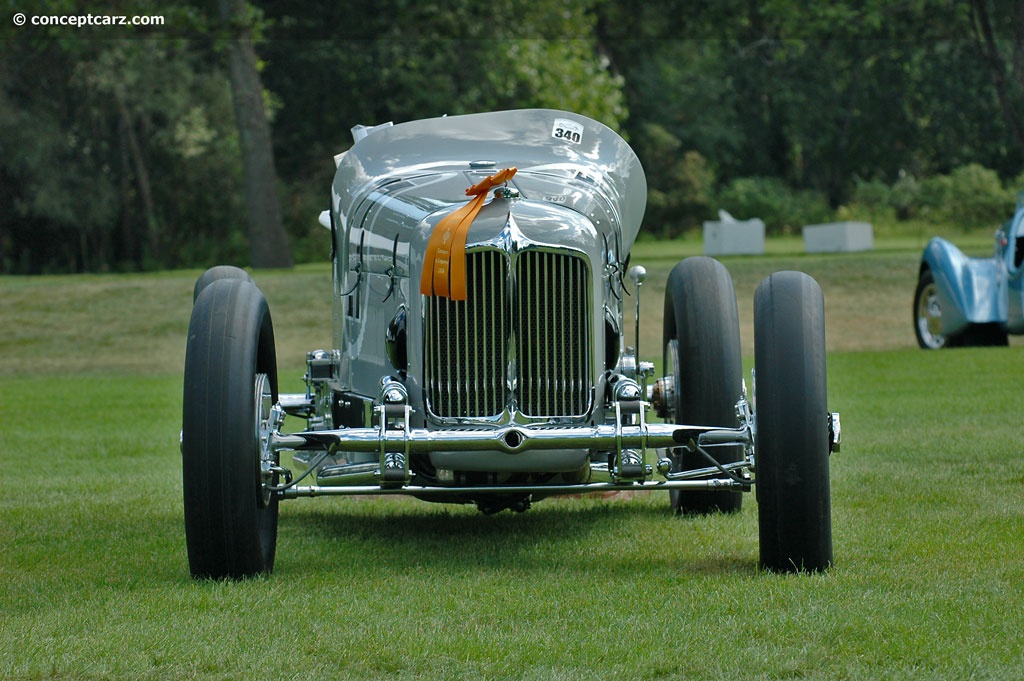


1931 Miller Championship Race Car Vehicle Profiles

Recent Vehicle Additions


Related Automotive News

Historic and Prestigious Classics to Take Center Stage at Gooding & Company's Pebble Beach Auctions; Full Catalogue Launches Online Today
The undisputed star of the show is the 1937 Bugatti Type 57SC Atalante, alongside a 1930 Bentley 4 12 Litre Supercharged Blower Sports Tourer and a 1931 Bentley Eight Litre Sports Tourer.
The official auction house of the Pebble Beach Concours...

Impact of DOHC Technology on Motor Development of Iconic Racecars
Brumos Collections Inside The 59 Highlights Prowess and Technical Evolution of Dual Overhead Cam Engines in Iconic Racecars
Posting October 29, Newest Video To Feature Collections 1914 Peugeot L45, 1930 Miller Samson Special and 1963...

Mecum Offers 600 Collector Cars At The Daytime Auction, Aug. 15-17
Historically Significant Classic and Collector Cars Teeing Off at Del Monte Golf Course
Walworth, Wis. – Aug. 13, 2018 – Mecum Auctions, the worlds largest collector car auction company, is set to return to the Del Monte Golf Course...

RARE BUGATTI TYPE 57S CABRIOLET BY VANVOOREN OFFERED FOR PUBLIC SALE FOR FIRST TIME AT RM SOTHEBY'S AMELIA ISLAND
RM Sothebys returns to Amelia Island, Florida, March 11, 2017, for its 19th annual collector car sale
The official auction of the Amelia Island Concours dElegance, event to present some 80 blue-chip automobiles
One-of-three 1937 Bugatti Type...

RK MOTORS ADDS 'LEGENDS OF MOTORSPORTS' COLLECTION OF HISTORIC RACING MACHINES TO UPCOMING AUCTION
Charlotte, N.C. – October 14, 2013— Only weeks after revealing plans to auction the 1977 McLaren M26 that James Hunt drove to his final F1 victory, RK Motors Collector Car Auctions (RKMCCA) today announced that four additional iconic racing...