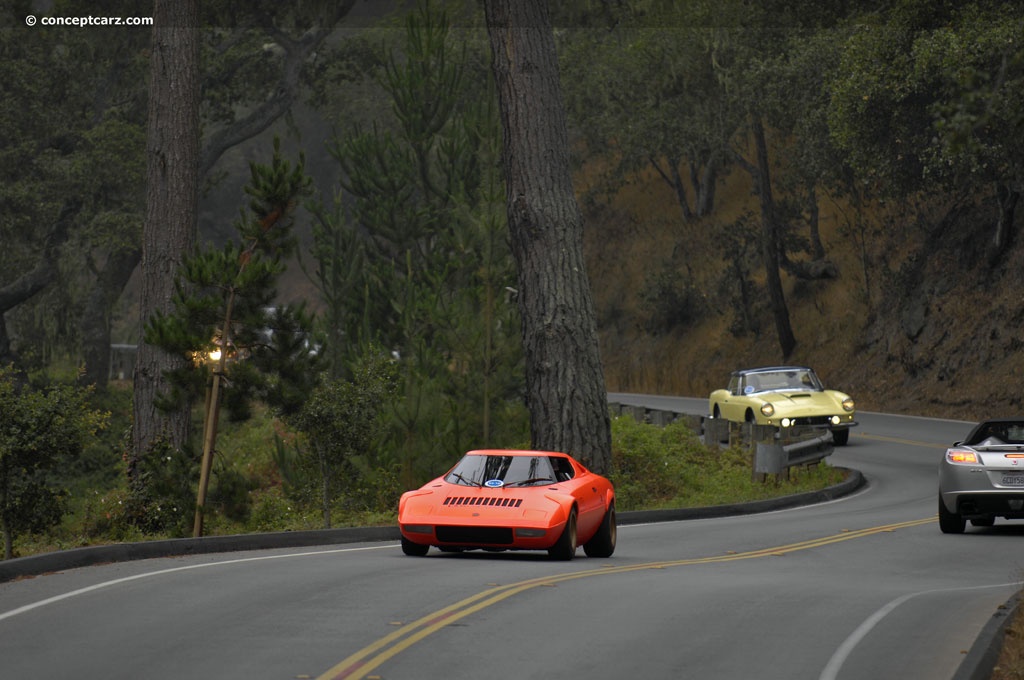
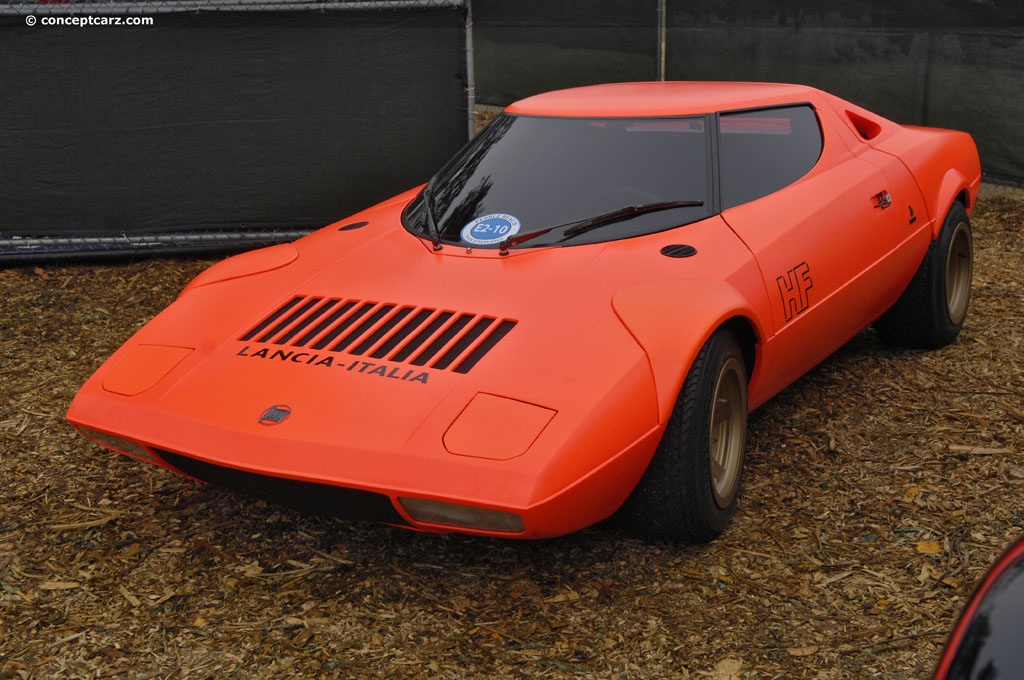
The Lancia Stratos HF Prototype was a clandestine project done by the legendary design studio Bertone and constructed from parts from a used Lancia Fulvia. The front-engined car was converted to an exotic mid-engine layout with power from the engine sent to the rear wheels. The wedge-shaped exterior bodyshell was penned by Marcello Gandini, with an overall height of just over 42 inches. 
Coupe
Chassis #: 1240
View info and historyThis project was done independently from Lancia. When the car was shown at the Turin Motorshow, it was easily a highlight. Cesare Fiorio, the competition manager for Lancia, apparently walked passed the vehicle on several occasions. Obviously, the Lancia personnel were impressed but did not offer contracts to Bertone, nor did they initiate conversation. After the show, Bertone tried to set-up meetings, but Lancia was not interested. Undeterred, Bertone drove the concept to the Lancia factory. It was short enough to pass under the security gate and enter the premises. Bertone finally had the attention he wanted, and his persistence was rewarded with a contract from Lancia.Bertone, along with help from Fiorio, was commissioned to further develop the car into a Group 4 rally car. Gandini created a new design that drew heavily upon the concept car. It was given a monocoque chassis and fitted by Lancia with a four-cylinder engine from a Fulvia. The engine was later scrapped, and development began on a proper powerplant.The second prototype, the Stratos Zero, was completed in just four months and painted in an eye-catching DayGlo fluorescent red. It was shown at the 1971 Turin Show and later Geneva in non-functional form as its engine had not been completed. The engine would take very long to complete resulting in Lancia scrapping it in favor of a Ferrari unit.
Coupe
Chassis #: 1240
View info and historyThe car was put through rigorous testing, which, after several revisions, was a well-tuned machine. The double wishbone suspension was swapped in favor of a McPherson strut setup on the production cars. Also, instead of aluminum, the body was formed from fiberglass. Design and development took three years, meaning the assembly of the production version did not start until 1973. The cars were assembled quickly in order to comply with the necessary 400 examples to qualify for Group 4 homologation. The racing version of the Stratos was given a heavily-modified engine that raised the base 190 horsepower to 280 bhp. The body was modified to distinguish it from its road-going sibling. The Stratos, which had been racing in the Group 5 class, was cleared for racing in Group 4 competition midway through 1974. The cars were very successful for both privateers and the works team. The cars would win seventeen World Rally Championship victories during their career, with the first victory earned by Sandro Munari.
Coupe
Chassis #: 1240
View info and historyProduction of the Stratos lasted from 1973 through 1978, with nearly 500 examples built. Fifty examples were competition cars.
by Daniel Vaughan | Oct 2008

Coupe
Chassis #: 1240
View info and history
Coupe
Chassis #: 1240
View info and history
Coupe
Chassis #: 1240
View info and history
by Daniel Vaughan | Oct 2008
Related Reading : Lancia Stratos History
The Betone-designed Stratos was built for one purpose, to win the World Rally Championship. Two prototype versions of the Stratos were shown, one during the 1970 Turin Motor Show and another a year later. The road-going versions of this car were built only to satisfy the homologation rules. As a result, the road version had noisy cockpits, was uncomfortable, and did not have good cabin air circulation.....
Continue Reading >>
Continue Reading >>
Related Reading : Lancia Stratos History
A big success by any standard both in and out of competition, the Lancia Stratos was developed as a homologation Special for European rallying. After production ceased, it became a cult car and is now highly-priced as the modern classis it is. Conceived strictly for rallying, the Lancia Stratos, however, makes an exciting road car, though it is very far from GT standards in both luxury and refinement. The....
Continue Reading >>
Continue Reading >>
Similar Vehicles


1971 Lancia Stratos HF Prototype Vehicle Profiles

Recent Vehicle Additions


Performance and Specification Comparison
Stratos Specification Comparison by Year
Year
Production
Wheelbase
Engine
Prices
Related Automotive News

Lamborghini Miura Celebrated In A Dedicated Class At The 59Th Pebble Beach Concours d'Elegance
SantAgata Bolognese, 12 August 2019 – The Pebble Beach Concours dElegance, established in 1950, is the one of the most renowned classic car shows in the world, and every year the selection of cars for display is very severe, because only the...

Alfa Romeo 4C and 4C Spider Add More Personalization Options for 2016, Further Amplifying the Groundbreaking Theme of Advanced Technology, Race-inspired Performance and Seductive Italian Style
New for 2016, Alfa Romeo is offering even more carbon fiber All-new carbon fiber halo offering elevates the 4C Spiders technical look, while hinting at its exclusive carbon-fiber monocoque chassis
All-new Carbon Fiber Trim Package further prolif...

ALL-NEW 2015 ALFA ROMEO 4C SPIDER PRICING ANNOUNCED
All-new 2015 Alfa Romeo 4C Spider Delivers Race-inspired Performance, Advanced Technologies, Seductive Italian Style, and Now an Even More Exhilarating Driving Experience With Open-air Freedom
All-new Alfa Romeo 4C Spiders open-air performance ****...

World-premiere: All-new 2015 Alfa Romeo 4C Spider Delivers Race-inspired Performance, Advanced Technologies, Seductive Italian Style, and now an Even More Exhilarating Driving Experience With Open-air Freedom
Production version of the all-new 2015 Alfa Romeo 4C Spider, revealed at the 2015 North American International Auto Show, will arrive at dealerships this summer All-new 2015 Alfa Romeo 4C Spiders open-air performance cockpit and mid-engine propo...

CHEVROLET TO SHOW CHAPARRAL VISION GRAN TURISMO CONCEPT
Boundary-pushing, Chevy-powered race cars changed motorsports design
DETROIT – When racers Jim Hall and Hap Sharp founded Chaparral Cars in 1962, few could have guessed how they would shake up the conformities of the racing world – and...