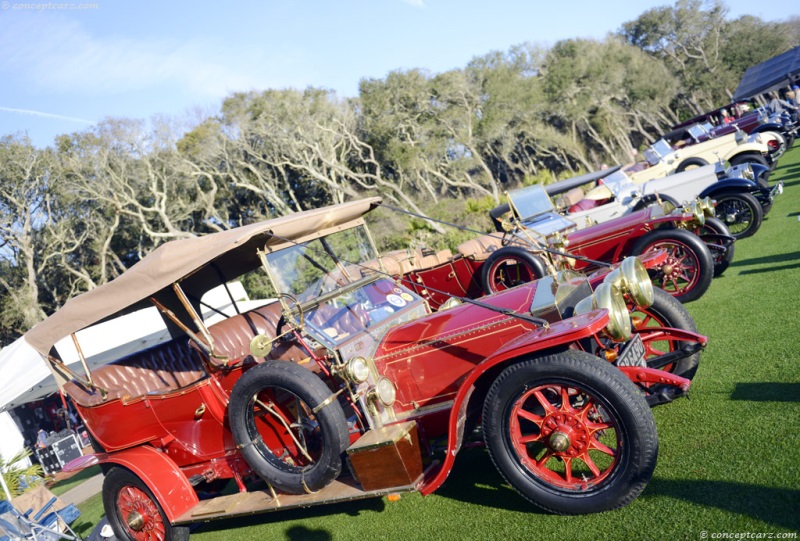
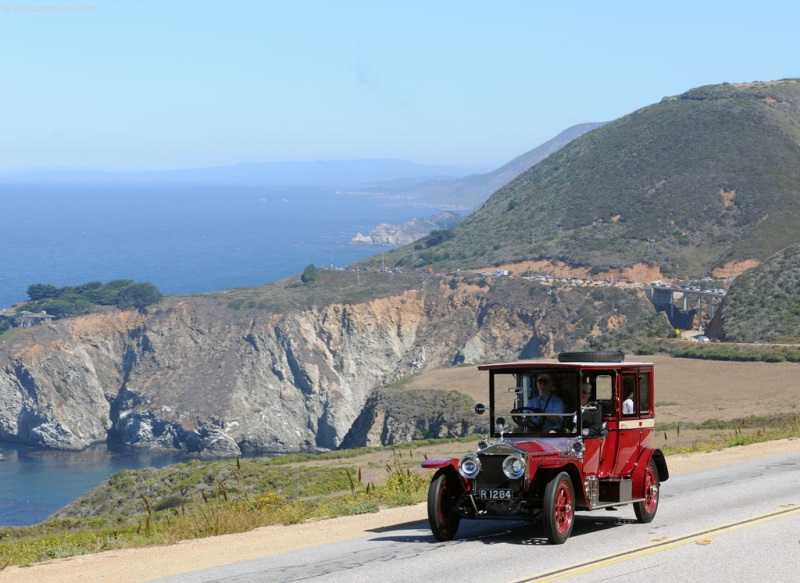
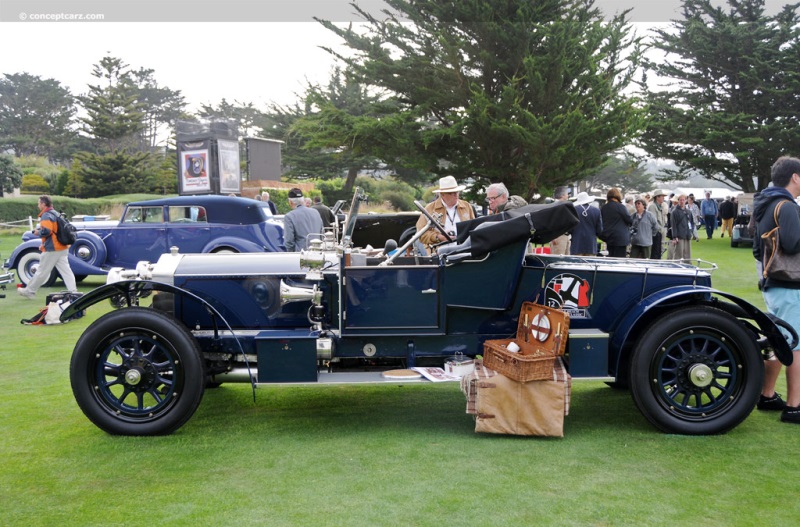
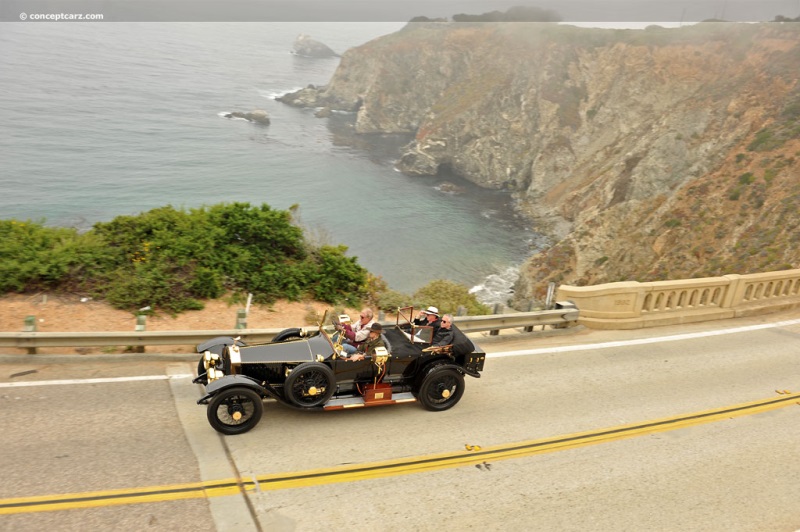
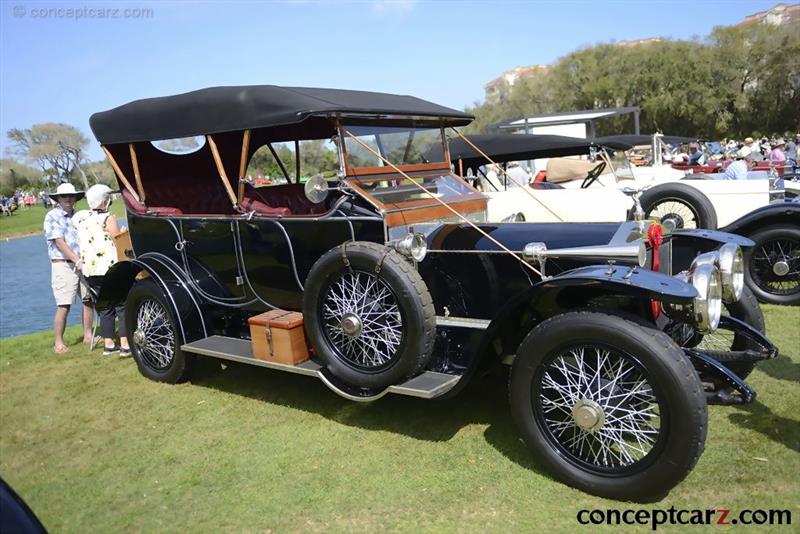
Henry Royce's new six-cylinder, 40/50hp Rolls-Royce was launched at Olympia in 1906. The engineering genius of Royce combined with the charisma and charm of the Hon. Charles Stewart Rolls and the business flair of Claude Johnson elevated the new model to 'The Best Car in the World' (first used by the Pall Mall Gazette in November 1911). Advertisements in Autocar in 1907 read: 'Silent as a Ghost, Powerful as a Lion, Trustworthy as Time.' Another early advertisement for the company carried the testimonial from a new Silver Ghost owner: 'I may say my car is a perfect dream. It is so reliable that I have done away with my carriages and horses.' 
Touring by Wilkinson
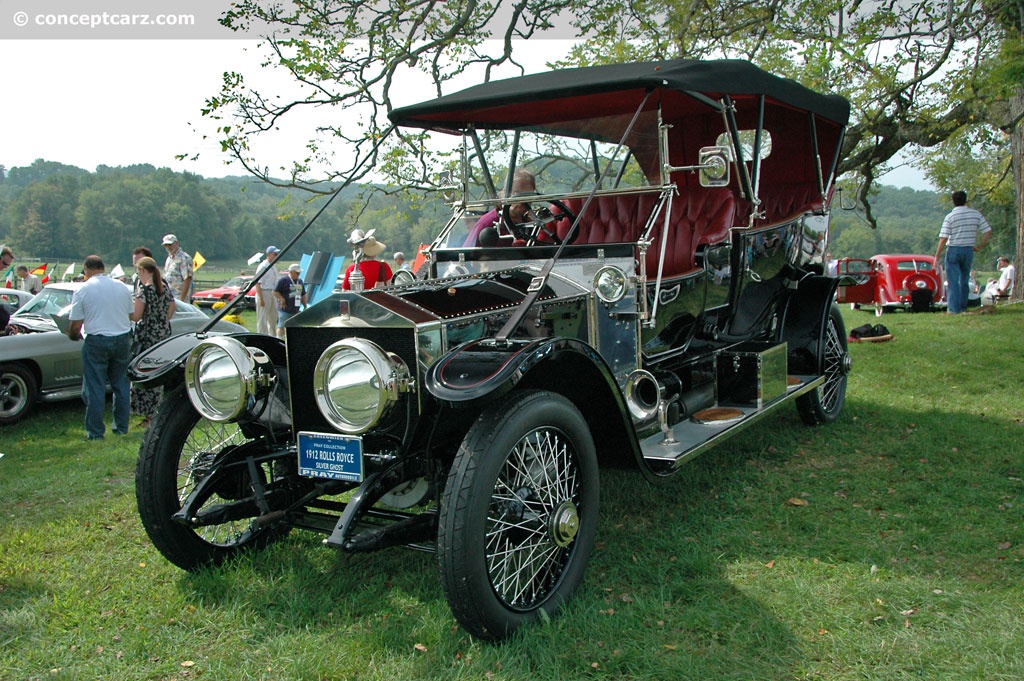
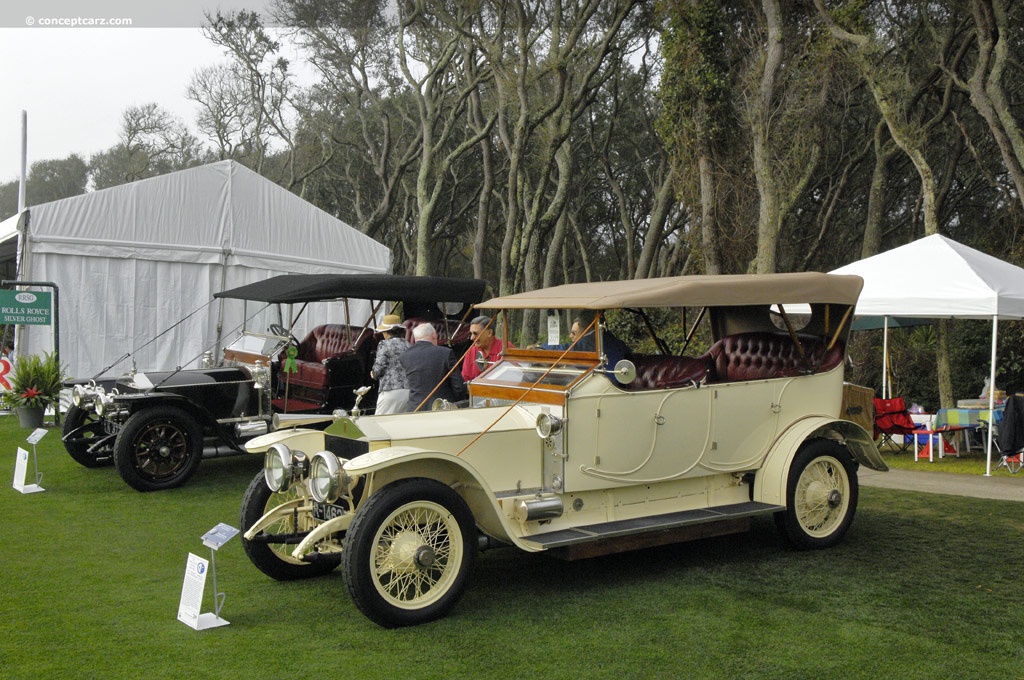
View info and historyChassis number 60551 was displayed at the 1906 London Motor Show wearing touring coachwork by Barker & Co. and silver paint, eventually leading to the nickname, the 'Silver Ghost.' Most of the cars on the road were noisy and vibrated so violently that they often scared horses. Chassis 1701, however, was ghostly quiet. This 'Silver Ghost' was such a marketing success that Mr. Royce standardized on this one model and concentrated on improving it as each new design or invention was thoroughly tested before being implemented into the chassis. Prior to 1908, when it relocated to a new factory in Derby, the Rolls-Royce company had manufactured a variety of models at its Manchester premises. The list included two, three, four and six-cylinder models, and even an abortive V8, before Managing Director Claude Johnson focused the company's attention on building the range-topping 40/50hp. Chassis number 60551, the factory demonstrator, successfully completed a 2,000-mile trial under RAC supervision. It was then entered in the 1907 Scottish Reliability Trial, completing the 15,000-mile run and setting a new World Record. Rolls-Royce's principal rival, around 1910, was Napier. To prove which manufacturer built a better automobile, Napier and Rolls-Royce agreed to compete in a top-gear-only run from London to Edinburg, Scottland. Gear changes, even from the start, were not allowed. The contest was supervised by the Royal Automobile Club (RAC). The RAC documented fuel consumption and the highest speed achieved by these two cars on the Brooklands racetrack. The Napier automobile had a driver and three adult passengers. It finished the test with 19.35 fuel consumption and a maximum speed of 76.42 mph. The Rolls-Royce car was driven by Works tester, E. W. Hives, and carried three adult male passengers. The chassis was number 1701E (British registration plate number, 'AX201') and it began its journey on September 6th of 1911, leaving London for Edinburgh using top gear only. It wore a lightweight touring body and achieved the run averaging 24.32 mpg, and a maximum speed of 78.26 mph at Brooklands. It had traveled approximately 800 miles north mainly via The Great North Road and returning down the west side of the country.
Touring by Wilkinson
Chassis #: 2018
Engine #: 15G
View info and history
Auction entries : 2Rolls-Royce had beaten Napier in both fuel economy and maximum speed. The lightweight touring body was so well received that the company began to produce a full series of London-to-Edinburgh tourers for interested buyers. This resulted in the creation of 188 of the special chassis, which became known as duplicates of No. 1701. The first production models being delivered to the coachbuilders in the Spring of 1912 and the last, no. 2699, in October 1913. The 40/50 HP was the model designation in accordance with the former British tax racing system. Colloquially referred to as 'The Silver Ghost,' production continued in the Cooke Street Works in Manchester, England until 1925 and no fewer than 6,173 were built in the U.K. with an additional 1,703 created at the Springfield Factory in the United States (from 1920 to 1926). Cars built in the U.S. had hub centers with an indentation for the wheel spanner; U.K.-built wheel hubs are flat. In 1912, a Rolls-Royce Silver Ghost cost L1,850, comprised of just a rolling chassis, body not included. During the same time period, a brand new 1912 Ford Model T was $240 which included the body. The average annual salary in 1912, in the United States, was around $750 (average).
Tourer by Mulliner
Chassis #: 2092
Engine #: 101X
View info and history
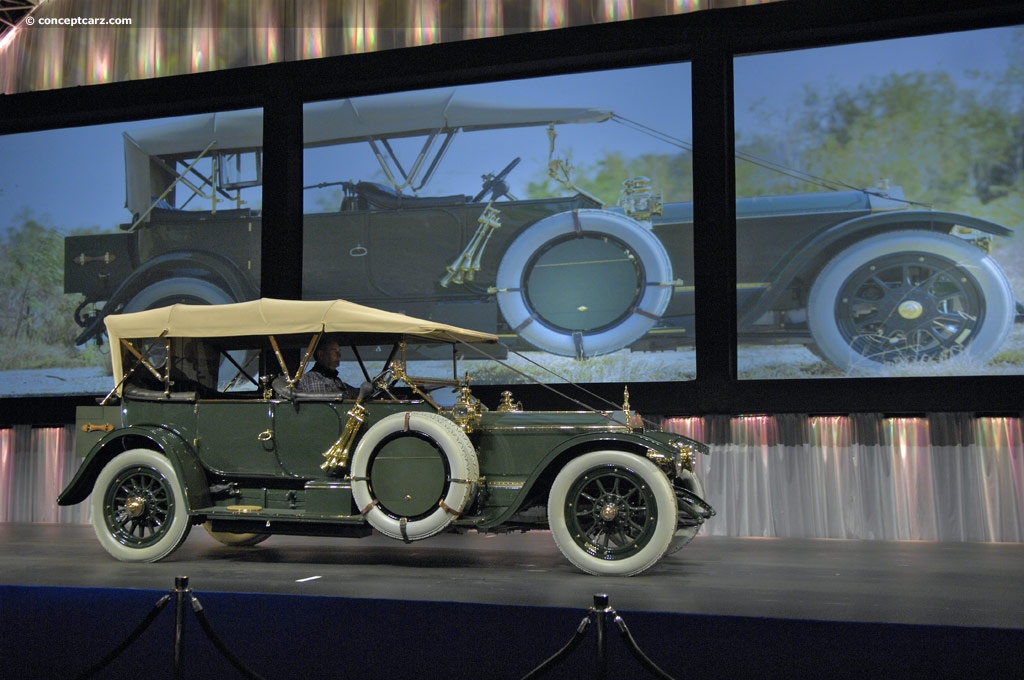
Auction entries : 2The body of the Rolls-Royce was hand-built per the specification, needs, and desires of the purchaser. Rolls-Royce built no car bodies prior to 1939, however, they were particular about who they allowed to build bodies for their chassis. Some Silver Ghosts were delivered from new with more than one body - often a formal closed design as well as an open design. This allowed the bodies to be changed to suit the occasion or climate. The Silver Ghost was powered by a 7,036cc side-valve six equipped with a seven-bearing crankshaft and pressure lubrication. While other six-cylinder vehicles often suffered from the long and flexible crankshafts that induced vibration and harsh noises, Royce's design used larger bearings and a pressurized oiling system, secured by seven main bearings and contained in a strong and rigid crankcase. The design allowed for removable cylinder blocks with fixed heads, eliminating leaks and cooling problems. By casting them in triplets, the engine was shortened and lightened. Reliability and thorough combustion were ensured via twin ignition (by magneto and distributor and coil) - at a time when many cars used a single ignition system. The manifolds and new twin-jet carburetor, developed by Royce, provided superior breathing and airflow. With a low compression of just 3.4:1, the Ghost produced generous amounts of torque while turning at just 1,250 RPM. The crankcase was formed from aluminum alloy and the timing drive and ignition were driven by gears, not chains. Ground and polished by hand, the timing gears were made of nickel steel and phosphor bronze. Mr. Royce's demand for precision and perfection resulted in the crankshaft being ground to an accuracy of .00025 on its bearing surfaces. They were then hand-polished to ensure that any minute scratches left by the grinder were removed.
Tourer by Mulliner
Chassis #: 2092
Engine #: 101X
View info and history
Auction entries : 2The chassis was comprised of channel-section side members and tubular cross members were suspended on semi-elliptic springs at the front and a 'platform' leaf spring arrangement at the rear, though the rear setup was soon revised. Engine displacement grew to 7,428cc, and the original four-speed gearbox was replaced in 1909 by a three-speed unit. In 1913, it reverted back to four-speeds but with a direct top gear. Drivers of the era were unaccustomed to shifting and running in top gear only provided a smooth ride, particularly when the owners were generally the rear passengers. The Ghost had an admirable reputation of being able to accelerate from a standing start to top speed without shifting, and performing this task silently. During its two-decade production lifespan there would be numerous other improvements to the car, one of the most important being the adoption of servo-assisted four-wheel brakes towards the end of 1923.
by Daniel Vaughan | Jun 2020
Touring by Wilkinson
View info and history
Touring by Wilkinson
Chassis #: 2018
Engine #: 15G
View info and history
Auction entries : 2
Tourer by Mulliner
Chassis #: 2092
Engine #: 101X
View info and history
Auction entries : 2

Tourer by Mulliner
Chassis #: 2092
Engine #: 101X
View info and history
Auction entries : 2
by Daniel Vaughan | Jun 2020
Related Reading : Rolls-Royce Silver Ghost History
In 1906 a new model, the 4050 horsepower, was developed with a longer chassis and a six-cylinder engine. The popularity of the new Rolls-Royce grew quickly as it developed a reputation for smoothness, silence, flexibility and, above all, reliability. In 1907 a writer from the Autocar described riding in the Rolls-Royce 4050 hp as ....the feeling of being wafted through the countryside. Engineers....
Continue Reading >>
Continue Reading >>
Related Reading : Rolls-Royce Silver Ghost History
The Rolls-Royce vehicles have always been the pinnacle of design, technology, and ambiance. The loudest noise that could be heard by occupants of their vehicles was said to be the clock. In 1904 engineer Frederick Henry Royce joined with the entrepreneur and businessman, the Honorable Charles Stewart Rolls. This union became known as the Rolls-Royce Company. The Silver Ghost became available in....
Continue Reading >>
Continue Reading >>


1912 Rolls-Royce Silver Ghost Vehicle Profiles







Recent Vehicle Additions


Performance and Specification Comparison
Silver Ghost Specification Comparison by Year
Year
Production
Wheelbase
Engine
Prices
Related Automotive News

Bespoke Flying Spur Hybrid by 'The Surgeon' revealed during Art Basel Miami
One-of-one Flying Spur Hybrid specified by The Surgeon celebrates shared values of design and craft at the highest level
Unique specification co-created with Dominic Ciambrone – a.k.a. The Surgeon – the worlds leading creative custom shoemaker
...

A Comparison of 1997 Best of Show and 2022 Best of Show Nominee at the Pebble Beach Concours d'Elegance
Left 1997 Best of Show Right 2022 Best of Show Nominee
The combined efforts of Talbot-Lago and Figoni %26 Falaschi resulted in many wondrous automotive creations, including the T150C model with goutte deau, literally a drop...

Flying Spur Ready To Soar With V8 Power
Worlds best luxury four door grand tourer now available with hugely popular Bentley V8 powertrain
Customer research leads to increased driver focus, with decline in daily rear seat usage
4.0-litre, twin-turbocharged V8 petrol engine develops 5...

CONCOURS OF ELEGANCE 2016 CELEBRATES MORE THAN 200 YEARS OF COACHBUILT LUXURY
From Her Majesty The Queens 1800s Ascot Landau, coachbuilt by Hooper, to the 2016 Touring Supeleggera Disco Volante Spider, Concours of Elegance celebrates 200 years of coachbuilding
Some of the most amazing models from historys most legendary co...
HILTON HEAD ISLAND MOTORING FESTIVAL & CONCOURS D'ELEGANCE PRESENTS 2015 PINNACLE AND HONORED COLLECTORS
Fred Guyton collection to feature 2014 Pebble Beach Concours Best in Class winner
William Tom Gerrard recognized for Post-War collection and key Concours contributions
HILTON HEAD ISLAND, S.C. – Each year, the Hilton Head Isla...